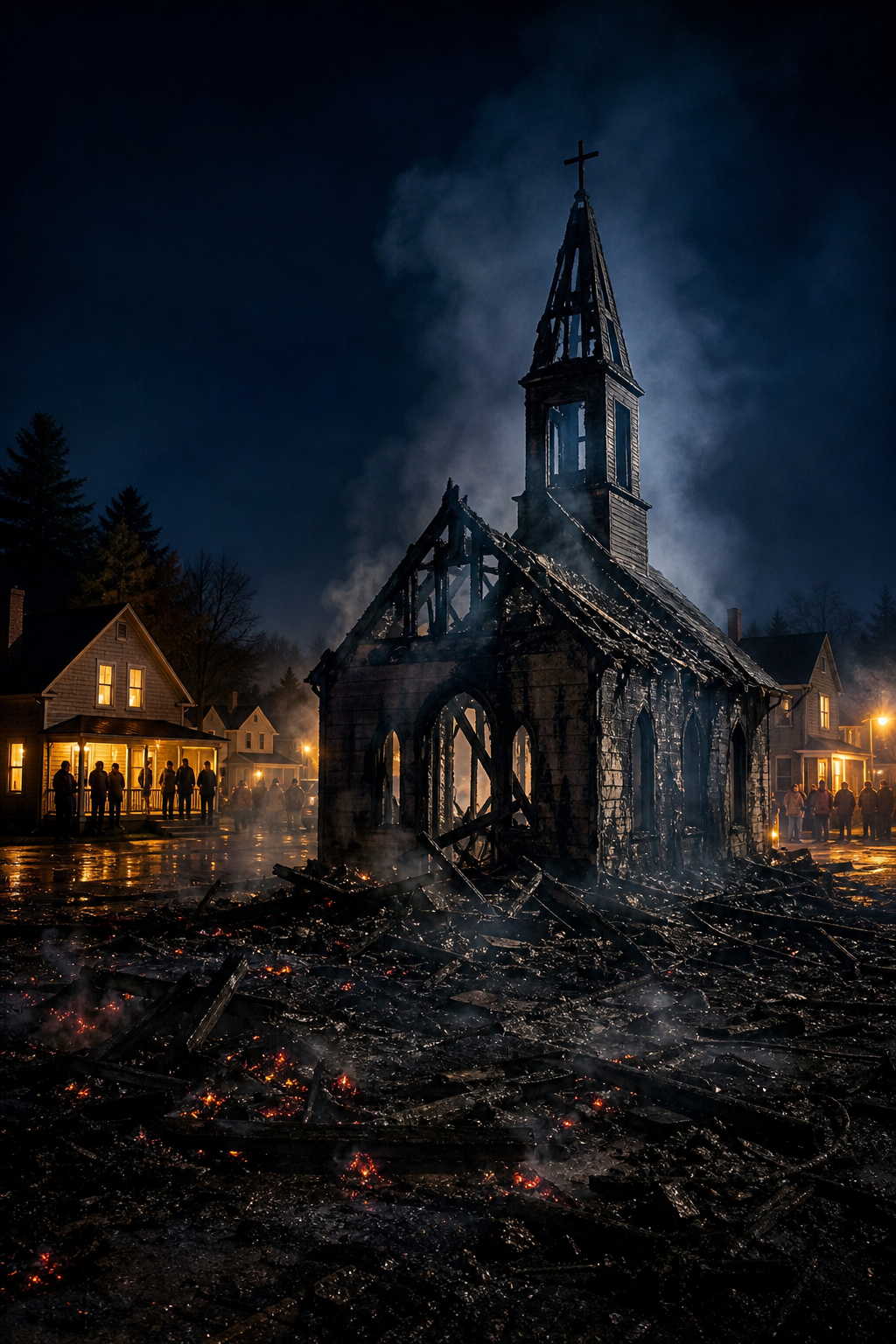
The fire started in the sanctuary. The flames took the roof first, then the walls, then the stained glass installed in 1923. By morning, nothing remained but blackened stone and the charred skeleton of the steeple.
David stood in the parking lot with thirty congregants. Mrs. Patterson wept. The Hendersons held hands and said nothing. David should have reminded them that the church was not a building but a people. But he could only stare at the ruin where he had preached for eleven years.
They met in the elementary school gymnasium the following Sunday. Folding chairs. A portable communion tray. The basketball hoops loomed like strange altars.
He preached on exile. On the Israelites in Babylon, wondering if God had abandoned them because the temple lay in ruins. The synagogue was born in exile, he said. Prayer could rise wherever two or three were gathered. They listened. But David could see the anger.
The next week they met in the Hendersons' living room. Then the Thompsons' basement. Then David's own dining room. They squeezed onto couches, perched on stairs, stood in doorways. And something changed.
In the building, David had preached from a raised platform. In living rooms, he sat on folding chairs like everyone else. Scripture was read by whoever had a Bible closest. Prayers were offered by Mrs. Patterson from her wheelchair, by Marcus who had never spoken aloud before, by Sarah who had never prayed publicly. They noticed the Hendersons' strained marriage, Mr. Patterson's forgetfulness, Marcus's careful attention to Scripture. They were in each other's homes, no longer protected by pews and bulletins.
David began to understand that the church was indeed a people. Not a people defined by a building, but by proximity, by shared bread and shared sorrow.
Then they caught the arsonist.
Tyler Brennan was twenty-four, unemployed, estranged from his family. He had attended once, two years before. Just rage, gasoline, and a match. No explanation. The congregation wanted justice. Maximum sentence. David understood. He felt it too, walking past the ruins at dawn.
But on the Sunday after Brennan's arrest, David knew what he had to preach. He stood in the Hendersons' living room.
"Tyler Brennan is our neighbor. I do not ask you to forgive him today. But remember that the same grace that saved us is the same grace that can save him. The same Christ who died for our sins died for his. If we pray for anything less than his repentance and salvation, we pray for something less than what God desires."
Mrs. Patterson's voice was sharp. "He burned down our church, David."
"He burned down a building. And we have learned that the church is not a building. If the church is a people, the question is what we will become. Will we receive grace but not extend it? Will we claim Christ's forgiveness for our own sins but demand punishment for the sins of others?"
He paused. "Remember that you and I were once enemies of God, and while we were yet enemies, Christ died for us. That is the scandal of grace. It is not fair. And if we are honest, we do not want it to be fair, because fair would mean we perish in our own sins."
Marcus spoke up. "So we just let him off?"
"No. He will face the law, and the law is God's servant for justice. But we can pray for his repentance. We can pray that the same fire that consumed our building will be used by God to consume his old life and make him new. That is not weakness. That is the hardest thing there is."
David looked around the room. He saw anger, hurt, the struggle of flesh against spirit.
"I will pray for him. That God would grant him repentance. Not because I am better than him, but because I am exactly like him: a sinner who deserves wrath, saved by grace alone through faith alone, not by works, so that no one can boast. And if you cannot pray that yet, I understand. But I ask you to ask God to help you want to pray it."
He did not know whether the congregation would follow him. He did not know whether the church they were building in living rooms would hold that kind of grace.
But he knew they were learning something the building could never have taught them. The church is not a place you go but a people you become. Grace is not a doctrine to be defended but a reality to be lived, even when it means praying for the man who burned down everything you loved.
And in the months that followed, as Tyler Brennan sat in his cell and the congregation slowly began to write him letters and pray for his soul, David watched the church become what it had always been meant to be: not a building that could burn, but a people who could not be destroyed, held in the hands of a God whose grace was deeper than fire and more enduring than any structure made with human hands.