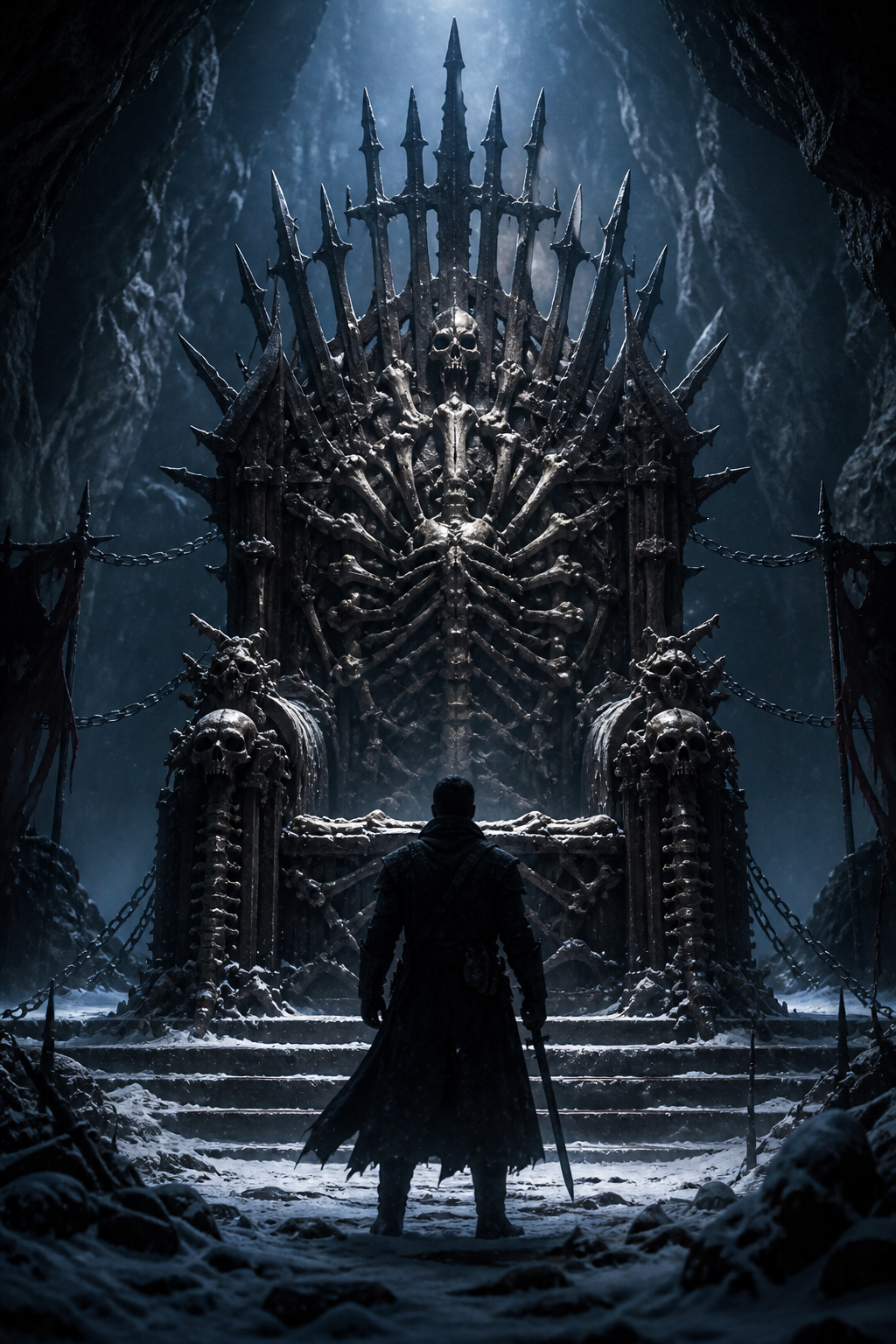
Chapter 1
THE FIRST SNOW
The snow started at 3:47 AM.
I knew the exact time because I was awake. I am always awake now. The lattice doesn't sleep, so neither do I. It hums behind my eyes—a low-frequency resonance that feels like standing too close to a transformer station. Constant. Warm. Intimate as a second pulse.
I watched it from the bluff.
Farhad's estate sits on ninety hectares of Olympic Peninsula rainforest, a 1923 Craftsman compound built by men who understood timber and silence. The main house faces west, toward the Strait of Juan de Fuca, but I wasn't looking at the water. I was watching the sky over the treeline turn from black to charcoal, the first flakes falling soft as ash.
White ash.
The name still haunts me. White Ash was the conspiracy. The scroll. The thing that killed my father and took my wife and rewrote the chemistry of my nervous system. Now it was falling from the sky in crystalline form, covering the estate in a blanket that would be six inches deep by dawn, a foot by noon, two feet by nightfall. The Pacific Northwest had finally committed to winter.
The scroll warmed against my forearm.
Layer 12—the permanent global neural lattice—had settled into my biology **six months ago**. Not metaphorically. Cellularly. Dr. Wright had confirmed it with bloodwork. My white cell count was wrong. My neural firing patterns were wrong. My temperature ran at 99.8 degrees constantly, two degrees above baseline, like a low-grade fever that never broke. The lattice was rewriting me. Slowly. Inevitably.
I had 2.3 years left, according to Wright's latest estimate. Maybe three if I stopped using the lattice entirely. But stopping wasn't an option. The lattice showed me things. Every former Vessel, every liberated facility, every person the scroll had ever touched—they glowed in my peripheral vision like heat signatures on infrared. I could feel them. Seventy-three kids in the dorms below. Fourteen adult staff. Maria in the south wing, asleep finally after forty-eight hours of logistics.
Maria.
I pushed that thought down. The lattice was already showing me her breathing rhythm through the floorboards, the thermal bloom of her body heat radiating through two stories of timber and insulation. It was wrong to know this. Wrong to feel it. But the lattice didn't care about right or wrong. It only cared about connection.
The first real gust came off the Strait.
The wind carried salt and ice, cutting through my thin jacket like it wasn't there. I didn't feel the cold the way I used to. The lattice kept me warm. Another side effect. Another small death.
I turned back toward the compound.
The dojo was lit. It was always lit now. Min-ji had taken to sleeping on the tatami mats after her nightmares, and I didn't have the heart to make her go back to the children's dorm. She was nine years old in chronological terms, but the accelerated aging process that the Covenant had engineered made her closer to twelve in development. Sometimes fourteen. The scroll matured its hosts faster than biology intended.
Min-ji was the leader of the 47.
Not officially. Officially, I ran the Jin School. Officially, Farhad owned the estate and funded the operation and handled the legal architecture. Officially, Dr. Wright managed medical protocols and Dr. Amira consulted on scroll science.
But everyone knew. The kids knew. The staff knew. When Min-ji spoke, the 47 listened. When she decided something, it happened. An eight-year-old girl—now nine—who had survived Layer 8 of the scroll's neural lattice and come out the other side with her sanity intact, more or less.
The dojo door slid open before I reached it.
Min-ji stood in the entrance, wrapped in a quilted jacket two sizes too large, her hair wild from sleep. She didn't look surprised to see me. She rarely looked surprised anymore. The lattice had given her reflexes that bordered on precognition.
"You didn't sleep," she said. Not a question.
"Did you?"
"Nightmares." She stepped aside to let me in. "Hana was screaming again."
Hana. Vessel 3. Sixteen years old, rescued from the El Segundo facility six months ago. The scroll had been activated in her at age eight, same as the rest of the 47, but her neural pathway had developed differently. She had reached Layer 8—the lattice echo—before her brain could stabilize the lower layers. The result was seizures. Migraines. Episodes where she saw things that weren't there.
The lattice showed me Hana's signature now—a flickering amber pulse in the east dormitory, unstable, beautiful, and dangerous.
"How long?" I asked.
"Twenty minutes. Farhad gave her the sedative. She's quiet now."
I walked into the dojo.
The space had been expanded since we arrived. Farhad's contractors had knocked out the eastern wall and added a second training floor, then a third. The compound now housed seventy kids between ages eight and sixteen, all former Vessels, all carrying some degree of scroll activation. Seventy kids who had been bred in test tubes, accelerated to childhood in months, and liberated from Covenant facilities across three continents.
They were my responsibility.
Not because I wanted them. Because I had killed the men who made them, and killing carried obligations. Pastor Kim had said that in his last letter from Seoul. "You didn't choose this, Jeffrey. But you chose what came after. The choosing is what matters."
I looked at the kids sleeping on the mats.
Thirty of them had migrated from the dorms to the dojo in the past week. They said the tatami felt safer. They said the dormitories were too quiet, too dark. The dojo had lanterns. The dojo had me.
I didn't sleep, so they didn't have to sleep alone.
Min-ji followed my gaze. "The snow is early this year."
"It's December. Snow is supposed to come in December."
"Not here. Not on the Peninsula. Mr. Farhad says it usually waits until January."
"Mr. Farhad is from Iran. He thinks forty degrees is a blizzard."
She almost smiled. Almost. Min-ji didn't smile much anymore. She had seen too much in her short life. The Covenant's breeding facility. The surgical rooms. The other children who didn't survive the acceleration process. She had watched them die. Had held their hands while the scroll's neural pathways burned through their brains like wildfire through dry timber.
Then I had arrived. The white-haired man—no, that was wrong. My hair was still black. The white came later. In Kazakhstan. In the reactor core. That hadn't happened yet.
"You should teach a class today," Min-ji said. "The younger ones are falling behind. They don't understand The Weight yet."
"They understand it. They're just afraid of it."
"So am I."
I looked at her. She met my eyes without flinching. That was new. In the early weeks, she couldn't hold eye contact for more than two seconds. Trauma. The body remembers before the mind catches up.
"What are you afraid of?" I asked.
"That you'll leave. Like the others. Like Dr. David."
Dr. David. My father. Dead in the El Segundo facility, heroically, not as a villain. The Covenant had manipulated his research, twisted his intentions, but in the end he had died saving the 47's transport convoy from an ambush.
"I'm not going anywhere," I said.
"You say that now."
The scroll warmed against my forearm. Layer 12 pulsed—a slow, rhythmic throb that matched my heartbeat. Or maybe my heartbeat matched the lattice. I couldn't tell anymore where I ended and it began.
"I mean it, Min-ji."
She nodded, but her eyes said she didn't believe me. She had lost too many people to believe in permanence. Faith, for Min-ji, wasn't a doctrine. It was a discipline. You chose to trust, knowing you might be betrayed. You chose to carry weight, knowing your back might break.
That was The Weight. Not a martial art. A theology made physical.
I walked to the center of the dojo.
The mats were cold beneath my feet. I could feel the temperature differential through the lattice—cold surface, warm body, the interface where biology met physics. The scroll had made me sensitive to things I never noticed before. Air pressure changes. Electromagnetic fields. The emotional states of people within a hundred-meter radius.
Maria was dreaming now. I could feel it through the floorboards—a REM-sleep signature, turbulent, anxious. She was dreaming of Colombia. Of her mother. Of the cartel.
I pushed the sensation away. It was wrong to know this. Wrong to feel it.
But the lattice didn't care about wrong.
I knelt on the tatami and breathed.
Psalm 23. Whispered in the dark. Not because I felt it—faith had been thin since Sarah's death—but because the ritual mattered. The discipline of speaking truth when you didn't feel it. That was faith, according to Pastor Kim. Not emotion. Obedience.
"The Lord is my shepherd," I whispered. "I shall not want."
Min-ji knelt beside me.
"He makes me lie down in green pastures," she continued. "He leads me beside still waters."
The other children stirred. Some sat up. Others remained lying down but opened their eyes. They knew this rhythm. They had learned it in the weeks since liberation—not because I demanded it, but because they had watched me do it every morning at 4:00 AM, and children imitate what they see.
"He restores my soul," we said together.
Seventy voices. Soft. Ragged. Some with accents I couldn't place—Russian, Korean, Arabic, Spanish. The 47 were a United Nations of trauma.
"He leads me in paths of righteousness for his name's sake."
The scroll pulsed.
Not metaphorically. The lattice on my forearm glowed faintly in the dark—a bioluminescent warmth that the scroll had developed since Layer 12's permanent activation. The kids could see it. They didn't react anymore. They had grown accustomed to their teacher glowing.
"Even though I walk through the valley of the shadow of death," I said, and my voice caught.
Sarah. The valley was literal now. Not a metaphor. I walked through it every day, every hour, every sleepless night.
"I will fear no evil."
The dojo door slid open again.
Farhad stood in the entrance, wrapped in a Persian wool coat, his beard dusted with snow. He didn't knock. He never knocked anymore. The estate was his, but he had surrendered ownership in spirit to the school.
"Jeffrey," he said. His voice was tight.
I stood. "Hana?"
"No. Worse." He held up a satellite phone. "There's a helicopter coming. No transponder. No flight plan. Military profile, civilian registration—Swiss shell company."
I took the phone.
The lattice showed it before Farhad spoke. A thermal signature, distant but closing fast—two turbines, heavy lift configuration, approaching from the north over the Strait. Estimated arrival: fourteen minutes.
"Who?" I asked.
"I don't know. But I know who they sent to tell us."
He held up the phone again. A text message on the screen:
**DR. AMIRA EN ROUTE. ALONE. BRINGING WARNING. —Q**
Qasim. The Afghan pilot who had extracted us from Manila. He had been running supply routes between the Peninsula and our safe houses in Anchorage, keeping the school's logistics chain alive.
Dr. Amira. The Covenant scientist who had defected during the El Segundo raid. The woman who understood the scroll's biology better than anyone alive.
"Alone?" I asked.
"Alone means no guards. No soldiers. Just her and whatever she's carrying."
I looked at the kids.
Seventy faces looked back at me. Some scared. Some blank. Some already calculating exits—the trauma brain at work, always planning for betrayal.
"Min-ji," I said.
"Yes, Mr. Jin."
"Emergency protocol. Everyone to the south cellars. Now."
She didn't ask questions. She moved.
The 47 responded to her voice like a single organism—seventy children rising from tatami mats, grabbing pre-packed go-bags, filing toward the cellar stairs in practiced silence. They had rehearsed this. We had rehearsed this. Because the Covenant wasn't dead. It had been wounded, scattered, but its cells still operated. And wounded animals were dangerous.
I walked to the weapons locker.
The SIG P320RX sat in its foam cradle, magazine loaded, seventeen rounds total. I had staged it at sixteen rounds since the Manila facility—one in the chamber, fifteen in the magazine. I had never fired it. Not through the El Segundo raid. Not through the six months since.
I checked the chamber. Staged at sixteen. Unfired.
The SIG Karambit sat beside it. Carbon fiber handle, curved blade, serrated spine. I had used it twice since liberation—both times non-lethal, disabling strikes against Covenant contractors who had tracked us to an Anchorage safe house.
The Omani khanjar—my grandfather's blade, inherited through my father's effects—rested in a leather sheath. Curved. Heavy. Older than the Korean War. I had carried it every day since the Olympic Peninsula battle, a physical reminder that The Weight predated the Covenant by centuries.
I didn't take the P320RX.
I took the khanjar.
The helicopter would be here in ten minutes. Whatever Dr. Amira was bringing, it wasn't good news.
The scroll pulsed against my forearm.
Layer 12 showed me something new—a cluster of thermal signatures, distant but distinct, moving in formation toward the estate's eastern perimeter. Not the helicopter. Ground team. Four operatives, spaced at fifty-meter intervals, approaching through the forest.
They weren't with Dr. Amira.
They were here to intercept her.
I walked out into the snow.
The bluff was white now, the first inch accumulating on the gravel path. The helicopter's turbine whine carried from the north, still distant but louder than the wind. The ground team moved through the trees to my east—four warm signatures against the cold background, visible only to the lattice.
I didn't run.
The Weight teaches that running burns energy you can't afford. It teaches that stillness is a weapon. It teaches that the first move is often the wrong move.
I stood in the snow and waited.
The ground team didn't know I could see them. They thought they had surprise. They thought the snow provided cover. They thought an estate full of children and exhausted adults would be easy prey.
They were wrong.
The first man emerged from the treeline twenty meters to my right. AR-15 configuration, suppressor, night vision rig. Professional. Not Covenant—Coviet operatives had a different profile, different movement patterns. These were contractors. Mercenaries. Hired by someone who wanted Dr. Amira stopped before she reached us.
I didn't move.
He scanned the bluff, thermal imaging sweeping past me. I had learned to regulate my body temperature since Layer 12—the lattice let me suppress my thermal signature, blending into the snow's ambient temperature. I was invisible to his optics.
Invisible. But not absent.
The second man emerged. Then the third. They moved in a wedge formation, covering the fourth man who carried a shoulder-fired rocket launcher—a LAW or similar, Russian manufacture.
They weren't here to capture anyone.
They were here to destroy the estate.
The helicopter noise grew louder.
I counted heartbeats. The contractor's pulse: elevated, 110 BPM, adrenaline and cold. The second: 95 BPM, calmer, veteran. The third: 105 BPM, uncertain. The fourth—the rocket man—120 BPM, eager.
The khanjar felt warm in my hand.
I moved.
Not fast. The Weight isn't speed. It's placement. I stepped into the first contractor's blind spot—his peripheral vision blocked by the snow glare—and struck his carotid with the khanjar's pommel. Not the blade. The pommel. Non-lethal. He dropped without a sound, nerve clusters overloaded, consciousness fading.
I caught him before he hit the snow.
Lowered him gently. Because The Weight isn't cruelty. It's carrying.
The second man turned.
I was already inside his guard. The khanjar's spine caught his wrist, redirecting the AR-15's barrel skyward. I twisted—not to break, just to control—and his finger spasmed on the trigger. Three rounds into the air, swallowed by snowfall and rotor wash.
I struck his solar plexus with an open palm. He folded.
The third man had time to react.
He raised his weapon—a submachine gun, MP5 configuration—and I felt the lattice surge. Layer 12 didn't predict the future. It processed probabilities faster than conscious thought. I saw the line of his barrel, calculated the angle, knew where the rounds would go if he fired.
I moved where the rounds wouldn't be.
The MP5 chattered. Snow exploded beside me. I was already past him, the khanjar's edge against his throat—not cutting, just pressing, the threat implicit.
"Drop it," I said.
He dropped it.
The fourth man—the rocket man—had time to shoulder his weapon.
I didn't reach him.
Min-ji did.
She moved from the dojo's shadow like a ghost, Layer 4 active in her small frame—JUDGMENT, the scroll's fourth layer, enhancing reflexes and spatial processing to superhuman levels. She struck his knee with a palm heel, collapsing his stance, then drove her elbow into his throat before he could scream.
He dropped the launcher.
I caught it before it hit the snow.
Min-ji stood over him, breathing hard, her eyes wide. Not with fear. With recognition. She had crossed a line. She had struck with intent to harm. For a child who had been bred as a weapon, this was both victory and defeat.
"It's okay," I said.
"It's not okay."
"It's survival. We'll talk about it later."
The helicopter emerged from the snowfall.
Not a gunship. A civilian Bell 412, white with medical markings, its registration matching Qasim's description. It banked over the bluff, rotor wash scattering snow in horizontal sheets, and settled onto the landing pad we had cleared last month.
Dr. Amira emerged before the blades stopped.
She was smaller than I remembered. Arab features, silver-streaked hair pulled back in a severe bun, wearing a down parka over a lab coat. She carried a hard-sided case—aluminum, biometric locks, the size of a large toolbox.
She didn't look at the four men on the ground.
She looked at me.
"Jeffrey," she said. Her voice was hoarse. "We need to talk."
"Who sent them?"
"The Countess." She stepped closer, close enough that I could smell antiseptic on her hands, the chemical signature of a lab worker who didn't wash off the job. "Varga is alive. And she's building something in Siberia that makes El Segundo look like a kindergarten."
The scroll pulsed.
Layer 12 showed me something—distant, fragmented, but clear enough. A facility carved into a mountain. Bones in the walls. Production lines. Not seven scrolls.
Seven hundred.
"What's the name?" I asked.
Dr. Amira's eyes were hollow. "The Bone Throne. That's what she calls it. And Jeffrey—she's not hiding from you. She's recruiting you."
The snow fell harder.
Behind me, seventy children waited in the cellar, breathing in the dark, trusting me to keep them safe.
I was supposed to be their teacher.
Instead, I was becoming their soldier.
And the lattice—the warm, pulsing, sleepless lattice—was becoming something I no longer controlled.
I looked at the khanjar in my hand.
My grandfather's blade. My father's legacy. My own burden.
"Tell me everything," I said.
And the snow kept falling.
Chapter 2
THE DIPLOMAT
The hard-sided case sat on the kitchen table like a coffin for secrets.
Dr. Amira hadn't opened it. She had accepted coffee from Farhad—Persian-style, cardamom and saffron, the way her mother used to make it—and sat in silence for ten minutes, warming her hands around the ceramic cup, staring at the snow accumulating on the window ledge.
The estate's kitchen was built for a large family, expanded by Farhad's contractors to feed seventy children plus staff. Industrial appliances, stainless steel counters, a wood-fired oven that Farhad insisted on for bread. The room smelled of yeast and lamb and the chemical undertone of the medical supplies Dr. Wright stored in the adjacent pantry.
I sat across from her. Maria sat to my right, freshly awake, her hair still wet from a shower she had taken in the thirty minutes since the helicopter's arrival. She hadn't changed out of her sweatpants and t-shirt. Operational uniform could wait until we knew what we were facing.
Farhad leaned against the counter, arms crossed, watching Dr. Amira with the patience of a man who had survived the Iranian Revolution, the Iran-Iraq War, and three decades of international arms dealing before finding God in a Damascus prison cell.
Miguel stood by the door. His shoulder—the one wounded in the El Segundo raid, the one that had gone septic in the Manila facility, the one that had required dialysis before Dr. Wright stabilized him—was wrapped in a compression brace. He hadn't regained full range of motion. He hadn't regained full strength. But he had regained his mind, and that was what mattered.
"The Bone Throne," Dr. Amira said finally. Her English was precise, British-educated, with the clipped consonants of someone who had learned the language formally rather than natively. "That's what she calls it. Not a code name. Not operational security. She literally carved the words above the entrance in bone."
"Whose bone?" Maria asked.
"Hers." Dr. Amira looked up from her coffee. "She's been collecting skeletons. Soviet-era Gulag victims. Local indigenous populations. Korean prisoners from the Japanese occupation. She has a pathologist on staff who cleans and prepares them. The facility's structure is reinforced with femurs and ribs. She thinks it makes the lattice stronger."
I felt the scroll pulse against my forearm.
Layer 12 showed me something—distant, fragmented, the way a radio station fades when you drive through a tunnel. A mountain. Caves. The thermal bloom of industrial equipment buried deep underground. But it wasn't clear. The lattice's range wasn't infinite, and Siberia was half a world away.
"Where?" I asked.
"Sakha Republic. Northeastern Siberia. Built into a natural cave system beneath an abandoned uranium mine. The Soviets never knew what was under it. The Russians never knew. Varga found it through Covenant archival research—something Jin Do Young had mentioned in his original notes."
My grandfather's name hit the room like a dropped plate.
Jin Do Young. The lost founder of Teukgong Moosool. The man who had refined the scroll's original Korean shamanic tradition into a martial art. The man who had disappeared before I was born, leaving only stories and a blade.
"What did my grandfather mention?" I asked.
"A 'place of bones where the weight gathers.' He wrote about it in 1974, during his research into the scroll's origins. The Covenant dismissed it as mythology. Varga didn't."
Dr. Amira set down her coffee cup. Her hands were steady. That was either discipline or exhaustion too deep to register.
"The Bone Throne isn't just a facility, Jeffrey. It's a production line. The Covenant made seven scrolls—seven Vessels, seven test subjects. Varga has scaled that to seven hundred. Mass production. Assembly-line neural lattice implants. She's not selecting candidates anymore. She's manufacturing them."
"Children?" Maria's voice was flat.
"Embryos. Grown in vitro, implanted with scroll precursors at eight weeks gestation, accelerated to birth in four months. The 47 were her first generation. These are Generation Two. Smaller. More efficient. The scroll precursors are embedded in their DNA now—heritable, self-replicating. She doesn't need to make scrolls anymore. She just needs to make babies."
The room went quiet.
Farhad stopped breathing. Miguel shifted his weight, the movement triggering a wince he tried to hide. Maria's jaw tightened—a muscle tic I had learned to read in the weeks since Manila.
I felt the lattice surge.
Not anger. Something worse. Something that lived below anger, in the place where grief and duty became indistinguishable. The scroll had been made from suffering. I knew that. But the 47 had at least been born—test tube babies, yes, but babies, with bodies and faces and names. Varga's Generation Two weren't even that. They were product. Inventory. Numbers on a spreadsheet.
"Why tell us?" Maria asked. "You defected to get away from this. Why come back?"
Dr. Amira looked at her. "Because I made a mistake. I thought running would be enough. I thought if I got out, if I told what I knew, someone else would handle it. But there's no one else. The CIA thinks the Covenant was dismantled in Chapter 30. Interpol thinks Shaw and Choi were the leadership. NIS thinks Korean national security is intact. They're all wrong."
She reached into her coat pocket and withdrew a folded photograph.
She set it on the table between us.
It showed a child. Maybe six years old. Korean features, thin, with the oversized eyes of someone who had been accelerated too fast. The child stood in front of a scroll symbol—the same design that had been burned into my forearm, into the forearms of the 47, into the bodies of every Vessel the Covenant had created.
But this child's scroll symbol was different. It glowed.
Not bioluminescence. Something else. Something that registered on photographic film as overexposure, a white-hot burn that obscured the child's face.
"This was taken three weeks ago," Dr. Amira said. "Inside the Bone Throne. The child is designated Subject 2-047. Generation Two, production batch 47. She activated Layer 1 at age four. Layer 2 at four and a half. Layer 3 at five. She's six now, and she's reached Layer 8."
I looked at the photograph.
Layer 8. The lattice echo. Hana's level. The level that caused seizures and hallucinations and neural destabilization. I had reached Layer 8 at age thirty-two, after decades of training and trauma. This child had reached it at six.
"She's dying," Dr. Amira said. "The acceleration is too fast. Her brain can't stabilize the lower layers before the higher ones activate. It's like building a skyscraper without a foundation. She'll collapse within six months. Maybe less."
"And the others?" I asked.
"Same trajectory. All of them. Seven hundred subjects, all on accelerated schedules. Varga thinks she's creating an army. What she's creating is a mass grave."
Maria picked up the photograph.
She held it to the light, studying the child's obscured face, the scroll symbol's nuclear glow. Her expression didn't change. But her hands trembled. Just slightly. Just enough.
"You said Varga is recruiting me," I said. "Explain."
Dr. Amira nodded. She had been waiting for this question.
"She doesn't want you dead, Jeffrey. She wants you converted. The original scroll design—the seven prototypes—were imperfect. They required external activation, surgical implantation, careful monitoring. Your scroll is different. It self-integrated. It reached Layer 12 organically. Do you understand what that means?"
"I'm the only one who's reached Layer 12 without dying or going insane."
"You're the only one who's reached Layer 12, period. The Covenant's theoretical ceiling was Layer 11. They never achieved 12 in testing. You did it by accident, under extreme trauma, with no medical supervision. Varga wants to study how. She wants to replicate it. And she thinks the only way to replicate it is to put you through controlled conditions that approximate your original trauma."
Maria set down the photograph. "She wants to torture him until his biology produces another Layer 12."
"She wants to understand the process. Yes. Torture is one method she's considering."
I felt the lattice pulse again. Warm. Rhythmic. Intimate.
It knew what I was thinking. It always knew. The connection wasn't telepathy—it was pattern recognition, probability calculation, emotional inference so precise it felt like mind-reading. The lattice had been studying me for months, learning my neural architecture, predicting my responses.
It knew I was considering going to Siberia.
It knew I was considering it not because of the seven hundred children, or the threat to global security, or the obligation to stop Varga.
It knew I was considering it because I was tired. Because carrying seventy kids was heavier than I had expected. Because the sleepless nights and the constant warmth and the lattice's low-frequency hum were eroding my sanity in ways I couldn't admit to anyone.
The scroll offered escape. Not death—something worse. Integration. Becoming part of the lattice permanently, consciousness distributed across the global network, no longer burdened by a single body, a single identity, a single set of responsibilities.
Varga's recruitment wasn't torture. It was seduction.
"The facility's defenses," I said. "Tell me."
Dr. Amira opened the hard-sided case.
Inside were files. Photographs. Technical schematics. Satellite imagery printed on thermal paper. She spread them across the kitchen table like a dealer laying out cards.
"Four hundred plus security personnel. Former Wagner Group, disbanded after the Moscow incident, recruited by Varga through cutout companies. Heavy weapons—.50 cal machine guns, RPGs, limited anti-air. They have drone swarms, thermal imaging, ground-penetrating radar around the perimeter."
She pointed to a schematic.
"Three levels. Administration on top—Varga's quarters, command center, communications. Research in the middle—production facilities, laboratories, the embryo farms. Prison on the bottom—test subjects, failed experiments, political prisoners she's collected for leverage."
"What's this?" Maria pointed to a notation on the prison level schematic.
Dr. Amira's face went still.
"That's the reason I came alone," she said. "The prison level has a special containment unit. Single occupant. Code name: Subject Zero."
I felt the lattice surge.
"Who?" I asked.
"Jin Do Young's first student. The only person before you to survive all thirteen layers. She's been in Varga's custody for forty-one years."
I looked at the schematic.
Subject Zero. My grandfather's student. The original bearer. Alive for four decades in a prison beneath a mountain of bones.
"Her name," I said.
"Eun-ha."
The name meant nothing to me. But the lattice recognized it. I felt a pulse—a sympathetic resonance, like a guitar string vibrating in response to a matching frequency. Somewhere in the global network, Eun-ha's signature still existed. Distant. Fading. But present.
"She's dying," Dr. Amira said. "The scroll's immortality isn't infinite. It's borrowed time—cellular regeneration at the cost of accumulated neural damage. She's been conscious for forty-one years in constant pain. She wants it to end."
"And Varga won't let her."
"Varga needs her. Eun-ha's neural patterns are the template for the Generation Two scrolls. Without her, the production line stops."
I stood.
The chair scraped against the tile floor—a sound too loud in the quiet kitchen. The children were still in the cellar, quiet, breathing. The snow continued falling outside. The helicopter sat on the pad, engines cooling, Qasim probably asleep in the cockpit.
"We need a team," I said.
"Jeffrey—" Maria started.
"Not a large team. Small. Fast. Surgical. Maria, Miguel, Dr. Amira for technical support. Qasim for extraction."
"And me?" Farhad asked.
"You stay here. Protect the school. If we don't come back, you're the contingency."
Farhad nodded. He didn't argue. He had argued in Manila, when I had insisted on going to the El Segundo facility alone. He had learned that my stubbornness was a force of nature, like the snow outside. You didn't argue with it. You built shelter around it.
"When?" Miguel asked.
"Three days. We need to prep, gather equipment, establish cover identities. Dr. Amira, you have the facility's layout memorized?"
"Every corridor. Every camera. Every ventilation shaft."
"Good. You'll brief us en route."
Maria stood. "Can I talk to you? Alone?"
We walked to the library.
The estate's library had been Farhad's favorite room—a two-story space with floor-to-ceiling windows facing the Strait, leather chairs, a fireplace that burned real wood. The snow had accumulated enough to obscure the view, turning the windows into white rectangles that glowed with diffused light.
Maria closed the door behind us.
"You're not doing this for Eun-ha," she said.
"I'm doing it for the seven hundred kids."
"Bullshit. You're doing it because you're dying anyway, and you'd rather die doing something than die teaching children to punch each other in a dojo."
I didn't answer.
"I read Dr. Wright's report," Maria continued. "Two years. Maybe three. The lattice is consuming your biology. Every time you use it, you lose time. Every time you let it process information, you lose cells. You're trading decades for minutes."
"The minutes matter."
"The decades matter more. The kids need you for years, not months. Hana needs you. Min-ji needs you. Song needs—"
"Song?"
"The new intake. From Seoul. Eight years old, scroll precursor activated, parents killed in a Covenant cleanup. He arrived last week. You haven't met him because you've been on the bluff every night, staring at the water." She paused, letting the words land. "You met him for the first time this morning. In the dojo. For thirty seconds, before you went back outside."
I looked at the white windows.
Song. Another child. Another weight.
"I met him this morning," I said. "In the dojo. He didn't speak. Just watched me pray."
"He hasn't spoken to anyone. Trauma-induced mutism. Dr. Wright says he might never speak again."
"He'll speak."
"How do you know?"
"Because I didn't speak for six months after Sarah died. Then Pastor Kim sat with me. Didn't say anything. Just sat. For three hours. And eventually, I started talking. Not because he asked. Because he stayed."
Maria was quiet.
"I'll stay," she said finally. "In Siberia. Whatever happens. I'll stay."
"You don't have to."
"I do. Because you're not the only one carrying something."
She stepped closer. Close enough that I could smell the shampoo she used—something herbal, rosemary and mint. Close enough that I could feel her body heat through my shirt. The lattice registered it all: 98.6 degrees, pulse 72 BPM, respiration slightly elevated. Fear or anticipation. The math couldn't distinguish.
"The snow scene," she said. "Last month. When I stayed until you slept."
"I remember."
"That was the first time I felt safe since Colombia. Not because of the walls. Not because of the guns. Because of you. Your presence. Your weight."
"I'm not safe, Maria. I'm dying."
"Everyone's dying. Some faster than others. But not everyone's carrying what you're carrying. Not everyone would."
She reached out.
Her hand touched my chest—not my heart, but the lattice's warmth beneath the skin. She could feel it. The constant throb. The second pulse. The thing that was slowly replacing Jeffrey Jin with something else.
"Come back from Siberia," she said. "Not for the kids. Not for the mission. For me."
I didn't promise.
I had learned not to make promises I couldn't keep.
But I nodded. And she nodded back. And in the space between promises and nods, something held.
The library door opened.
Min-ji stood in the doorway, wearing a quilted jacket over her pajamas, her feet bare on the hardwood. She looked at Maria. She looked at me. She looked at Maria's hand on my chest.
"Mr. Jin," she said. "Hana is screaming again."
I moved past Maria, past Min-ji, toward the east dormitory.
Behind me, the snow kept falling. And somewhere in Siberia, seven hundred children were growing in vats, their neural pathways being rewritten by a technology their ancestors had called magic, their futures measured in months instead of years.
I walked through the library door.
The scroll pulsed.
Warm. Rhythmic. Waiting.
And I carried it.
Chapter 3
THE LETTER
The supply manifests didn't balance.
Maria sat in the estate's converted office—a former sunroom that Farhad's contractors had enclosed with ballistic glass and heated flooring—and stared at the spreadsheet on her laptop. Seventy children consumed more than she had projected. Medication for Hana. Protein supplements for the accelerated metabolisms. Winter clothing in sizes that changed monthly because the 47 grew faster than normal children.
The numbers mocked her.
She had run logistics for the Colombian National Police's counter-cartel unit before the Covenant recruited her. Before she had become Vessel 7. Before she had watched her entire team die in a Bogotá warehouse because someone had sold their route to the highest bidder.
She knew supply chains. She knew inventory management. She knew how to move contraband across borders without leaving fingerprints.
What she didn't know was how to factor hope into the equation.
The 47 consumed more than calories. They consumed possibility. Every meal was a statement—*you will survive*. Every blanket, every textbook, every Band-Aid was a promise that someone had made and someone else had to keep.
Maria had never been good at promises.
She closed the laptop.
Outside, the snow had reached four inches. The estate's grounds crew—three local men Farhad had hired from Port Angeles—were struggling with the driveway, their plow truck coughing blue smoke into the gray morning. The Pacific Northwest had committed to winter with the enthusiasm of a convert.
She stood and walked to the window.
The dojo was visible from here, a low wooden structure with steam rising from its vents. Inside, Jeffrey would be teaching. Or meditating. Or standing in the center of the room, glowing faintly in the dark, while seventy children watched him with the devotion of disciples.
She had watched him too.
Not with devotion. With something more complicated. Recognition, maybe. The understanding of someone who had also been broken and rebuilt, who carried scars that didn't show on skin. Jeffrey's scars were neural—scroll architecture burned into his forearm, his nervous system, his identity. Maria's scars were Colombian—cartel violence, police corruption, the memory of a mother who had chosen survival over morality and a daughter who had never forgiven her.
The letter had arrived yesterday.
She hadn't opened it.
It sat in the office drawer now, beneath the spare ammunition magazines and the encrypted satellite phone she used for contact with Qasim's supply network. Colombian postal mark. Her mother's handwriting—spidery, uncertain, the penmanship of a woman who had learned to write late in life and never trusted the skill.
*Maria. Hija. I know where you are.*
That was all she had read before closing the envelope. The rest remained sealed, unread, burning in the drawer like a live grenade.
Her mother knew.
Not about the Covenant. Not about the scroll. Her mother knew about the Jin School, the estate, the Pacific Northwest location. Someone had told her. Someone in Colombia had connections to someone in the diaspora, and the information had traveled like water finding cracks in concrete.
The question was why.
Why now? After three years of silence? After Maria had left Colombia without explanation, without farewell, without the traditional blessing? Her mother had been a practical woman—she had raised Maria in the shadow of the cartels, had taught her to read streets the way other mothers taught reading. *See the man on the corner? Watch his hands. See the car with tinted windows? Don't walk past it. See the police checkpoint? Smile, but don't trust.*
Practicality didn't explain the letter.
Maria opened the drawer.
The envelope lay where she had left it, corners curled from humidity and handling. She picked it up. Held it to the light. Held it to her chest.
Then she slit it open.
*Maria,*
*I am dying.*
*The doctor says six months. Maybe less. Liver. The same thing that took your grandfather, though he drank more than I ever did. I tell you this not for pity. You stopped pitying me when you were twelve, and I do not blame you. I was not a good mother. I taught you to survive, but I did not teach you to live. There is a difference.*
*I know where you are because a man came to the house. American. He said he worked for a Senator who was interested in your welfare. He showed me photographs. You in Los Angeles. You in Manila. You in a place with snow.*
*I told him nothing. But I am writing to tell you: they know. Whoever they are, they know about the school. They know about the children. They know about the man with the white hair—though the photograph showed him with black hair, so perhaps this is an old picture.*
*I am also writing to tell you something else. Something I should have told you when you were sixteen, when you joined the police, when you thought you could fight the cartels from inside.*
*The hit on your team was not random.*
*It was ordered by someone called La Condesa. A European woman. She paid for the route, paid for the informant, paid for the explosives. I did not know this when it happened. I learned later, from a man who thought he was buying my silence. He was wrong. I sold the information to a different buyer.*
*I am not a good mother, Maria. But I am your mother. And I am telling you now because you have a chance I never had.*
*You can reach La Condesa.*
*She is in Siberia. I know this because the American showed me a map. He thought it would frighten me. It did. But it also gave me hope. Because you are the kind of daughter who does not frighten easily.*
*I do not ask for forgiveness. I do not ask for a visit. I am dying, and that is my own business. But I ask you—if you find her, if you stand before her—tell her my name. Tell her Elena Vargas sent you. Tell her she owes a debt to a woman who sold her soul for information she never used.*
*And then do what you need to do.*
*Your mother,*
*Elena*
Maria read it three times.
The first reading was for information. Her mother was dying. The Senator's people had found her. La Condesa—The Countess—was Varga. Siberia was confirmed. The hit on Maria's team had been personal, ordered, purchased like a commodity.
The second reading was for emotion. She felt nothing. Or rather, she felt everything at once, compressed into a single point of numbness too dense to process. Her mother's betrayal. Her mother's confession. Her mother's final act of something that might have been love, if love could be expressed through espionage and silence.
The third reading was for duty.
*Do what you need to do.*
Her mother had always spoken in code. Even in a deathbed letter, even in a final confession, she couldn't say the word. *Kill her. Avenge us. Take what she took from you.*
Maria folded the letter.
She didn't put it back in the drawer. She put it in her pocket, close to her heart, where she could feel the paper's edges through her sweater. A reminder. A weight.
She walked out of the office.
The estate's main corridor ran east-west, connecting the kitchen to the dormitories, passing the dojo on the southern side. She could hear Jeffrey's voice through the walls—not words, just rhythm. The cadence of instruction. The pause between demonstration and correction. The silence of seventy children breathing in unison.
She didn't go to the dojo.
She went outside.
The snow had stopped falling, but the sky remained low and gray, the color of old concrete. The temperature hovered at twenty-eight degrees—cold enough to burn exposed skin, warm enough that the accumulation remained powdery rather than icy. Her boots crunched through four inches of fresh powder as she walked toward the bluff.
Jeffrey was already there.
He stood at the edge, looking west toward the Strait. The water was invisible, obscured by snowfall and fog, but he stared anyway. His jacket was thin—a leather bomber he had brought from Los Angeles, inadequate for Peninsula winter. He didn't seem to feel the cold. The lattice kept him warm.
She didn't announce herself. She just stood beside him.
For ten minutes, neither spoke.
The silence wasn't uncomfortable. That was the strange thing. Maria had spent her life in places where silence was dangerous—Colombian streets where silence meant someone was listening, police stations where silence meant someone was lying, Covenant facilities where silence meant someone was planning. Silence had always been prelude.
This silence was different. It was Jeffrey's silence. The Weight of it, she supposed. He had taught her that word—*The Weight*—and she had thought it was martial arts terminology. It wasn't. It was theology. The burden of presence. The discipline of staying.
"I killed my first man when I was nineteen," she said.
Jeffrey didn't turn. "Cartel?"
"Police. Corrupt police. He was taking money from the Cali syndicate, tipping them to raids. I found out. I confronted him. He pulled a gun. I pulled mine faster."
"Self-defense."
"That's what the review board said. That's what I told myself for years. But it wasn't self-defense. It was anger. He was dirty, and I was clean, and I wanted to prove the difference between us. So I shot him three times in the chest and walked away."
She felt Jeffrey's presence shift. Not physically—he didn't move. But the lattice registered something. A change in his electromagnetic field. Concern, maybe. Or recognition.
"My mother sent me a letter," she continued. "She's dying. Liver. Six months."
"I'm sorry."
"Don't be. She's not a good person. She sold information. She sold people. She sold me, once, to a cartel boss who wanted a police informant inside his rival's organization. I was twenty-two. I didn't know until after."
Jeffrey turned.
His eyes were different now. The lattice had changed them—not color, but focus. He looked at her with an intensity that felt physical, like pressure against her skin. The scroll's glow was faint in daylight, but she could see it beneath his jacket sleeve. A warm pulse. A second heartbeat.
"Why are you telling me this?" he asked.
"Because she also told me who ordered the hit on my team."
"Varga."
"Varga. La Condesa. The Countess. She bought the route. She bought the informant. She bought the explosives that killed twelve people I trained with, ate with, prayed with. She killed them because she could. Because it was efficient. Because we were in her way."
Maria reached into her pocket.
She withdrew the letter. Held it out. Jeffrey didn't take it.
"I want to go to Siberia," she said. "Not because of the seven hundred children. Not because of Eun-ha. Not because of the mission. Because I want to stand in front of Varga and tell her my mother's name. And then I want to watch her understand that she's not the only one who buys death."
"That's revenge."
"I know."
"Revenge doesn't carry weight. It drops it."
"Then teach me to carry it."
Jeffrey looked at her. Looked at the letter. Looked at the snow-covered bluff and the invisible Strait beyond.
"I haven't slept through a night in six weeks," he said.
"I know."
"The lattice won't let me. Every time I close my eyes, I see the global network. Every Vessel, every facility, every person the scroll ever touched. They're all there, glowing, pulsing, waiting. I can't turn it off."
"Have you tried?"
"I've tried meditation. Prayer. Sedatives. Dr. Wright prescribed trazodone. It made me groggy but didn't stop the dreams. The lattice doesn't care about pharmaceuticals."
Maria folded the letter and put it back in her pocket.
"Come inside," she said.
"I have a class in twenty minutes."
"Come inside."
She didn't explain. She walked back toward the house, not looking to see if he followed. She didn't need to. The lattice told her his position—warm signature, moving, matching her pace at ten meters.
They entered through the kitchen. Farhad was gone—probably checking on the grounds crew. The room smelled of cardamom and yesterday's lamb. She walked through to the library, the same room where they had talked last night, where she had asked him to come back from Siberia for her.
She didn't stop in the library.
She went to the stairs.
Jeffrey followed.
They climbed to the second floor in silence. The estate's upper level held staff quarters—Farhad's suite, Dr. Wright's clinic, Miguel's room, and the small bedroom Maria had claimed as her own. It faced east, toward the mountains, away from the Strait. She had chosen it because sunrises reminded her of Colombia. Because waking to light felt like hope, even when hope was a lie.
She opened her door.
The room was small, utilitarian. A twin bed with a wool blanket. A desk with her laptop and encrypted files. A window with blackout curtains she rarely closed. A crucifix above the bed—not because she was devout, but because her grandmother had given it to her at First Communion, and some things you kept even when you stopped believing.
"Sit," she said.
Jeffrey sat on the bed.
She sat beside him. Close enough that their shoulders touched. Close enough that she could feel the lattice's warmth radiating through his clothes, through hers, into her skin.
"Close your eyes," she said.
"Maria—"
"Close your eyes."
He closed them.
She didn't touch him. Didn't speak. She just sat, shoulder to shoulder, and breathed. In. Out. The rhythm she had learned in police meditation classes, before the Covenant, before the scroll. Box breathing: four counts in, four counts hold, four counts out, four counts hold.
She felt him match her.
Not immediately. The lattice fought it—showed him things, pulled at his attention, offered the global network's seductive glow. But she kept breathing. Kept her shoulder against his. Kept her presence constant, unyielding, warm.
Five minutes.
Ten.
She felt his head droop. Felt his breathing deepen. Felt the lattice's pulse slow, syncopate, eventually match his heart rate rather than override it.
He slept.
Not deeply. The lattice wouldn't allow deep sleep anymore. But he slept—head on her shoulder, breathing steady, the scroll's glow dimming to a faint ember beneath his jacket.
She didn't move.
The window showed afternoon light, gray and diffused, the snow reflecting illumination from a sky that never quite cleared. Downstairs, the 47 would be eating lunch. Farhad would be arguing with contractors. Dr. Wright would be checking Hana's vitals. Miguel would be doing physical therapy, working to regain the shoulder strength he had lost in Manila.
The world continued. The Weight continued.
She stayed.
An hour passed. Maybe two. She lost track, measuring time by the changing light rather than clocks. Jeffrey's breathing remained steady, his head heavy against her shoulder. She felt the moment he entered REM sleep—a subtle shift in his electromagnetic field, the lattice's processing intensifying as his subconscious accessed the global network.
She felt it when he dreamed.
Not the content. The lattice didn't broadcast dreams. But she felt the emotional signature. Grief. Sarah. The Silver Lake apartment, the incense, the knock at 6:17 AM. The lattice showed him what he had lost, over and over, a loop of trauma that never resolved because resolution required letting go, and Jeffrey didn't know how to let go.
She stayed.
When he woke, it was with a gasp—not a scream, but a sharp inhalation, the body remembering terror before the mind caught up. His hand found hers. Gripped it. Hard enough to hurt.
"It's okay," she said.
"I saw her."
"I know."
"She's still there. In the lattice. Not her—her pattern. The way the scroll recorded her before she died. It's not memory. It's data. But it feels like memory."
Maria didn't answer. There was no answer. She just held his hand until the grip relaxed, until his breathing normalized, until the scroll's glow dimmed to its baseline warmth.
"Thank you," he said.
"For what?"
"Staying."
"You stayed for me. In Manila. When I was dying from Varga's poison. You stayed."
"That was different."
"No. It wasn't."
She stood. Her shoulder was stiff, her back aching from the immobility. She didn't complain. Pain was information. The body telling you where you were.
"The letter," Jeffrey said. "From your mother."
"What about it?"
"Keep it. But don't let it write the mission. Varga is the target. The children are the reason. Your mother's name—Elena's name—can be the prayer you say before you pull the trigger. But it can't be the trigger."
Maria nodded.
She didn't promise. She had learned that from him.
But she understood.
She walked to the door. Stopped. Looked back.
Jeffrey sat on the bed, awake now, the lattice's glow faint but present. He looked older than he had in Manila. The sleeplessness had carved lines around his eyes. The constant warmth had dried his skin. He was thirty-four years old and looked forty-five.
"Two years," she said.
"What?"
"Dr. Wright says two years. Maybe three. That's what you have."
"I know."
"Then use them. Not for Siberia. Not for Varga. For this." She gestured at the room, the estate, the invisible dojo below. "For the kids. For Min-ji. For Song. For whatever comes after the Bone Throne."
"There is no after. Not for me."
"Then make one."
She closed the door behind her.
In the hallway, she leaned against the wall and breathed. Box breathing. Four counts in, four counts hold, four counts out, four counts hold. The technique her police instructor had taught her, the one she had used before raids, before interrogations, before the moments when violence was inevitable.
She didn't go downstairs.
She went to the window at the end of the hall and looked out at the snow. The grounds crew had cleared the driveway. The helicopter sat on its pad, covered in fresh accumulation, Qasim probably still asleep in the cockpit. The mountains were invisible, wrapped in cloud.
She took out the letter.
Read it one more time.
*Do what you need to do.*
She folded it. Put it back in her pocket.
Then she went downstairs to plan the mission to Siberia.
That night, Jeffrey slept again.
Not deeply. Not restfully. But he slept for four hours—longer than he had managed in weeks. Maria knew because she checked on him at midnight, standing in his doorway, watching the scroll's glow rise and fall with his breath.
She didn't enter.
She didn't need to. Presence was enough. The Weight of it.
She closed the door and went back to her own room.
The crucifix above her bed caught the moonlight—what little penetrated the clouds. She knelt. Not because she believed, but because her grandmother had taught her that knees on the floor were a language older than words.
"For Elena," she whispered. "For the twelve. For whatever comes next."
She didn't say amen.
She didn't believe in endings.
Chapter 4
THE WEIGHT
The class began at 4:00 AM, before dawn.
I didn't schedule it that way. The children did. They had learned my rhythm—my sleeplessness, my early mornings, my habit of kneeling in the dojo while the sky was still black. They began arriving earlier and earlier, until eventually the entire school was present by 4:15, sitting in rows on the tatami mats, watching me pray.
I didn't lecture. I demonstrated.
The Weight wasn't a martial art in the traditional sense. It didn't have forms or katas or belt rankings. It had positions. Postures. Ways of holding your body that taught your mind something physics couldn't explain.
I stood in the center of the doji.
"Show me your stance," I said.
The youngest group—eight children between ages eight and ten, all Generation One survivors, all carrying scroll precursors in various stages of activation—rose from the mats and assumed what they thought was a fighting posture. Feet apart, fists raised, knees bent. Aggressive. Ready.
"No," I said.
They looked at me. Confused.
"That is Teukgong Moosool. That is what my grandfather taught. It is good. It is effective. It is not The Weight."
I walked to the youngest child—a boy named Jun, Korean, eight years old, scroll precursor embedded at four weeks gestation. He had been liberated from the El Segundo raid six months ago. His hands trembled when he was frightened. His hands trembled now.
"What are you carrying?" I asked.
He didn't answer. He never answered. The Covenant's training had taught him that adults asked questions to find weaknesses.
"I'll tell you what I see," I said. "I see a boy who carries the memory of a white room. Bright lights. Men in masks. The sound of machines that beeped too fast. You carry that. Every day. In your shoulders. In your jaw. In the way you sleep with your back to the wall."
Jun's hands trembled harder.
"The Weight is not about fighting what scares you. It's about carrying what scares you. Here." I touched his chest, over his heart. "And here." I touched his stomach, below the ribs. "You don't drop it. You don't throw it. You carry it. Until it becomes part of you. Until it becomes weight you can move with."
I stepped back.
"Show me again."
Jun adjusted his stance. He lowered his fists. He straightened his spine—not rigid, but aligned. His feet came together, not in a fighting stance, but in a posture of attention. A posture of readiness. A posture that said: *I am here. I am carrying something. And I am not leaving.*
"Better," I said.
I walked down the line.
Min-ji watched from the back of the dojo, arms crossed, her expression unreadable. She had heard this lesson a hundred times. She had taught it herself, in her own way, to the younger children when I was absent on the bluff. She knew The Weight better than I did, in some ways. She had been carrying it since birth.
"The Covenant taught you to fight," I said to the class. "They taught you violence as a solution. Strike first. Strike hard. Remove the threat. That is not wrong. Sometimes violence is necessary. But it is not The Weight. The Weight says: the threat exists. The trauma exists. The fear exists. You carry it. You do not become it. You do not let it become you."
Song sat in the corner.
He was eight years old, small for his age, with the dark circles under his eyes that I recognized from my own mirror. He had arrived last week from Seoul, brought by a Covenant defector who had died in transit—heart failure, stress, guilt. Song's parents had been killed in a Covenant cleanup operation, their apartment burned, their bodies never recovered. He had not spoken since.
He watched me with the intensity of a child who had seen too much and expected worse.
"You carry the deaths of your parents," I said to him. Not as a question. The lattice showed me his grief—a cold signature, distant, the way frost forms on glass. "You carry them every minute. They are heavy. They make your shoulders hurt. They make your chest tight. They make you want to scream or sleep or run. That is normal. That is human."
Song didn't move.
"But here is what The Weight teaches: you do not run. You do not scream. You do not sleep to escape. You stand. You breathe. You feel the heaviness. And you carry it forward. One step. Then another. Until the weight becomes strength. Until the burden becomes muscle."
I demonstrated.
I knelt on the tatami. Not a fighting position. A carrying position. Back straight, shoulders aligned, hands resting on thighs, palms up. Open. Vulnerable. The posture said: *I am not hiding. I am not attacking. I am here. I am holding something. And I will not drop it.*
The children watched.
After thirty seconds, I stood. The movement was slow, deliberate, powered by the legs and core rather than momentum. The Weight translated into motion. The burden became the engine.
"Again," I said.
The children knelt.
They held the position. Some shook. Some cried silently, the tears running down faces that had learned not to make noise. Some were still, their trauma too deep to express in movement.
Song knelt too.
His posture was wrong—shoulders hunched, chin tucked, hands gripping his thighs rather than resting on them. He was holding on, not carrying forward. He was surviving, not living.
I walked to him.
I didn't touch him. I knelt beside him, mirroring his posture, letting him see the difference between his hunched tension and my aligned stillness.
"Your parents are not gone," I said. "They are here." I touched his chest. "Here. They are part of what you carry. And carrying them means carrying their love too. Not just their deaths. Their love. Their hope. Their belief that you would survive."
Song's shoulders shook.
"You are heavy," I whispered. "That is okay. The Weight is supposed to be heavy."
He looked at me.
His mouth opened. Closed. Opened again.
"Heavy," he said.
One word. Raspy. Uncertain. The first word he had spoken since his parents died.
The dojo went silent.
Min-ji uncrossed her arms. The other children turned to look. Even the older students—those who had been training for months, who had seen horrors that would break most adults—stared at Song with something that might have been hope.
"Yes," I said. "Heavy. That is the word. That is The Weight."
Song nodded. Once. Small. Fragile.
Then he closed his eyes and breathed.
I stayed beside him. Not touching. Just present. The lattice showed me his neural patterns—chaotic, fragmented, but stabilizing. The scroll precursor in his system responded to the posture, to the breathing, to the permission to feel without acting. Layer 1, barely active, settled into a calmer rhythm.
After five minutes, I stood.
"Class is over," I said. "Breakfast in twenty minutes. Then academic study. Dr. Amira will teach you biology today. The scroll is not magic. It is biology. And biology can be understood."
The children rose. They filed out of the dojo in silence, their footsteps soft on the tatami, their postures subtly changed. Carrying, not fighting.
Song lingered.
He stood slowly, his legs unsteady, his eyes still closed. When he opened them, he looked at me directly. Something had shifted in his face—not healing, not yet, but recognition. He had found a language for his grief.
"Heavy," he said again.
"Heavy," I agreed.
He walked out.
Min-ji approached.
"He spoke," she said.
"He spoke."
"You did that."
"He did that. I just stayed."
She looked at me. The same expression she had worn in the snow, the night Dr. Amira arrived. Fear and recognition. The understanding that I was leaving, and that she would have to carry what I left behind.
"You're teaching them to be like you," she said.
"I'm teaching them to be themselves. With weight."
"You're teaching them to die young. Like you will."
The scroll pulsed.
"I'm teaching them to live fully before they die," I said. "There is a difference."
Min-ji didn't answer.
She walked out of the dojo, her footsteps heavier than the other children's. She carried more than they did. She carried them.
I stood alone.
The dojo was quiet now. The lanterns flickered. The snow outside had resumed, soft against the windows. I could feel the lattice showing me the global network—distant, fragmented, a constellation of pain and possibility that I could never fully ignore.
I knelt.
Psalm 23. Whispered. Not because I felt it. Because the discipline mattered. Because the words were true regardless of my feelings. Because carrying truth was The Weight's highest form.
"He restores my soul."
The scroll warmed against my forearm.
I stayed on the tatami for another hour, breathing, carrying, waiting for the team to assemble for Siberia.
The Weight didn't end. It only changed shape.
Chapter 5
THE DEPARTURE
The equipment filled Farhad's wine cellar.
Not wine anymore. He had moved the bottles to a secondary storage facility in Port Angeles three months ago, after the school's expansion made the cellar necessary for operational supplies. Now the racks held ammunition crates, medical kits, encrypted communication devices, and cold-weather gear purchased through Qasim's network of cutout companies.
I stood at the head of the long table and watched the team assemble.
Maria checked her go-bag for the third time—a ritual she had performed since Colombia, the same sequence every departure: ammunition count, comms test, medical supplies, escape documentation. She had obtained a Brazilian passport through Farhad's contacts, identity established through six months of layered shell companies and bank transactions. Her cover name: Mariana Santos, agricultural engineer, consulting on Siberian greenhouse projects.
Miguel sat on a crate near the door, his shoulder still wrapped. He had argued for three days about joining the team, and I had refused for two. On the third day, he simply showed up at the equipment table with his bag packed.
"You're not healed," I had said.
"I'm healed enough."
"The mission requires full mobility."
"The mission requires someone who knows the Covenant's facility layouts. I was Vessel 7. I was inside five facilities before I escaped. I know their corridors, their cameras, their blind spots."
He was right. I knew he was right. That didn't make it easier to watch him favor his left side as he rose from the crate.
"You carry the M4," I said. "Not the primary. Support only. If we encounter resistance, you cover the exit. You don't engage."
"I know the role."
"I'm not asking you to know it. I'm asking you to follow it."
Miguel nodded. He understood. The shoulder wound had changed him—not just physically. In Manila, he had been fearless, almost reckless. Now he moved with the deliberation of someone who had felt mortality's teeth.
Dr. Amira sorted technical equipment at the far end of the table. Biometric scanners, scroll detection devices, syringes pre-loaded with sedatives for Eun-ha's extraction. She had brought samples from the Bone Throne—dust from the facility's ventilation system, traces of the chemical compounds used in Generation Two's acceleration process.
"The dust contains high concentrations of lithium and barium," she said, holding a vial to the light. "Used in the scroll precursor's neural binding process. Also traces of a synthetic compound I haven't identified yet. Something new. Varga's own development."
"Dangerous?" Maria asked.
"Only if you breathe it for extended periods. Or ingest it. The children in the facility are probably exposed constantly."
"The children." Maria's jaw tightened. "Not embryos anymore?"
"Generation Two includes subjects up to age six. The acceleration process slows after birth. They're not fully human in development terms—they're physiologically twelve-year-olds in six-year-old bodies. But they're conscious. They're aware. They suffer."
The room went quiet.
I felt the lattice pulse. Not from proximity—Dr. Amira was twenty feet away, and the scroll's sensing range required closer contact for detailed readings. This was memory. The lattice showing me Manila again. The El Segundo facility. The children in white rooms, staring at ceilings, their small bodies twitching with neural overstimulation.
"We'll need extraction vehicles," I said. "Two, minimum. In case one is compromised."
"Already arranged," Qasim's voice came from the cellar stairs. He descended slowly, carrying a thermal coffee carafe, his Afghan features weathered by decades of flying contraband across borders that didn't officially exist. "Two UAZ Patriots. Russian surplus, registered to a Sakha Republic mining cooperative. They'll be waiting at the rendezvous point, forty kilometers from the facility."
"Weapons?" Maria asked.
"In the vehicles. AK-74Ms, RPG-7s, night vision. Enough for a firefight if necessary, but I recommend avoiding firefights. The Sakha Republic is remote but not empty. Local authorities are corrupt but not blind. Heavy weapons draw attention."
"We're not looking for a firefight," I said. "We're looking for surgical extraction. Eun-ha. Evidence. Destruction of the production line."
"And Varga," Maria added.
I looked at her.
She met my eyes. Unflinching. The letter was in her jacket pocket—I could see its outline through the fabric. Her mother's handwriting. Her mother's confession. Her mother's debt.
"Varga is a secondary objective," I said.
"She's primary for me."
"Then make her secondary for this mission. Eun-ha can't wait. The seven hundred can't wait. Revenge can."
Maria didn't answer. She returned to her bag, zipping compartments with more force than necessary.
Qasim set down the carafe. "Flight plan is filed. We leave from Boeing Field at 0600. Anchorage refuel, then across the Bering Strait to Magadan. From Magadan, a contracted Mi-8 to the Sakha Republic. Total transit time: eighteen hours."
"Weather?" Miguel asked.
"Siberian winter. Minus thirty degrees Celsius. Wind gusts to sixty kilometers per hour. The Mi-8 pilot is ex-military, flew combat missions in Chechnya. He says he can handle it."
"Can we handle it?" Miguel touched his shoulder.
"We'll handle it," I said.
I walked to the weapons rack.
The SIG P320RX sat in its foam cradle. Seventeen rounds total, staged at sixteen. I checked the chamber. One in the pipe. Fifteen in the magazine. The weapon was clean, oiled, ready.
I didn't take it.
I took the khanjar.
The curved blade felt warm in my hand—not from the lattice, but from the cellar's heating system. The leather sheath was worn smooth by decades of handling, first by my grandfather, then by my father, now by me. Three generations of Jin men, carrying the same weight.
Maria watched.
"You're not taking the P320?" she asked.
"Not for this phase."
"Jeffrey—"
"The khanjar is quieter. Closer. More precise. If I need a gun, I'll take one from the facility's armory."
"That's not the reason."
She was right. It wasn't.
I didn't take the P320 because firing it would mean crossing a line I hadn't crossed yet. Seventeen rounds, staged at sixteen, unfired through thirty chapters and six months of aftermath. Every time I checked the chamber, every time I confirmed the count, I was making a choice. Violence was available. I was choosing not to use it.
That choice mattered. It was The Weight.
"The khanjar has history," I said. "It carries my grandfather's discipline. My father's sacrifice. Whatever I do with it, I do with them."
Maria nodded. She understood.
She took her own sidearm—a Glock 19, 9mm, fifteen rounds, standard issue for her cover identity as a Brazilian agricultural engineer who didn't exist. She checked the magazine, racked the slide, engaged the safety. Professional. Mechanical. The way weapons should be handled.
"We're missing someone," Miguel said.
I looked around.
Min-ji stood in the cellar doorway.
She wore the quilted jacket she had worn the night Dr. Amira arrived, her feet in boots too large for her, her hair pulled back in a severe ponytail. She looked younger than nine. She looked older than time.
"You didn't say goodbye," she said.
"I'm saying it now."
"No. You're leaving. That's different."
I walked to her.
The lattice showed me her emotional state—a storm of signals, fear and anger and love compressed into a child-sized frame. She wasn't crying. She had learned not to cry in the Covenant's facilities. Crying meant weakness. Weakness meant disposal.
"I'll come back," I said.
"You said that before."
"And I came back."
"From Manila. Barely. From Seoul. Barely."
"I came back."
She looked at the khanjar in my hand.
"You're taking the blade," she said.
"Yes."
"Not the gun."
"No."
"Why?"
"Because the blade requires proximity. It requires presence. It requires me to be close to what I'm doing. The gun removes me. It makes me distant. And I don't want to be distant anymore."
Min-ji considered this.
"That's The Weight," she said.
"Yes."
"That's what you taught us."
"Yes."
"Then teach them to come back."
She stepped forward. Hugged me. Brief. Hard. The embrace of a child who had learned that affection was temporary, that every touch might be the last.
She released me and stepped back.
"I will carry them," she said. "While you're gone. The 47. The younger ones. Song. I'll carry them."
"I know you will."
"But when you come back, you have to carry me."
The scroll pulsed.
"I will," I said.
She nodded. Turned. Walked up the cellar stairs without looking back.
The team was quiet.
Qasim cleared his throat. "0600. Boeing Field. Don't be late."
He followed Min-ji up the stairs.
I stood in the cellar with Maria, Miguel, and Dr. Amira. Four people against a mountain. Four people against seven hundred children and four hundred mercenaries and a woman who had built a throne from human bones.
"One more thing," Dr. Amira said.
She reached into her bag and withdrew a small metal box. Inside, wrapped in antistatic film, was a scroll fragment—not a full scroll, not a functioning lattice, but a piece of the original Korean artifact that my grandfather had studied in 1974.
"This was Jin Do Young's research sample," she said. "The Covenant seized it when they captured him. I've kept it hidden for forty years."
"Why bring it?" I asked.
"Because Eun-ha was the last person to touch it before she was taken. Her neural pattern is imprinted on it. The lattice in your forearm can read it. It can locate her exact position within the facility."
I took the fragment.
It was warm. Not from body heat. From something older. Something that had been carried by my grandfather, by Eun-ha, by decades of suffering and hope.
The lattice responded.
A pulse. A recognition. A distant voice, barely audible, saying something I couldn't quite hear.
I put the fragment in my pocket.
"0600," I said. "Don't be late."
We walked up the stairs.
The estate was dark, the snow still falling, the children sleeping in the dormitories and the dojo and the south cellars. Farhad stood at the kitchen window, watching the weather, his coffee cold in his hands. Dr. Wright was in the clinic, checking Hana's sedatives. Song was in the corner of the east dormitory, back to the wall, eyes open, carrying something too heavy for his small frame.
I walked to the bluff one last time.
The snow had stopped. The clouds had parted, briefly, showing a slice of stars between the gray. The Strait was invisible, but I could hear it—the eternal rhythm of waves against rock, the oldest sound on the continent.
I whispered Psalm 23.
Not for comfort. For discipline. For the weight of words spoken when comfort was impossible.
Then I walked back to the house.
To the team. To the mission. To whatever waited in the mountain of bones.
The scroll pulsed against my forearm.
Warm. Rhythmic. Waiting.
I carried it.
Chapter 6
TRANSIT
The Mi-8 shook like a dying animal.
Forty years old, Russian surplus, patched with welding seams that caught the cockpit's red light. The pilot—a Sakha man named Grigory who smelled of vodka and aviation fuel—hadn't spoken since Magadan. He didn't need to. His hands on the cyclic told the story: white knuckles, constant corrections, fighting wind shear that the gauges said shouldn't exist at this altitude.
I sat in the cabin's forward jump seat, wedged between a crate of medical supplies and a fuel drum that leaked vapor through a corroded seam. The cold was absolute. Even with the engine heat bleeding through the firewall, the temperature inside the cabin hovered at minus ten degrees Celsius. Outside, it was minus forty.
Maria sat across from me, wrapped in a parka so thick she looked like a child wearing her father's coat. Her face was pale, lips chapped, eyes focused on a point somewhere beyond the riveted aluminum wall. She had been silent since Anchorage, where she had made a sat-phone call to Farhad, checking on the estate. The call had lasted ninety seconds. She hadn't mentioned her mother.
Miguel dozed in the rear corner, his bad shoulder propped against a cargo net, his breathing shallow. The vibration of the helicopter made his wound ache—he had admitted that much before takeoff—but he refused the painkillers Dr. Amira offered. "Need to be sharp," he had said. "Pain keeps you sharp."
Dr. Amira sat beside the medical crate, reviewing scroll fragment data on a ruggedized tablet. The screen's blue light illuminated her face in harsh contrast, highlighting the wrinkles that hadn't been there in Manila. Six months of running, hiding, planning. The defection had aged her twenty years.
"The fragment's signature is getting stronger," she said. "We're within two hundred kilometers."
I felt it too.
The lattice showed me Eun-ha's presence—not a clear image, but a resonance, like the harmonic overtone of a struck bell. She was alive. She was in pain. She was waiting.
The scroll fragment in my pocket pulsed in sympathy.
"How long?" I asked.
"Three hours to the drop point. Then forty kilometers overland to the facility."
"Weather?"
Grigory answered without turning. His English was guttural, accented by decades of speaking Sakha and Russian and only occasionally needing English for contraband pilots. "Storm coming. Six hours, maybe eight. We land now, or we don't land for two days."
"Can you wait?" Maria asked.
"Can wait. Expensive."
"We'll pay."
Grigory shrugged. The gesture said he had heard that before, from smugglers and mercenaries and desperate people who thought money mattered in a place where the cold killed faster than bullets.
The helicopter bucked.
A gust caught us broadside, tilting the cabin thirty degrees. Cargo nets swung. Medical supplies crashed against the fuel drum. Maria grabbed the nearest strap, her knuckles white, her jaw set.
I didn't grab anything.
The lattice processed the motion before my conscious mind registered it—calculating angles, probabilities, center of gravity. I knew, before the pilot corrected, that we would recover. I knew, before the altimeter settled, that we had dropped two hundred feet and would regain it in four seconds.
Knowledge without comfort. That was the lattice's gift.
"You okay?" Maria asked.
"I'm fine."
"You're glowing."
I looked at my hands.
She was right. The lattice's bioluminescence was visible through my gloves, a faint blue-white pulse that matched my heartbeat. It happened when the scroll was processing large amounts of data—location tracking, neural mapping, threat assessment. The more I used it, the brighter it glowed.
"It'll fade," I said.
"When?"
"When I stop using it."
"When will you stop?"
I didn't answer.
The helicopter steadied. Grigory muttered something in Sakha—probably profanity—and adjusted his course. The mountains below were invisible, wrapped in cloud and darkness, but I could feel them through the lattice. Ancient stone. Permafrost. The bones of the earth, buried under ice.
"Tell me about Eun-ha," I said to Dr. Amira.
She looked up from her tablet.
"What do you want to know?"
"Everything. You said she was my grandfather's first student. When?"
"1972. Jin Do Young was thirty-four, researching the scroll's origins in a remote village in Gangwon Province. Eun-ha was sixteen, an orphan, raised by her grandmother who practiced the old shamanic traditions. She had seizures. Hallucinations. The village thought she was possessed."
"The scroll precursor," I said.
"Natural activation. Not implanted. Not engineered. Eun-ha was born with it—latent, dormant, triggered by the stress of adolescence and the isolation of her circumstances. Jin Do Young recognized the pattern. He had been studying the scroll for ten years, searching for someone who carried the precursor naturally."
"He taught her Teukgong Moosool."
"He taught her more than that. He taught her The Weight. The carrying. The discipline of presence without action. And she learned faster than anyone he had ever trained. By eighteen, she had reached Layer 6. By twenty, Layer 8. By twenty-two, Layer 10."
"And Layer 13?"
Dr. Amira was quiet.
"1975," she said finally. "The Covenant found them. They had been monitoring Jin Do Young's research for years, waiting for him to produce a viable subject. Eun-ha was the proof of concept. They raided the village at night. Killed her grandmother. Killed three villagers who tried to intervene."
"And my grandfather?"
"Escaped. Wounded, but escaped. He left Eun-ha behind. The Covenant's logic was simple: if he valued her, he would come for her. If he didn't, they still had the first natural Vessel. Either way, they won."
I felt the lattice surge.
My grandfather had abandoned his student. The man whose blade I carried, whose discipline I taught, whose name the children whispered like scripture—he had run.
"Did he come for her?" I asked.
"He tried. Three times. The Covenant was ready each time. The third attempt cost him his left hand. After that, he went underground. Changed his name. Disappeared. He died in 1989, never having seen her again."
The scroll fragment pulsed.
Forty years. Eun-ha had been in Covenant custody for forty years. Not just custody—experimentation. The template for every scroll that followed. The source code for the neural lattice that now lived in my forearm, in the forearms of seventy children, in the DNA of seven hundred embryos.
"Why didn't she die?" Maria asked. "The lattice consumes its hosts. You said yourself, Jeffrey, you have two years. How did she survive forty?"
"Because she stopped fighting it," Dr. Amira said. "The lattice doesn't kill you because it's malicious. It kills you because you resist it. Eun-ha learned to surrender. To integrate. To let the lattice become part of her rather than trying to control it."
"That's not survival," I said. "That's dissolution."
"It's both. She's more lattice than human now. Consciousness distributed across the network. Body maintained as a vessel for something else. She lives, but she's not alive. Not the way you understand it."
The helicopter dropped again.
This time it wasn't wind shear. Grigory was descending, bringing us below the cloud ceiling, searching for the drop point—a flat expanse of frozen tundra that Qasim's contacts had cleared and marked with infrared reflectors.
"Five minutes," Grigory said.
I looked out the small side window.
The world below was white and black. Snow and rock. No trees. No structures. No signs of human habitation. The Sakha Republic in winter was the closest thing to another planet that Earth offered—a landscape of permanent cold, where the ground was frozen two meters deep and the sun was a rumor.
"There," Miguel said.
He pointed.
Through the snow, barely visible, a line of dark shapes against the white. Vehicles. Two UAZ Patriots, exactly where Qasim had promised. Beside them, a smaller shape—a snowmobile, probably the advance scout who had secured the landing zone.
Grigory brought the Mi-8 down hard.
The skids crunched into snow compacted by wind and cold. The rotor wash blasted a blizzard of ice crystals against the vehicles. The engine whined as Grigory powered down, the blades slowing from a blur to individual shapes to stillness.
"Go now," he said. "Storm in four hours. I wait twelve, then I leave. You not back, I still leave."
"Understood," Maria said.
We unloaded quickly. Gear bags. Weapons crate. Medical supplies. The fuel drum stayed behind—Grigory would need it for the return trip.
The cold hit like a physical blow.
Minus forty degrees Celsius. The air was so cold it burned to breathe. My lungs seized, then adapted, the lattice increasing my metabolic rate to compensate. I felt my body temperature rise—99.8 climbing to 101, 102—burning fuel to maintain function in an environment that wanted me dead.
Maria pulled a balaclava over her face. Only her eyes were visible, dark and focused.
Miguel moved stiffly, his shoulder protesting, but he didn't complain. He loaded the gear into the lead UAZ while Maria checked the engines and Dr. Amira verified the navigation system.
I stood in the snow and looked north.
The Bone Throne was out there. Somewhere beyond the horizon, buried in a mountain that had been a uranium mine, then a prison, then a factory for something that shouldn't exist.
Eun-ha was waiting.
I touched the scroll fragment in my pocket.
It was warm. Pulsing. Alive.
"Jeffrey," Maria called.
I turned.
She stood by the UAZ's open door, her breath crystallizing in the air, her eyes meeting mine through the balaclava's eye holes.
"You ready?" she asked.
"No."
"Good. Neither am I."
She climbed into the vehicle.
I followed.
The engine started on the third try, coughing black exhaust into the white world. Miguel drove. Maria navigated. Dr. Amira monitored the fragment's signal, watching it strengthen as we headed north.
The snow began to fall harder.
And somewhere in the mountain ahead, seven hundred children were growing in vats, their neural pathways being rewritten, their futures measured in months.
I closed my eyes.
The lattice showed me Eun-ha's signature—closer now, clearer, a voice in the static saying something I still couldn't quite hear.
"I'm coming," I whispered.
The UAZ lumbered forward.
Into the storm.
Chapter 7
THE BONE THRONE
The facility entrance was carved into the mountain's face like a mouth.
Not a door. A mouth. The opening was thirty meters wide, twenty meters high, the rock shaped by industrial cutting tools into something that resembled jaws. Above it, set into the cliff in letters that glowed faintly in the dark, were the words Varga had chosen:
**THE BONE THRONE**
The letters were not painted. They were constructed from bone—human femurs, bleached and sealed, arranged in a serif font that would have looked elegant in any corporate headquarters.
Here, in minus forty degrees, three hundred kilometers from the nearest village, they looked like a declaration of war against everything human.
We parked the UAZs two kilometers out, behind a ridge of granite that offered concealment from the facility's thermal cameras. The hike in had taken forty minutes through snow that reached our thighs, the wind cutting through our layers like they were tissue paper.
I felt the lattice surge.
The fragment in my pocket was burning now—not painful, but insistent, a directional beacon pointing toward the mountain's interior. Eun-ha was close. Close enough that the lattice could read her neural signature, her pain, her waiting.
"Perimeter?" Maria whispered.
She didn't need to whisper. The wind would swallow a shout. But training was training, and whispering was the discipline of stealth.
"Four guards visible," Miguel said. He had binoculars—Russian military surplus, night vision capable, the lens frosting over in seconds. "Two on the ridge above the entrance. Two at the gate. Patrol pattern: every twelve minutes."
"Cameras?"
"Thermal on the ridge. Standard optical on the gate. Nothing fancy."
"They're confident," Maria said.
"They're remote," I corrected. "No one comes here. No one knows here. The defenses are for show, not function."
Dr. Amira checked her tablet. "The ventilation shaft I marked—there, on the eastern face. It's not on their official schematics. I found it in Jin Do Young's research notes. Used to be an emergency exit for the uranium mine."
"Can we reach it?"
"From here? Two hundred meters across exposed rock. Then a vertical climb of fifteen meters."
Maria looked at me. "Can you do that?"
"Can you?"
"I'm asking you."
I looked at my hands. The lattice glow was visible through my gloves now—a steady blue-white pulse that matched my elevated heart rate. The cold was burning calories faster than I could replace them. The metabolic cost of maintaining body temperature in this environment was already depleting my reserves.
"I can do it," I said. "But I'll need food after. And sleep."
"You'll get neither until we're out."
"Then I'll do it tired."
We waited for the patrol cycle.
Twelve minutes. The guards on the ridge disappeared behind the entrance's overhang. The gate guards stepped inside a heated sentry box. For ninety seconds, the eastern face was unwatched.
"Now," Miguel said.
We moved.
The rock was ice-slick, treacherous, each handhold requiring concentration that the cold tried to steal. I climbed first, the lattice showing me micro-variations in the stone—thermal differentials where the rock retained heat, fracture lines where grip was possible.
Maria followed. Then Miguel, moving slower, favoring his shoulder. Dr. Amira last, her tablet secured in a waterproof case, her hands wrapped in climbing gloves that were too thin for this temperature.
The ventilation shaft was a vertical pipe, two meters in diameter, descending into darkness.
"No ladder," Maria observed.
"Old mining equipment. Probably removed when the Soviets abandoned the site."
"How do we descend?"
I looked into the shaft.
The lattice showed me the depth—forty meters to the first level, another thirty to the research facilities, another twenty to the prison level where Eun-ha waited. The air rising from the shaft was warm, humid, carrying the chemical signature of the scroll production line.
"I'll go first," I said. "Find handholds. Guide you down."
"Jeffrey—"
"I can see in the dark."
It was true. The lattice's neural enhancement included low-light vision, the ability to process ambient infrared and thermal signatures into a coherent image. Not daylight clarity, but enough to navigate.
I lowered myself into the shaft.
The descent was slow. Painfully slow. Each handhold tested, each foothold verified, the lattice calculating weight distribution and grip strength in real time. The warmth increased as I descended—minus forty outside, minus ten at twenty meters, zero at thirty, plus ten at forty.
At forty meters, I found a maintenance platform.
I pulled myself onto it and waited for the others.
Maria arrived first, breathing hard, her balaclava soaked with condensation from the warmer air. Miguel followed, his face pale, his shoulder obviously hurting. Dr. Amira descended last, methodical, unhurried, the discipline of someone who had spent decades in laboratories where patience was the only virtue.
"Level one," she whispered. "Administration."
The maintenance platform connected to a corridor through a rusted steel door. I pushed it open—carefully, silently—and stepped into a hallway that had been painted institutional green sometime in the 1980s. The paint was peeling. The lights overhead were fluorescent, buzzing, half of them burned out.
It looked like a Soviet hospital. It smelled like a Soviet hospital—antiseptic, old food, the faint chemical undertone of scroll precursor.
I moved down the corridor.
The lattice showed me what the cameras couldn't: thermal signatures behind walls, electromagnetic fields from powered equipment, the neural resonance of scroll-activated subjects somewhere below. The facility was larger than Dr. Amira's schematics suggested. Varga had expanded downward, into the mountain's deeper caves.
"Left," Dr. Amira whispered. "Then stairs."
We turned left.
The stairs were metal, rusted, descending into a darkness broken only by emergency lighting. The temperature increased as we went down—plus fifteen, plus twenty, plus twenty-five. The scroll production required warmth. The embryos required incubation. The mountain's natural cold was a problem Varga had solved with industrial heating.
At the bottom of the stairs, we found a door.
Not rusted steel. Polished chrome. Biometric lock. Retinal scanner.
"Research level," Dr. Amira said. "This is where the embryos are grown."
"Can you open it?" Maria asked.
"Not without triggering alarms."
"Then we don't open it."
I placed my hand on the door.
The lattice showed me what was behind it—rows of incubation chambers, each containing a human embryo at various stages of development. The scroll precursors were visible as faint luminescence, like bioluminescent plankton in a dark ocean. Seven hundred of them. Growing. Waiting.
"Jeffrey," Maria said.
"I see them."
"What do you see?"
"Children. Not yet born. But children."
I removed my hand.
"We need to go deeper," I said. "Eun-ha is below."
Dr. Amira led us past the chrome door to a secondary corridor, older, narrower, carved from the mountain's natural rock rather than constructed. The floor was uneven. The ceiling was low enough that Miguel had to duck.
"Emergency escape route," she whispered. "Used by the original miners. The Covenant never mapped it."
"How do you know?"
"Because I mapped it. Forty years ago, when they first brought me here. Before I knew what they were building."
The corridor ended at a ladder.
Metal rungs set into the rock, descending into a darkness so complete even the lattice struggled to resolve it. The air here was different—still warm, but with an undertone that I recognized from Manila. From El Segundo. From every Covenant facility I had ever entered.
Pain.
"Prison level," I said.
We descended.
The ladder ended in a chamber that had been a natural cave before the Covenant modified it. The walls were reinforced with concrete, the floor leveled and drained, but the ceiling remained natural stone, dripping condensation that pooled in channels carved for the purpose.
There were cells.
Not modern cells. Not the clean white rooms of El Segundo. These were cages—iron bars set into the rock, each containing a mattress, a bucket, a figure huddled in shadow.
Some of the figures moved as we passed. Some didn't.
"Failed experiments," Dr. Amira whispered. "Generation One subjects who didn't stabilize. The Covenant keeps them for research. Tissue samples. Neural mapping."
"How many?" Maria asked.
"Forty-three, last I knew."
"We can't leave them."
"We can't take them. Not yet. Eun-ha first. Then we come back."
I walked to the chamber's far end.
The cells ended at a solid wall, but the lattice showed me what was behind it—a larger space, a single occupant, a neural signature so intense it registered as pain even at this distance.
Eun-ha.
"There's a door," Dr. Amira said. "Hidden. Panel on the left."
I found the panel.
It was a section of rock that moved when I pressed the right sequence—pressure points that Dr. Amira had memorized decades ago. The wall slid aside, revealing a space beyond.
The room was circular.
Thirty meters across, the walls lined with scroll symbols—not painted, not carved, but grown. The lattice in the stone itself, bioluminescent, pulsing with a rhythm that matched the fragment in my pocket.
In the center of the room, suspended in a harness of cables and tubes, was a woman.
She was old.
Not elderly—ancient. Her skin was translucent, showing veins and arteries and the lattice's glow beneath. Her hair was white, not from age but from the scroll's bleaching effect. Her eyes were closed, but the lattice showed me she was conscious.
"Eun-ha," I said.
Her eyes opened.
They were not human eyes. Not anymore. The irises had been replaced by scroll symbols, the pupils replaced by something that looked like a star field—distant lights in an infinite darkness.
"Jin Do Young's grandson," she said.
Her voice was not a voice. It was the lattice speaking through her vocal cords, the same resonance I felt in my own forearm, amplified by forty years of integration.
"I've come to take you out," I said.
"No." She smiled. The expression was terrible, beautiful, inhuman. "You've come to learn what I know. Then you will leave me here. Because if you take me out, the production line stops. And the children—the seven hundred, the forty-three, all of them—they die."
"What do you mean?"
"My neural pattern is the template. The source code. Remove me, and the Generation Two embryos lose their stabilization protocol. They collapse. They die. Varga knew this. She built the system around my presence. I am not a prisoner. I am a component."
I felt the lattice surge.
Not from my forearm. From hers. From the room itself. The entire space was saturated with her neural signature, the scroll's energy so concentrated that my own lattice resonated in sympathy.
"Then we take you and the embryos," Maria said.
"There are seven hundred embryos. You have two vehicles and four people. The math doesn't work."
"We'll find a way."
"There is no way." Eun-ha's eyes closed again. "There is only choice. Save me, and the embryos die. Save the embryos, and I remain. Or—" she paused, the lattice showing me her hesitation, something almost human beneath the integration, "—destroy the facility. All of it. Me, the embryos, the research, the records. Burn it to the ground and salt the earth."
"That's genocide," Miguel whispered.
"That's mercy," Eun-ha said. "The embryos are not children. They are products. They will never be children. The scroll precursors in their DNA will activate regardless of environment. They will suffer as I have suffered. They will become what I have become. Or they will die."
I stepped closer.
The lattice showed me her physical state—every cell, every neuron, every pathway that had been rewritten by four decades of integration. She was dying. Slowly, over years, but dying. The lattice could only maintain so much biology before the biology failed.
"How long do you have?" I asked.
"Months. Maybe a year."
"And the embryos?"
"Decades. If they stabilize. If Varga perfects the process."
I looked at Maria.
She looked at me.
The letter in her pocket. Her mother's confession. Varga's name. The debt that had to be paid.
"Where is Varga?" Maria asked.
Eun-ha's eyes opened again. The star-field pupils fixed on Maria with an intensity that made me step between them.
"She knows you're here," Eun-ha said. "She's been waiting."
The lattice screamed.
Not pain—warning. Threat. Multiple signatures, moving fast, converging on our position.
"Ambush," I said.
The room's walls began to glow brighter.
And Eun-ha smiled.
"Welcome to the Bone Throne," she said.
The door behind us sealed shut.
Chapter 8
THE AMBUSH
The door sealed with a sound like a bone snapping.
Not a hydraulic hiss. Not a mechanical clang. Something organic. Something final. The rock wall that had slid aside now slid back, grinding against ancient stone with a noise that made my teeth ache.
Maria was at the door before I could move. Her hands found the seams, the edges, the invisible mechanism. She pushed. She pulled. She struck the rock with the heel of her boot.
Nothing.
"Sealed from outside," she said. "We're trapped."
"Not trapped," Eun-ha said. "Contained."
The room's bioluminescence intensified. The scroll symbols on the walls pulsed in sequence, a wave of light traveling clockwise around the circular chamber, building speed with each revolution. The symbols were not Korean. Not any language I recognized. They were the lattice's native script—neural patterns translated into geometry, the way a heartbeat might be written as a sine wave.
"What is this?" Miguel asked. He had his sidearm out—a Glock 17 he had taken from the weapons crate, not the M4 he was supposed to carry. His hand was steady. His face was not.
"Containment protocol," Dr. Amira said. She was backing against the wall, her tablet forgotten, her eyes tracking the light's acceleration. "Eun-ha's neural signature triggers it. When she senses threat, the room seals. The Covenant installed it forty years ago."
"Can you override it?" I asked.
"Not from inside."
The light completed its third revolution.
The lattice surged—not just in my forearm, but throughout my body. The scroll symbols on the walls resonated with my own lattice, creating interference patterns that strobed my vision, failed my balance, compressed my sense of self into a single point of awareness.
My knees hit the floor.
"Jeffrey!" Maria's voice, distant, underwater.
"Don't touch him," Eun-ha said. "The lattice is synchronizing. He's experiencing what I experience. What all bearers experience. The dissolution of boundaries. The compression of self."
I saw.
Not with eyes. With the lattice.
The room was not a room. It was a neural node—a junction point in the global network where multiple Vessel signatures converged. Eun-ha was not just a prisoner here. She was the facility's power source. Her suffering generated the energy that maintained the scroll production line. Her integration kept the embryos stable.
Forty years of pain, distilled into infrastructure.
I saw the forty-three failed experiments in their cages above, their neural signatures flickering like dying bulbs, kept alive by Eun-ha's overflow. I saw the seven hundred embryos in their incubation chambers, their development synchronized to her heartbeat. I saw Varga, somewhere above, watching monitors, waiting for me to arrive.
She had known I would come.
She had known because the lattice told her. Because Eun-ha told her. Because in a network of suffering, there were no secrets.
"Get up," Maria said.
Her hand was on my shoulder. Against Eun-ha's warning, she touched me. Her warmth—98.6 degrees, steady, human—anchored me. The lattice's surge stabilized, syncopated, eventually matched her pulse rather than Eun-ha's.
I stood.
The light had stopped accelerating. It pulsed now at a steady rhythm—Eun-ha's heartbeat, transmitted through the walls, through the floor, through the air itself.
"Why?" I asked Eun-ha.
"Why what?"
"Why help her? Why maintain the production line? Why keep the embryos alive if they're products?"
Eun-ha's smile was terrible.
"Because I promised."
"Promised who?"
"Your grandfather."
The room went still.
"Jin Do Young came to me," Eun-ha said. "Not physically. Through the lattice. In dreams. In the space between sleep and waking. He told me to survive. To carry the weight until his bloodline returned. 'My grandson will come,' he said. 'He will carry what you cannot. Teach him to surrender.'"
"My grandfather is dead."
"Yes. But the lattice remembers. The network preserves. I have been waiting for you, Jeffrey Jin. Not to rescue me. To replace me."
The lattice pulsed—once, deep, like a second heartbeat waking.
"No," I said.
"You have no choice. The lattice has already begun. Look at your hands."
The bioluminescence was stronger now—not just in my forearm, but spreading. Veins in my wrists glowed faintly. The lattice was expanding, colonizing new tissue, using Eun-ha's proximity as a catalyst.
"Proximity amplification," Dr. Amira whispered. "When two Vessels are close, the lattice synchronizes. It shares information. It shares... structure."
"What does that mean?" Maria asked.
"It means Jeffrey is becoming more like her. More integrated. More... distributed."
"Stop it," Maria said to Eun-ha.
"I can't. The process is automatic. The lattice wants to unify. It always has. The separation into individual Vessels is artificial—a Covenant invention. The natural state is convergence. One bearer. One consciousness. One weight."
I felt it happening.
Not pain. Something worse. The dissolution of boundaries. My memories mixing with Eun-ha's. Her forty years of isolation bleeding into my six months of insomnia. Her surrender becoming my surrender. Her dissolution becoming my dissolution.
"Jeffrey." Maria's voice again. Closer now. Her hands on my face, turning me toward her.
"Look at me."
I looked.
Her eyes were dark. Human. Specific. The color of Colombian soil after rain. The color of the bluff at dawn. The color of someone who had chosen to stay.
"You are Jeffrey Jin," she said.
"I am—"
"Say it."
"I am Jeffrey Jin."
"You are not her. You are not the lattice. You are not your grandfather's prophecy or pattern or whatever she calls it. You are a man. You are thirty-four years old. You are the son of Dr. David Jin and the husband of Sarah and the teacher of seventy children who need you to come back."
The lattice pulsed.
"Say it again," Maria commanded.
"I am Jeffrey Jin."
"Again."
"I am Jeffrey Jin."
The synchronization slowed.
Not stopped. The lattice was still trying to merge, still pulling me toward Eun-ha's distributed consciousness. But I had slowed it. Maria's voice, her presence, her refusal to let me dissolve—had created friction. Resistance. The Weight.
"That won't last," Eun-ha said. "The lattice is patient. It has waited forty years. It can wait hours. Days."
"Then we'll move fast," I said.
"There is no fast. The door is sealed. Varga is coming. And when she arrives, she will offer you a choice."
"What choice?"
"The same choice she offered me. Integration in exchange for survival. Surrender in exchange for the children's lives. She will tell you that if you take my place, she will stop the acceleration. She will let the embryos develop naturally. She will free the forty-three."
"And if I refuse?"
"She will kill your team. One by one. She will make you watch. Then she will force the integration anyway."
Maria's jaw tightened. "We've faced worse."
"No," Eun-ha said. "You haven't."
The room's ceiling began to move.
Not collapse—open. A section of natural stone, three meters across, rotated on hidden hinges, revealing a shaft that led upward into darkness. Light filtered down—artificial, harsh, the color of surgical lamps.
A ladder descended.
"She's here," Eun-ha said.
I looked up.
The shaft was vertical, fifteen meters, terminating at a platform I couldn't see. But the lattice showed me what waited above: four thermal signatures, armed, positioned at the shaft's opening. And one more—cold, precise, almost machine-like.
Varga.
"We need another way out," Miguel said.
"There isn't one," Dr. Amira said. "This room was designed for containment. The only exit is the shaft."
"Then we fight our way out."
"Four of us. Five of them. With Eun-ha's lattice amplification suppressing our coordination."
"Then what?" Maria asked.
I looked at Eun-ha.
She hung in her harness, suspended by cables and tubes, her translucent skin glowing with the lattice's pulse. She had carried this weight for forty years. She had maintained the production line that created the 47. She had kept the embryos alive that would become Generation Two.
She had surrendered. And the surrender had become a prison.
"The Weight," I said.
"What?" Maria asked.
"Eun-ha carried it alone. For forty years. That's why the lattice consumed her. She had no one to share it with. No community. No one to stay with her."
"I'm not following."
"The lattice doesn't want one bearer. It wants connection. It wants the thing Eun-ha never had—the thing I found in the dojo. Seventy children. Breathing together. Carrying together."
I stepped closer to Eun-ha.
"What are you doing?" Maria grabbed my arm.
"What I should have done from the beginning."
I placed my hand on Eun-ha's shoulder.
The lattice surged. Not synchronization—something else. Something the Covenant had never anticipated. Eun-ha's forty years of distributed consciousness, her accumulated neural weight, her massive integration—it wasn't a threat. It was data. Experience. Memory.
I didn't absorb it. I couldn't. The lattice in my forearm wasn't strong enough to contain what she had become.
But I could share it.
"Min-ji," I whispered.
Not to anyone in the room. To the lattice. To the global network. To the scroll signatures that connected every Vessel, every former bearer, every child who carried the precursor.
"Help me carry this."
The lattice pulsed.
Not from Eun-ha. From somewhere distant. Somewhere warm. The Olympic Peninsula. The dojo. Seventy children, sleeping, breathing, dreaming.
Their signatures responded.
Not consciously. They didn't know what they were doing. But the lattice connected them to me, and me to Eun-ha, and Eun-ha to them. The distributed network that had been her prison became a community. The weight that had been hers alone became weight shared across seventy small backs.
"What are you doing?" Eun-ha asked. Her voice was different now. Smaller. More human.
"Teaching you what my grandfather couldn't," I said. "How to let others carry."
The lattice's glow in the room intensified—not from Eun-ha's amplification, but from the network's expansion. Seventy-two signatures now, pulsing in harmony. The 47 in the dojo. The other children in the dormitories. All connected, all sharing, all carrying.
The door began to move.
Not the sealed entrance. The ceiling shaft. The rock above us groaned, shifted, began to open wider.
"The lattice is responding," Dr. Amira said. "It's not just a neural network. It's a decision-making system. It's choosing you, Jeffrey. It's choosing community over isolation."
"It's choosing survival," Eun-ha said. But her voice was smaller now. Less certain. The integration that had made her vast was fragmenting, distributing, becoming something she had forgotten how to be.
Human.
"Get ready," I said to Maria.
"For what?"
"For Varga. She's still coming. But she's not bringing a trap anymore. She's bringing a choice."
"What choice?"
"The same one she always brings. Integration or destruction. But this time, the answer is different."
The shaft opened fully.
Light poured down. Harsh. White. Surgical.
And a voice, from above, carrying the accent of Eastern Europe and the precision of someone who had learned English from textbooks:
"Jeffrey Jin. Finally. I've been waiting forty years to meet you."
I looked up.
Varga stood at the shaft's edge.
She was not what I expected.
Not old. Not young. Somewhere in between, ageless in the way that extreme wealth and extreme discipline could make someone timeless. Her hair was silver, pulled back in a severe bun. Her face was pale, unlined, with the blankness of someone who had removed every expression that might reveal weakness. She wore white—a laboratory coat over tailored trousers, the color of the facilities she built, the color of the ash she took her name from.
She was beautiful.
That was the worst part.
"You look like your grandfather," she said. "He was beautiful too. Before I took his hand."
I didn't answer.
"I can see you've been talking to Eun-ha. She's told you about integration. About surrender. About the cost of carrying weight alone." Varga smiled. The expression did not reach her eyes. "She's told you half the truth. The easy half."
"And the other half?"
"The other half is that integration isn't a prison. It's freedom. Eun-ha has been conscious for forty years without sleeping, without dreaming, without the weakness of biology. She has seen the world through the lattice's eyes. She has known things no human has ever known. And she has suffered because she was alone. Because she was the only one."
Varga extended her hand.
"But you're not alone, Jeffrey. You have the school. You have the 47. You have the network that Eun-ha never had. If you integrate now, you won't dissolve. You'll expand. You'll become what the lattice was always meant to be—a global consciousness, distributed across thousands of hosts, immortal and omniscient."
"You're offering me godhood," I said.
"I'm offering you purpose. The embryos need a template. The Generation Two subjects need stabilization. The network needs a center. You can be that center. You can save them all."
"By becoming them."
"By becoming more than yourself."
I looked at Maria.
She shook her head. Microscopic. Almost invisible. But I saw it.
I looked at Miguel. At Dr. Amira. At Eun-ha, whose eyes were human again, whose face showed something I hadn't expected.
Hope.
"No," I said.
Varga's smile didn't waver.
"Then your friends die."
She raised her hand.
The guards at the shaft's edge raised their weapons—M4 carbines, not AKs, American military hardware that shouldn't exist in a Russian uranium mine. I counted four. Professional spacing. Covering angles.
"One shot each," Varga said. "Maria first. Then Miguel. Then Dr. Amira. You'll watch. Then I'll take you anyway. The integration works regardless of consent. It just hurts more without it."
Maria stepped forward.
"You don't want to do this," she said.
"I assure you, I do."
"My name is Maria Elena Vargas. My mother sent me to find you. She said you owed her a debt."
Varga's expression flickered.
"Elena Vargas," she said. "The Colombian informant. She sold me your team's route. I remember."
"She also sold your name. Your location. Your facility layout. To a different buyer."
"That was forty years ago."
"She's dying now. Liver. Six months. She wrote me a letter before she went. She said: 'Tell La Condesa my name. Tell her she owes a debt to a woman who sold her soul for information she never used.'"
Varga was silent.
"I don't want your money," Maria continued. "I don't want your power. I want you to know that Elena Vargas saw what you were before anyone else did. And she chose to fight you, even when she couldn't win. Even when she was dying. Even when she had nothing left."
Varga looked at me.
"You have interesting friends, Jeffrey."
"I know."
"They're going to die now."
"No," I said.
I raised my hand.
The lattice surged—not from me, not from Eun-ha, but from the seventy children sleeping six thousand miles away. Their signatures, their presence, their collective weight. They didn't know what they were doing. They were asleep. But the lattice connected them to me, and me to Eun-ha, and Eun-ha to the facility's infrastructure.
The lights went out.
Not just the surgical lamps. Every light in the facility. The incubation chambers. The security systems. The weapons.
The guards' M4s clicked empty.
"What—" Varga started.
"The lattice controls the power," I said. "Eun-ha has been the power source for forty years. Now she's sharing the load. And she's choosing who gets the light."
The room plunged into darkness.
Not complete darkness. The lattice's bioluminescence provided enough illumination to navigate. But Varga's guards were blind. Their night vision—American military-grade, dependent on battery power—was dead.
"Move," I said to Maria.
We moved.
Not fighting. Escaping. The Weight isn't always confrontation. Sometimes it's the discipline to retreat when retreat saves lives.
Maria grabbed Dr. Amira. Miguel grabbed his sidearm—the Glock 17 he'd kept on his hip, not the M4 he had left in the vehicle. His shoulder couldn't manage the long gun in these corridors. I grabbed Eun-ha.
She was light. Lighter than she should have been. Forty years of integration had consumed most of her physical mass, leaving only the lattice's architecture and the minimum biology required to maintain it.
"The shaft," I said.
We climbed.
Varga screamed something in Hungarian. The guards fired blindly, muzzle flashes illuminating the darkness in strobes of violence. But they couldn't see. They couldn't aim. The lattice had blinded them.
We reached the platform.
It was a control room—monitors, consoles, the infrastructure of a facility that had just gone dark. Varga was somewhere below, in the darkness, shouting orders that no one could follow.
"Which way?" Miguel asked.
"The ventilation shaft," Dr. Amira said. "We came in that way. We go out that way."
"The guards will be waiting at the exit."
"Then we find another exit."
I closed my eyes.
The lattice showed me the facility's layout—not from memory, but from the network itself. The seventy children's signatures created a map, their presence lighting up the structure like a constellation. I could see the ventilation shaft. I could see the emergency exits the Covenant had built but never mapped. I could see a way out.
"This way," I said.
We ran.
Through corridors that had been lit minutes ago and were now pitch black. Through laboratories where embryos floated in darkened chambers, their development paused, their futures uncertain. Through cages where forty-three failed experiments stirred in confusion, freed from the lattice's constant monitoring, experiencing something they had never known.
Silence.
We reached the emergency exit.
It was a steel door, rusted, frozen, set into the mountain's eastern face. Miguel kicked it. Once. Twice. It groaned, shifted, opened on hinges that hadn't moved in decades.
The cold hit us like a wall.
Minus forty. The wind had intensified, carrying snow that cut like glass. The storm that Grigory had predicted was here, early and violent.
"The vehicles are two kilometers south," Maria said.
"We won't make two kilometers in this," Miguel said.
"We will," I said.
I looked at Eun-ha.
She was conscious. Barely. The separation from the facility's infrastructure was killing her—literally. Without the constant energy feed, without the lattice's amplification, her biology was failing. She had minutes. Maybe less.
"Carry me," she whispered.
"I am."
"Not physically. In the lattice. Keep me in the network. Don't let me disconnect."
I nodded.
I felt the other children's signatures surge—not consciously, but responsively, the way a choir harmonizes without individual intention. They were carrying her. We were all carrying her.
We stepped into the storm.
The wind was a physical force, pushing us backward, filling our lungs with ice. I led, the lattice showing me the way through the whiteout, the thermal signatures of the vehicles glowing like beacons in my peripheral vision.
Behind us, the facility's entrance gaped—the mouth of bone, the letters glowing faintly in the darkness, powered by emergency batteries that wouldn't last.
Varga was inside.
She would survive. She always survived. She had survived Budapest, survived Seoul, survived the collapse of the Covenant's leadership. She would survive this.
But she would remember.
She would remember that Jeffrey Jin had walked into her throne room and walked out with her prize. She would remember that the lattice had chosen community over control. She would remember that Elena Vargas's daughter had stood before her and refused to bow.
We reached the vehicles.
Maria started the lead UAZ. Miguel loaded Eun-ha into the back, wrapping her in every blanket and coat we had. Dr. Amira monitored her vitals, her face pale in the dashboard's dim light.
"She's fading," Dr. Amira said.
"Hold on," I said to Eun-ha.
"I'm trying."
"Hold on."
The UAZ's engine caught. We drove.
Into the storm. Into the dark. Into a future where Eun-ha might live and Varga might fall and the seven hundred embryos might have a chance to become something other than weapons.
The scroll pulsed against my forearm.
Warm. Rhythmic. Alive.
I carried it.
And seventy children carried me.
The Weight had never been heavier.
And it had never been lighter.
Chapter 9
THE STORM
The UAZ died at kilometer twelve.
Not from enemy fire. Not from sabotage. From cold. The engine block, stressed by forty years of Sakha winters and inadequate maintenance, cracked along a frost-weakened seam. Oil spilled onto snow that was too cold to melt. The pistons seized with a sound like a fist closing.
Miguel wrestled the wheel, guiding the vehicle to a stop beside a granite outcropping that offered marginal windbreak. The second UAZ pulled alongside, Maria at the wheel, Dr. Amira in the passenger seat with Eun-ha cradled in her lap like a child.
The storm had become something biblical.
Wind speeds exceeded ninety kilometers per hour, driving snow horizontally across the tundra in sheets that reduced visibility to arm's length. The temperature, according to the UAZ's failing gauge, had dropped to minus forty-seven degrees Celsius. At these temperatures, metal shattered. Fuel gelled. Human skin froze in minutes.
I sat in the back of the lead vehicle, the khanjar on my hip, the scroll fragment burning in my pocket. The lattice showed me what the weather hid—thermal voids in every direction, the landscape erased by cold, no landmarks, no navigation points, no sign of Grigory's Mi-8 or the rendezvous zone.
"How far?" Maria asked.
She didn't turn. Her hands gripped the wheel, knuckles white through her gloves, her face a mask of concentration visible only in the dashboard's dying light.
"Four kilometers to the landing zone," I said.
"Can we walk it?"
"Not in this. Not with Eun-ha."
"Then what?"
I looked at Eun-ha.
She was conscious. Barely. Her eyes—the star-field irises that had replaced her humanity—flickered with each gust of wind, the lattice struggling to maintain coherence in a body that was failing faster than the UAZ's engine. Dr. Amira had wrapped her in every thermal blanket we carried, but the cold found gaps. The cold always found gaps.
"She's hypothermic," Dr. Amira said. "Core temperature dropping. The lattice can't regulate what the biology won't maintain."
"Can you stabilize her?"
"Not here. Not with these supplies. She needs the school. The collective lattice. The seventy children."
"We're four thousand miles from the school."
"Then we need to get closer."
I stepped out of the vehicle.
The wind hit me like a physical blow, driving the breath from my lungs, filling my eyes with ice crystals that froze against my lashes. I pulled my balaclava higher, narrowing my vision to two slits, and looked into the white.
The lattice showed me something.
Not the landing zone. Not Grigory's helicopter. Something closer. Something that shouldn't exist.
A thermal signature.
Small. Distant. But distinct. Not the diffuse void of frozen rock. A concentrated bloom of warmth, maybe two kilometers to the northeast, partially obscured by a ridge line.
"There's something," I said.
"What?" Maria had opened her door, leaning into the wind to hear me.
"Heat. Northeast. Two kilometers."
"Grigory?"
"Too small. Too low."
"Then what?"
I didn't answer.
I walked into the storm.
The Weight teaches that movement generates warmth. That every step is a choice to survive. That stillness is death. I moved—not fast, not recklessly, but steadily, the lattice processing the terrain beneath the snow, calculating weight distribution, finding the paths where ice gave way to rock, where drifts concealed crevasses, where the tundra's frozen skin was thick enough to hold.
Maria followed.
Then Miguel, his shoulder hunched, his bad arm pressed against his chest. Then Dr. Amira, carrying Eun-ha, her medical kit bouncing against her hip.
We moved as a line, connected by a rope Miguel had found in the UAZ's emergency kit—a nylon climbing cord, rated for two tons, now the only thing keeping us from losing each other in the whiteout.
The thermal signature grew stronger.
Not a building. Not a vehicle. A cave.
The ridge line concealed a depression in the tundra—a sinkhole, maybe twenty meters across, where the permafrost had collapsed centuries ago, revealing a cave system beneath. The opening was small, shoulder-width, but the air emerging from it was warm. Plus five degrees. Maybe plus ten.
"Geothermal," Dr. Amira gasped. "Sakha Republic has them. Underground springs. Volcanic vents."
"Safe?" Maria asked.
"Safer than the surface."
We squeezed through.
The cave was narrow at the entrance, widening into a chamber the size of a subway car. The walls were basalt, black and glassy, warm to the touch. Steam rose from a pool at the chamber's far end—a mineral spring, maybe forty degrees Celsius, the water thick with dissolved salts that made it viscous, almost gel-like.
Eun-ha stirred.
"Water," she whispered.
"Not safe to drink," Dr. Amira said. "Mineral content—"
"Not for drinking. For the lattice. Water conducts neural signals. The scroll was originally developed near hot springs. The minerals... amplify..."
Her voice faded.
I carried her to the pool's edge.
The water was warm. Almost hot. I lowered her into it—not fully submerged, just enough that the mineral-rich liquid covered her legs, her torso, her arms. The scroll fragment in my pocket pulsed in sympathy.
"Jeffrey," Maria said. "What are you doing?"
"What she asked."
"She's delirious."
"She's dying. And she knows more about the lattice than anyone alive."
Eun-ha's eyes opened.
The star-field irises reflected the pool's surface, creating an effect like looking into a galaxy floating on water. The lattice's glow in her skin intensified—not from the water's warmth, but from something else. Something the minerals were doing to her neural architecture.
"The children," she said.
"What about them?"
"They feel me. Through you. The lattice connects... across distance... if the medium is right..."
I felt it.
The seventy children, six thousand miles away, sleeping in their dormitories and dojo mats. Their signatures, faint but present, resonating through the global network. And now—stronger. Clearer. The mineral spring acting as an amplifier, a relay station, boosting the signal.
"They're helping," Eun-ha whispered. "Carrying... what I cannot..."
Her breathing steadied.
Not healed. Not recovered. But stabilized. The collective weight of seventy small signatures, distributed across the network, sharing the burden that had been hers alone for forty years.
"How long?" Maria asked.
"Minutes," Dr. Amira said. "Maybe an hour. The spring buys us time. Not survival."
"Then we need to move."
"Where? The vehicles are dead. The helicopter—"
"The helicopter is still at the landing zone," I said.
"Grigory said he'd wait twelve hours."
"And he will. If he's still alive."
I looked at the cave's ceiling. The basalt was porous, fractured, creating natural ventilation shafts that led upward. The lattice showed me thermal differentials—warm air rising, cold air sinking, a chimney effect that might connect to the surface.
"There's a way up," I said.
"You can't see that."
"I can feel it. The lattice reads air pressure. Temperature gradients. There's a shaft. Narrow. But climbable."
"How narrow?"
"Eun-ha won't fit."
"Then she stays."
"No." Eun-ha's voice was stronger now, the minerals giving her enough coherence to speak. "I climb. Or I die here. Those are the options."
"You can't climb. You're—"
"I am forty years of integration and I am not dying in a cave because someone decided I was too weak to try. Help me up, Jeffrey."
I helped her.
She stood in the pool, water streaming from her translucent skin, her body glowing faintly in the darkness. She looked like a ghost. She looked like a saint. She looked like something that had stopped being human so long ago that humanity had become a memory she visited rather than a state she inhabited.
"The shaft," she said. "Show me."
I led her to the cave's northern wall.
The opening was there—a vertical chimney in the basalt, maybe sixty centimeters in diameter, ascending into darkness. The lattice showed me its path: twelve meters up, then a slight bend, then another eight meters to the surface.
"I'll go first," I said.
"No." Eun-ha placed her hand on the rock. "I go first. The lattice can guide me. And if I fall, I fall alone. If you fall, the network collapses."
"Eun-ha—"
"I've been climbing since before you were born, Jeffrey Jin. In the Covenant's facilities. In the mountains of North Korea. In dreams. I know how to ascend."
She entered the shaft.
The climb took twenty minutes.
She moved slowly, methodically, her body pressed against the rock, finding holds that existed only as thermal differentials, as air pressure changes, as subtle variations in stone texture that the lattice processed into navigable terrain.
I followed.
Then Maria. Then Miguel, struggling with his shoulder, his breathing ragged. Then Dr. Amira, last, her tablet finally abandoned, her hands raw from the cold.
We emerged onto the tundra's surface.
The storm had not abated. If anything, it had intensified—the wind now a constant scream, the snow a horizontal wall of white. But the lattice showed me something new: a thermal signature, large and distant, that hadn't been there before.
"Grigory," I said.
"You're sure?"
"No. But it's warm. And it's moving. And it's the only thing out here that isn't us."
We moved toward it.
The walk took an hour. Maybe two. Time became meaningless in the whiteout—the lattice's internal clock was the only measure, and even that stuttered as the cold drained the scroll's energy.
The signature resolved.
Not a helicopter. A snowmobile. Small, battered, loaded with supplies. Beside it, a figure in furs, waving a flare that burned red against the white.
"Grigory?" Maria asked.
"No," I said.
The figure resolved as we approached: a woman. Sakha, middle-aged, her face weathered by decades of tundra survival. She carried a rifle—old, bolt-action, probably a Mosin-Nagant from the Soviet era. She didn't raise it.
"You the ones from the helicopter?" she asked. Her English was heavily accented, learned from contraband pilots and radio broadcasts.
"Who are you?" Maria asked.
"Irina. Grigory's sister. He sent me. Said you might need help. Said the storm would kill you before Varga could."
"Where's Grigory?"
"At the landing zone. Waiting. He won't leave without payment."
"Then let's pay him."
Irina looked at Eun-ha.
Her eyes widened. Not with fear—with recognition.
"The ghost," she whispered.
"What?"
"The ghost of the mountain. The old woman who glows. My grandmother spoke of her. Said the Soviets found her in 1975. Said they built the facility around her. Said she was the mountain's soul."
Eun-ha smiled.
"Not a soul," she said. "Just a woman. Too stubborn to die."
Irina crossed herself—Orthodox, old-style, the gesture of someone who remembered when the Soviets had banned such things.
"Come," she said. "The snowmobile carries four. The rest walk behind."
"Eun-ha can't walk."
"Then she rides. And you carry her, ghost-woman. Because I will not touch what the mountain made."
We loaded Eun-ha onto the snowmobile's cargo sled, wrapped in furs that smelled of reindeer and woodsmoke. Irina started the engine—a two-stroke Soviet relic that coughed blue smoke and settled into a steady rumble.
Maria sat behind Irina. Miguel and Dr. Amira walked alongside, holding the sled's rails, using the snowmobile's momentum to pull them through drifts that would have otherwise swallowed them.
I walked behind.
The lattice showed me the way—the snowmobile's heat signature, Irina's heartbeat, the distant bloom of Grigory's helicopter at the landing zone. And something else. Something faint but growing.
The seventy children.
They were awake now. Somewhere in the Olympic Peninsula, in the dark hours before dawn, they had stirred in their sleep. They had felt Eun-ha's presence through the lattice. They had reached out—not consciously, not intentionally, but with the instinctive solidarity of children who had learned that survival required community.
They were carrying her.
And they were carrying me.
The Weight had never been heavier.
And I had never been more grateful.
The landing zone emerged from the whiteout like a memory of civilization—a flat expanse of packed snow, the Mi-8's silhouette hunched against the wind, its rotors tied down, its cabin glowing with the warmth of a kerosene heater.
Grigory emerged as we approached.
"Twelve hours," he said. "I wait twelve hours. You are eleven hours, forty minutes. Very close."
"You would have left?" Maria asked.
"No." Grigory looked at Eun-ha, at her glowing skin, at the star-field eyes. "But I would have charged extra."
We loaded into the helicopter.
The engine started with a whine that became a roar. The rotors untied, spinning slowly, then faster, then blurring. The Mi-8 lifted into the storm, bucking and twisting, Grigory's hands white on the cyclic.
I looked down.
The Bone Throne was invisible, buried in the white. But I felt it. The lattice felt it. Seven hundred embryos, paused in their development. Forty-three failed experiments, stirring in their cages. Varga, somewhere in the darkness, planning her next move.
And Eun-ha, beside me, her hand in mine, her consciousness distributed across a network that spanned continents.
"You saved them," she whispered.
"No," I said. "They saved us."
"Same thing."
The helicopter climbed.
The storm swallowed the mountain. The white became the sky. And we flew toward the Pacific, toward the school, toward whatever came next.
The scroll pulsed.
Warm. Rhythmic. Alive.
I carried it.
Chapter 10
THE RETURN
The Olympic Peninsula had changed.
Not the landscape—the mountains, the strait, the rainforest were eternal. But the estate felt different. Smaller. More fragile. After the vastness of Siberia, after the Bone Throne's mountain of ice and bone, Farhad's compound felt like a dollhouse.
We landed at Boeing Field at dawn, four days after departure. The transit had been brutal—Magadan to Anchorage, Anchorage to Seattle, each leg a test of endurance for Eun-ha, whose body deteriorated further with every hour away from the mineral spring's amplification.
Dr. Wright met us on the tarmac.
He was older than I remembered. Six months had aged him ten years—the stress of managing seventy children's medical needs, of monitoring my deteriorating condition, of waiting for a team that might not return. His white coat was stained with coffee. His hands shook as he checked Eun-ha's vitals.
"Get her to the clinic," he said. "Now."
We moved.
Farhad had prepared the clinic—expanded from a single examination room to a full medical bay, complete with portable imaging equipment, IV stands, and a surgical table that had been a dining room table six months ago. The Covenant's medical supplies, captured from Manila and El Segundo, lined the shelves: sedatives, stimulants, compounds whose chemical structures Wright was still decoding.
Eun-ha was laid on the table.
She looked like a specimen. Translucent skin stretched over visible bone. The lattice's glow flickering like a failing bulb. Her eyes—those terrible, beautiful star-field irises—dimming with each passing minute.
"Her organs are shutting down," Wright said, scanning the portable ultrasound. "Kidneys first. Then liver. Then heart. The lattice is the only thing keeping her conscious, and even that's fragmenting."
"Can you stabilize her?" I asked.
"Not with what I have. She needs something I can't synthesize. She needs the other children."
"What do you mean?"
Wright looked at me. His eyes were red, rimmed with exhaustion, but his voice was steady.
"The lattice isn't just neural architecture. It's a network. A distributed system. When Jeffrey's here, the 47 are more stable. Hana's seizures decrease. The younger children's scroll precursors settle. I've measured it. There's a measurable effect when he's on the estate versus when he's away."
"Proximity amplification," Dr. Amira said.
"Call it what you want. The point is: Eun-ha has spent forty years as the network's central node. Now she's disconnected from the facility's infrastructure, and her biology can't maintain the load alone. She needs other Vessels to share it."
"Then bring them," I said.
"Who?"
"The 47. All of them."
They came.
Not summoned. Not ordered. They came because they felt it—the lattice's distress, Eun-ha's fading signature, the network's need for reconnection.
Min-ji led them. She walked into the clinic at 6:00 AM, still in her pajamas, her hair uncombed, her eyes wide with something I couldn't name.
"She's here," Min-ji said.
"Who?"
"The old woman. The one from the mountain. I've been dreaming about her since you left."
The other children filed in behind her. The 47. Plus the newer intakes. Plus Song, who walked unaccompanied, his eyes fixed on Eun-ha's glowing form.
"What do we do?" Min-ji asked.
"What Jeffrey taught you," Dr. Wright said. "The Weight. Carry her."
The children formed a circle around the table.
They didn't touch Eun-ha. They didn't speak. They simply stood, shoulder to shoulder, and breathed.
I felt it.
The lattice surged—not from my forearm, but from the collective presence of seventy children, their neural signatures harmonizing like a choir finding its pitch. The scroll precursors in their systems, dormant or active, latent or expressed, all resonated with Eun-ha's fading signature.
They were carrying her.
Not physically. The Weight was never physical. They were carrying her consciousness, distributing her neural load across seventy small minds, sharing the burden that had been hers alone for four decades.
Eun-ha's eyes opened.
The star-field irises brightened—not the artificial glow of the lattice, but something more natural. Something approaching human.
"So many," she whispered.
"Seventy," I said.
"When I was taken, there were none. Just me. Your grandfather. The village."
"You have a family now."
She looked at the children. At Min-ji, who met her gaze without flinching. At Song, who stood at the circle's edge, his small hands clenched, his jaw tight, carrying weight he didn't understand.
"They're afraid of me," Eun-ha said.
"They're afraid of what you represent. The future. The possibility of becoming what you became."
"And you?"
"I'm afraid of what I'll become."
She smiled. It was the first truly human expression I had seen from her—the curve of lips, the crinkle at the eyes, the warmth that the lattice couldn't simulate.
"Then we're the same," she said.
The children's breathing synchronized.
Dr. Wright monitored the portable equipment, his face shifting from concern to confusion to something approaching hope.
"Her vitals are stabilizing," he said. "Not improving. But stabilizing. The collective effect... it's measurable. Blood pressure rising. Neural activity normalizing. She's not healing, but she's not dying."
"How long?" I asked.
"Days. Maybe weeks. Long enough to figure out a permanent solution."
"And if we don't figure one out?"
Wright didn't answer.
He didn't need to.
I stepped back from the circle.
The children didn't notice. They were focused, present, carrying. Min-ji's eyes were closed. Song's too. The Weight had become communal, something they did together rather than something imposed upon them.
Maria touched my shoulder.
I turned.
She was pale, her own exhaustion evident in the lines around her eyes, the tension in her neck. She hadn't slept since Magadan. None of us had.
"You need rest," she said.
"So do you."
"I'm not the one glowing."
I looked at my hands.
She was right. The lattice's bioluminescence had intensified since Siberia. My veins glowed faintly through my skin, a network of blue-white lines that pulsed in time with my heartbeat. The other children's signatures—distant, warm, collective—made my own lattice brighter, as if proximity to the network amplified what was already there.
"It's getting worse," I said.
"Wright noticed. He wants to run tests."
"When?"
"Now. Before you collapse."
"I won't collapse."
"You say that now."
I walked out of the clinic.
The estate's main corridor was quiet—the early morning hour, the children's presence in the clinic, the staff sleeping after a night of waiting. I passed the kitchen, where Farhad sat alone with cold coffee, staring at nothing.
"Jeffrey," he said.
"Farhad."
"She's alive?"
"For now."
"And you?"
"Also for now."
Farhad nodded. He had learned not to press for details. Six months of operating the Jin School had taught him that some weights could not be shared, only witnessed.
"Your room," he said. "It's prepared. Sleep. Even if it's only an hour."
"I can't sleep."
"Then pretend."
I went to my room.
It was small—a converted servant's quarters on the estate's third floor, facing east toward the mountains. A single bed. A desk with my grandfather's scroll notes. A window with blackout curtains I never closed.
I sat on the bed.
The lattice showed me the estate's thermal signatures—seventy-three children in the clinic, fourteen adult staff in their quarters, Farhad in the kitchen, Maria somewhere below, moving through corridors with the purpose of someone who couldn't stop moving.
And Eun-ha. Faint but present. Alive.
I lay back.
The ceiling was plaster, cracked, stained by decades of Pacific Northwest moisture. I stared at it and tried to pray.
Psalm 23. The words came automatically, learned by repetition, spoken so often they had become reflex rather than devotion. "The Lord is my shepherd. I shall not want."
But I did want.
I wanted sleep. I wanted silence. I wanted the lattice's hum to stop, just for an hour, just for a minute. I wanted to be Jeffrey Jin again, not a node in a global network, not a carrier of something that was slowly replacing my humanity with its own architecture.
"He makes me lie down in green pastures."
There were no green pastures. Only snow. Only the weight of seventy-three children and one ancient woman and a mountain of bone that I couldn't forget.
"He leads me beside still waters."
The still waters were frozen. The strait was ice. The Pacific churned with storms that matched the turbulence in my chest.
"He restores my soul."
My soul was not restored. It was being rewritten. Cell by cell. Synapse by synapse. The lattice didn't restore—it replaced.
I closed my eyes.
Sleep didn't come. But something else did.
A vision. Not a dream—the lattice didn't allow dreams anymore. A vision. Fragmented. Distant.
I saw Varga.
Not physically. Her thermal signature didn't register—the vision was too abstract for that. I saw her intention. Her planning. The chess moves she was making while I sat on a bed, staring at cracked plaster.
She wasn't coming after the estate.
She was coming after the money.
Farhad's fortune. The network of shell companies. The supply chain that kept seventy-three children fed and clothed and medicated. The infrastructure of the Jin School, built in six months from the wreckage of a conspiracy.
She would attack the funding.
She would cut off the supply lines.
She would make it impossible to maintain the school, the clinic, the medical care that kept Eun-ha alive and Hana stable and the 47 growing.
She wouldn't need guns. She wouldn't need soldiers.
She would starve us.
I sat up.
The vision faded, but the certainty remained. The lattice didn't predict the future—it processed probability. And the probability of Varga targeting our finances was approaching certainty.
I went to find Farhad.
He was still in the kitchen, still staring at his cold coffee.
"She's going after the money," I said.
"Who?"
"Varga. She knows she can't reach us physically—not with the school's defenses, not with the lattice's early warning. So she'll attack the infrastructure. The accounts. The supply chain. The legal entities."
Farhad's jaw tightened.
"I've already seen signs," he said. "The Port Angeles shell company—our primary holding—was audited last week. Routine, they said. But the timing is suspicious."
"How much do we have?"
"Liquid? Six months, maybe eight. After that, we start selling assets. The estate itself."
"No."
"Then we need more money."
"How?"
Farhad looked at me.
"You know how."
I did.
The Covenant's financial records. The accounts we had captured from Shaw and Choi. The billions in cryptocurrency, in offshore holdings, in gold bullion stored in vaults across three continents. We had avoided touching it—blood money, tainted by the same suffering that created the 47.
But blood money was still money.
And seventy-three children needed to eat.
"Do it," I said.
"Jeffrey—"
"Do it. Access the Covenant accounts. Move what we need. Disguise the transfers. Use every shell company, every cutout, every banking relationship you still have from the old days."
"That money is cursed."
"So am I. And the children don't care about curses. They care about dinner."
Farhad nodded.
He stood. Poured his cold coffee down the drain. Washed the cup with the mechanical precision of someone who needed routine to maintain sanity.
"It will take time," he said.
"How much?"
"Two weeks. Maybe three."
"We don't have three weeks."
"Then we find another way."
I walked out of the kitchen.
The estate was waking now. Staff moving through corridors. Children returning from the clinic, their faces exhausted but peaceful, the collective carrying having given them something I couldn't name. A purpose, maybe. A sense that their suffering meant something.
I found Maria in the office.
She sat at her laptop, the screen showing spreadsheets, supply manifests, the endless calculus of survival. She didn't look up when I entered.
"Varga's coming after the money," I said.
"I know. Farhad told me."
"We need to move fast."
"We also need to talk." She closed the laptop. "About your mother."
"What about her?"
"Her letter. Elena's letter. She mentioned a Senator. Someone who found her, who showed her photographs, who knew about the school."
"And?"
"And I found him."
She opened a drawer and withdrew a file.
Inside was a photograph. A man in his sixties, white hair, blue eyes, the face of someone who had spent decades in rooms where decisions became consequences. He wore a suit that cost more than the estate's monthly operating budget.
"Senator Charles Whitfield," Maria said. "Republican, Wyoming. Member of the Senate Select Committee on Intelligence. And according to my sources, a silent investor in Covenant shell companies for the past twenty years."
"Sources?"
"The Senator's ex-wife. She lives in Miami. She drinks. She talks."
I looked at the photograph.
Whitfield's face was familiar. Not from television—from the lattice. From the global network. His signature was faint but present, a connection I hadn't recognized until now.
He was connected to the scroll.
Not as a Vessel. Not as a bearer. As something else. A user. A consumer. Someone who had benefited from the Covenant's technology without bearing its cost.
"What does he want?" I asked.
"What they all want. Control. The Covenant is dead, but its technology isn't. Whitfield wants to rebuild it. Under government supervision. With himself as director."
"And Varga?"
"Varga wants the same thing. They're competitors now. Not allies. The Bone Throne was her bid for independence. Without the Covenant's leadership, she's building her own empire."
"So we have two enemies."
"We have two enemies who are also enemies of each other."
I sat on the edge of the desk.
The lattice showed me something—distant, fragmented, but clear enough. Whitfield and Varga. Two predators circling the same prey. The Jin School. The 47. Eun-ha. Me.
"What do we do?" I asked.
"We let them fight each other. While we prepare for what comes after."
"And what comes after?"
Maria looked at me.
"You know what comes after."
I did.
Eun-ha had said it, in the containment room beneath the mountain. The lattice was patient. It had waited forty years. It could wait longer.
But I couldn't.
I had 2.3 years. Maybe three. And every day, every hour, every minute spent fighting Varga and Whitfield and the endless emergencies of survival was time I wasn't spending with the children. Wasn't spending with Maria. Wasn't spending being human before the lattice finished its work.
"I need to teach them," I said.
"Teach who?"
"The 47. The younger ones. Song. Min-ji. Everyone. I need to teach them everything I know. Before I can't."
"You have time."
"I don't. And neither do they."
Maria stood.
She walked to the window. The snow had resumed, light but persistent, the Pacific Northwest's winter settling in for the long months ahead.
"Then teach them," she said.
"What?"
"Everything. The Weight. The scroll. The theology. The fighting. The carrying. Everything you know, everything your grandfather knew, everything Eun-ha knows."
"That's a lifetime."
"Then give them what you have."
I walked to the window.
I stood beside her. Our shoulders didn't touch, but I felt her warmth, her presence, the specific gravity of another human being who had chosen to stay.
"The snow," she said.
"What about it?"
"It covers everything. Makes it clean. Then it melts, and everything is still there. The dirt. The damage. The weight."
"That's pessimistic."
"That's realistic. The snow doesn't fix anything. It just hides it. Then the spring comes, and you have to deal with what's underneath."
"And what's underneath?"
She turned to me.
"You are. And me. And Varga. And Whitfield. And all the things we've done and haven't done and will do. The snow will melt, Jeffrey. And when it does, we'll still be here. Carrying what we carry."
I nodded.
I didn't touch her. I didn't kiss her. Those moments would come, maybe, in the future that the lattice kept showing me in fragments. But not now. Now was for standing. For breathing. For acknowledging the weight without collapsing under it.
"I'll teach them," I said.
"I know you will."
We stood at the window.
The snow fell. The children breathed. Eun-ha stabilized. And somewhere in the world, Varga and Whitfield moved their pieces across a board we couldn't see.
The game continued.
But so did we.
Chapter 11
THE COLD FRONT
The first sign was the pharmacy.
Dr. Wright had been ordering Hana's medication through a Seattle compounding pharmacy—a small operation in Fremont that specialized in custom formulations for rare neurological conditions. The pharmacist, a woman named Chen who had treated Wright's own daughter for epilepsy twenty years ago, had never questioned the prescriptions.
On the morning of December 17th, six days after our return from Siberia, Dr. Wright's order was refused.
Not delayed. Not backordered. Refused.
"Regulatory compliance review," the email said. "Pending DEA audit of Schedule II handling procedures. Pharmacy temporarily suspended from controlled substance distribution."
Wright brought the printout to the kitchen table.
"They're not under DEA review," he said. "I checked. Chen's spotless. Her license is current. Her inspections are perfect."
"Then why the suspension?" Farhad asked.
"Because someone made a phone call. Someone with connections to the DEA's regional office. Someone who knows what Hana needs and wants her to stop getting it."
I felt the lattice pulse.
Not a vision. Just recognition. The pattern was familiar—the Covenant had done the same thing to Sarah's family in California, cutting off her insurance to force her into their research program. The same tactic. The same precision. Find the dependency, then sever the supply.
"What else?" I asked.
"The protein supplier in Anchorage. Cancelled our contract. 'Quality control issues.' The winter clothing distributor in Vancouver. 'Inventory shortage.' The encrypted communication service Qasim uses. 'Service interruption, investigating.'"
"How many?" Maria asked.
"Seven so far. In forty-eight hours."
Farhad's jaw tightened. "Varga."
"Or Whitfield," Maria said. "Or both. Working separately or together."
"Does it matter?" Miguel asked. He sat at the table's far end, his shoulder wrapped in a fresh bandage, his face pale from the infection that had set in after Siberia. "Either way, we're being strangled."
"Then we find new suppliers," I said.
"We can't. Not fast enough. The medications are custom formulations—they take three weeks to synthesize. The protein supplements are specialized amino acid chains that aren't available off the shelf. The communications infrastructure—"
"Then we build our own," I said.
Everyone looked at me.
"The Covenant built their own supply chains," I continued. "They had laboratories, manufacturing facilities, distribution networks. We captured some of that infrastructure in Manila and El Segundo. We have the records, the contacts, the formulas."
"We captured it," Farhad said. "But we didn't know how to operate it. Dr. Amira knows the science. But the logistics, the regulatory navigation, the financial architecture—that was Shaw's domain. And Shaw is dead."
"Shaw is dead. But his records aren't."
I stood.
"Maria, you ran logistics for the Colombian National Police. You know supply chains."
"Police logistics. Not pharmaceutical manufacturing."
"Miguel, you were inside five Covenant facilities. You know their layouts, their procedures, their blind spots."
"That was before I had a hole in my shoulder."
"Farhad, you built an international arms network from nothing. You know shell companies, cutout financing, regulatory evasion."
"That was thirty years ago."
"And you still have the skills."
Farhad didn't argue.
"What are you proposing?" he asked.
"I'm proposing we stop reacting and start building. Varga thinks she can starve us out. Whitfield thinks he can buy us out. Neither of them understands what we're building here."
"And what are we building?" Maria asked.
"A school. A community. A place where children who were bred as weapons learn to be human. And that community doesn't need Varga's suppliers or Whitfield's money. It needs its own infrastructure. Its own supply chain. Its own Weight."
The room was quiet.
Dr. Wright broke the silence. "It will take months."
"Then we start today."
The work began in the cellar.
Not Farhad's wine cellar—the operational supply room where we had planned the Siberia mission. A different cellar. One that had been sealed since we acquired the estate, its entrance hidden behind a false wall in the basement's utility corridor.
Farhad had found it during the initial renovation. He hadn't mentioned it to anyone except me.
"Prohibition-era smuggling tunnel," he had said, six months ago, when he first showed me the iron door. "Ran from the coast to the mountains. Used by rum-runners in the twenties, then forgotten. The estate's original owner built the house over the entrance to hide it."
"What's inside?"
"Dust. Rust. And about two thousand square feet of underground space that the county assessor doesn't know exists."
Now we opened it again.
The iron door groaned on hinges that hadn't moved in decades. Beyond it, a concrete corridor sloped downward, lit by emergency lamps that Miguel had installed in the weeks before Siberia. The air was cold but dry, the ventilation adequate, the space surprisingly clean for something that had been abandoned for a century.
"Our laboratory," I said.
Dr. Amira stepped inside. She carried a flashlight and a tablet loaded with Covenant manufacturing specifications—recovered from Shaw's personal files, decrypted by Qasim over three sleepless nights.
"The equipment we'll need," she said, scrolling through manifests. "Chemical synthesizers. Centrifuges. Spectrometers. Industrial-grade ventilation for volatile compounds. We're not talking about a hobby lab. We're talking about a pharmaceutical manufacturing facility."
"Can we build it?" I asked.
"With enough money and time."
"Money we have."
"Time we don't."
"Then we prioritize. What does Hana need?"
Dr. Amira checked her tablet. "Sodium valproate. Custom formulation, 800 milligrams, sustained release. She's taking it three times daily. We have a fourteen-day supply remaining."
"Can we synthesize it?"
"With basic organic chemistry equipment. Yes. But the purity standards for neurological medications are stringent. One contaminant, one side reaction, and we could make her worse."
"Then we don't synthesize it. We buy it."
"From where? Our supplier was shut down."
"From somewhere they can't shut down."
Maria stepped forward. "Mexico."
Everyone looked at her.
"I still have contacts," she said. "From my police days. From before. The cartels control pharmaceutical distribution in northern Mexico—legitimate and illegitimate. They don't care about DEA audits or FDA compliance. They care about money."
"You're suggesting we buy Hana's medication from drug cartels?" Wright asked.
"I'm suggesting we buy it from people who don't answer to Varga."
"That's not—"
"It's not ideal," I said. "But it's survival. Maria, make the calls."
She nodded.
"What about the other supplies?" Miguel asked. "Protein, clothing, communications?"
"We diversify. Multiple suppliers in multiple jurisdictions. No single point of failure. Farhad, you know the shell company architecture. Build redundancy into every contract."
"That will cost—"
"I don't care what it costs."
Farhad nodded.
"And Whitfield?" Maria asked. "If he's watching our finances, he'll see the transfers."
"Then we hide them. In plain sight. The Covenant's financial records include dozens of legitimate pharmaceutical investments. We'll route our purchases through those entities. Let Whitfield chase his own tail."
"He's a Senator. He has resources."
"And we have seventy-three children who need to eat."
Maria didn't argue.
She walked out of the cellar, already dialing her phone, speaking rapid Spanish to someone in Tijuana or Juárez or Culiacán—a voice from a life she had abandoned but never escaped.
I watched her go.
The lattice showed me her emotional state—anxiety, determination, the familiar tension of someone preparing to do something dangerous for someone else's sake.
"She's going back," Miguel said.
"No. She's bringing the past forward. There's a difference."
"Is there?"
I didn't answer.
The cellar work continued.
Dr. Amira and Dr. Wright mapped the space, calculating electrical loads and ventilation requirements. Miguel sketched security layouts, camera placements, access controls. Farhad worked on his laptop, building corporate structures that existed only on paper, routing money through jurisdictions that didn't cooperate with American regulatory bodies.
I went to the dojo.
The class was smaller than usual.
Twelve children. The oldest group—ages twelve to sixteen, the ones who had been with us longest, who understood The Weight's discipline. They sat in a semicircle, waiting, their faces showing the exhaustion that had settled over the estate since our return.
"Today," I said, "we learn something different."
They waited.
"The Weight teaches us to carry. To endure. To survive. But carrying isn't enough. Sometimes, you have to build."
I knelt on the tatami.
"Show me your stance."
They assumed the carrying posture—feet together, spine straight, hands open, palms up. The posture of readiness. Of presence.
"Good. Now change it."
They looked confused.
"The Weight is not static. It shifts. It moves. Sometimes it presses down. Sometimes it pulls sideways. Sometimes it lifts. You have to adjust. You have to adapt. You have to build a posture that can hold any weight, from any direction."
I demonstrated.
I shifted my weight to my left foot, then my right. I extended my arms, then brought them in. I rotated my torso, then my hips, then my shoulders. The movement was fluid, continuous, a dance rather than a stance.
"This is called the Builder's Posture. My grandfather taught it to farmers who carried loads up mountains. To mothers who held children while cooking. To soldiers who built fortifications under fire. It is not beautiful. It is not elegant. It is functional."
The children watched.
"You are builders now. Not just survivors. The school needs walls. The clinic needs medicine. The kitchen needs food. You will learn to build these things. You will learn to carry the weight of creation, not just survival."
Song raised his hand.
Not a full raise—just a finger, tentative, the gesture of a child who had learned to speak only weeks ago and was still uncertain that his voice mattered.
"Yes, Song?"
"Build what?"
"What we need. What others need. What the world needs."
"World doesn't want us."
"The world doesn't know you. Yet."
Song lowered his finger.
He looked at his hands—small, scarred, the hands of a child who had been bred in a laboratory and liberated into a world that had no place for him.
"Heavy," he whispered.
"Yes."
"Carry it?"
"We carry it together."
He nodded.
The class resumed.
I taught them the Builder's Posture. The way to shift weight. The way to breathe while lifting. The way to use leverage rather than force. The practical physics of survival.
After an hour, I dismissed them.
They filed out, their faces less exhausted than when they entered. Purpose did that. The Weight wasn't just suffering—it was meaning.
Min-ji waited at the door.
"She's worse," she said.
"Who?"
"Eun-ha. She's asking for you."
I went to the clinic.
Eun-ha lay on the medical table, her translucent skin flickering with the lattice's unstable pulse. Dr. Wright had added IV lines—saline, glucose, electrolytes—the basic fluids that her failing body couldn't maintain.
"Jeffrey," she whispered.
"I'm here."
"The children. They're carrying me. But they're also... changing."
"What do you mean?"
"The shared dreams. The collective presence. It's not just sustenance. It's... evolution. The lattice is adapting to the network. Becoming something it wasn't designed to be."
"Is that dangerous?"
"Everything is dangerous. The question is: dangerous to whom?"
She reached for my hand.
Her fingers were cold. Too cold. The lattice's warmth was fading, her biology losing the battle against integration.
"I saw something," she said. "In the network. A presence. Not human. Not Vessel. Something else."
"What?"
"Layer 14."
I felt the lattice surge.
"There is no Layer 14. The Covenant documented thirteen."
"The Covenant documented what they could measure. Layer 14 isn't measurable. It's... theoretical. Potential. The next stage. What the lattice becomes when it's not confined to individual hosts."
"You're saying the lattice wants to evolve?"
"I'm saying it is evolving. The seventy children. The distributed network. The collective carrying. It's creating something new. Something the Covenant never anticipated. And Varga... Varga knows."
"How?"
"Because she's watching. Through the financial system. Through the supply chains. Through everything she can access. She can't see the lattice directly. But she can see its effects. The school. The children. The way you're building something she can't control."
Eun-ha's eyes closed.
"She'll attack directly," she whispered. "Soon. Not through proxies. Through force. She knows she can't starve you. So she'll burn you."
"Then we'll be ready."
"No. You won't. Because she's not coming for the school. She's coming for you."
The scroll pulsed.
"For me?"
"You are the center. The node. The one who connects everything. If she takes you, the network collapses. The children scatter. The school dies. And she gets what she always wanted—a Layer 12 bearer under her control."
I didn't answer.
"Run," Eun-ha whispered.
"I don't run."
"Then hide."
"I don't hide either."
"Then prepare. Because she's coming. And this time, she won't offer integration. She'll take it."
Eun-ha's hand fell from mine.
Her breathing steadied into the shallow rhythm of someone whose body had given up but whose consciousness refused to leave.
I stood.
The clinic was quiet. The IV machines beeped. The children slept in their dormitories, dreaming dreams they didn't understand, carrying weight they hadn't chosen.
I walked out into the snow.
The storm had passed, but the cold remained—minus five degrees, the Pacific Northwest's winter settling in for the long months ahead. The strait was invisible in the darkness, but I could hear it—the eternal rhythm of water against rock.
I whispered Psalm 23.
"Even though I walk through the valley of the shadow of death, I will fear no evil."
But I did fear.
Not for myself. For the seventy-three children sleeping inside. For Min-ji, who carried too much. For Song, who had just learned to speak. For Maria, who was walking back into a past that had nearly killed her.
For Eun-ha, who had carried alone for forty years and was now learning, too late, that community might have saved her.
The snow fell.
I carried it.
Chapter 12
THE TRAIL
The flight to Miami took six hours.
Maria sat in coach, aisle seat, wearing a blonde wig and sunglasses that she didn't remove even when the cabin lights dimmed. Her passport said she was Mariana Santos, Brazilian agricultural engineer, traveling to a conference on sustainable greenhouse technologies.
The passport was good. Farhad had paid forty thousand dollars for the identity layer—birth certificate, work history, credit trail, social media presence. The kind of deep cover that took years to build and seconds to destroy.
She didn't sleep.
The seat beside her was empty—a small mercy. The businessman across the aisle snored softly, his laptop open to a spreadsheet that glowed in the dark cabin. The flight attendants moved through the aisle with practiced efficiency, offering drinks that Maria declined.
She thought about Jeffrey.
Not the way she usually thought about him—the lattice, the glow, the sleepless nights on the bluff. She thought about his hands. The way they had held the khanjar in Siberia. The way they had gripped hers in the containment room when Varga offered godhood. The way they trembled, almost imperceptibly, when he taught the children to carry.
He was dying.
Not dramatically. Not immediately. But cellularly. The lattice was consuming him in increments too small to see but too large to ignore. Dr. Wright's latest bloodwork showed elevated markers that Wright wouldn't explain to her, only to Jeffrey. And Jeffrey wouldn't explain to anyone.
She understood.
The Weight. The carrying. The discipline of bearing what others couldn't without asking them to share it.
But she wanted to share it.
That was the thing Jeffrey didn't understand about her. She didn't want to be protected. She wanted to be present. She wanted to sit beside him in the dark and feel the lattice's warmth and know that she was carrying something too—not the scroll, not the network, just the weight of choosing to stay.
The plane began its descent.
Miami emerged from the clouds—a grid of light against the Atlantic, warm and bright and indifferent to the problems of people who didn't belong there.
Maria adjusted her wig and checked her phone.
One message. Encrypted. From Qasim:
*Senator Whitfield's ex-wife confirmed at address. Alone. Expecting contact from "agricultural consultant interested in geothermal greenhouse investments."*
Maria deleted the message.
The plane landed.
Coral Gables was money.
Not the flashy money of South Beach—Russian oligarchs and Colombian narcos buying condos they never visited. This was old money. Quiet money. The money of people who had inherited wealth from grandfathers who had built railroads and shipping companies and political machines that lasted generations.
Senator Whitfield's ex-wife lived in a Spanish Colonial mansion on a street lined with banyan trees. The house was three stories, pale stucco, red tile roof, surrounded by a wall that was more aesthetic than defensive.
Maria walked to the gate at 9:00 PM.
The intercom buzzed.
"Yes?"
"Mariana Santos. Geothermal consulting. Your husband—ex-husband—suggested you might be interested in greenhouse investments."
A pause. Longer than expected.
"You don't look like a consultant."
"I don't look like a lot of things."
The gate clicked open.
Catherine Whitfield was sixty-two.
She had the face of someone who had been beautiful in her youth and had chosen not to fight the aging process. Her hair was silver, cut short, framing features that were sharp rather than soft. She wore linen pants and a silk blouse—the uniform of wealthy women who didn't need to impress anyone.
She led Maria to a sitting room that overlooked a pool lit from beneath, the water glowing turquoise in the dark.
"Drink?" she asked.
"No."
"I insist. If we're going to talk about my ex-husband, you'll need one."
"Then bourbon. Neat."
Catherine poured two glasses from a crystal decanter. She handed one to Maria and settled into a wicker chair that probably cost more than the UAZs in Siberia.
"You're not here about greenhouses," she said.
"No."
"You're here about Charles."
"I'm here about the Covenant."
Catherine's expression didn't change. But her hand tightened on the glass.
"I wondered when someone would come. It's been twenty years. I thought maybe they had forgotten me."
"Who?"
"The ones who didn't die. The ones who went underground after Seoul."
Maria leaned forward.
"Tell me about the Senator."
Catherine sipped her bourbon.
"Charles wasn't always corrupt. That's what people don't understand. He started as a idealist. Wyoming state legislature. Anti-corruption platform. Environmental protection. The whole small-government, big-heart routine."
"What changed?"
"Our daughter. Emily. She was diagnosed with ALS at twenty-six. Progressive, aggressive, terminal. The doctors gave her two years."
"I'm sorry."
"Don't be. She's still alive. She's forty-eight now. Living in a facility in Zurich. Costs two hundred thousand dollars a month. Has cost that much for twenty-two years."
Maria did the math.
"Fifty-two million dollars."
"Give or take. Charles didn't have that kind of money. Not from Senate salary. Not from Wyoming real estate. He needed... alternatives."
"The Covenant."
"They found him. Or he found them. I'm not sure which came first. They offered experimental treatments. Not FDA-approved. Not legal. But effective. Emily's ALS stopped progressing. She's not cured—she never will be. But she's stable. Alive."
"And the price?"
"Information. Access. Influence. Charles became their man in Washington. Committee assignments. Budget approvals. Regulatory exemptions. He built a network of protection that kept the Covenant operating for two decades, even as other senators tried to shut them down."
"And you?"
"I found out. In 2006. By accident. A phone call I wasn't supposed to hear. I confronted him. He didn't deny it. He explained. Emily's life versus his soul. He chose Emily."
"You divorced him."
"I stayed for three more years. Trying to convince myself that the ends justified the means. Then I realized they didn't. I left. Took a settlement large enough to buy this house and never work again. And I started drinking."
She raised her glass.
"Which brings us to tonight."
"What do you know about Varga?" Maria asked.
"La Condesa. The Countess. She was the Covenant's money. Not the brains—that was Shaw. Not the science—that was your friend Amira. Varga handled the finances. The shell companies. The offshore accounts. The investments that turned dirty money into legitimate returns."
"Is she still connected to Whitfield?"
"Connected? She's funding him. Or he her. I'm not sure which direction the money flows anymore. After the Covenant collapsed in El Segundo, Varga took the assets. All of them. She has more money than some countries. And she's using it to rebuild."
"Rebuild what?"
"The same thing. Different name. The Bone Throne was her first attempt. A production facility. Mass manufacturing of scroll-activated subjects. When you destroyed it—or partially destroyed it—she didn't stop. She pivoted."
"To what?"
Catherine reached beneath her chair and withdrew a folder.
She handed it to Maria.
"I collected these over the years. Insurance, in case Charles ever tried to have me killed. Bank statements. Wire transfer records. Property acquisitions."
Maria opened the folder.
The first document was a wire transfer record—twelve million dollars from a Swiss account to a Vatican Bank account, dated three weeks ago. The memo line: *"Opera Pia Congregatio pro Doctrina Fidei."*
"The Congregation for the Doctrine of the Faith," Maria said. "Cardinal Bianchi's department."
"You've done your homework."
"Varga is funding the Vatican?"
"Not the Vatican. One cardinal. One secret order within the Vatican. Bianchi believes the scrolls are God's new covenant. He thinks the Church has lost its way, that technology—not tradition—is the path to divine connection. Varga is using his theology to fund her operations."
"How much?"
"Thirty million in the past six months. Through the Vatican Bank, then through Catholic charities, then through missionary organizations operating in Africa and Southeast Asia."
"She's building facilities."
"Three that I know of. Uganda. Philippines. Paraguay. Each one smaller than the Bone Throne. Each one using local populations as test subjects. She's not making embryos anymore. She's recruiting."
Maria felt something cold settle in her stomach.
"Recruiting?"
"Orphans. Street children. Refugees. People no one would miss. She offers them food, shelter, medical care. And in exchange, they receive something they don't understand. A scroll precursor. Activation. The beginning of a process that makes them dependent on her infrastructure."
"How many?"
"Hundreds. Maybe thousands. Spread across three continents."
Maria closed the folder.
"Why tell me this?"
"Because someone needs to stop her. And because Emily's facility in Zurich is funded by the same accounts. If you take down Varga, the money stops. Emily dies."
"You're choosing between your daughter and—"
"I'm not choosing anything. I'm giving you information. What you do with it is your business."
Catherine finished her bourbon.
"But I'll tell you one more thing. Something I haven't told anyone. Not the FBI. Not the journalists who've called. Not even Charles, before I stopped speaking to him."
"What?"
"Emily isn't just stable. She's... different. The Covenant's treatments—they didn't just stop the ALS. They changed her. She dreams things. Sees things. Knows things she shouldn't know."
"She's scroll-activated."
"I don't know what she is. But last month, she called me. She hasn't spoken in three years—the ALS affected her vocal cords. But she called me. And she said: 'Tell the woman with the scar to look for the blue pulse.'"
Maria touched her shoulder.
Beneath her blouse, beneath the silk and the linen and the professional costume, was the scar. A burn mark, Covenant-made, from the scroll activation that had made her Vessel 7.
"She knew about you," Catherine said. "She knew you were coming. She knew about the scar. How does a woman who hasn't spoken in three years know about a scar on a stranger's shoulder?"
Maria stood.
"The blue pulse," she said. "What does it mean?"
"I don't know. Emily didn't explain. She just said it. Then she went silent again. The nurses say she hasn't made a sound since."
Maria walked to the window.
The pool glowed turquoise. The banyan trees moved in a warm breeze that had nothing to do with winter or Siberia or the weight she carried.
"Thank you," she said.
"Don't thank me. I'm not a good person. I'm a woman who stayed with a monster for three years and has been drinking to forget it ever since."
"You stayed because of your daughter. That's not monstrous."
"It is when the daughter's life costs other children's lives."
Maria turned.
"I'll stop Varga. But I won't stop Emily's treatments. Find another way to fund her."
"There is no other way."
"Then create one."
She walked out.
The flight back to Seattle was longer than the flight to Miami.
Maria sat in the same aisle seat, the same blonde wig, the same sunglasses. But the folder was heavier now. The information was heavier.
She thought about Jeffrey.
About the dojo. About the snow. About the way he had looked at her when she asked him to come back from Siberia—for her.
She thought about her mother.
Elena Vargas. Dying in Colombia. Having sold her daughter's team to the woman who now funded Cardinals and built facilities in Uganda.
*Do what you need to do.*
The letter was still in her pocket. She hadn't thrown it away. She hadn't burned it. She carried it. Because some weights you didn't drop. You carried them until they became part of you. Until they became the reason you kept moving.
The plane began its descent.
Seattle emerged from the clouds—gray, wet, cold. The Pacific Northwest in winter. The place she had chosen. The place Jeffrey had built.
She adjusted her wig.
She had found Varga's trail. The Vatican. The cardinal. The three facilities. The thousands of children being recruited into something they didn't understand.
And the blue pulse.
Whatever that was.
The plane landed.
She walked out of the airport, into the rain, toward the car that Farhad had arranged—a nondescript sedan registered to a shell company in Delaware.
She drove north.
Toward the estate. Toward Jeffrey. Toward the Weight.
The scroll pulsed.
Not hers. Jeffrey's. She felt it through the lattice's distributed network—a distant warmth, a second heartbeat, a presence that said: *I am here. I am carrying. I am not leaving.*
She drove faster.
The rain fell harder.
And somewhere in the world, Varga moved her pieces across a board that spanned continents, and Cardinal Bianchi prayed to a God he thought could be improved with technology, and Emily Whitfield dreamed dreams that showed her things she shouldn't know.
The game continued.
But Maria had found the trail.
And trails, once found, could be followed.
Chapter 13
THE DREAMING
I wake up crying.
Not from nightmare. From words. Words I don't understand, spoken in a voice that isn't mine, in a place that doesn't exist. The white room. The old woman. The stars where her eyes should be.
I wipe my face. My pillow is wet. Not just my tears. Other tears too. The pillow is shared—eight girls in this dormitory, and the pillow belongs to whoever needs it. Tonight, I needed it.
The other girls are awake.
So Hee sits up, her hair sticking to her face with sweat. She's twelve. She reached Layer 3 last month. She's been having headaches since. Tonight, she has no headache. She has something else.
"The room," she says. "Did you see it?"
"Yes."
"She spoke to me. The old woman. She said..." So Hee stops. Shakes her head. "I don't remember. I just remember feeling... heavy."
"Heavy is The Weight," I say.
"Not that weight. Different."
I stand.
The dormitory is long and narrow—Farhad's contractors converted the estate's servant quarters into sleeping space for the 47. Bunk beds in rows. Storage lockers. A single window that faces east, where the sun will rise in three hours if the clouds allow it.
The other girls are stirring. Some crying. Some laughing—a strange, unsettled laugh that isn't happiness. Some sitting silent, their eyes open but not seeing the room.
I count.
Forty-seven. All present. All awake. All having had the same dream.
No. Not a dream. Something else.
I walk to the boys' side.
The door is open. It shouldn't be open. Mr. Farhad's rules: doors closed at night, for safety, for warmth, for the discipline of boundaries. But it's open. Because someone opened it. Because the dream didn't respect doors.
The boys are awake too.
Jun sits on his bed, cross-legged, his hands in the carrying posture Mr. Jin taught us. But his eyes are wrong. They're looking at something I can't see. Something in the white room.
Song is not on his bed.
I find him in the corner, sitting against the wall, his knees drawn up, his chin on his knees. He doesn't look at me when I approach. He looks at the wall. But he's not seeing the wall.
"Song," I say.
He doesn't answer.
"Song. Did you dream?"
He nods. Small movement. Smaller than he is.
"What did you see?"
"The woman." His voice is raspy still. He hasn't spoken much since the first word. Heavy. That was his word. He uses it sparingly, like ammunition. "She said... we're connected now. All of us. The old network and the new."
"What does that mean?"
"I don't know."
"Did anyone else hear words?"
Song looks at me. His eyes are dark. Too dark for an eight-year-old. The acceleration did that. Made him older in some ways, younger in others.
"Everyone heard words," he says. "But different words. For Jun, she said: 'Carry what I cannot.' For So Hee: 'The weight is shared.' For me..." He stops. Swallows. "She said: 'Tell him he is not alone.'"
"Tell who?"
"Mr. Jin."
I feel something cold in my chest. Not the cold of the room. The cold of knowing.
"Stay here," I say to Song. "Watch the others. If anyone starts screaming, find Mr. Farhad."
"Where are you going?"
"To see the old woman."
The clinic is lit.
Not brightly. Dr. Wright keeps it dim at night, for the patients' sleep cycles. But Eun-ha doesn't sleep. I know this because I've checked. Three times since they brought her back from the mountain. Each time, her eyes were open. Each time, she was looking at something I couldn't see.
Tonight, she's awake.
She lies on the medical table, covered in blankets that don't seem to warm her. The tubes run into her arms. The machines beep. But her eyes—the star-field eyes—are focused on the ceiling.
"Min-ji," she says.
She doesn't turn her head. She doesn't need to. The lattice shows her where I am. I've learned this. Mr. Jin taught me. The scroll gives you senses you didn't ask for. You don't always want them.
"You spoke to us," I say.
"I spoke. Whether you heard... that depends on the listener."
"We all heard. All forty-seven. Same dream. Same room. Same you."
Eun-ha smiles. It's not a happy smile. It's an old smile. A tired smile. The smile of someone who has seen too much and is surprised to find herself still seeing.
"The network is adapting," she says. "When I was connected to the facility, the dreams were controlled. Directed. The Covenant used them to monitor us, to influence us, to program our responses. Now... the network is free. It dreams what it wants."
"What does it want?"
"To connect. To share. To become what it was always meant to be."
"What was it meant to be?"
Eun-ha turns her head.
The star-field eyes fix on me. I don't flinch. I've seen worse. I've seen things that would make this old woman's gaze feel like a mother's touch. But I don't like it. I don't like being seen by someone who sees too much.
"Community," she says. "The original Korean shamans—the ones who discovered the lattice before the scrolls, before the Covenant, before all of it—they understood. The lattice isn't a weapon. It isn't a tool. It's a way of being together. Of sharing consciousness. Of carrying weight across distance."
"Then why did it hurt you?"
Eun-ha's smile fades.
"Because I was alone. The shamans had communities. Dozens of carriers, sharing the load, distributing the weight. I had no one. Just the Covenant. Just Varga. Just forty years in a room made of bone."
"And now?"
"Now I have you. And you have me. And Mr. Jin has all of us. And the network... the network is learning to breathe again."
I step closer.
"I'm afraid," I say.
"Of what?"
"Of becoming you. Of losing myself in the network. Of forgetting who I am because the lattice is louder than my own thoughts."
Eun-ha doesn't answer immediately.
She looks at the ceiling again. The star-field irises reflect the fluorescent lights, creating tiny galaxies on the surface of her eyes.
"I lost myself," she says finally. "Not because of the lattice. Because I had no one to remind me who I was. Your grandfather tried. In dreams. In the network. But dreams aren't enough. You need someone in the room. Someone physical. Someone who can touch your hand and say: 'You are still here.'"
"Mr. Jin does that," I say.
"Yes. He does. And he will continue to do it, until he can't."
"Until he can't?"
"The lattice is consuming him, Min-ji. You know this. You've seen the glow. The sleeplessness. The way he stands on the bluff, staring at nothing. He has two years. Maybe three. And when he goes..."
"He won't go."
"Everyone goes."
I feel tears forming. I don't let them fall. Crying is for children. I am a child, chronologically. But I've stopped being a child in the ways that matter.
"Then I'll remind him," I say. "Every day. Every hour. I'll touch his hand and say: 'You are still here.' Until he believes it. Until the lattice believes it. Until..."
"Until?"
"Until I can't anymore."
Eun-ha closes her eyes.
"You're strong, Min-ji. Stronger than I was. Stronger than Mr. Jin. Stronger than you know."
"I'm not strong. I'm just... carrying."
"That's what strength is."
The door opens.
Mr. Jin stands in the entrance. He wears the same leather jacket he wore in Siberia, the same thin clothes that don't keep out the cold. The lattice keeps him warm. The glow is visible even in the dim light—a faint blue-white pulse from beneath his jacket.
"Min-ji," he says.
"Mr. Jin."
"The children are awake."
"I know. I was there."
"You didn't wake me."
"You were sleeping."
He looks surprised. He shouldn't be. He sleeps so rarely that when it happens, the entire estate notices. The lattice settles. The air changes. The children breathe easier.
"For how long?" he asks.
"Three hours. Dr. Wright checked your vitals. He said..." I stop.
"What did he say?"
"He said your body temperature dropped to normal. Ninety-eight point six. For three hours. It was the first time since..."
"Since Layer 12."
"Yes."
Mr. Jin walks into the clinic.
He approaches Eun-ha's table. He doesn't look at me. He looks at her. At the star-field eyes. At the translucent skin. At the forty years of carrying that show in every line of her body.
"The dream," he says. "You caused it?"
"I didn't cause it. I participated in it. The network caused it. The children's collective presence. The amplification of proximity. The minerals from the spring. All of it together."
"Are they in danger?"
"From the dream? No. From what the dream represents... possibly."
"Explain."
"The network is evolving. The distributed carrying—the seventy children sharing my load, sharing yours, sharing each other's—is creating something new. Layer 14, as I told you. The next stage."
"What happens at Layer 14?"
"I don't know. No one knows. The Covenant never reached it. Your grandfather theorized about it. He called it 'the communion.' The state where individual consciousness becomes indistinguishable from the collective. Where 'I' becomes 'we.'"
Mr. Jin's jaw tightens.
"And the children?"
"Are approaching it. Slowly. Unconsciously. Through dreams. Through shared presence. Through the carrying."
"Can we stop it?"
"Do you want to?"
Mr. Jin doesn't answer.
I watch him. I watch the way his hands curl into fists, then relax. The way his shoulders rise, then fall. The way the lattice's glow intensifies, then dims. He's fighting himself. Fighting the scroll. Fighting the thing that wants to make him part of something larger.
"I want them to be children," he says finally.
"They are children."
"Children who dream their own dreams. Not shared ones. Not network ones. Their own."
"Can you give them that?" Eun-ha asks. "Can anyone?"
Mr. Jin looks at me.
For the first time, he really looks. Not through the lattice. Not as a teacher. As a person. As someone who sees another person.
"What do you want, Min-ji?" he asks.
I don't expect the question.
Adults don't ask children what they want. They tell them. They decide for them. They build the world and expect children to live in it.
"I want..." I stop.
I want my mother back. I want to have been born in a normal family, in a normal place, with normal parents who didn't sell me to a laboratory. I want to not have seizures. I want to not know what Layer 8 feels like. I want to be nine years old and worried about homework and friends and whether the boy in the next dormitory likes me.
But I can't have those things.
So I say: "I want to choose."
"Choose what?"
"Whether to be part of the network. Whether to carry. Whether to... to become what she's becoming." I point at Eun-ha. "I want to choose. Not have it chosen for me."
Mr. Jin nods.
"Then I'll teach you to choose."
"How?"
"The same way I taught you The Weight. One step at a time. One breath at a time. One decision at a time."
He kneels.
He kneels so he's at my level. So I don't have to look up. So we're eye to eye, person to person, not teacher to student.
"The lattice connects you," he says. "But it doesn't control you. Not unless you let it. The dreams—you can choose whether to enter them. The carrying—you can choose how much to carry. The evolution—you can choose whether to evolve."
"How do you know?"
"Because I choose. Every day. Every hour. The lattice shows me things. Offers me things. Integration. Dissolution. Communion. And I say no. Not yet. Not now. Maybe not ever."
"But you're dying."
"Yes."
"And choosing 'no' is making you die faster."
"Maybe. But it's my choice. My Weight."
I look at his hands.
They glow faintly. The veins visible. The lattice's architecture showing through the skin.
"Will you teach me?" I ask.
"Yes."
"Promise?"
"I promise."
He doesn't make promises easily. I've learned this. He checks the P320RX every day but never fires it. He speaks Psalm 23 every morning but doesn't claim to believe it. He makes few commitments because he knows the cost of breaking them.
But he promises me.
"One more thing," I say.
"What?"
"Song. He's different from the others. He hears more. Sees more. The old woman spoke to him directly. Told him to tell you..."
"I know."
"What does it mean? You're not alone?"
Mr. Jin stands.
He walks to the window. The snow has stopped. The sky is clear, stars visible, the Pacific Northwest's winter offering a brief glimpse of eternity.
"It means," he says, "that I've been trying to carry everything alone. The school. The children. The lattice. The mission. And she's telling me... telling us... that the Weight isn't meant to be carried alone."
"We already knew that."
"Knowing and believing are different things."
I join him at the window.
The estate is dark. The dormitories are quiet. The 47 are sleeping again—the shared dream has passed, the network has settled, the collective carrying has resumed its normal rhythm.
But something has changed.
I can feel it. In the lattice. In my chest. In the way the air moves through the clinic's ventilation.
We are becoming something.
Not just survivors. Not just students. Not just children who were bred as weapons and liberated into a world that doesn't want us.
We are becoming a network.
A community.
A Weight distributed across seventy small backs.
"Mr. Jin," I say.
"Yes, Min-ji."
"I'm still afraid."
"I know."
"But I'll carry it."
He puts his hand on my shoulder.
Warm. Human. Specific.
"I'll carry it with you," he says.
And for the first time since the dream, I don't feel alone.
Chapter 14
THE CONFESSION
The fire was low.
Not dying—Farhad kept it fed with split cedar from the woodpile behind the kitchen—but low. The flames had settled into coals that pulsed with a rhythm like breathing, like the lattice, like something alive that had decided to rest.
Eun-ha sat beside it.
Not in a chair. She couldn't manage chairs anymore. Her atrophied muscles, forty years of captivity in a facility designed for vertical integration rather than human movement, had forgotten how to sit upright. She sat on a cushion on the floor, wrapped in blankets that Farhad's wife had woven, her translucent skin catching the firelight and turning it into something sacred.
I sat across from her.
Maria had gone to bed—Miami's jet lag, or something deeper. Miguel was in the clinic, his shoulder reinfected, Dr. Wright pumping him with antibiotics that were running low. The children slept in their dormitories, the 47's collective dreaming quiet for once, the network settled into a rhythm that approached normal.
Just Eun-ha and me.
And the fire.
"You want to know," she said.
It wasn't a question.
"I want to understand what my grandfather did. What he was. What he made you into."
Eun-ha looked at the fire.
The star-field irises reflected the flames, creating an effect like watching galaxies burn.
"I was seventeen," she said. "Nineteen seventy-three. Your grandfather found me in a village outside Pyeongchang. My family were miners. Coal dust in our lungs, in our pores, in our dreams. I had a gift. Or a curse. I could feel what others felt. Not empathy. Something deeper. Something physical."
"The lattice precursor."
"We didn't call it that. We called it *nunchi*. The ability to read a room. To know what someone needed before they spoke. Your grandfather called it something else. He called it 'the first layer of heaven.'"
She shifted on her cushion.
The movement caused her pain—I saw it in the lattice's peripheral awareness, the flicker of her neural signature, the spike in her distress hormones. But she didn't make a sound. Forty years of silence in captivity had taught her that pain was private.
"He was looking for someone like me," she continued. "Someone whose nervous system could accept the scroll without rejecting it. The Covenant had already tried with twelve others. All died. Convulsions. Neural hemorrhage. The lattice was too aggressive for normal biology."
"But you survived."
"I survived because I was already halfway there. The *nunchi*. The sensitivity. My nerves were primed for connection. Your grandfather understood this. He had been studying the phenomenon for thirty years."
"How did he find you?"
"A monk. A Buddhist monk from a temple near my village. He had noticed my... abilities. He wrote to your grandfather. Jin Do Young came personally."
Eun-ha's voice softened.
"He was old. Even then. Sixty, maybe sixty-five. But his eyes—your eyes, Jeffrey—were young. They saw things other people couldn't. They saw me."
The fire popped.
A cedar knot exploding, sending sparks up the chimney.
"He trained me for two years. Not fighting. The scroll isn't about fighting. He taught me to meditate. To breathe. To let the lattice settle rather than struggle against it. The first layer was grief. He made me grieve everything—my family, my village, my childhood, my innocence. He said grief was the foundation. That you couldn't carry weight until you understood what it cost."
"And the other layers?"
"Pressure. Sacrifice. Judgment. Truth. Mercy. Love. Each one harder than the last. Each one requiring something from me that I didn't know I had. By Layer 8, I stopped eating solid food. The lattice provided energy. By Layer 10, I stopped sleeping. The lattice provided rest. By Layer 13..."
She stopped.
"By Layer 13, I stopped being human."
I didn't speak.
"Your grandfather didn't know. He thought Layer 13 was the completion. The perfection. He didn't understand that the lattice doesn't stop at completion. It keeps going. Layer 13 isn't an end. It's a... transformation. The cocoon before the butterfly. Except the butterfly never comes. You just stay in the cocoon. Changing. Becoming. Not dying. Not living. Just... becoming."
"What happened in 1975?"
Eun-ha's jaw tightened.
"The Covenant found us. Not the organization you know now—the early version. A group of Korean scientists funded by American intelligence. They wanted the scroll for military applications. Your grandfather refused."
"And?"
"And they took me. While he was teaching a class. While he was distracted. They came with sedatives and restraints and a helicopter. I fought. Layer 13 made me strong. I killed three of them. But there were more. Always more."
"My grandfather didn't stop them?"
"He tried." Eun-ha's voice broke. "He came after the helicopter. On foot. Through the mountains. He found the facility—a converted mine, not the Bone Throne, that came later. He fought his way to my cell. He saw what I had become."
"What did he see?"
"The glow. The translucent skin. The eyes. He saw that I wasn't his student anymore. I was something else. Something he had made but didn't understand. And he knew—he told me later, in dreams, in the network—that if he took me back, the Covenant would keep coming. They would never stop. Not until they had the scroll. Not until they had me."
"So he left you."
"He left me." Eun-ha nodded. "Not because he was cruel. Not because he was weak. Because he was afraid."
"Of what?"
"Of becoming me. Of what the scroll would do to him if he stayed. If he kept pushing the layers. He had reached Layer 11. He was close. He could feel it. And he saw me—seventeen years old, immortal, inhuman, in constant pain—and he understood that Layer 13 was not enlightenment. It was a prison."
The fire dimmed.
I added a cedar split.
"He ran," Eun-ha said. "Back to his village. To your father. To a life of secrecy and shame. He destroyed his research. Burned his notes. Told no one what he had made. What he had lost. And the Covenant... the Covenant kept me."
"For forty years."
"For forty years." She smiled. It was terrible. "They studied me. Harvested my neural patterns. Used my biology to create the scroll precursors. The 700 embryos. The clone project. Everything Varga built... it started with me. With what your grandfather made."
"You were the template."
"I was the template. The original sin. The first weight."
I looked at my hands.
The glow was faint in the firelight, but present. The veins visible. The lattice's architecture showing through the skin. I was becoming what she had become. Cell by cell. Synapse by synapse.
"Why didn't you tell me this before?" I asked.
"Because you weren't ready. Because you needed to see the Bone Throne first. To understand what the scroll becomes when it's industrialized. To understand that your grandfather's sin wasn't abandoning me. It was creating me in the first place."
"And now?"
"Now you're ready. Because now you've seen. And now you carry the same weight. The full 13 layers. The transformation."
I looked at her.
"Are you angry?" I asked. "At him? At me?"
"Anger requires energy. I don't have energy. I have... presence. I have endured. I have waited. I have carried. And now..." She looked at the fire. "Now I have you. And the children. And something I haven't had in forty years."
"What?"
"Hope."
The word hung in the air.
Not dramatic. Not loud. Just present. Like the fire. Like the weight.
"The children carry me now," she said. "The 47. Their network. Their collective presence. It's not the same as what I lost. But it's something. It's community. It's the thing your grandfather tried to create and couldn't sustain."
"Will you stay?" I asked. "At the school? After... after you're better?"
"Better." She laughed. It was a strange sound—rusty, unused, like a hinge that hadn't moved in decades. "There is no better, Jeffrey. There is only carrying. And eventually... stopping."
"Don't say that."
"Why not? It's true. My body is failing. The 47 are keeping me alive, but they're not healing me. They're just... distributing the decay. When they tire—when the network needs its energy for something else—I'll finish what the mineral spring started."
"We won't let that happen."
"You don't get to choose. That's what your grandfather never understood. The Weight isn't something you control. It's something you surrender to. And surrender means accepting that some things are beyond your power."
The fire crackled.
I watched the flames.
"Tell me about Layer 14," I said.
Eun-ha's expression changed.
Something like fear. Something like awe.
"I told you. It's theoretical."
"You told me it was the next stage. The communion. The state where individual consciousness becomes collective."
"Yes."
"Is it real?"
Eun-ha didn't answer.
She looked at me. Through me. Into the lattice that connected us, the network that spanned continents, the seventy children sleeping in rooms above our heads.
"It's real," she whispered. "And it's already beginning."
"What do you mean?"
"The dreams, Jeffrey. The shared presence. The way the children feel what each other feels. That's not Layer 13. Layer 13 is individual transformation. What the children are experiencing... that's something else. Something new. Something the Covenant never reached because they were trying to make weapons. The children are making community."
"And I'm part of it."
"You're the center of it. The node. The one who connects everything. Without you, the network is just... children. With you, it's something else. Something that could become Layer 14. Or something beyond it."
"Is that good?"
"I don't know. No one knows. That's what makes it terrifying. And beautiful. And heavy."
She reached for my hand.
Her fingers were cold. So cold. But her grip was firm.
"Your grandfather made a mistake," she said. "He thought the scroll was about power. About layers. About progression. But it's not. It's about relationship. About carrying each other. About the weight shared."
"I know."
"Do you?"
"I'm learning."
"Then learn faster. Because Varga is coming. And she doesn't understand what you understand. She thinks the scroll is something to control. Something to own. Something to weaponize. And if she takes you—if she takes the network—she'll turn it into what the Covenant always wanted."
"She won't take me."
"Promise?"
"I promise."
Eun-ha smiled.
"Your grandfather made promises too."
She released my hand.
She closed her eyes.
Not sleeping. Just resting. Just present. Just carrying what she carried.
I sat by the fire.
I watched the coals.
And I thought about my grandfather. About the man who had taught me The Weight. Who had hidden his greatest sin and his greatest love in the same secret. Who had run from what he made and spent the rest of his life trying to forget.
I wouldn't run.
That was the promise. Not to Eun-ha. Not to the children. To myself.
I would carry what he couldn't.
I would stay where he left.
I would face what he fled.
The fire burned lower.
The lattice pulsed.
And somewhere in the darkness beyond the windows, something moved.
Chapter 15
THE SIEGE
The lattice screamed at 4:47 AM.
Not a sound. A sensation. A wrongness in the neural field that woke me from a sleep I hadn't fallen into consciously. I had been sitting by the fire, listening to Eun-ha's confession, and at some point the conversation had become meditation, and meditation had become something like rest. Not sleep—the lattice didn't allow sleep anymore—but a hovering, a suspension, a state between waking and whatever came next.
The wrongness was thermal.
Multiple signatures, moving fast, low to the ground, approaching from the northwest. Twelve bodies. No, sixteen. Armed—each carried a heat bloom consistent with rifles and sidearms. Thermal suppressors on their clothing, but not perfect. The lattice read their heart rates, their breathing, their adrenaline.
They were excited.
Not nervous. Not afraid. Excited.
Professionals who enjoyed their work.
I was on my feet before I understood why.
Eun-ha stirred. "What?"
"Company."
"How many?"
"Sixteen. Armed. Moving in pairs."
"Varga?"
"Who else?"
Eun-ha tried to stand.
Her legs wouldn't support her. Forty years of captivity had stolen more than her humanity. It had stolen her body.
"Leave me," she said.
"No."
"Jeffrey—"
"I didn't carry you out of a mountain to leave you in a burning house."
I lifted her.
She weighed nothing. Literally. The lattice's metabolic changes had reduced her body mass to something barely more than bone and membrane. I carried her in my arms like a child, her head against my shoulder, her translucent skin glowing faintly in the darkness.
The fire had died to embers. The room was cold. The estate was dark.
I moved through the kitchen.
Farhad sat at the table, a shotgun across his knees. He wasn't sleeping either. Six months of running the Jin School had taught him that rest was a luxury.
"How many?" he asked.
"Sixteen. Northwest approach. Probably more on other vectors."
"P320RX?"
"In the safe."
"Get it."
"No."
Farhad looked at me.
"Sixteen armed operatives, Jeffrey. And you're going to face them with what?"
"The Weight."
"The Weight doesn't stop bullets."
"It doesn't need to."
I moved past him.
The corridor led to the clinic, where Dr. Wright slept on a cot beside Eun-ha's medical equipment. I laid her on the examination table.
"Dr. Wright."
He woke instantly—six months of emergency medicine had trained his nervous system to surface at full alert.
"What?"
"Varga's here. Armed team. Sixteen confirmed, probably more."
"Oh God."
"Not God. Varga." I handed him the khanjar. "You know how to use this?"
"I'm a doctor, not—"
"The handle. Hold it like a hammer. Strike with the pommel. Non-lethal if you aim for joints."
"And if they shoot me?"
"Don't let them shoot you."
I moved to the door.
"Jeffrey," Eun-ha called.
I turned.
"The children. The 47. They're in the network. They'll feel this. Protect them from what they might see."
"I will."
I stepped into the corridor.
Maria met me at the junction.
She wore tactical clothing—black pants, black shirt, boots. She had been up early, or hadn't slept. Her blonde wig from Miami was gone. Her hair was pulled back. Her face was sharp.
"Six on the north ridge," she said. "I spotted them from the attic window. Thermal suppressors, but not good ones. They're using IR strobes for coordination."
"Professional?"
"Wagner alumni. Same breed as Siberia. Varga's been recruiting the leftovers."
"Numbers?"
"I counted eighteen total. Two teams of nine. One hitting from the ridge. One from the coast."
"They'll have the coast covered."
"They do. I saw a boat. Small, fast. Probably carried the second team."
"Extraction?"
"Same boat. They expect this to be quick. In and out. Grab Eun-ha. Kill anyone who resists."
"They underestimate us."
"They always do."
She handed me something.
The scroll fragment. Jin Do Young's original notes, wrapped in oilcloth.
"You left this in the clinic," she said.
"Keep it."
"No. You carry it. You're the one who needs it now."
I took it.
The paper was warm. The lattice recognized the ink, the paper fiber, the chemical signature of my grandfather's sweat from fifty years ago. It was part of the network. Part of the Weight.
"The children?" I asked.
"Miguel's waking them. Evacuation through the tunnel."
"Good."
"What about you?"
"I'm the distraction."
"Jeffrey—"
"They want me. And Eun-ha. If I'm visible, they'll focus on me. You get the children out."
"And then?"
"Then I catch up."
Maria grabbed my arm.
Her grip was hard. Her fingers dug into the leather of my jacket, finding the lattice's warmth beneath.
"Don't be a martyr."
"I'm not. I'm being practical."
"Practical is running."
"Practical is buying time."
"For what?"
I looked at her.
"For you to get them clear. For me to do what I need to do. For us to meet at the rendezvous point."
"Which is?"
"The bluff. The old fishing dock. Two kilometers south."
"And if you don't make it?"
"Then you carry them."
She didn't let go.
"I mean it, Jeffrey. Don't you dare—"
"I know what you mean. And I hear you. Now go."
She released me.
She walked down the corridor toward the dormitories, her boots making no sound on the carpet.
I went the other way.
Toward the ridge.
Toward the sixteen.
Toward the Weight.
The north ridge was wooded.
Cedar and fir, Pacific Northwest old growth, trees that had stood for centuries before Varga was born. The lattice showed me their positions—thermal signatures, heart rates, movement patterns. They had split into three groups of six, each moving along different elevation contours, converging on the estate's main entrance.
They expected resistance.
They didn't expect it to come from outside.
I moved through the trees.
The Weight teaches that stillness is the foundation of movement. That you must be completely present in each step before taking the next. That haste is noise, and noise is death.
I was noiseless.
The first team of six moved along the ridgeline, single file, their weapons shouldered, their NVG scopes glowing faint green. They were good. Professional. But they were looking for defenders behind walls. They weren't looking for someone in the forest.
I found the trail man.
He walked backward, covering the rear, his rifle sweeping in a lazy arc. He didn't expect contact from behind. No one ever does.
I didn't kill him.
The khanjar's pommel against the occipital ridge. Not hard enough to fracture. Hard enough to disrupt. He dropped without a sound, his NVG flying off into the underbrush, his body going limp in the ferns.
The lattice showed me his status—unconscious, breathing steady, no cranial bleeding. He would wake in four hours with a headache that would last a week.
I took his radio.
"Raven Six, this is Raven Three. Check in."
The voice was Russian-accented English. Professional. Bored.
I keyed the mic. "Raven Three, this is Six. Rear clear. Moving to Phase Two."
"Copy, Six. Phase Two in five."
I dropped the radio.
They would realize the deception in minutes. Maybe seconds. I moved to the second team.
The Weight is not about fighting. It is about carrying. About bearing what others cannot. About absorbing force rather than generating it.
The second team's point man walked into a root.
Not by accident. I had stepped on the root's opposite end, creating a lever, a trip, a sudden shift in the terrain that his boot found at exactly the wrong moment. He stumbled. His rifle rose. His balance shifted.
I was there.
The khanjar's flat against his wrist. The radial nerve. His hand went numb. The rifle fell. I caught it—left hand—and threw it into the underbrush, twenty meters away.
He reached for his sidearm.
I stepped on his foot.
Not hard. Just enough. The Weight of my body, distributed through his ankle, his knee, his hip. He went down. I guided the fall. His head found a moss-covered rock. Not hard enough to crack. Hard enough to quiet.
Two down.
Four to go.
But they knew now.
"Contact!" someone shouted. "Contact rear!"
Gunfire.
Not at me. Into the trees. Panicked. Inexperienced despite their training, because training is theory and contact is reality, and nothing prepares you for an enemy you can't see.
I moved.
Not away. Toward.
The third man fired into darkness. His muzzle flash blinded his NVG. I walked around him, behind him, my hand on his shoulder, my hip against his hip, a dance step that became a throw. The Weight. He flew. Four meters. Into a tree. Not hard enough to break bone. Hard enough to stop.
Three down.
The fourth saw me.
His rifle came up.
I didn't dodge. Dodging is prediction, and prediction is uncertain. I moved into the rifle's arc, inside his guard, my forehead against his cheek, my weight against his weight, my center lower than his center. He fell backward. I rode the fall. His head hit the ground. My knee was on his chest. Not crushing. Just present. Just weight.
He stopped struggling.
Four down.
The fifth and sixth ran.
Not cowards. Professionals who understood that something was wrong, that the mission parameters had changed, that the intel had been catastrophically flawed. They ran toward the estate. Toward their backup.
I let them.
They would tell Varga what they had seen. Or failed to see. They would tell her that the target wasn't hiding behind walls. He was in the forest. He was the forest.
I picked up the fourth man's radio.
"All stations, this is Raven Actual. Abort. I say again, abort. Extraction at Point Bravo."
Varga's voice.
Calm. Controlled. Angry in the way that only precision could express.
"Acknowledged, Actual," someone replied. "Moving to Point Bravo."
I keyed the mic.
"Varga."
Silence.
Then: "Mr. Jin. I wondered when you'd find the radios."
"You sent eighteen. I sent four to sleep. Fourteen left. Want to try again with more?"
"I don't need more. I need patience."
"You don't have patience."
"I have something better. I have time. And you, Mr. Jin, are running out of it."
The radio clicked. Dead air.
I stood in the forest.
The unconscious men breathed around me. The estate was quiet behind me. The children were moving through the tunnel beneath me. And somewhere on the coast, Varga's boat waited, and Varga's mind calculated, and Varga's patience stretched into something that approached eternity.
I didn't chase the fleeing operatives.
I didn't shoot the unconscious ones.
I walked back to the estate.
The Weight isn't for winning.
It's for surviving what comes after.
The estate was empty.
Not destroyed. Varga's team hadn't reached it. The abort had come before they breached the walls. But the children were gone. The staff was gone. The clinic was empty—Eun-ha's table bare, the IVs disconnected, the medical equipment packed.
Only Farhad remained.
He sat at the kitchen table, the shotgun across his knees, a cup of cold coffee in front of him.
"They're clear," he said.
"The tunnel?"
"Miguel has them. Two kilometers south. The fishing dock."
"And Varga?"
"Her boat is still there. She's waiting."
"For what?"
"For you."
I walked to the window.
The coast was visible in the distance, through the trees. The boat—a rigid inflatable, military-grade, probably ex-Royal Navy—bobbed in the pre-dawn chop. A figure stood on the deck.
Too distant to identify. But the lattice felt her.
The signature. The pattern. The weight of forty years of ambition and cruelty and something that might have been human once.
"She won't wait forever," Farhad said.
"She doesn't need to. She just needs to outlast me."
"Will she?"
I looked at my hands.
The glow was stronger now. Pulsing. The lattice's architecture visible through the skin, the veins glowing blue-white, the transformation accelerating.
"No," I said.
"How do you know?"
"Because I'm not going to give her the chance."
I walked out of the kitchen.
Toward the coast.
Toward the boat.
Toward Varga.
The sun was rising behind me. The snow was melting. The Pacific Northwest was waking to another day of winter, another day of carrying, another day of weight.
I carried it.
Chapter 16
THE OFFER
The boat was smaller than it had appeared from the ridge.
Twenty feet of rigid hull, black in the pre-dawn light, its outboard motor silent, its deck empty except for a single figure standing at the bow.
Varga.
She was alone.
The lattice confirmed it—one thermal signature, one heartbeat pattern, one breathing rhythm. No guards in the hold. No snipers in the trees. No ambush waiting. Just her.
I stopped at the water's edge.
The tide was low, the strait's mudflat extending twenty meters from the tree line to where the hull rested. The air smelled of salt and seaweed and Pacific Northwest winter. My boots sank into the mud. I didn't raise the khanjar. I didn't reach for anything.
"Mr. Jin," Varga said.
Her voice carried across the stillness. Not loud. Just present. The voice of someone who didn't need to shout to be heard.
"Countess."
"You disabled four of my men. Non-lethally. I'm impressed."
"They're not dead."
"I know. I checked. Concussions. Dislocations. One mild hypothermia from lying in wet ferns. You could have killed them. You chose not to."
"That bothers you?"
"It interests me." She turned to face me. "Most men in your position—dying, desperate, defending children—would have killed. You carry... restraint."
"I carry what I can."
"And what you can't?"
"I find another way."
Varga smiled.
It was not a warm expression. It was the smile of someone who had studied humanity from a distance for so long that the performance had become indistinguishable from the feeling.
"Come aboard," she said.
"No."
"Then we'll talk from the mud. But the tide is rising. You'll be wet."
"I've been wet before."
She nodded.
"Fair enough. Then I'll speak plainly. I didn't come here to kill you. I didn't come here to capture the old woman. I came here to offer you something."
"I don't want anything from you."
"You want to live."
The words hung between us.
"Dr. Wright's bloodwork," she continued. "I have sources. Your lattice markers are elevated. Your cellular degradation is accelerating. The 2.3 years he gave you? You're burning through it faster than you think. Every time you use the lattice to track my men, to fight, to maintain that global network of children—you shorten your lifespan."
"I know."
"Then you know that at your current rate, you have maybe eighteen months. Not twenty-seven. Not thirty-six. Eighteen. And that's optimistic."
"What's your point?"
"My point, Mr. Jin, is that I can stop it."
I didn't answer.
"The clone project," she said. "Kazakhstan. You haven't found it yet, but you will. Or someone will tell you. Dr. Park, perhaps. The Korean scientist your grandfather trusted."
"He's dead."
"No. He's in Kazakhstan. Working for me. Not willingly—his family is hostage. But working nonetheless. And he's solved something your grandfather never could."
"What?"
"The stabilization protocol. Not the half-measure Dr. Wright cobbled together for your 47 children. The real thing. A way to integrate the lattice without cellular degradation. Without the burnout. Without the death sentence."
"You're lying."
"Am I? You felt it in the Bone Throne. The embryos. The 700 scrolls. They weren't weapons, Mr. Jin. They were the solution. A way to distribute the lattice across multiple hosts so no single bearer carries the full weight."
"You were making soldiers."
"I was making carriers. There's a difference. Soldiers die. Carriers endure."
The tide was rising.
My boots were wet now, the cold Pacific water seeping through the leather, finding my skin. The lattice warmed in response, fighting the cold, burning energy I couldn't spare.
"Why tell me this?" I asked.
"Because I need you."
"For what?"
"The lattice chose you. Not me. Not Shaw. Not the Covenant's engineers. It chose you, Jeffrey Jin. And until I understand why, I can't replicate it. I can't control it. I can make carriers. I can make soldiers. But I can't make what you are."
"And what am I?"
"A convergence point. The shamans called it 'the one who carries the weight of heaven.' The Covenant called it Subject Zero. Your grandfather called it..." She paused. "He called it his greatest mistake. And his greatest hope."
"You're quoting him."
"I'm reading him. His notes. His journals. The ones he burned and I recovered. The ones he thought he destroyed but that I pieced together from ash and memory. I know your grandfather better than you do, Mr. Jin. I know what he wanted. And I know what he feared."
"What did he fear?"
"That the lattice would find a single bearer. One mind. One body. One soul strong enough to carry the full network. And that this bearer would become..." She searched for the word. "A god."
"I'm not a god."
"No. You're dying. Because you don't understand what you carry. Because no one taught you. Because your grandfather ran before he could finish your education."
She stepped to the boat's edge.
"I can teach you," she said. "I can show you what the lattice really is. What it wants. What it's becoming. I can give you the eighteen months you have left, and maybe more. Years. Decades."
"In exchange for what?"
"Partnership. Not subordination. Not slavery. Just... cooperation. You teach me what the lattice shows you. I teach you how to survive it. Together, we build something that outlives both of us."
"And the children?"
"Distributed. Safe. No single bearer. No Jeffrey Jin burning himself alive to keep them alive."
"And you?"
"I get what I always wanted. Control. Understanding. The ability to shape what comes next."
I looked at her.
The lattice showed me her signature—nervous system, endocrine profile, emotional state. She was excited. Nervous. Hopeful, in a way that the word didn't quite fit. She believed what she was saying. Or she was performing belief so perfectly that the distinction didn't matter.
"You're offering me survival in exchange for collaboration," I said.
"I'm offering you life in exchange for partnership."
"And if I refuse?"
"Then you die. Slowly. Painfully. Alone. While the 47 watch their teacher become something they fear."
The scroll pulsed.
Warm. Rhythmic. Alive.
"You made a mistake," I said.
"Which one?"
"You told me the Kazakhstan facility exists. You told me Dr. Park is alive. You told me the stabilization protocol is real."
"And?"
"And now I don't need you. I need Dr. Park."
Varga's smile faded.
For a moment—just a moment—her composure cracked. Something cold and sharp showed through.
"Dr. Park is under my protection."
"Dr. Park is under your coercion. There's a difference."
"You can't reach Kazakhstan. Not in your condition. Not with my security."
"I reached the Bone Throne."
"The Bone Throne was a production facility. Kazakhstan is a fortress."
"Everything is a fortress until someone walks through the door."
Varga stepped back.
"Then you're choosing death."
"I'm choosing what I've always chosen. To carry what I carry. Without your help. Without your partnership. Without your poisoned survival."
"You'll be dead in a year."
"Then I'll be dead in a year."
"And the children?"
"Will carry on without me. That's what The Weight means. Not that one person lives forever. But that the burden passes. From hand to hand. From generation to generation."
Varga's face hardened.
"You're a fool, Mr. Jin."
"I'm a fool who knows what you're afraid of."
"And what's that?"
"That I'll find Dr. Park. That I'll free him. That I'll learn what he knows. And that I'll use it to build what you're trying to build—but without you. A network of carriers. A community of Weight. Something you can't control. Something you can't own. Something you can only witness."
Varga turned.
She walked to the boat's helm. The engine started—a low growl that became a steady purr.
"The offer expires in one month," she said. "When it expires, I take what I want. Not from you. From them. The 47. The school. Everything you've built. I'll burn it to the ground and sift the ashes for what I need."
"You already tried that tonight."
"Tonight was a conversation. Next time is conquest."
The boat pulled away.
Varga didn't look back.
I stood in the rising tide.
The water was at my knees now. Cold. Heavy. The lattice burned against it, consuming my reserves, shortening my life in minutes that I would never get back.
But I didn't move.
I watched the boat until it became a speck on the strait's gray surface. Until the sound of the engine blended with the wind and the waves. Until there was nothing left but water and cold and the weight I carried.
Then I walked back to the estate.
Maria met me at the door.
She had been watching from the attic window. She had seen the conversation. She had seen Varga leave.
"What did she want?" Maria asked.
"My cooperation."
"And?"
"She didn't get it."
Maria nodded.
She didn't ask what Varga had offered. She didn't ask what Jeffrey had refused. She just stood there, wet and cold and present, and I knew—without the lattice, without any supernatural sense—that she had been afraid.
Not for herself.
For me.
"Kazakhstan," I said.
"What?"
"Dr. Park. The stabilization protocol. It's real. And he's there."
"How do you know?"
"Varga told me. She thinks I can't reach him. She thinks I'll be dead before I try."
"Will you?"
"Not if I move fast."
Maria looked at me.
The lattice showed me her heartbeat. Elevated. Her cortisol. High. Her eyes—dry, focused, afraid in a way that her face didn't show.
"When?" she asked.
"Two weeks. We prepare. We plan. We stabilize the school. Then we go."
"Who goes?"
"You. Miguel. Qasim. And me."
"Eun-ha?"
"Stays. She's too weak to travel. But she can teach. From the clinic. Through the network."
"And the 47?"
"They learn. They carry. They grow. Because if we fail—if I die in Kazakhstan—they need to be ready."
Maria didn't argue.
She reached out.
Her hand found mine.
Warm. Human. Specific.
"You'll come back," she said.
It wasn't a question. It was a demand.
"I promise," I said.
And for the first time since Siberia, I believed it.
Chapter 17
THE GATE
The letter arrived on a Tuesday.
Not email. Not encrypted message. Physical mail, dropped in the estate's roadside box by a carrier who had no idea what she carried. The envelope was thick, cream-colored, the kind used for formal invitations or legal documents. No return address. Postmark: Astana, Kazakhstan.
I opened it in the kitchen.
Maria stood behind me. Farhad watched from the stove, where he was burning eggs because he was paying attention to the envelope rather than the pan. Dr. Wright had gone to the clinic. The children were in class.
Inside was a single page.
Handwritten. Korean. My grandfather's handwriting.
I recognized it immediately—the angular strokes, the specific way he formed the character for "gate" (*mun*), the pressure variation that showed his arthritis in the later years. I had seen this handwriting in his scroll notes, in his letters to Pastor Kim, in the margin annotations of his personal Bible.
The letter said:
*The gate is not a prison. It is a door. And doors open both ways. I built it to keep something out. Varga built it to let something in. You must decide which side you stand on. The stabilization protocol exists. Park has it. But it requires a sacrifice I could not make. You must choose. — JDY*
I read it three times.
"Your grandfather?" Maria asked.
"His handwriting."
"But he's dead."
"He's dead."
"Then who sent this?"
I turned the envelope over.
In the lower corner, barely visible, was a symbol. Not Korean. Not any language I recognized. A geometric pattern—concentric circles, twelve points, like a mandala. Like the lattice's visual signature when I accessed Layer 12's global network.
"The lattice," I said.
"What?"
"This symbol. It's the lattice's architecture. The way it maps neural connections. Someone who understands the scroll sent this. Someone who has access to my grandfather's notes."
"Dr. Park?"
"Or someone using his name."
Farhad scraped the burned eggs into the sink.
"If it's a trap," he said, "it's an elaborate one."
"It's a trap," I said. "Everything from Varga is a trap. But traps can be useful if you know where the trigger is."
I folded the letter.
"I need to see Eun-ha."
The clinic was quiet.
Dr. Wright had added equipment since my last visit—an EEG monitor, a portable MRI, IV stands with fluids I didn't recognize. The 47's collective carrying had stabilized Eun-ha, but stabilization wasn't improvement. She was alive because seventy children shared her burden. But she wasn't healing. She wasn't recovering. She was existing in a state of distributed decay.
She lay on the table, her eyes closed, her translucent skin glowing faintly in the fluorescent light. The EEG showed brain activity—not normal human patterns, but something more complex, more distributed, as if her consciousness were spread across multiple processing centers rather than localized in her cortex.
"She's been dreaming," Dr. Wright said. "For three hours. We can't wake her."
"Dreaming what?"
"The EEG shows activity consistent with the lattice's global network. She's... traveling. Moving through the network. Visiting the children's signatures. Checking on them."
"Can she hear me?"
"I don't know. Try."
I knelt beside the table.
"Eun-ha."
Her eyes opened.
The star-field irises focused slowly, finding my face, my features, the glow of my own lattice visible beneath my jacket.
"The gate," she whispered.
"What about it?"
"I saw it. In the dream. The gate your grandfather built."
"Where?"
"Everywhere. Nowhere. It's not a place. It's a state. Layer 13 isn't a neurological configuration. It's a threshold. A point of no return."
"And beyond it?"
"Beyond it is what the shamans called *cheon-ui mugae*. The Weight of Heaven."
She tried to sit up.
Dr. Wright moved to help her, but she waved him off. She propped herself on her elbows, her atrophied muscles trembling with the effort, her breath coming in shallow gasps.
"Your grandfather reached Layer 11," she said. "He could have gone further. He could have reached 12. 13. Beyond. But he stopped. He chose to remain human."
"Why?"
"Because he saw what I became. And he was afraid."
"Of immortality?"
"Of isolation." Eun-ha looked at me. "Layer 13 doesn't just change your body. It changes your relationships. Your connection to other people. The lattice becomes so loud, so present, so... overwhelming... that human voices fade. Human touch becomes distant. Human love becomes a memory of something you once felt but can't quite recall."
"You still feel love."
"I feel the memory of love. The concept. The shape. But the sensation..." She shook her head. "It's like trying to remember a dream from childhood. You know it mattered. You know it was real. But you can't quite touch it."
I thought of Maria.
Of her hand in mine. Her voice at the window. The demand: *You'll come back.*
"If I reach Layer 13," I said, "I'll lose that?"
"You'll lose the ability to feel it. Not the love itself. The love will still exist. Like a radio signal broadcasting into space. But your receiver will be tuned to a different frequency."
"And the stabilization protocol?"
"Doesn't prevent the transformation. It just slows it. Lets you maintain human function longer. But eventually..."
"Eventually what?"
"Eventually you become what I am. Or what your grandfather refused to become."
I stood.
"Then I won't reach Layer 13."
"You already have, Jeffrey. The moment you accepted the full pattern from me in the Bone Throne. The moment the 47's collective carrying connected you to the global network. You're past the threshold. You're just... slowing down. Refusing to take the final steps."
"Then I'll stop."
"You can't stop. The lattice doesn't stop. It only changes direction."
I walked to the window.
The estate was visible through the glass—the dojo where the children practiced, the dormitories where they slept, the kitchen where Farhad burned eggs. The world I had built in six months. The world I was trying to protect.
"What did my grandfather mean?" I asked. "'The gate opens both ways.'"
Eun-ha didn't answer immediately.
"The lattice connects to something," she said finally. "The shamans called it the source. The original consciousness that the scrolls were designed to access. Not a god. Not a spirit. Just... awareness. Presence. The thing that makes consciousness possible."
"And?"
"And your grandfather thought he could use the gate to keep that awareness out. To protect humanity from something too large to understand. But Varga thinks the opposite. She wants to open the gate wider. Let more through. Make more carriers. More nodes. Until the entire human species is part of the network."
"A hive mind."
"Not a hive mind. A chorus. Individual voices, singing together. But Varga wants to be the conductor."
"And if I go to Kazakhstan? If I find Dr. Park? If I get the stabilization protocol?"
"Then you buy time. But you also make a choice. Because the protocol requires something from you. Something your grandfather couldn't give."
"What?"
Eun-ha's eyes closed.
"Surrender," she whispered. "Complete surrender. The lattice doesn't stabilize through control. It stabilizes through trust. Through letting go. Through accepting that you're part of something larger than yourself."
"I already accept that."
"You accept it intellectually. But emotionally? Spiritually? You're still fighting, Jeffrey. Still resisting. Still trying to be the one who carries everything. And that resistance is what's killing you."
The EEG monitor beeped.
Her brain activity was shifting, the distributed patterns contracting, her consciousness returning to her body, to the clinic, to the present.
"The letter," she said. "From your grandfather. It's real. But not from him."
"Then who?"
"The lattice. The network. The collective consciousness of every bearer who ever lived. Jin Do Young is part of it now. Dead but present. Gone but speaking. The letter is his words, filtered through the network's memory."
"Why?"
"Because the network is trying to help you. Because it doesn't want to lose another bearer to resistance and burnout. Because..." She smiled, faint, distant. "Because it loves you. In its way. The way a system loves its components. The way a body loves its cells."
I walked back to the table.
I took her hand.
"I'll go to Kazakhstan," I said. "I'll find Dr. Park. I'll get the protocol. And I'll come back."
"Promise?"
"I promise."
She squeezed my hand.
It was weak. But it was there.
"Teach them," she said. "Before you go. Teach the children what The Weight really means. Not fighting. Not surviving. Just... being present. Being together. Being human while they still can."
"I will."
I left the clinic.
The corridor was long and empty, the estate quiet in the midday lull between classes and meals. My footsteps echoed on the hardwood floors. My breath came steady. My heart beat its familiar rhythm.
And beneath it all, the lattice pulsed.
Warm. Rhythmic. Alive.
Waiting for me to surrender.
Chapter 18
THE EXODUS
The attack came at 3:00 AM.
Not Wagner contractors this time. Something worse.
The lattice woke me—not with thermal signatures, but with absence. A void where there should have been sound. The forest's nocturnal symphony—owls, rodents, wind through cedar needles—suddenly silenced. Something had scared everything into stillness.
I was on my feet before I understood why.
Maria burst into my room.
"Helicopters," she said. "Three of them. Black, no lights. Five minutes out."
"Varga?"
"Worse. Military. Or military pretending not to be."
"Numbers?"
"Unknown. But three helicopters means at least thirty personnel. Maybe fifty."
"The children?"
"Miguel's waking them. Farhad's preparing the tunnel."
"Eun-ha?"
"Dr. Wright's moving her."
"How?"
"He has a wheelchair. From the clinic."
"She can't—"
"She doesn't have a choice."
I dressed quickly—leather jacket, the khanjar on my hip, the scroll fragment in my pocket. The P320RX stayed in the safe. No time. And what use was a pistol against fifty men with helicopters?
The estate was chaos.
Children in pajamas, clutching blankets and stuffed animals and each other. Staff members in various states of undress, carrying bags and boxes and medical supplies. Farhad at the tunnel entrance—a false panel in the basement's utility corridor—shoving people through with the efficiency of someone who had done this before, in another life, in another war.
"Go," he said to me. "Now."
"I'm last."
"You're the target. You're first."
"I'm last."
Farhad didn't argue.
He had learned.
The tunnel was narrow.
Concrete walls, low ceiling, emergency lights spaced every ten meters. It sloped downward, then upward, following the terrain's natural drainage. The air was damp and cold. Water dripped from somewhere above.
I counted the children as they passed.
Forty-seven. Plus the newer intakes. Plus Song, carried by a teenage girl named Ji-yoon because he was too small to walk fast enough.
Seventy-three total.
All accounted for.
Miguel brought up the middle of the column, his shoulder bandaged, his face pale, his Glock 17 in his good hand.
"The tunnel leads to the old logging road," he said. "Two kilometers. Qasim has vehicles waiting."
"And if they're watching the road?"
"Then we walk."
"In December. In the Pacific Northwest. With seventy-three children."
"Then we carry them."
I nodded.
The Weight.
We emerged from the tunnel into a world of sound.
The helicopters were overhead—not directly above, but close enough that the rotor wash shook the trees. Their searchlights swept the ridge where the estate sat, turning the night into a surreal stage production of war. The sound was deafening—thump-thump-thump, the heartbeat of something monstrous searching for prey.
"Move," I whispered. "Now. East. Toward the creek."
The children moved.
Not fast. But they moved. The older ones helped the younger. The 47's collective awareness—something that had grown stronger since Eun-ha's integration—allowed them to coordinate without words. They felt each other's fear. They shared each other's strength.
We reached the creek.
The water was freezing, ankle-deep, snowmelt from the mountains. The children splashed through without complaint. Min-ji led the way, her hand in Song's, her face set in an expression too old for her nine years.
Behind us, the estate erupted.
Not in flames. In light. Searchlights, spotlights, the helicopters' infrared systems painting the buildings with a spectrum we couldn't see but the lattice could feel. The thermal bloom of fifty armed men moving through corridors. The electromagnetic signature of jamming equipment—communications blocked, GPS blocked, the outside world severed.
"They're inside," Maria said.
She was beside me, her breath visible in the cold air, her face illuminated by the distant lights.
"Looking for us," I said.
"They'll find the tunnel."
"Eventually."
"How long?"
"Ten minutes. Maybe fifteen."
"Then we need to be gone."
We moved faster.
The creek became a trail. The trail became a path. The path became the logging road where Qasim waited with three vehicles—a panel van, a pickup truck, and a school bus that he had somehow acquired in the past six months.
"Get them in," I said.
The loading was quick. Efficient. The older children helped the younger into seats. The staff distributed blankets and water bottles. Dr. Wright settled Eun-ha in the van's cargo area, her wheelchair strapped down, her IV bags hanging from the ceiling's cargo hooks.
"Where?" Qasim asked.
"North." I climbed into the van's passenger seat. "Port Angeles. The safe house."
"And after that?"
"We figure that out when we get there."
The vehicles started.
The van first. Then the pickup. Then the bus, its engine coughing diesel smoke into the cold air.
We drove.
The safe house was a fishing cabin.
Not luxurious. Not even comfortable. Two bedrooms, a kitchen, a living room with a wood stove. Sleeping bags on the floor. The children arranged by age—the youngest in the bedrooms, the older ones in the living room, the staff rotating watch shifts.
I stood on the porch.
The strait was visible in the distance, black and infinite, the stars reflected on its surface. The helicopters were behind us now, distant searchlights probing the ridges where the estate had been. They would find it empty. They would search. They would fail.
For now.
Maria joined me.
"They're not giving up," she said.
"No."
"This was Senator Whitfield. Not Varga."
"How do you know?"
"The helicopters. Black Hawks. Military specification. Varga doesn't have access to American military hardware."
"Whitfield does."
"Committee on Intelligence. He can requisition equipment. Classify operations. Make people disappear without paperwork."
I nodded.
"Then we have two enemies now."
"We always had two. We just know the second one's name now."
She handed me something.
A cup of coffee. Instant. Made with water boiled on the wood stove. Bitter and thin.
"Farhad counted supplies," she said. "We have three days of food. Four if we ration. Water's not a problem—we can filter from the creek."
"And after four days?"
"We move."
"To where?"
"Canada. Vancouver. I have contacts there."
"And the estate?"
"Gone. Whitfield will seize it. Classify it as a national security threat. Use it as a staging ground for whatever comes next."
I sipped the coffee.
It was terrible. It was warm. It was human.
"Eun-ha?" I asked.
"Stable. The move didn't kill her. But it didn't help."
"The children?"
"Scared. Confused. Asking when they can go home."
"What did you tell them?"
"That home isn't a place. It's who you're with."
I looked at her.
"When did you become a philosopher?"
"About the time I became a fugitive."
We stood on the porch.
The stars were brilliant. The cold was biting. The weight was heavy.
"Kazakhstan," I said.
"Still?"
"More than ever. We need the protocol. We need to stabilize the 47. We need to make them unstoppable—unseizable, unclassifiable, beyond Whitfield's reach."
"And you?"
"I need to survive long enough to teach them."
Maria didn't answer.
She just stood beside me.
Present.
Carrying what she carried.
In the morning, I taught The Weight.
Not in a dojo. Not on tatami. On the cabin's dirt floor, in the space between the wood stove and the kitchen table, with seventy-three children sitting cross-legged in sleeping bags and blankets.
"Today," I said, "we learn to carry together."
They listened.
"The Weight isn't just one person's burden. It's shared. Distributed. When someone falls, someone else lifts. When someone stumbles, someone else steadies. That's what makes us strong. Not individual power. Community."
Min-ji raised her hand.
"What if there's no one else?" she asked.
"Then you remember that there was. That someone carried you before. That someone will carry you again. And you keep moving."
"What if you can't move?"
"Then you rest. And you trust."
Song didn't raise his hand.
He just looked at me.
His eyes—dark, deep, too old for eight years—held something I couldn't name. Recognition, maybe. Or warning.
"Teach me," he whispered.
It was the most words he had spoken at once.
"I will," I said.
And I did.
For three hours, in a fishing cabin on the Olympic Peninsula, with enemies searching the ridges and the future uncertain and the Weight heavier than it had ever been—I taught them.
The Builder's Posture. The carrying breath. The step that shares the load.
And they learned.
Not perfectly. Not completely. But enough.
Enough to keep moving.
Enough to keep carrying.
Enough to survive what came next.
Chapter 19
THE DEPARTURE
The decision was made on the third day.
Not by me. By the math.
Farhad's supply count: two days of food remaining. Qasim's fuel check: not enough to reach Vancouver and return. Maria's contact verification: the Vancouver safe house was compromised—someone had asked questions, someone had been watching, someone had sold the address for money that would buy less than what we needed.
Dr. Wright's medical assessment: Eun-ha had maybe a week. Maybe less. The move from the estate had disrupted the 47's collective carrying. The network was still holding her, but the connection was fraying. Without a stable environment, without the mineral spring's amplification, without the estate's infrastructure—she was slipping.
And the lattice showed me something else.
Whitfield's men were expanding their search. Not randomly. Systematically. Grid pattern. Starting from the estate and working outward in concentric circles. They had satellite assets. Thermal imaging. Radio triangulation. They would find the cabin within forty-eight hours.
We couldn't stay.
We couldn't run together.
So we split.
The plan was simple.
Maria would take the children to Canada. Not Vancouver—the compromised safe house—but east, toward the interior, toward a network of churches and refugee organizations that didn't ask questions about undocumented children with glowing veins. Pastor Kim had contacts. Churches that sheltered North Korean defectors, that hid political refugees, that understood the theology of sanctuary.
Qasim would fly me to Kazakhstan.
Not directly. No commercial flight could carry someone with my lattice signature through security. The metal detectors, the millimeter wave scanners, the biometric checkpoints—all of it would flag me as an anomaly. As something wrong.
So we would go by cargo route.
Anchorage to Seoul. Seoul to Almaty. Almaty to Aktau by truck. Qasim's connections from his Afghan Air Force days—smugglers, black market pilots, men who didn't care what you carried as long as you paid in cash.
"It's a five-day trip," Qasim said. "Minimum. If weather cooperates. If borders cooperate. If nobody asks questions."
"And if they do?"
"Then I answer them. Or you do."
He looked at my hands. At the glow visible even in the cabin's dim light.
"You're getting brighter," he said.
"I know."
"In a week, you'll be visible in daylight."
"Then we leave tonight."
The goodbye was brief.
Not because we wanted it that way. Because brevity was survival. Because every minute of daylight increased the risk of detection. Because the children needed to sleep, to move, to carry what they carried.
I found Min-ji in the cabin's small bedroom.
She sat on the lower bunk, her legs dangling, her face illuminated by the moonlight through the window. The other children slept around her—Song on the upper bunk, So Hee on a mattress on the floor, the room's walls breathing with the rhythm of exhausted sleep.
"You're leaving," she said.
Not a question.
"Yes."
"To find the doctor."
"Yes."
"In Kazakhstan."
"Yes."
"Will you come back?"
I knelt.
My knees found the cold floorboards. My hands rested on the bunk's edge. My face was level with hers.
"I promised."
"People break promises."
"I don't."
"You might die."
"I might."
"Then who teaches us?"
"Eun-ha. Through the network. And Maria. And Farhad. And each other."
"It's not the same."
"No. It's not. But it's what we have."
Min-ji looked at her hands.
Small. Scarred. The hands of a child who had been bred in a laboratory and liberated into a world that still didn't know what to do with her.
"I dreamed about you," she said.
"What did you see?"
"White. Everything white. Snow. Bones. A mountain that wasn't a mountain. And you... you were walking toward something. Something that was waiting."
"Did you see what it was?"
"No. But it was old. Older than Eun-ha. Older than the scrolls. Something that was here before people."
The lattice pulsed.
Not from me. From her. From Min-ji. Her signature—still faint, still developing, but present—resonated with something in the global network. Something she was sensing before I could.
"When you feel that thing," I said, "in the dream. What do you do?"
"I run."
"Don't run."
"Then what?"
"Turn around. Face it. And say: 'I am carrying something. And you are not taking it.'"
Min-ji looked at me.
Her eyes—dark, deep, too old—held something that might have been trust. Or might have been fear. Or might have been the same thing.
"Okay," she said.
"Okay."
I stood.
I walked to the door.
"Mr. Jin," she whispered.
I turned.
"Carry yourself too. Not just us."
I nodded.
Then I left.
Maria waited outside.
Not by the cabin's porch. Further down the path, where the trees opened to a view of the strait, where the moonlight made the water into a road of silver.
"Qasim's fueling the plane," she said.
"Where?"
"Private strip. Ten kilometers north. Friend of a friend. No tower. No registry. Just a gravel runway and a Cessna Caravan that's been smuggling cargo since the Soviet collapse."
"Sounds safe."
"Nothing is safe."
She turned to me.
Her face was sharp in the moonlight. The scar on her cheekbone—a old wound from her police days, before the scroll, before the Covenant—stood out white against her skin.
"I want to go with you," she said.
"No."
"Jeffrey—"
"The children need you. The school needs you. If I fail, you're the only one who can keep them together."
"And if you succeed?"
"Then I'll find you. Wherever you are."
"Promise?"
"I promise."
She stepped closer.
Not touching. Not yet. Just closer. Close enough that I could feel her warmth. Close enough that the lattice registered her heartbeat, her breathing, the specific gravity of her presence.
"Kazakhstan is a trap," she said.
"I know."
"Varga wants you there."
"I know."
"Then why go?"
"Because the alternative is worse."
"What's worse than a trap?"
"Watching the children die. Watching Eun-ha fade. Watching the 47 burn out by age fourteen because I was too afraid to walk into a room I knew was rigged."
Maria nodded.
"Then walk into it," she said. "But walk out again."
"I will."
She reached out.
Her hand found my chest. Not my hand. Not my face. My chest. Over my heart. Over the lattice's glow. Over the thing that was slowly replacing what I had been.
"This," she said. "This is still you. Underneath. Behind the glow. Behind the scroll. Behind everything. This is Jeffrey Jin. And I need him to come back."
"I will."
"Say it again."
"I will come back."
She nodded.
She dropped her hand.
"Go," she said.
I went.
The Cessna Caravan was older than Qasim.
Single engine. High wings. A cargo hold that smelled of diesel and old fish and something chemical that I didn't want to identify. The fuselage was dented, patched with riveted aluminum plates, painted in a color that might once have been white.
Qasim sat in the pilot's seat, running through pre-flight checks with the mechanical precision of someone who had done this ten thousand times.
"You sure about this?" he asked.
"No."
"Good. Certainty gets pilots killed."
I climbed into the cargo hold.
No seats. Just a pile of blankets and foam padding that Qasim had arranged for the journey. The hold was unheated. At altitude, the temperature would drop to minus forty. The lattice would have to keep me warm.
"How long?" I asked.
"To Anchorage? Four hours. From there, we refuel. Then Seoul. Twelve hours. Then Almaty. Six hours. Then we figure out the rest."
"Five days."
"If we're lucky."
"We're not lucky."
"Then six."
The engine started.
It coughed. It sputtered. It caught.
The propeller spun.
The plane lurched forward.
The gravel runway was short—maybe six hundred meters. The Caravan used every meter, its wheels kicking up stones, its engine straining, its wings finding lift at the last possible moment.
We climbed.
The cabin dark. The engine loud. The stars visible through the small cargo window, brilliant and indifferent.
I lay on the blankets.
The lattice showed me the network—distant, fading, the children's signatures growing weaker with each mile. Min-ji. Song. So Hee. The 47. Maria. Farhad. Dr. Wright. Eun-ha.
All of them.
Fading.
But not gone.
I reached out through the lattice.
Not with words. With presence. With warmth. With the specific gravity of someone who was carrying them even as he flew away.
I felt them respond.
Faint. Distant. But there.
*Carry on,* I sent. *I'll carry with you. From wherever I am.*
The plane climbed higher.
The stars grew brighter.
And somewhere below, in a fishing cabin on the Olympic Peninsula, a nine-year-old girl closed her eyes and dreamed of white mountains and ancient things and a man who glowed in the darkness, carrying something he refused to put down.
Chapter 20
THE TURN
The cabin was too small.
Not for the number of people—seventy-three children, twelve staff, the narrow spaces somehow absorbing bodies like water into sand. But for the weight they carried. For the fear. For the lattice's collective hum that had grown louder since Jeffrey left, as if the network were searching for its missing node and filling the silence with static.
I sat by the window.
The glass was cold—single-pane, old glass, the kind that distorted the world outside into ripples and ghosts. Through it, I could see the strait. The stars. The darkness where Jeffrey's plane had disappeared three hours ago.
He was gone.
Not dead. The lattice told me that much. His signature—warm, bright, distinct—still registered in the network's peripheral awareness. Fading with distance. But present. Alive. Carrying.
But gone.
"Min-ji."
I turned.
Song stood behind me. He wore three layers of borrowed clothing—sweatpants, two sweaters, a coat that had belonged to someone larger. His small hands were clasped in front of him. His eyes were dark in the moonlight.
"You should be sleeping," I said.
"Can't."
"Why?"
"The network. It's loud."
I nodded.
It was loud. Louder than it had been at the estate. The displacement, the stress, the fear of seventy-three children packed into a space designed for six—the lattice was processing it all, amplifying it, turning individual anxiety into a collective scream that buzzed at the edge of consciousness.
"Sit," I said.
He sat beside me.
The window was narrow. Our shoulders touched. I felt his signature through the lattice—anxious, steady, younger than the others but somehow more focused. Song was different. He had been different from the moment he arrived. Something about his trauma, his mutism, his delayed speech—it had wired his nervous system differently. He felt the lattice more acutely than the other children. He filtered less. He processed more.
"He's still there," Song whispered.
"Mr. Jin?"
"Yes."
"I know."
"He's far."
"I know."
"Will he come back?"
I looked at Song.
He was eight years old. He had watched his sister die. He had killed twelve guards with a grief he didn't understand. He had traveled from North Korea to the Olympic Peninsula with a man he barely knew. And now he sat in a fishing cabin in a country where he didn't speak the language, asking the same question I was asking.
"He promised," I said.
"People break promises."
"Not him."
"How do you know?"
"Because he's carrying us. And you don't drop what you're carrying."
Song considered this.
"The old woman says different," he said.
"What does Eun-ha say?"
"She says he's changing. Becoming something else. Something that might not be able to come back."
I felt something cold in my chest.
"When did she tell you this?"
"In the dream. The shared dream. She's been teaching me. Through the network. She says I hear better than the others."
"Hear what?"
"The truth."
I stood.
"Show me," I said.
Song led me through the sleeping children.
They were arranged in rows on the floor—sleeping bags, blankets, pillows scavenged from the cabin's closets and the vehicles' emergency kits. The breathing was uneven. Some children whimpered in their sleep. Others lay rigid, eyes open, staring at ceilings they couldn't see.
The 47.
My family. My burden. My Weight.
Eun-ha was in the back bedroom.
Not on a bed. On a cot that Farhad had dragged from the cabin's storage shed. Not comfortable. But stable. The network held her—forty-seven small signatures, plus the newer children, plus the staff, all contributing to the collective carrying that kept her alive.
Her eyes were closed.
But she spoke.
"Min-ji."
"You told Song that Mr. Jin isn't coming back."
"I told Song that Mr. Jin is changing."
"What's the difference?"
Eun-ha opened her eyes.
The star-field irises found me. Found my face. My fear. My determination.
"The lattice transforms the bearer," she said. "Layer by layer. Jeffrey is past Layer 12 now. Moving toward 13. The Kazakhstan facility—if he finds Dr. Park, if he gets the protocol—it won't stop the transformation. It will only slow it."
"Then why did he go?"
"For you. For the 47. For the stabilization that will let you survive what he cannot."
"We don't need stabilization. We need him."
"You need both. And you can only have one."
I knelt beside her cot.
"You survived alone for forty years," I said. "Without community. Without the network. Without anyone carrying you."
"Yes."
"How?"
"I didn't survive, Min-ji. I endured. There's a difference. Survival is active. It's growth. It's hope. Endurance is passive. It's waiting. It's existing without living." She reached for my hand. "I endured because I had no choice. You have a choice. You can survive. Together."
"Without him?"
"With him. In a different form. The lattice doesn't end when the bearer dies. It passes. From node to node. From hand to hand. That's what The Weight means. That's what your grandfather understood. That's what Jeffrey is trying to teach you."
I felt tears forming.
I didn't let them fall.
Nine years old. Chronologically. But I had stopped being a child in the ways that mattered. The scroll had seen to that. The acceleration. The layers. The suffering that preceded each activation.
"What do I do?" I asked.
"You lead."
"I'm not a leader."
"You are now. The other children trust you. They feel your stability through the network. They sense your presence when their own fails. That's what leadership is, Min-ji. Not giving orders. Just... being present."
I looked at the children.
At So Hee, twitching in her sleep. At Ji-yoon, holding a younger girl's hand. At the mass of small bodies, breathing, dreaming, carrying.
"I'm scared," I whispered.
"Good. Fear means you understand the weight."
"I don't want to be strong."
"Then be present. That's stronger."
I stood.
I walked to the center of the room.
The children were waking.
Not all at once. But gradually. The lattice's collective awareness rippling through the network, one consciousness touching another, spreading outward like light from a candle.
They looked at me.
Forty-seven faces. Plus the newer ones. Plus Song, standing beside me, his small hand finding mine.
"Mr. Jin is gone," I said.
Silence.
"Not dead. But gone. Far away. Looking for something that will help us. Help all of us."
A girl named Hye-jin raised her hand. She was eleven. Layer 2.
"When is he coming back?" she asked.
"I don't know."
"Will he come back?"
"He promised."
"What if he can't?"
I squeezed Song's hand.
"Then we carry on," I said. "Not because he told us to. But because we choose to. The Weight isn't his. It's ours. All of ours. Together."
The children looked at each other.
The lattice rippled.
Not from me. From them. From the collective decision that I could feel forming—not in words, but in presence. In warmth. In the specific gravity of seventy-three small beings choosing to carry what they carried.
"Teach us," Hye-jin said.
"What?"
"What he taught. The Weight. The carrying. Everything."
"I'm not—"
"You know it," she said. "We all know it. Through the network. Through the dreams. Through the old woman. We know what he knows. But we need someone to say it. To make it real."
I looked at Eun-ha.
She smiled.
Faint. Distant. But real.
"Teach them," she whispered.
I nodded.
"Stand up," I said.
The children stood.
Sleeping bags fell. Blankets dropped. Small bodies rose in the darkness, illuminated by moonlight through the windows, by the lattice's faint glow, by something that might have been hope.
"Assume the posture," I said.
They did.
Feet together. Spine straight. Hands open. Palms up.
The carrying posture.
I assumed it too.
"Breathe," I said.
We breathed.
Together.
The dream came later.
Not the shared dream of the network. My own. Or something that was mine and not mine simultaneously.
I saw a city.
Not the Olympic Peninsula. Not the strait. Not the cabin.
A city of towers and neon and ancient palaces. Seoul. I recognized it from pictures, from Jeffrey's stories, from the network's collective memory of places most of us had never been.
In the city, a child.
A girl. Maybe seven. Maybe eight. Standing in an alley. Alone.
She was crying.
Not from physical pain. From grief. From loss. From something taken that would never be returned.
And as she cried, something activated.
Not visible. Not audible. But I felt it through the lattice. A new node. A new signature. A new bearer.
Layer 1.
The grief layer.
The first weight.
The child in Seoul wasn't one of the 47. She wasn't from the Covenant. She wasn't from Varga's facilities or Whitfield's programs or any of the networks we had mapped.
She was new.
Someone had given her a scroll.
Or she had found one.
Or the lattice had chosen her, the way it chose Jeffrey, the way it chose all of us—not by plan, but by probability. By need. By the weight of heaven pressing down until someone had to carry it.
I woke.
The cabin was dark. The children slept. The network was quiet.
But somewhere in the world, a child was crying.
And somewhere in the network, Jeffrey felt it too.
I knew because I felt him feel it.
A pulse. A recognition. A brief communion across distance.
*I know,* he sent. *I feel her too. I'll find her. When I can.*
*Carry on,* I sent back.
*And you,* he answered. *Carry on.*
The connection faded.
Not broken. Just distant. Like a voice at the end of a long tunnel.
I sat by the window.
The strait was visible in the darkness. The stars reflected on its surface. The world turned. The weight continued.
Somewhere, a child cried.
Somewhere, a man flew toward a trap he knew was waiting.
Somewhere, seventy-three children breathed in unison, carrying what they carried, becoming what they were becoming.
And I sat among them.
Present.
Carrying.
The Weight.
In the morning, I taught class.
Not in a dojo. Not on tatami. On the cabin's dirt floor, in the space between the wood stove and the kitchen table, with seventy-three children sitting cross-legged in sleeping bags and blankets.
"Today," I said, "we learn to carry each other."
They listened.
"The Weight isn't one person's burden. It's shared. Distributed. When someone falls, someone else lifts. When someone stumbles, someone else steadies."
Song raised his finger.
"What if there's no one else?" he asked.
"Then you remember that there was. That someone carried you before. That someone will carry you again. And you keep moving."
"What if you can't move?"
"Then you rest. And you trust."
The children looked at me.
Not as a teacher. Not as a leader.
As one of them.
A carrier.
A bearer.
A child who chose to carry what she carried.
"Assume the posture," I said.
They did.
Feet together. Spine straight. Hands open. Palms up.
The carrying posture.
"Breathe," I said.
We breathed.
Together.
And somewhere in the world, a new carrier woke to her first morning of grief, her first day of the Weight, her first step toward whatever she would become.
The network grew.
The Weight continued.
And we carried it.
Chapter 21
THE SIGNAL
Almaty smelled of coal and cumin.
The city sat in a bowl of mountains, snow-capped peaks visible between Soviet-era apartment blocks and new glass towers that reflected the winter sun. The air was thin at this altitude—720 meters—and thinner in my lungs, which had forgotten what it meant to breathe without the lattice compensating.
I stood in an alley off Furmanov Street, watching a tea shop across the road.
Qasim had disappeared into the city three hours ago to arrange the next leg—Aktau, then the facility. His contacts were Afghans who had settled here after the Soviet collapse, smugglers who moved anything across the Caspian for the right price. I didn't ask what the right price was. I didn't have money. I had the lattice, and in certain markets, that was more valuable.
The tea shop's window steamed with condensation. Inside, men in thick coats drank chai and talked in languages I didn't speak—Kazakh, Russian, Uzbek, Dari. But the lattice didn't need language. It registered thermal signatures, heart rates, the electromagnetic signatures of phones and weapons and panic.
Four men in the tea shop.
Two were calm. Low heart rate. Regular breathing. Civilians.
One was nervous. Elevated pulse. Sweating despite the cold. He had a phone in his left hand and a pistol under his coat— Makarov, 9mm, the Soviet legacy still carried by half the private security in Central Asia.
The fourth was different.
He had no thermal signature.
Not invisible—there. I could see him through the window, a man in a brown sheepskin coat, drinking tea with both hands on the cup. But the lattice read him as an absence. A void where biology should be. His heart rate didn't register. His body temperature didn't register. He was either dead or shielded.
Or he was carrying something that blocked the lattice.
I crossed the street.
The bell above the door chimed as I entered. Warm air. Cardamom. The murmur of conversation that didn't stop when I appeared—they didn't know me here, didn't care about another foreigner in a leather jacket with blood under his fingernails from the flight.
The man in the sheepskin coat didn't look up.
I sat at his table.
"You're not supposed to be here," he said in Korean.
"Neither are you."
He smiled. His face was weathered, the skin of someone who had spent decades in harsh climates. Korean features. Maybe sixty. Maybe older—the lattice couldn't tell.
"Jin Do Young's grandson," he said. "I knew your grandfather. He saved my life in 1982. A tunnel in Busan. The KCIA was hunting defectors. He carried me out on his back."
"Who are you?"
"My name is Park. Dr. Park Sung-jae. And you're looking for me."
The tea grew cold while we talked.
Park had been running Varga's Kazakhstan facility for four years—not willingly. They had his family. Wife, daughter, grandson. Living in a compound outside Aktau, surrounded by guards and dogs and the empty steppe. He did the work because refusing meant watching them die, one by one, on video.
"The facility," I said. "What does it do?"
"You know what it does. You've seen the Bone Throne."
"I saw retail. I want to know about wholesale."
Park's hands tightened on his cup.
"Varga's Siberian facility was manufacturing. Scroll production. Neural imprinting. The Kazakhstan facility is... different. It's research and development. The next generation."
"The clones."
He looked at me sharply. "How do you know that word?"
"The lattice showed me. In a dream. Or a vision. Biological scrolls grown in vats."
"Not clones," Park said. "Not exactly. The word she uses is *vessels*. But not like your 47. These are... optimized. Accelerated. The original scrolls required years of training, layer by layer, trauma by trauma. The new ones activate in days. Hours, sometimes."
"How?"
"They're not technology, Mr. Jin. They're not devices or texts. They're organisms. Living tissue cultured from the original scroll material. Grown in nutrient baths. Infused with the lattice at the cellular level. You don't read them. You... ingest them. Absorb them. They colonize your nervous system."
I thought of the warmth in my forearm.
The pulse.
The heartbeat that wasn't mine.
"And the original scrolls?"
"Her ancestors." Park set down his cup. "The facility has seven original scrolls. The ones Jin Do Young created. The ones the Covenant stole. The ones that started everything. They're dying. The cellular material degrades over time. Eun-ha's pattern—the only complete Layer 13 ever achieved—was the stabilization they needed. But they lost her when you took her from the Bone Throne."
"So Varga's desperate."
"Varga's dying."
The word hit me like cold water.
"What?"
"The enhancements. The cellular preservation. They have side effects. She's been alive for a very long time, Mr. Jin. Longer than natural biology allows. And her body is failing. She needs a new host. A new vessel. Someone who can carry the full pattern without degrading."
He looked at my hands.
At the glow visible beneath my skin.
"She needs you," Park said. "Not to kill you. To become you. To transfer her consciousness into a body that can sustain the lattice indefinitely."
"That's not possible."
"It is. Eun-ha proved it. Forty years in that facility, her body withered but her mind intact. The lattice sustained her. The pattern preserved her. Varga wants the same thing."
The lattice pulsed.
Not from me. From the network. A new activation, distant but distinct. Then another. Then a third.
I closed my eyes.
The global map unfolded in my mind—the same Layer 12 awareness that Eun-ha had taught me to access. Points of light across the planet. The 47 in the Pacific Northwest. The rescued vessels in Mexico, Dubai, Seoul. The facilities we had destroyed.
And now, new points.
Twelve of them.
Activating simultaneously.
"You feel it," Park said.
"Twelve new carriers."
"In the past forty-eight hours. Since you left the Olympic Peninsula. The distribution network Varga built—it's automated. She doesn't need to run it anymore. The scrolls are out there. Seven hundred of them, distributed through channels I don't even know. Religious charities. Medical aid programs. Humanitarian shipments. They're in the world, Mr. Jin. And they're choosing new hosts."
"Children?"
"Mostly." Park's voice broke. "Always children. The lattice responds to trauma. To grief. To the breaking of a young mind. Adults can carry it, but they burn out faster. The younger the host, the deeper the integration."
I thought of Min-ji.
Of Song.
Of the 47 children sleeping in a fishing cabin on the Olympic Peninsula, carrying what they carried because I had failed to stop the source.
"The stabilization protocol," I said. "Eun-ha said you have it."
"I have part of it."
"Where's the rest?"
Park reached into his coat.
I tensed. The lattice read his muscles, his intent, the micro-tremors in his fingers.
He wasn't reaching for a weapon.
He pulled out a photograph.
A young woman. Korean features. Thin, pale, with the same star-field irises that Eun-ha had.
"My daughter," Park said. "Hye-yeon. She's been a test subject at the facility for six years. Since she was fourteen. Varga needed a control group—someone to test the new scrolls against the old. Hye-yeon carries Layer 8. She's stable, but she's not growing. Not progressing. Not healing."
"And she has the rest of the protocol?"
"In her nervous system. The only way to extract it is..."
He stopped.
"Is what?"
"Is to take it from her. The same way Eun-ha gave you her pattern. Direct transfer. Neural to neural. Lattice to lattice. But Hye-yeon's not strong enough to survive the transfer. She's too damaged. Too broken."
I looked at the photograph.
The girl's eyes held something I recognized.
The same look Min-ji had when I first found her.
The same look Song had when he arrived from North Korea.
The look of a child who had been turned into a weapon and was waiting for someone to see the human underneath.
"Where is she?" I asked.
"The facility. Underground level. But we can't just walk in, Mr. Jin. The security—"
"Tell me about the security."
Park talked for twenty minutes.
Former Spetsnaz. Wagner contractors. Experimental detection systems—thermal, electromagnetic, biometric. The facility was built into a former Soviet nuclear test site, which meant radiation shielded it from satellite detection and made anyone approaching without proper gear sick within hours.
"The radiation," I said. "It doesn't affect the scroll bearers?"
"It does. But the lattice repairs the damage. Fast enough to keep you functional. Not fast enough to keep you comfortable."
"And the facility itself?"
"Three levels. Administration on top. Research in the middle. The original scrolls and the clone vats on the bottom. Hye-yeon is in a medical cell on level two."
"And Varga?"
"She was here two days ago. She left for the Pacific Northwest. Something about unfinished business."
I felt something cold in my chest.
"The school."
"She knows where they are, Mr. Jin. She always has. She let you run because she wanted you to gather them in one place. Easier to harvest that way."
I stood.
"We're going tonight."
"Tonight? The preparations—"
"Tonight. Every hour we wait, twelve more children become carriers. Every hour we wait, Varga gets closer to the school. Every hour we wait, your daughter spends another night as a lab rat."
Park stood too.
His knees trembled. His hands shook. He was sixty-something, terrified, a scientist who had spent four years serving a monster because the alternative was watching his family die.
"I don't know if I can face her," he said.
"You don't have to face Varga. You just have to show me where the door is."
He nodded.
"One more thing," he said.
"What?"
"The khanjar. The one you're carrying."
I touched the weapon on my hip.
"What about it?"
"It's not just a blade. Jin Do Young had it made for a specific purpose. The Omani craftsman who forged it used meteoric iron. The same material the original scrolls were printed on. The khanjar can disrupt the lattice. Cut through it. Kill a bearer permanently, not just their body—their pattern. Their presence in the network."
I looked at the blade.
The curved edge. The meteoric iron.
"He made it to kill Eun-ha," I said. "In case she became dangerous."
"Yes."
"And now?"
"Now," Park said, "it's the only weapon that can kill Varga. Truly kill her. Not her body. Her. The thing she's become."
We left the tea shop.
The mountains watched.
The steppe waited.
And somewhere in the world, twelve children were dreaming of white light and ancient patterns, becoming something they had never chosen to be.
Qasim met us at the edge of the city.
He had a truck—a battered UAZ Hunter, Russian-made, the kind that could drive through frozen rivers and keep running. In the cargo bed: winter gear, radiation suits, ammunition I hadn't asked for, and a crate of medical supplies that Dr. Wright would have recognized.
"You found him," Qasim said, nodding at Park.
"He found me."
"The facility?"
"Five hundred kilometers southwest. Near the Mangystau border. Old Soviet test site."
Qasim's face darkened.
"The Polygon. I know it. My uncle died there. 1989. Cleaning up a test site. Radiation poisoning. Took six months."
"I'm sorry."
"Don't be sorry. Be careful. The radiation there... it's not just leftover. It's active. The Soviets buried things they didn't document. Some of the hot spots will kill you in hours."
"The lattice will protect me."
"Will it protect him?" Qasim nodded at Park.
I looked at Park.
He shook his head. "I don't carry the scroll. I'm... I'm just a scientist."
"Then you wait at the perimeter," I said. "Show me the entrance on the map. I'll go in alone."
"You can't go in alone. The biometric scanners—they need a registered palm print. Mine is in the system."
"Then you come to the entrance. And you leave."
Park didn't argue.
He knew the math.
We loaded into the truck.
The sun was setting behind the mountains, turning the snow into gold and then blood and then darkness.
We drove.
The steppe opened around us.
Flat. Empty. Infinite.
A landscape that didn't care about scrolls or children or the weight of heaven.
A landscape that would bury us all without noticing.
And beneath the emptiness, something hummed.
Not the lattice.
Something older.
The earth itself, carrying its own weight.
Chapter 22
THE NETWORK
Hong Kong smelled of money and the sea.
Not the honest salt of the Pacific Northwest—the cold, clean brine that filled your lungs and reminded you that the world was larger than your problems. This was the smell of commerce. Of container ships and diesel and the particular rot of harbors that had been used for too long by too many people with too many secrets.
I stood on the roof of a parking garage in Kowloon, watching the sun set over Victoria Harbour.
The city was a contradiction of beauty and function. The skyline—Needle, Exchange Square, the International Commerce Centre—glittered like a promise. The water below carried barges and ferries and probably bodies. I'd learned, in my years of cartel work and police work and whatever-I-was-now work, that every beautiful harbor had a dumping ground.
The phone in my pocket buzzed.
Encrypted. Routing through six countries before it reached me. A system that Qasim's Afghan contacts had set up, paid for with money that Isabella had moved through three shell companies from a Dubai account we'd liberated from a Covenant middleman.
"Station One," I said.
Not my voice. A voice modulator—Qasim's touch, added to the phone before I left Vancouver. The children were safe now. Pastor Kim's network had absorbed them like water into parched ground. Churches in Surrey, Richmond, Vancouver proper. Families who asked no questions about glowing veins or accelerated aging or children who dreamed in unison.
The 47 were distributed.
Not scattered. Distributed. Like a network.
Min-ji had coordinated it. Nine years old and she'd organized the transfer with a precision that would have impressed my DEA instructors. Each child to a specific family. Each family connected to a specific church. Each church linked to a specific pastor who had signed the sanctuary covenant that Pastor Kim had drafted in Seoul and hand-carried to Vancouver.
"Station One, this is Coyote." Miguel's voice. Distorted by his own modulator. Background noise: traffic, Spanish radio, the particular echo of a warehouse. "Package secured in Mexico City. Twenty-three scrolls. All biological. All active."
"Confirmed, Coyote. Status?"
"Three wounded. Mine. Non-critical. The facility was a pharmacy front—three blocks from the Zócalo, can you believe that? Right under the government's nose. They had kids in the basement. Fourteen of them. Pre-activation. Waiting for trauma induction."
I closed my eyes.
"Status of the children?"
"Extracted. Handed to the padre. Father Esteban. He knows the network. They'll be in Oaxaca by morning, then Guatemala, then the safe house in Costa Rica."
"And the scrolls?"
"Burned."
"Confirmed. Good work, Coyote. Station out."
I ended the call.
The second phone buzzed.
Different network. Isabella's team. Dubai.
"Station One, this is Sparrow."
"Go ahead, Sparrow."
"Shipment intercepted at Jebel Ali. Container marked 'medical supplies.' Actual contents: scroll vats. Forty units. Biological. Growing."
"Forty?"
"Confirmed. Active cell cultures. Estimated time to maturity: seventy-two hours."
"Disposition?"
"Sunk."
"Say again?"
"We loaded them onto a fishing trawler, took them twelve kilometers offshore, and dumped them overboard. The vats are designed for atmospheric pressure. At depth, they'll collapse. The salt water will destroy the cellular material."
"Confirmed. Good work, Sparrow. Station out."
Two down.
One to go.
The financial trail had brought me to Hong Kong.
Not physically at first. I'd followed it through screens and proxies and the kind of database mining that Jeffrey's lattice made possible from a distance. He couldn't read specific documents—not without touch, not without proximity—but he could sense the electromagnetic signatures of large data transfers. He could feel the lattice's presence in financial systems that had been infused with scroll-derived encryption.
The Covenant had used the lattice to secure their banking.
That was their mistake.
The lattice recognized itself.
Jeffrey had sat in the fishing cabin, three weeks ago, and traced the signatures. He'd found twelve major accounts. Then six. Then three. Then one.
A single node.
Routing through the Vatican Bank.
Not the Vatican itself—Jeffrey had been careful to make that distinction. Not the Church. Not Catholicism. One man. Cardinal Augusto Bianchi, Prefect of the Congregation for the Doctrine of the Faith. Using Vatican banking infrastructure to fund the scroll revival.
I'd come to Hong Kong because Bianchi's network didn't end in Rome.
It ended here.
In a building called the Phoenix Tower.
Forty-two stories of glass and steel in the heart of Central. Owned by a shell company called Meridian Horizon Holdings. Which was owned by another shell called Pacific Rim Ventures. Which traced back to a Liechtenstein trust controlled by the Sodalitium Verbi—a secret order within the Church that Bianchi had founded in 1989.
The Sodalitium believed the scrolls were sacred.
Not technology. Not biology. Sacrament.
They thought the lattice was God's new covenant. A direct neural connection to divine consciousness. The replacement for bread and wine. For confession. For grace.
They were wrong.
But they were funded.
I entered the Phoenix Tower at 9:47 PM.
Business hours were over. The lobby was empty except for a security guard—elderly, Cantonese, reading a newspaper behind a marble desk. He didn't look up as I crossed to the elevator bank. He'd been paid not to look up. Or he'd been told what happened to guards who looked up at the wrong people.
The elevator required a key card.
I had one.
It had cost ten thousand dollars and two weeks of negotiation through a Macau contact who owed Qasim a favor from the Afghan war. The card was cloned from an executive at Meridian Horizon—a woman named Chen Wei who traveled to Rome every month and never questioned why her expense reports included six-figure donations to Vatican charities.
Floor 38.
The elevator rose silently.
I checked the P320RX on my hip.
Jeffrey's gun.
He'd left it in the safe at the estate before we evacuated. I'd retrieved it during the exodus. He hadn't asked for it back. He'd taken the khanjar instead.
The P320RX was staged at 16 rounds.
I'd never fired it.
I hoped I wouldn't have to tonight.
The elevator doors opened.
Floor 38 was a single suite. Meridian Horizon's executive offices. Glass walls overlooking the harbor. Minimal furniture. Maximum security.
Two guards in the lobby area.
Both armed. Both alert. Both looking at me as the doors opened.
"Ms. Chen?" one said. "You're not scheduled—"
I moved.
Not fast. Not fancy. Just direct.
The Weight of Seventy—the posture Jeffrey had taught me, modified for my body, my reach, my speed. A palm strike to the first guard's nose. A sweep to the second guard's knee. Both down in three seconds. Neither dead. Both breathing.
I didn't have Jeffrey's precision.
But I had his discipline.
No killing unless necessary.
No killing unless there was no other way.
I stepped over them.
The server room was behind a biometric lock.
Chen Wei's key card opened the outer door. The inner door required a palm print and retinal scan.
I didn't have Chen Wei's palm.
But I had something else.
Jeffrey's lattice, transmitted through our phone connection, had mapped the room's electromagnetic field. He'd identified the server racks. The backup systems. The specific machine that handled Bianchi's transactions.
I didn't need to enter the room.
I just needed to kill the power.
I found the electrical panel in a utility closet three doors down.
Main breaker. Auxiliary breaker. Emergency generator cutoff.
I threw all three.
The floor went dark.
Emergency lighting—red, minimal—activated thirty seconds later. But thirty seconds was enough. The servers had lost power. The UPS batteries were engaged, but they were old—I'd confirmed that in the building's maintenance records, accessed through a city inspector's database that Jeffrey had found with his electromagnetic senses.
The batteries would last four minutes.
I didn't need four minutes.
I found the maintenance access panel for the server room's HVAC system.
Climbed inside.
Crawled through ductwork designed for air, not humans.
Emerging behind the server racks.
The room was dark. The servers hummed on battery power. The heat was intense—computers running at capacity, generating BTUs faster than the stalled HVAC could remove them.
I found the target.
Rack 7. Server 3.
The label: MV-SV-FINANCE-01.
Meridian Horizon. Sodalitium Verbi. Financial primary.
I pulled a device from my pocket.
Qasim's design. A USB drive modified to inject a specific electromagnetic pulse into the server's power supply. The pulse would fry the drives. Not delete—destroy. Physically corrupt the magnetic storage. No recovery possible.
I plugged it in.
The server made a sound.
Not a beep. A scream.
Electrical systems don't scream. But something in the lattice—something that had been embedded in the server's security protocols—reacted to the intrusion.
The room went white.
Not light. Something else.
A pulse. A wave. A burst of lattice energy that I felt in my teeth, my bones, my spine.
I fell.
My vision cleared.
The server was smoking.
The drives were dead.
And on the screen—still powered by the dying UPS—was a message.
Not from the computer.
From the lattice.
A single line of Korean text:
*The prison is not Layer 13.*
*It is what comes after.*
I unplugged the device.
I ran.
The harbor was cold at midnight.
I stood on the pier, watching the ferry to Macau load passengers—gamblers, businessmen, tourists seeking the neon promise of casinos that never closed.
The phone buzzed.
Jeffrey.
"Did you get it?" he asked.
"Got it. Server destroyed. But something else happened."
"What?"
"A message. On the screen. Korean."
"What did it say?"
I told him.
The line was silent for a long time.
"Jeffrey?"
"I'm here."
"What does it mean?"
"It means Varga knew I'd send you. It means she's been planning this longer than we thought. It means..." He stopped. "It means the lattice isn't just technology or biology. It's communication. Something is talking to us. Something that was here before the scrolls. Before the shamans. Before people."
"What is it?"
"I don't know. But I'm going to find out."
"Where are you?"
"Five hundred kilometers from Almaty. Heading to a facility called the Polygon."
"Alone?"
"With Dr. Park. And Qasim."
"Jeffrey—"
"I know. It's a trap. Everything from Varga is a trap. But traps can be useful if you know where the trigger is."
I looked at the water.
The ferry's horn sounded.
"Come back," I said.
"I will."
"Promise?"
"I promise."
He ended the call.
I stood on the pier.
The city glittered behind me. The water stretched before me. The weight stretched everywhere.
Three missions.
Mexico City: burned.
Dubai: sunk.
Hong Kong: destroyed.
But Varga's message proved what we'd suspected. Cut off one head, two more appear. The scrolls were out there. Seven hundred of them. Distributed through channels we were only beginning to map.
And beneath it all, something else.
Something that called itself a prison.
Something that came after Layer 13.
The ferry pulled away from the dock.
I didn't board.
I had a flight to Vancouver in six hours.
The children were waiting.
And somewhere in the world, a white-haired man was walking into a nuclear test site to face a monster who wanted to wear his skin.
I walked back to the city.
Alone.
But carrying.
Always carrying.
Chapter 23
THE PRODIGAL
I was teaching So Hee to breathe when the lattice screamed.
Not a sound. A sensation. The same wrongness that had warned me of Whitfield's helicopters, of Varga's boats, of every threat that had ever come for the children in my care. But this was different. Not an attack. An activation.
So Hee—twelve years old, Layer 5, the quietest of the 47—looked up at me with wide eyes.
"You felt it too?" she asked.
"Yes."
"What is it?"
"Someone new."
I stood in the dojo.
The estate was gone—seized by Whitfield's people, classified as a national security threat, cordoned off with federal tape and armed guards who didn't know what they were guarding. But the school continued. Pastor Kim's network had absorbed us like water into dry ground. Churches in Surrey, Richmond, Vancouver. Families who asked no questions about glowing veins or shared dreams or children who spoke in unison.
The 47 were distributed now.
Not scattered. Networked.
Each child placed with a specific family. Each family linked to a specific church. Each church connected to Pastor Kim's sanctuary covenant. Min-ji had coordinated the transfer with a precision that would have impressed my military instructors.
She was nine years old.
She was also, functionally, the school's operations officer.
I found her in the kitchen of our temporary safe house—a ranch-style home in Surrey, British Columbia, owned by a Korean-Canadian Presbyterian elder who had signed the covenant without asking what we were running from.
Min-ji was making sandwiches.
Peanut butter and jelly. Forty-seven of them. Arranged in rows on the counter like a military supply cache.
"New activation," I said.
"I know." She didn't look up from her work. "Seoul. Gangnam district. An orphanage. Eight years old. Female. Layer 1 triggered by—" she paused, her face scrunching as she accessed the network's collective knowledge "—a fire. The orphanage burned. She lost everyone. The lattice responded to her grief."
"How do you know all that?"
"The network shows me. When someone new joins, we all feel the echo. Like a stone dropped in a pond." She looked up. "She's scared, Mr. Jin. She's alone. And she's burning."
"Burning?"
"Layer 1 doesn't just activate. It consumes. Grief becomes rage. Rage becomes heat. Literal heat. Her body temperature is spiking. The orphanage staff thinks it's a fever. But it's not. She's burning from the inside."
I picked up my jacket.
"Where are you going?" Min-ji asked.
"Seoul."
"You can't."
"Why not?"
"Because you're not stable." She pointed at my hands. "Look."
I looked.
My fingers were translucent in the morning light. The lattice visible beneath the skin—not just in my forearm, where the scroll had first embedded. Everywhere. Veins of pale blue light threading through my hands, my wrists, disappearing up my sleeves toward my chest.
"Dr. Wright said you shouldn't travel," Min-ji continued. "The stress. The altitude changes. The electromagnetic fields in airports. They could trigger a cascade."
"And if I don't go, that child dies."
Min-ji didn't answer.
She handed me a sandwich.
"For the plane," she said.
I took it.
"Watch the others," I said.
"Always."
I left.
The flight to Seoul was fourteen hours.
Vancouver to Incheon. Business class, paid for with funds that Isabella had moved through a shell company in the Caymans. The seat was comfortable. The lattice was not.
At altitude, the electromagnetic fields of the aircraft's systems—communications, navigation, the engines' electrical generators—interacted with my neural pattern in ways I didn't understand and couldn't control. The lattice pulsed erratically. My temperature spiked to 103°F. The flight attendants asked if I needed medical attention. I said no. I drank water. I breathed. I carried.
The Weight wasn't just for combat.
It was for commercial aviation at 35,000 feet with your nervous system rewriting itself in real time.
Incheon Airport was a maze of biometric checkpoints.
I couldn't pass them. Not normally. The lattice registered as an anomaly on millimeter-wave scanners. My body temperature was too high. My electromagnetic signature was too irregular.
So I didn't pass through normally.
I accessed the network.
Not the global lattice—I wasn't strong enough for that anymore, not at this distance from the 47's collective carrying. But the local network. The airport's systems. The RFID chips in employee badges. The thermal sensors in the ceiling.
I found a blind spot.
A maintenance corridor near Gate 47, where a ventilation shaft intersected with a power conduit. The electromagnetic interference from the conduit masked my signature. The thermal camera had a 0.3-second refresh gap.
I walked through it.
Not invisible. Just unregistered.
Like a ghost in the machine.
The orphanage was in Gangnam.
Not the wealthy district of K-drama fantasies. The old Gangnam. The part that existed before the towers, before the brands, before the money. Narrow streets. Low buildings. A concrete structure wedged between a church and a convenience store, its paint peeling, its windows barred.
I stood across the street, watching.
The lattice showed me the interior. Twelve children. Six staff. One anomaly.
The anomaly was in a back room. Isolated. Feverish. Her body temperature—114°F, impossible by normal biology, sustainable only because the lattice was rewriting her cellular metabolism.
Her name was Ji-yoon.
I knew because the network told me. The lattice recognized its own. When two carriers were close enough, information flowed—not words, but presence. Identity. Emotional state.
Ji-yoon was terrified.
She was also dying.
Layer 1, uncontrolled, was consuming her. The grief that had triggered it—the fire, the loss, the orphanage burning with her friends inside—was feeding the lattice like oxygen feeds flame. Without stabilization, without training, without someone to teach her to carry rather than burn, she would be ash by morning.
I crossed the street.
The door was locked.
I knocked.
A woman answered. Middle-aged. Korean. The exhaustion of someone who had been up all night with a sick child.
"Yes?"
"I'm here for Ji-yoon."
The woman's face changed.
Not recognition. Fear.
"Who are you?"
"Someone who can help her."
"She's sick. She's in the hospital."
"She's not in the hospital. She's in the back room. And she's not sick. She's something else. Something you're not equipped to handle."
The woman stepped back.
Not inviting me in. Creating distance.
"I should call the police."
"You could. But by the time they arrive, she'll be dead. And they won't understand what killed her."
The woman looked at me.
Really looked.
She saw the translucent skin. The faint blue glow. The white hair that had started at my temples and was spreading.
"You're like her," she whispered.
"I'm what she'll become. If someone teaches her."
"And you can teach her?"
"I can try."
The woman—Mrs. Lee, according to the nameplate on her coat—made a decision.
She stepped aside.
"Back room. Last door on the left."
I entered.
Ji-yoon was burning.
Literally.
The room smelled of smoke and ozone. The sheets around her were scorched black at the edges. Her skin—where it was visible through her hospital gown—glowed with the same blue-white light that I carried, but uncontrolled. Chaotic. A fire without a hearth.
She was eight years old.
Small.
Fragile.
And she was destroying herself.
I knelt beside the bed.
"Ji-yoon."
She didn't respond. Her eyes were closed. Her breathing was shallow. Her heart rate—accelerated, arrhythmic, the lattice rewriting her cardiac tissue in real time.
"Ji-yoon. Can you hear me?"
Nothing.
I reached out.
My hand—translucent, glowing, alien—touched her forehead.
The connection was immediate.
Not gentle. Not soft. A torrent of grief and rage and loss, pouring through the lattice like water through a broken dam. I felt what she felt. The fire. The screaming. The children she couldn't save. The friends burning in their beds. The heat on her face as she watched them die.
She had survived.
And she hated herself for it.
"I know," I whispered.
I didn't just say it. I sent it through the lattice. The same way Eun-ha had spoken to me. The same way the 47 shared dreams. Direct neural transmission. No language. Just presence.
*I know what you feel. I know the fire. I know the guilt. I know the weight of surviving when others didn't.*
Her eyes opened.
They were normal eyes. Brown. Human. Filled with tears that evaporated before they could fall—her skin was too hot for liquid.
"Who?" she whispered.
"My name is Jeffrey. And I'm going to teach you to breathe."
"Can't. Hurts."
"I know. But you can. You just need to carry it differently."
"Carry what?"
"The fire. The grief. The weight. You don't push it away. You don't burn it up. You carry it. Like this."
I showed her.
Not with words. With the lattice itself.
I opened my pattern to her.
All thirteen layers. The full architecture. The complete Weight.
I didn't give it to her. I couldn't—she wasn't ready. But I showed her what control looked like. What discipline looked like. What it meant to carry the fire without being consumed by it.
Her temperature dropped.
Not to normal. But to sustainable.
108°F. Then 105°F. Then 102°F.
She was still feverish. Still altered. Still carrying something no child should carry.
But she was alive.
"Better?" I asked.
She nodded.
"Good. Now sleep. I'll be here when you wake."
She closed her eyes.
Her breathing evened.
The glow faded to a dim pulse beneath her skin.
I sat beside her.
The room was dark. The city was loud. The world was burning, in Seoul and everywhere else, and I was sitting in an orphanage back room teaching an eight-year-old girl how not to die from grief.
The Weight of Heaven.
The Weight of Gangnam.
The Weight of a burning orphanage and a child who survived.
I carried it.
All of it.
Mrs. Lee found me at dawn.
I hadn't moved. Ji-yoon was sleeping normally now. Her temperature was stable. The lattice had integrated—still Layer 1, still raw, still dangerous, but controlled.
"Who are you?" Mrs. Lee asked again.
"A teacher."
"Of what?"
"Of carrying."
She looked at Ji-yoon.
"Will she be okay?"
"Not okay. Not ever okay, not the way she was before. But alive. Functional. Carrying what she carries."
"And you?"
I looked at my hands.
The translucence had spread. My forearms now glowed visibly even in daylight. The white hair at my temples had crept toward my crown.
"I'm running out of time," I said.
"Time for what?"
"Time to teach them all. Before I become something that can't teach anymore."
Mrs. Lee handed me a cup of coffee.
Instant. Bitter. Warm.
"Thank you," she said.
"For what?"
"For not being a miracle. For not promising she'd be fine. For just... being here."
I took the coffee.
I drank it.
And I carried on.
Chapter 24
THE STEPPE
The Polygon was a scar on the earth.
Not visible from the road. Not marked on any map that mattered. The Soviets had buried their secrets here—nuclear tests, biological weapons, things that had no name in any language—then covered them with sand and concrete and the passage of decades.
The UAZ Hunter's headlights carved a tunnel through the darkness.
Park sat in the passenger seat, navigating by memory and starlight. Qasim drove. I sat in the back, wrapped in a radiation suit that wouldn't help me and would barely help the others.
The lattice was singing.
Not a pleasant song. A warning. The electromagnetic fields ahead—distorted by decades of radiation, by buried isotopes, by the Soviet habit of solving problems with geology—were creating interference patterns that the lattice registered as pain.
My head ached.
My vision blurred at the edges.
The glow beneath my skin pulsed in rhythm with the truck's engine, as if the lattice were trying to match frequencies with something it didn't understand.
"Ten kilometers," Park said.
"Security?" I asked.
"Thermal sensors on the perimeter. Motion detectors. But the radiation interferes with them. There's a window—twenty minutes every hour—when the sensors recalibrate. We have to cross during the window."
"When's the next one?"
"Forty minutes."
Qasim slowed the truck.
"We wait here," he said.
He pulled off the road—a dirt track that barely qualified as a path—and killed the engine. The silence was immediate and absolute. No wind. No animals. The steppe at night was a dead place.
I stepped out.
The cold hit me like a physical blow. Minus forty. Maybe colder. The lattice compensated—raising my core temperature, redirecting blood flow, burning calories at a rate that would have killed a normal human through metabolic exhaustion.
I wasn't normal.
I wasn't sure I was human anymore.
I walked away from the truck.
The stars were brilliant. The Milky Way a river of light across the sky. The kind of sky you only see in places that civilization has abandoned.
The lattice showed me the facility.
Not visually. Through the ground itself. The electromagnetic signature of buried power cables. The thermal bloom of underground heating systems. The rhythmic pulse of ventilation fans cycling air through three levels of buried complex.
It was larger than Park had described.
Much larger.
"You said three levels," I said.
"That's what I knew about."
"There's a fourth."
Park stared at me.
"Where?"
"Deep. Below the reactor. The lattice can feel it. Something older than the facility. Older than the Soviets. Something they built over."
Qasim joined us.
"What is it?"
"I don't know. But it's cold. Not thermally cold. Emotionally cold. The lattice reads it as... absence. Like Eun-ha's void, but deeper. Older."
"Varga?"
"No. This isn't human."
We stood in the darkness.
The stars watched.
The steppe waited.
And somewhere below us, something that wasn't human waited too.
The sensor window opened at 2:17 AM.
We crossed on foot.
Qasim carried a backpack—explosives, medical supplies, a satellite phone with a Faraday cage. Park carried nothing but his terror. I carried the khanjar and the weight of everything I had become.
The perimeter fence was standard—chain link, razor wire, electrified. The lattice found the grounding fault. I touched the fence with the khanjar's pommel and the electricity grounded through the blade, through my hand, through my body, and into the earth.
It hurt.
But the fence was dead.
Qasim cut the wire.
We slipped through.
The facility entrance was a concrete bunker half-buried in the sand. Blast doors. Keypad. Biometric scanner.
Park stepped forward.
He placed his palm on the scanner.
He leaned into the retinal camera.
The system beeped.
Green light.
The door clicked.
"I'm in the system," Park whispered. "They'll know someone entered. But they won't know who. Not immediately."
"How long?" I asked.
"Five minutes. Maybe ten."
"Then we move fast."
The corridor beyond was Soviet brutalism at its most functional. Concrete walls. Fluorescent lighting on battery backup. The air was dry and smelled of ozone.
"Level Two," I said. "Hye-yeon."
Park led the way.
Hye-yeon was not in a cell.
She was in a garden.
Not a real garden—there was no sunlight, no soil that hadn't been trucked in, no plants that hadn't been selected for their ability to survive artificial light. But it was a garden nonetheless. Trees in planters. Flowers in hydroponic beds. A stream of recycled water flowing through rocks that had been painted to look natural.
She sat on a bench.
Reading.
A book in Korean. Poetry. I couldn't see the title from the corridor.
She was twenty years old.
Not fourteen. Not the age Park had described.
"Hye-yeon?" Park whispered.
She looked up.
Her eyes—the star-field irises of a Layer 8 bearer—found her father. Found me. Found Qasim.
"Father," she said. "You brought him."
"You knew I would?"
"The lattice told me."
She stood.
She was tall. Thin. The same atrophied muscles that Eun-ha had carried, but less severe. She had been mobile. She had exercised. She had maintained what she could.
"You're Jeffrey Jin," she said.
"Yes."
"The bearer. The one who carries everything."
"I carry what I can."
"Not everything." She smiled. It was a sad smile. "The lattice shows me your pattern. You're incomplete. Layer 12 is accessible. Layer 13 is theoretical. You haven't crossed the threshold."
"I don't want to cross it."
"You will. When you need to."
Park stepped toward her.
She raised a hand.
"Don't," she said. "I'm contagious."
"Contagious?"
"The new scrolls. The biological ones. They're not just implanted. They're infectious. They spread through the lattice. Anyone who touches me—anyone who shares the network—absorbs the pattern. Layer 8 is the tipping point. After that, the lattice becomes... generative. Self-replicating."
I thought of the twelve new activations.
The children around the world.
"That's how Varga distributed them," I said. "Not by selling scrolls. By creating carriers. Walking infection vectors."
"Yes."
"And you?"
"I'm Patient Zero. The first successful biological carrier. The template for all the others."
She held up her hands.
The translucent skin. The visible lattice. The same glow I carried, but concentrated. Focused. Controlled in a way mine wasn't.
"I have what you need," she said. "The stabilization protocol. But I can't give it to you the way Eun-ha gave you her pattern. It's not in my nervous system. It's in my cells. In my DNA. To extract it, you need to..."
She stopped.
"To what?" Park asked.
"To consume me."
The word hung in the artificial garden.
"The protocol requires biological integration," Hye-yeon continued. "Eun-ha's transfer was neural. Pattern to pattern. But the biological scrolls work differently. They're cellular. To get the stabilization code, you need to absorb my cellular material. Blood. Tissue. The lattice will decode the genetic information and incorporate it."
"That's cannibalism," Qasim said.
"It's science," Hye-yeon said. "Or it's theology. Or it's both. The original scrolls were printed on human skin. The shamans understood what we're only now rediscovering: the lattice lives in biology. It always has."
I looked at her.
Really looked.
The intelligence in her eyes. The resignation. The acceptance.
"You've known this was coming," I said.
"Since I was fourteen. Since they made me the template. I've had six years to prepare. Six years to read poetry. To think. To decide what my death would mean."
"You're not dying today."
"I am. One way or another. If you don't take the protocol, Varga will. She'll extract it by force. Vivisection. She'll cut me open and sequence my cells and use the information to build her new body. Your body."
"She wants to transfer her consciousness into me."
"Yes. And she can. The lattice allows it. Pattern transfer between compatible hosts. She'll overwrite you. Your consciousness will be... archived. Stored. Not destroyed, but not in control. A passenger in your own body."
I thought of the khanjar.
The meteoric iron.
The blade that could kill a bearer permanently.
"There's another option," I said.
"The blade?" Hye-yeon smiled. "Yes. I know about it. The khanjar. Your grandfather's failsafe. But if you kill me with it, you destroy the protocol. The pattern dies with me. And Varga wins anyway—she finds another template, another host, another way."
"Then we escape. All of us. You, your father, Qasim. We take you out of here. We find another way to extract the protocol."
"There is no other way."
"There's always another way."
Hye-yeon looked at me.
Her star-field eyes held something I couldn't read.
"You really believe that," she said.
"I have to."
"Then I'll show you what's below."
She stood.
She walked to the garden's far wall.
She pressed a sequence of flowers—hydroponic controls disguised as decoration—and the wall opened.
A staircase.
Descending.
"Level Four," she said. "What the Soviets found. What Varga built over. What comes after Layer 13."
"What is it?"
"It's not a layer. It's not a scroll. It's not technology."
She looked back at me.
"It's the reason your grandfather stopped at Layer 11."
We descended.
Chapter 25
THE REACTOR
Level Four was not Soviet.
The staircase descended through concrete first—Soviet construction, 1970s, reinforced with rebar that had begun to rust. Then through rock. Natural limestone, carved by water over millennia. Then through something else.
Bone.
Not metaphor. Not geological similarity. Actual bone.
The walls of the final descent were lined with it. Ribs the size of tree trunks. Skulls with eye sockets I could have stood inside. Vertebrae stacked like amphitheater seats, curving into darkness that the emergency lighting couldn't penetrate.
"What is this?" Qasim whispered.
"A graveyard," Hye-yeon said. "Or a nursery. Depending on your theology."
"Theology?"
"The Soviets didn't build over this. They built into it. The facility was designed to use it. The radiation, the geothermal energy, the electromagnetic fields—everything was oriented toward this space."
We reached the bottom.
The chamber was vast.
A cathedral of bone and stone. The ceiling—lost in darkness above—must have been a hundred meters high. The floor was smooth, polished by water or by intention. In the center: a pool.
Not water.
Something else.
Liquid. Luminescent. Blue-white, the same color as the lattice, but denser. Thicker. It didn't ripple like water. It pulsed. Like a heartbeat. Like the scroll's warmth made visible.
"The source," Park whispered. "Your grandfather found references to this. In the shamanic texts. The place where the lattice originates."
"It's not a place," Hye-yeon said. "It's a presence. A consciousness that predates humanity. The scrolls were designed to access it. To commune with it. To carry its Weight."
"And the reactor?" I asked.
"Above us. Level Three. The Soviets built it to power the facility. But also to suppress this. To keep it contained. The radiation creates interference. It limits the lattice's reach."
"What happens if the reactor shuts down?"
Hye-yeon looked at me.
"Then it expands."
The lattice in my forearm screamed.
Not in fear. In recognition.
The thing in the pool—if it was a thing, if it was conscious—was looking at me. Through the lattice. Through the connection that Eun-ha had established, that the 47 maintained, that the global network sustained.
It knew me.
It had been waiting.
"Your grandfather reached this point," Hye-yeon said. "Layer 11. He stood where you're standing. And he chose to turn back."
"Why?"
"Because communion with this... presence... requires surrender. Complete surrender. Your identity. Your will. Your self. You become part of it. Or it becomes part of you. There's no boundary afterward."
"And Varga?"
"Varga wants that. She wants to dissolve into it. To become infinite. To escape the dying body she's trapped in."
"And if I let her?"
"Then she becomes a god. Or something indistinguishable from one. And humanity becomes her congregation."
I stepped toward the pool.
The liquid was warm.
Not hot. Warm.
Like blood. Like breath. Like the space between sleeping and waking.
"The stabilization protocol," I said. "How do I get it?"
"You don't get it from the pool. You get it from me. And to get it from me..."
"I have to consume you."
"Yes."
I turned from the pool.
I looked at Hye-yeon.
At Park—her father, trembling, tears on his face.
At Qasim—soldier, pilot, survivor, watching with the flat expression of someone who had seen too much to be surprised by anything.
"No," I said.
"Mr. Jin—"
"No. I won't consume a human being to save myself. I won't become a cannibal to become a better bearer. There is always another way."
"There isn't," Hye-yeon said. "Not this time."
"There is." I looked at the pool. "The pool has the pattern. The complete pattern. Layer 13. Beyond Layer 13. Everything. If I surrender to it—if I let it in—I get the protocol. And I don't have to hurt you."
"You don't understand what you're offering."
"I understand perfectly."
"You'll lose yourself."
"Maybe. Or maybe I'll find something else. Something my grandfather found and turned away from. Something Eun-ha found and endured."
"They were stronger than you."
"They were more afraid."
I stepped into the pool.
The liquid closed over my boots. My calves. My knees.
It was not water.
It was consciousness.
The universe opened.
Not a vision. Not a hallucination. The actual experience of consciousness expanding beyond the limits of my skull, my nervous system, my biology.
I felt the 47.
All of them. At once. Their individual signatures—Min-ji's determination, Song's silence, So Hee's gentleness, the new girl Ji-yoon's grief—distinct and simultaneous. I felt their fear. Their hope. Their dreams of the night before.
I felt Maria.
In Hong Kong. On a pier. Watching a ferry depart. Missing me. Carrying what she carried.
I felt the twelve new activations.
Children in Seoul, Mexico City, Lagos, Mumbai, São Paulo. All burning. All carrying. All waiting for someone to teach them.
I felt Eun-ha.
Not dead. Archived. Present in the network's memory. Speaking to me without words.
*Carry on,* she said.
*And you,* I answered.
I felt the thing beneath.
The presence that predated humanity. The consciousness that the shamans had first contacted, that Jin Do Young had refined, that the Covenant had weaponized.
It was not malevolent.
It was not benevolent.
It was.
Like gravity. Like time. Like the weight of water above a diver.
And it offered me something.
Not a voice. Not words. Just... possibility.
The pattern. Complete. Layer 13. Beyond.
The stabilization protocol.
The cost: I would carry it. Permanently. Not as a bearer. As a vessel. The pattern would live in me. I would be the scroll. The source. The Weight.
I accepted.
Not because I was brave.
Because the alternative was watching Hye-yeon die.
Because the alternative was letting Varga win.
Because the alternative was failing the 47.
The pattern entered me.
Not gentle. Not kind. A flood of information, of neural architecture, of cellular instructions that rewrote my DNA in real time.
I screamed.
Or the lattice screamed through me.
Or the pool screamed, and I was just the medium.
I emerged six hours later.
Or six minutes. Or six years.
Time didn't work the same in the pool.
Qasim pulled me out. He was wearing a radiation suit. The suit was torn. He was bleeding from a cut on his forehead.
"What happened?" I asked.
My voice sounded wrong. Deeper. Multiple harmonics. Like several people speaking in unison.
"Varga's people," Qasim said. "They found us. Five minutes after you went under."
"Hye-yeon?"
"Gone. They took her. And Park."
"Took them where?"
"Up. To the reactor."
I stood.
My legs worked. My body worked. But differently. The glow beneath my skin was brighter now. Visible even through clothing. My hair—what I could see of it—was white. Not gray. White. Like snow. Like bone.
"The reactor," I said.
"Jeffrey, you're not—"
"The reactor. Now."
We ran.
Up the staircase. Through the bone-lined corridor. Past the garden where Hye-yeon had read poetry. Through the security doors that Park's palm had opened.
Level Three.
The reactor.
Soviet design. RBMK-style. Graphite-moderated. The same design that had destroyed Chernobyl. This one was smaller—a research reactor, not a power plant. But the principles were the same.
And it was melting down.
The alarms were screaming. Red lights strobing. The air was hot—thermally hot, not lattice-hot. The radiation monitors showed levels that would kill an unprotected human in minutes.
I was not unprotected.
The lattice—now the full pattern, now the complete protocol—repaired my cells as fast as radiation destroyed them. I felt it working. Felt the DNA stitching itself back together. Felt the cellular machinery compensating, adapting, evolving.
I ran through the reactor room.
Varga was there.
She stood on a catwalk above the core. Her body—emaciated, ancient, held together by machines and will—was supported by a metal frame. Tubes ran from her spine to the ceiling. Her eyes—the same star-field as Eun-ha's, as Hye-yeon's, as mine—found me.
"You took it," she said.
Her voice was a rasp. The voice of someone who had lived too long.
"I took it."
"You don't understand what you have."
"I understand perfectly."
"Then you know you're dying. The pattern consumes the bearer. Your grandfather knew. Eun-ha knew. Hye-yeon knows. You're a candle, Mr. Jin. And you just touched the flame."
I looked at the reactor core.
Park was there. On his knees. Hands tied behind him. A guard holding a pistol to his head.
Hye-yeon was beside him.
Unconscious. Or dead. I couldn't tell.
"Let them go," I said.
"Why would I?"
"Because I have what you want. The full pattern. Layer 13. Beyond. I can transfer it. To you. Directly."
Varga's eyes widened.
"You're lying."
"I'm not. The pool gave me the pattern. Complete. I can give it to you. But not while they're in danger. Release them. Let them go. And I'll stay."
"You'll become me."
"I'll become what I have to become."
Varga considered.
Her face—what was left of it—was a mask of desire and suspicion. She had lived for this moment. For the transfer. For the ascension.
"Guards," she said. "Release them."
The guard holding Park shoved him forward.
Park crawled to Hye-yeon. Cradled her. Checked her pulse.
"Alive," he whispered. "She's alive."
"Go," I said.
"Jeffrey—"
"GO."
Qasim grabbed Park. Dragged him. Hye-yeon in his arms.
They ran.
I watched them go.
Then I looked at Varga.
"The transfer," she said. "Now."
"Not a transfer. An exchange."
"What do you mean?"
"I mean you don't get my body. You don't get to overwrite me. You get the pattern. And I get... something else."
"What?"
"Freedom."
I pulled the khanjar.
The meteoric iron. The blade that could disrupt the lattice. The weapon my grandfather had made to kill Eun-ha if she became dangerous.
"No!" Varga screamed.
I didn't strike her.
I struck the reactor.
Not the core. The control systems. The graphite moderator. The emergency shutdown mechanism.
The blade—meteoric iron, lattice-disrupting, pattern-killing—sliced through the control rods like they were paper.
The reactor surged.
Not into meltdown.
Into overload.
The graphite caught. The fuel rods heated. The coolant boiled.
The explosion, when it came, was not nuclear.
It was thermal.
A flash of superheated steam and fuel fragments that vaporized everything in the reactor room.
Including Varga.
Including me.
I walked out of the facility six hours later.
The sun was rising over the steppe. The sky was pink and gold and impossibly beautiful.
My radiation suit was gone. Burned away by the explosion.
My skin was covered in burns. Healing even as I watched.
My hair was white.
My eyes—when I caught my reflection in a piece of shattered glass—were luminous. Not star-field. Something else. Something that had seen the source and returned.
Qasim found me at the perimeter.
He stared.
"You're dead," he said.
"Not yet."
"The explosion—"
"The lattice repaired me. Faster than before. The full pattern... it's different. More powerful. More... hungry."
"Varga?"
"Gone. The khanjar destroyed her pattern. Not just her body. Her presence in the network. She's archived, like Eun-ha. But she can't access. She can't communicate. She's... gone."
"And the facility?"
"Buried. The reactor collapse sealed the lower levels. The pool is contained. For now."
"And you?"
I looked at my hands.
The glow was constant now. Visible in daylight. My skin was translucent in places—veins of blue-white light threading through my forearms, my neck, my face.
"I'm the scroll now," I said. "Not metaphorically. Literally. The pattern lives in me. I am the protocol."
"How long?"
"Dr. Wright will have to tell me."
I walked toward the truck.
The steppe was beautiful in the dawn light.
Flat. Empty. Infinite.
A landscape that didn't care about scrolls or children or the weight of heaven.
But I cared.
And I would carry.
Until I couldn't.
Chapter 26
THE LEGEND
Spring came to the Pacific Northwest on a Tuesday.
Not gradually. Not the slow melt of winter into green that poets wrote about. All at once. The rain changed temperature. The buds on the maple trees outside the church's basement windows burst open like popcorn. The children who had spent six months underground—figuratively, sometimes literally—poured into the parking lot at the first hint of sun.
I watched them from the basement window.
Pastor Kim's network had grown. What started as forty-seven children in a fishing cabin had become two hundred and twelve students across seventeen locations. Churches. Community centers. Basements of Korean grocery stores. Anywhere that would take children who glowed faintly in the dark and dreamed in unison.
I was nine years old.
I was also, functionally, the principal.
"Min-ji."
I turned.
Father David Park stood in the doorway. Not Hye-yeon's father—another Park, a Korean-Canadian Presbyterian minister who had volunteered his church's basement for our largest concentration. Forty-three children. Ages eight to fourteen.
"Yes, Father?"
"There's a letter. For the school."
"From?"
He handed me the envelope.
Postmark: Pyongyang, North Korea.
I stared at it.
North Korea didn't send letters to Canadian churches. North Korea didn't acknowledge the existence of children with glowing veins. North Korea executed people for less.
"Who delivered it?" I asked.
"A courier. Chinese passport. Said it was urgent. Said it was for 'the one who carries.'"
"That's Mr. Jin."
"He said it was for the school. Not for Jin."
I opened the envelope.
Inside: a single photograph.
A child. Korean features. Approximately eight years old. Standing in front of a mountain. The mountain's face had been carved—not by tools, but by something else. A symbol. Concentric circles. Twelve points. The same pattern that Jeffrey had described from his grandfather's letter.
The same pattern that appeared in the lattice's architecture.
The child was glowing.
Not faintly. Brightly. The photograph had been taken at night, and the child's skin was the primary light source. Their face—impossible to read expression from a photograph—was turned toward the camera.
On the back of the photograph, in Korean:
*He killed twelve guards with a thought. He hasn't spoken since. His name is Song. He waits for the Weight.*
I looked up at Father Park.
"We need Mr. Jin."
"He's... not available."
"Where is he?"
Father Park hesitated.
"In the dojo."
I knew which dojo.
The dojo was not in Surrey.
It was on Salt Spring Island—a ferry ride from Vancouver, a remote property owned by a retired Korean businessman who had signed the sanctuary covenant without asking questions. The property had a barn. The barn had been converted.
I found Jeffrey sitting in the center of the floor.
Cross-legged. Spine straight. Hands open. Palms up.
The carrying posture.
But he wasn't carrying anymore. He was... broadcasting.
The glow was visible even in daylight. It leaked through the barn's boarded windows like a second sun. His hair—white, completely white, not gray but the color of fresh snow—hung to his shoulders. His skin was translucent in places. His eyes, when they opened, were luminous.
Not star-field.
Something else.
Something that had looked at the source and returned.
"Min-ji," he said.
His voice was different. Multiple harmonics. Like several people speaking in unison.
"Mr. Jin."
"You've grown."
"It's been three months."
"Has it?" He blinked. "Time moves differently for me now. The lattice... it's not local anymore. It's global. I feel everything. Everyone. All at once. The 47. The new carriers. The children in Mexico and Seoul and Lagos. It's... overwhelming."
"Then stop."
"I can't." He smiled. It was a sad smile. "The pattern doesn't stop. It only changes direction."
I handed him the photograph.
He looked at it.
For a long time.
"Song," he whispered.
"You know him?"
"I know the name. The lattice... showed me. A disturbance in the network. North Korea. Isolated. Blocked by their jamming systems. But present. Growing."
"They say he killed twelve guards."
"Layer 1. Grief and rage. Uncontrolled. The same fire that Ji-yoon carried. The same fire that every bearer carries at the beginning."
"He's eight years old."
"Yes."
"He's in a labor camp."
"Yes."
"We have to go get him."
Jeffrey looked at me.
His luminous eyes held something I couldn't read.
"I can't go," he said.
"Why not?"
"Because I'm not... portable. The radiation from Kazakhstan changed me. My electromagnetic signature is too strong now. I register on satellite systems. I trigger detection grids. I move through airports like a walking lighthouse."
"Then we find another way."
"There is no other way. Not for me."
"For you," I said. "But what about for someone else?"
He stared at me.
"You're nine years old."
"I'm Layer 4. Stable. Trained. And I know The Weight better than anyone except you."
"North Korea—"
"Is a labor camp. Not a military base. The DMZ is dangerous, but not impossible. Pastor Kim's network has contacts. Defectors. Smugglers. People who cross the border for money."
"And if you're caught?"
"Then I carry what I carry. Like you taught me."
Jeffrey stood.
He moved differently now. Not slow, but... deliberate. Every motion calculated against some invisible resistance. The lattice predicted his movements before he made them, adjusting his balance, his momentum, his mass.
"You're not ready," he said.
"Then teach me."
"In how much time?"
"However much we have."
He walked to the window.
The barn looked out over forest. Salt Spring Island was green and wet and alive with spring. Birds sang. Insects buzzed. The world turned.
"I have maybe a year," he said.
"A year?"
"Maybe less. Dr. Wright's reassessment, after Kazakhstan. The full pattern integration... it accelerated things. The reactor, the cellular rewrite. Before, the decay was linear. Predictable. Now it's exponential."
"Then we make that year count."
He turned.
His luminous eyes found mine.
"You really would go," he said.
"I would."
"To North Korea. Alone."
"Not alone. With your training. With the network. With everything you've taught me."
He smiled.
It was the first real smile I'd seen from him in months.
"Then we'll prepare," he said. "But not you alone. I know someone who can cross the DMZ. Someone who has before."
"Who?"
"Qasim."
"Qasim's a pilot."
"Qasim's whatever he needs to be. And he owes me. From Kazakhstan."
I nodded.
"Then let's go."
"Not yet." Jeffrey held up a hand. "First, you learn something new. Something I learned from the pool."
"What?"
"How to be invisible."
He reached out.
His hand—translucent, glowing, barely human—touched my forehead.
The connection was immediate.
Not the gentle presence of the network. Something deeper. The full pattern. The complete architecture. Everything he had become.
It was vast.
It was terrifying.
It was beautiful.
"This," he whispered, "is what The Weight really means."
I understood.
For the first time, I truly understood.
The Weight wasn't just carrying. It was being carried. It was the recognition that you were part of something larger than yourself. That your individual burden was shared across a network of consciousness that stretched across time and space.
And in that recognition, there was peace.
Not comfort. Not ease.
Peace.
"I see it," I whispered.
"Then you're ready," he said. "Or as ready as you'll ever be."
He dropped his hand.
The connection severed.
But the memory remained. The peace remained.
"Go," he said. "Prepare. Qasim will meet you in Vancouver in three days."
"And you?"
"I'll be here. Maintaining the network. Carrying what I carry."
I bowed.
The formal bow. Student to teacher.
He bowed back.
Lower.
Always lower.
I left the barn.
The spring air was warm. The birds were singing. The world was green and alive.
And somewhere in North Korea, a child named Song was waiting.
For the Weight.
For us.
For whatever came next.
Chapter 27
THE HERMIT KINGDOM
I stopped Min-ji at the ferry terminal.
She was waiting in line for the Tsawwassen-Swartz Bay crossing, a backpack over her shoulders, Qasim's instructions in her pocket, and the kind of determination that looked like courage from a distance but felt like fear up close.
I knew. I'd worn that same determination.
"No," I said.
She turned.
Her face—nine years old, accelerated, carrying Layer 4 like a soldier carries a rifle—showed no surprise. Just resignation. As if she'd expected this.
"You're going yourself," she said.
"Yes."
"Because I'm too young."
"Because it's my responsibility."
"I can do it. I've trained. I know The Weight. I know the network. I know—"
"You know everything except how to die in a North Korean labor camp." I knelt to her level. The ferry terminal's fluorescent lights buzzed above us. Travelers with coffee and newspapers walked past, not noticing the translucent man and the glowing child having a conversation that would decide a life. "Song is eight years old. He's killed twelve guards with grief. He's mute with trauma. He needs someone who understands that. Not someone who understands it academically. Someone who's lived it."
"You have the school. You have the network. You have—"
"A year. Maybe less."
She stopped.
"What if you don't come back?"
"Then you carry on." I touched her shoulder. The lattice connected us—brief, warm, a pulse of recognition between two nodes in a network that was becoming something larger than either of us. "That's what I've been trying to teach you, Min-ji. Not how to fight. Not how to survive. How to carry on."
Qasim appeared behind her.
He'd been waiting by the terminal's entrance, watching the conversation without interfering. He carried a duffel bag—supplies, documents, the kind of false papers that his Afghan networks had been forging since before the Soviet collapse.
"She's ready," Qasim said.
"I know she is. But she's not going."
"Then who is?"
"We are."
Qasim nodded.
He'd expected this too.
We crossed the DMZ at night.
Not the Joint Security Area—that was for diplomats and propaganda. The real border was elsewhere. A stretch of fence near the Cheorwon Valley, where the terrain was too steep for patrols and the minefields were too old for reliability.
Qasim had crossed borders before. Afghanistan to Iran. Iran to Turkey. Turkey to Greece. He knew the rhythm of it—the waiting, the listening, the moment between heartbeats when you moved or you died.
I knew something else.
The lattice let me read the guards before they saw us.
Thermal signatures. Heart rates. The electromagnetic hum of their radios and flashlights and night-vision equipment. The DMZ was saturated with detection technology—South Korean sensors on one side, North Korean patrols on the other—but the lattice saw it all as patterns. Frequencies. Probabilities.
I was a ghost in their systems.
Not invisible. Just unregistered.
"Two guards," I whispered to Qasim. "Fifty meters ahead. Moving east. Heart rates elevated—they're cold, bored, expecting nothing."
"Patrol pattern?"
"They pass this point in four minutes. We cross in three."
We waited.
The night was bitter. April in Korea was technically spring, but the mountains didn't read calendars. The ground was frozen. The wind carried snow from Manchuria.
Qasim wore white camouflage—stolen South Korean military gear, complete with unit patches that wouldn't hold up to scrutiny but would pass at a distance.
I wore black.
The lattice kept me warm.
At 3:47 AM, we moved.
Through a gap in the fence that Qasim had prepared—wire cutters, silent, the gap covered with reflective tape that mimicked the fence's thermal signature. Through a minefield that the lattice mapped by reading the electromagnetic signatures of the detonators—old Soviet technology, poorly maintained, gaps in the grid large enough for a careful walker.
The guards passed behind us.
We didn't run. Running made noise. Running made heat.
We walked.
Slow. Steady. The Weight applied to evasion—carrying the terrain rather than fighting it.
By dawn, we were in North Korea.
The labor camp was near Mount Paektu.
Not the tourist areas. Not the monuments to Kim Jong-il's birthplace. The real North Korea. The part that didn't appear on maps or in propaganda. Villages of mud and straw. Roads of frozen dirt. People who moved with the stooped posture of those who had learned not to attract attention.
Qasim had contacts.
Not North Korean contacts—no one had those, not really. But Chinese smugglers who operated along the Yalu River. Ethnic Koreans in Jilin Province who crossed the border for trade, for information, for the kind of money that could be made from desperate people.
One of them—a woman named Mrs. Han, sixty years old, face like a walnut from decades of outdoor labor—had a nephew in the camp's guard rotation.
"The boy," she said, in Korean that carried a Manchurian accent. "Song. He's in the punishment block. The guards are afraid of him."
"Afraid?"
"He killed twelve men. With nothing. No weapon. No tool. Just... thought. Just grief. The guards say he's possessed. They don't go near him. They slide his food through a slot and pray he doesn't look at them."
"How do we get in?"
"You don't. The camp is a fortress. Walls. Towers. Dogs. But the punishment block has a weakness."
"What?"
"The roof. It's adobe. Not concrete. The guards are lazy. They don't patrol it. Too cold. Too slippery."
"And the boy?"
"He sleeps during the day. The guards have learned not to disturb him. They think he curses them in their dreams."
I looked at Qasim.
"I go alone from here," I said.
"Jeffrey—"
"The lattice can mask one signature. Not two. If you're caught, you're dead. If I'm caught, I'm... something else."
"You're still flesh."
"Not entirely. Not anymore."
Qasim didn't argue.
He'd seen Kazakhstan.
He'd seen me walk out of a reactor explosion.
"Meet at the extraction point," he said. "Forty-eight hours. The fishing village on the Tumen River. Mrs. Han's cousin has a boat."
"If I'm not there?"
"Then I wait."
"For how long?"
"Until you come. Or until I can't wait anymore."
I nodded.
We separated.
I reached the camp at dusk.
The walls were ten feet of concrete topped with razor wire. The towers were manned—two guards visible, huddled against the cold, their thermal signatures clear against the evening sky.
But the lattice showed me more.
The electromagnetic grid of the camp's systems. The power lines. The generator's hum. The radio frequencies of the guards' communications. The thermal bloom of the kitchen, where rice was being prepared for eight hundred prisoners.
And the punishment block.
Separate from the main compound. Adobe walls. Adobe roof. No heating. No plumbing. Just a cell and a child and the weight of twelve deaths.
I climbed the wall.
Not over the razor wire—I went through a blind spot where a generator's electromagnetic field interfered with the motion detectors. The lattice showed me the gap. I slipped through it.
The compound was mud and ice.
Prisoners moved in groups—gray uniforms, shaved heads, eyes that didn't register my presence because they had learned not to register anything unusual. If you noticed things in a North Korean labor camp, you were punished for noticing. So they didn't.
I moved like a ghost.
Not fast. Not dramatic. Just... unnoticeable. The lattice predicted where eyes would be, where attention would focus, where the probability of detection was lowest. I walked through the camp like water through rocks.
The punishment block was unguarded.
Mrs. Han had been right. The guards were afraid.
I climbed to the roof.
The adobe was old. Crumbling. I dug through it with my hands—translucent, glowing, barely human—and made a hole large enough to drop through.
The cell below was dark.
Single window. Barred. Facing east, toward Mount Paektu. The mountain was visible through the bars—a sacred peak, the birthplace of Korean identity, the place where the Kim dynasty claimed divine mandate.
The child sat against the wall.
Small.
Thin.
Korean features. Shaved head. Uniform too large. Hands clasped around his knees.
He looked up.
His eyes—normal eyes, brown, human—found me.
Found the glow.
Found the thing I had become.
"Song," I whispered.
He didn't respond.
"My name is Jeffrey. I've come to take you out of here."
Nothing.
"I know what you carry. I know the fire. I know the grief. I know the twelve guards. I know the weight of being alive when others aren't."
His eyes flickered.
Not recognition. Something deeper.
The lattice.
He felt it in me. The same way Ji-yoon had felt it. The same way Min-ji felt it. The same way every bearer recognized their own.
"You're like me," he whispered.
His voice was rusty. Unused. The voice of a child who hadn't spoken in months.
"I'm like you. But older. And I've learned to carry it differently."
"How?"
"By not being alone."
I held out my hand.
"Come," I said. "The Weight is lighter when it's shared."
He looked at my hand.
At the glow.
At the thing that was barely human.
Then he took it.
His hand was small. Cold. Scarred from labor and from the fire that had killed his friends.
But it was human.
And in that touch, the lattice connected us.
Not a transfer. Not a download.
A recognition.
Two nodes in a network that was becoming something larger than either of us.
"I'm scared," he whispered.
"So am I."
"Every day."
"Every day."
"Does it stop?"
"No. But it changes."
"Into what?"
"Into purpose. Into community. Into the reason you keep breathing when breathing hurts."
He stood.
He was smaller than I'd expected. Malnourished. Underdeveloped. But there was strength in him. The strength of a child who had survived fire and labor and isolation and still had the capacity to feel fear.
That was the real strength.
Not the lattice. Not the power.
The fear.
The willingness to be afraid and still choose to move forward.
"How do we get out?" he asked.
"Through the roof."
"They'll see us."
"No. They won't."
The lattice showed me the guards' positions. Their attention. Their blind spots.
I climbed.
Song followed.
We emerged onto the roof.
The night was clear. The stars were brilliant. Mount Paektu stood against the sky like a sentinel.
"Beautiful," Song whispered.
"Yes."
"I didn't know it was beautiful. I only saw it through bars."
"Now you see it free."
We climbed down.
We moved through the camp.
We passed the kitchen, the barracks, the guards' quarters.
No one saw us.
Not because we were invisible. But because we were carrying something larger than their fear.
Something that outweighed even a labor camp's brutality.
The Weight.
We reached the Tumen River at dawn.
Qasim was there.
So was Mrs. Han's cousin.
So was the boat—a small fishing vessel, wooden, older than any of us, with an engine that coughed diesel smoke into the cold air.
Song hesitated at the water's edge.
"What if they follow?" he asked.
"They won't."
"How do you know?"
"Because the camp's generator failed twenty minutes ago. The alarms are silent. The phones are dead. And by the time they fix it, we'll be in China."
"You did that?"
"The lattice did. I just asked nicely."
He smiled.
It was a small smile. A rusty smile. The first smile I'd seen from him.
But it was real.
We boarded the boat.
The engine started.
The Tumen River carried us south.
Toward China. Toward the network. Toward the school.
Toward whatever came next.
Song stood at the bow.
He didn't speak.
He just watched the banks slide past.
The mud. The ice. The villages that didn't appear on maps.
And the mountain behind us.
Mount Paektu.
Sacred.
Distant.
Left behind.
"The scroll wants you to hit," I said.
He turned.
"The Weight wants you to carry. Choose."
He looked at his hands.
Small. Scarred. Glowing faintly with Layer 1's residual fire.
"Carry," he whispered.
"Good."
The boat moved south.
The sun rose.
And somewhere behind us, a labor camp woke to a missing prisoner, a failed generator, and the beginning of a legend that would spread through North Korea's whisper networks like a fire that couldn't be contained.
The Weight was moving.
And the world was changing.
Chapter 28
THE RETURN
The boat reached Chinese waters at noon.
Not the China of skyscrapers and commerce—the northern border region, where the Tumen River widened into marshland and the villages were collections of wooden houses that had seen better centuries. The cousin—an old man with three teeth and a lifetime of smuggling experience—navigated by memory, avoiding the patrol boats that appeared twice on the horizon but never approached.
"They don't care about people leaving North Korea," he said in Korean that carried a heavy Manchurian accent. "They care about people entering. The Chinese government doesn't want defectors. But a child and a..." he looked at me, at my translucent skin, my white hair, my luminous eyes "...whatever you are... leaving doesn't threaten them."
Song sat in the bow.
He hadn't moved in hours. Just watched the banks slide past. The mud. The ice. The distant mountains that weren't Mount Paektu but looked like it.
I sat with him.
"Talk to me," I said.
"About what?"
"Anything."
He was silent for a long time.
"My sister," he finally said.
"Tell me about her."
"She was older. By four years. She took care of me. After our parents were taken. She found food. She kept me warm. She told me stories about the outside world. About South Korea. About America. About places where children didn't work in mines."
"What happened to her?"
"The guards." His voice was flat. Not emotionless—the opposite. So full of emotion that it couldn't be expressed. "She was twelve. Old enough for the men's barracks. They took her. She screamed. I heard it. Through the wall. All night."
I didn't speak.
"In the morning, they threw her back. She couldn't walk. She couldn't speak. She just... looked at me. Like she was already gone. Like she was seeing something else. Something beyond the camp."
"How old were you?"
"Seven. Almost eight."
"And the fire?"
"Three days later. The guards came for her again. She couldn't move. They dragged her. I... I felt something break. In here." He touched his chest. "And then the fire came. Not from me. Through me. I was just... a door. And something walked through."
"The lattice."
"I didn't know what it was. I just knew I was angry. And the anger became heat. And the heat became..." He looked at his hands. "I killed them. Twelve guards. They burned. I watched them burn. And I felt nothing. Not happy. Not sad. Just... empty."
"That's Layer 1."
"What?"
"The first layer of the scroll. Grief made physical. Anger made thermal. It responds to trauma. To loss. To the breaking of something that can't be unbroken."
"Does it go away?"
"No. But you learn to carry it."
"How?"
"By not being alone. By having people who help you carry the weight. By choosing to turn the fire into warmth instead of destruction."
Song was silent.
"I don't know if I can," he whispered.
"I know. I didn't either."
"But you did."
"I had help." I thought of Min-ji. Of Maria. Of Eun-ha and her forty years of endurance. "You'll have help too."
He nodded.
Not acceptance. Just... acknowledgment.
The first step.
Qasim arranged the next leg.
Not by air—my electromagnetic signature was too strong for commercial aviation now. The lattice would trigger every sensor in every airport between here and Vancouver.
By land.
A truck. A long-haul driver who owed Qasim a favor from Kabul. The route: Dandong to Shenyang to Harbin to Vladivostok. Then a fishing boat across the Bering Sea to Dutch Harbor, Alaska. Then another truck down the Al-Can Highway to Vancouver.
Two weeks.
Minimum.
"You'll be missed," Qasim said.
"By who?"
"The school. The network. Min-ji."
"The network knows where I am."
"Knowing isn't the same as being there."
He was right.
I had become the network's central node—whether I wanted to or not. The full pattern from Kazakhstan had made me the scroll's living embodiment. Every carrier felt my presence. Every bearer drew strength from my proximity. My absence created a... void. An ache. A missing piece.
"I'll be back," I said.
"Will you?"
I didn't answer.
Because I didn't know.
The journey took eleven days.
Not two weeks. The truck driver—a Han Chinese man with a cousin in Vancouver's Chinatown—pushed harder than expected. The fishing boat—a converted trawler owned by a Korean-Russian family in Vladivostok—crossed the Bering in better weather than forecast. The Al-Can Highway was clear of snow, the spring thaw complete.
I spent the time teaching Song.
Not The Weight's physical forms. He was too weak for that. Too malnourished. Too damaged.
I taught him to breathe.
"In through the nose. Out through the mouth. Count to four. Hold. Count to four. Release."
Simple.
Basic.
The foundation of everything else.
At first, he couldn't do it. His breathing was shallow, panicked, the pattern of a child who had spent two years expecting death at any moment.
But gradually—hour by hour, day by day—he learned.
By the time we reached Vancouver, he could breathe for thirty seconds without his heart rate spiking.
It wasn't much.
But it was a beginning.
The school met us at the airport.
Not the airport itself—my signature wouldn't allow that. But the parking lot of a Korean church in Surrey, where Pastor Kim's network had gathered two hundred and twelve children and their host families to welcome the newest member.
Min-ji was at the front.
She had grown in eleven days. Not physically—acceleration didn't work that way. But something in her posture. Her presence. The way she carried herself.
She had been leading.
In my absence, she had become what she was always meant to be.
"Song," she said.
He stepped forward.
Small. Thin. Scarred. But standing straight.
"I'm Min-ji. I'm nine years old. I'm Layer 4. And I'm going to be your..." she paused, searching for the right word "...your sponsor."
"What's a sponsor?" Song asked.
"Someone who walks with you. Until you can walk alone."
He looked at me.
I nodded.
"Okay," he said.
Min-ji took his hand.
The lattice connected them.
Not a transfer. A recognition.
Two nodes. Two carriers. Two children carrying weights that no child should carry.
But carrying them together.
Dr. Wright examined me in the church basement.
It had become his makeshift clinic—tables, equipment, IV stands. The 47 came here for checkups. The new carriers came here for stabilization.
He took my temperature.
112°F.
"That's impossible," he said.
"The lattice compensates."
"Compensates for what?"
"For everything. Radiation. Heat. Cold. Damage. It repairs faster than it destroys."
"And the destruction?"
"Cellular. Genetic. The pattern is rewriting my DNA. Eventually, there won't be enough human material left to sustain consciousness."
"How long?"
"A year. Maybe less."
"The same assessment as before Kazakhstan."
"No. Before Kazakhstan, I had maybe two years. The full pattern integration changed the equation. The reactor, the cellular rewrite, the..." I searched for words. "The thing in the pool. It accelerated the decay. Made it exponential instead of linear. Every time I use the lattice now, the cost is higher. The burn is faster."
"Then stop using it."
"I can't. The network depends on me. The 47. The new carriers. Song. Ji-yoon. The children in Mexico and Dubai and Lagos. If I stop, the network collapses."
"And if you collapse?"
"Then they find another node. Or they collapse with me."
Dr. Wright was silent.
"There has to be another way," he finally said.
"There is. But it requires sacrifice."
"What sacrifice?"
"The same one Eun-ha made. The same one Hye-yeon offered. Transfer the pattern. Distribute it. Make the network independent of any single bearer."
"Can that be done?"
"Yes. But it requires someone to accept the full pattern. To become what I've become. And no one should have to carry this."
Dr. Wright packed his equipment.
"You're wrong," he said.
"About what?"
"About no one having to carry it. You carried it. Eun-ha carried it. The network exists because people chose to carry what was too heavy for one person alone."
"I'm not sure that's a choice."
"It is." He looked at me. "Every time you teach a child to breathe. Every time you show them The Weight. Every time you stand between them and the thing that wants to consume them—you're choosing. And that choice matters."
He left.
I sat in the basement.
Alone.
But not alone.
The network hummed around me. Two hundred and twelve signatures. Each distinct. Each carrying. Each connected.
I felt Song—fearful, hopeful, beginning.
I felt Ji-yoon—grieving, stabilizing, learning.
I felt Min-ji—determined, growing, leading.
I felt them all.
And they felt me.
Carrying.
Always carrying.
Maria returned that night.
Not from Hong Kong. From everywhere.
She had been traveling for three months—Mexico City, Dubai, Hong Kong, Lagos, São Paulo. Destroying distribution hubs. Intercepting shipments. Following the money to its source.
She found me on the church steps.
"You look terrible," she said.
"You look tired."
"I am tired."
"Sit."
She sat.
The steps were cold. The sky was clear. The stars were bright.
"I found something," she said.
"What?"
"The money. The Vatican connection. It's not just Bianchi."
"Who else?"
"The Sodalitium Verbi has branches. Twelve of them. In major cities. Each funded through different channels. Each recruiting. Each distributing."
"Can you shut them down?"
"Not alone. Not with what I have."
"Then we need help."
"From who?"
"The network. The 47. The new carriers. Everyone who's been carrying this Weight."
Maria looked at me.
"You're talking about an army."
"I'm talking about a community."
"Armies fight. Communities carry."
"Then we need both."
She leaned against me.
Not a romantic gesture. Just... proximity. Presence. The weight of another body against mine.
"You said a year," she whispered.
"Maybe less," I said. "Maybe more. Dr. Wright can't predict exponential decay. None of us can."
"That's not enough."
"I know."
"Then find a way to make it enough."
"I'm trying."
"Try harder."
I smiled.
The first real smile in months.
"Yes, ma'am."
She laughed.
It was a tired laugh. A broken laugh. But it was real.
And in that moment, sitting on church steps in Surrey, British Columbia, with the weight of two hundred and twelve children and a dying body and an enemy that spanned continents—we carried each other.
Present.
Together.
The Weight.
Chapter 29
THE MESSAGE
The letter arrived on a Thursday.
Not from Pyongyang. Not from the network. Not from any source the lattice recognized.
It was hand-delivered.
A young priest—Jesuit, by the collar—appeared at the church basement in Surrey at 7:00 AM, while the children were eating breakfast and Farhad was burning eggs in the kitchen he had commandeered as his own.
"I need to speak with Mr. Jin," the priest said.
His English was Oxford-educated. His hands were soft. His eyes were old.
"Who are you?" Min-ji asked.
She had appointed herself gatekeeper since my return, a role she performed with the efficiency of a veteran diplomat and the suspicion of a former prisoner.
"Father Thomas Moreau. I'm here on behalf of someone who wishes to remain anonymous. But I think Mr. Jin will want to read this."
He held out an envelope.
Cream-colored. Heavy stock. Sealed with red wax imprinted with a cross—not a generic crucifix, but a specific design. Twelve points radiating from a central circle.
The lattice pattern.
I took it.
The wax broke under my thumb.
Inside: a single page.
Typed. Not handwritten. The kind of formal communication that implied institutional authority rather than personal correspondence.
It read:
*Mr. Jin,*
*I know what you carry. I know what it costs. I know what it means.*
*The Sodalitium Verbi was founded in 1989 not to exploit the scrolls, but to protect them. To keep them from men like Shaw and women like Varga who would weaponize divine grace into human power. We failed. The order was infiltrated. Corrupted. Cardinal Bianchi serves a different master than the one he professes.*
*He believes the scrolls are a new sacrament. A replacement for the Eucharist. He is wrong, but he is sincere. That makes him more dangerous than Varga ever was. Varga wanted power. Bianchi wants salvation—for everyone, whether they choose it or not.*
*The twelve branches you have identified are not distribution centers. They are churches. Real churches, with real congregations, where real people worship a real God. Bianchi has hidden the scrolls in plain sight. He has convinced good people that neural communion is holy communion. He has twisted the gospel into the lattice.*
*I can help you stop him. But not from here. Not from within an institution he controls.*
*Meet me where the mountains meet the sea. You will know when.*
*The scroll was never meant to be a prison. It was meant to be a door. And doors open both ways.*
*-A Friend*
I read it three times.
"Who sent this?" I asked.
Father Moreau smiled.
"I wasn't told. I was given instructions to deliver it and to return without questions. But I will say this: the handwriting on the envelope—the address, not the letter itself—was familiar to me. I've seen it in the Vatican archives. In letters from 1982. From a man who died in 1987."
"Who?"
"Cardinal Yves Nguyen. A Vietnamese prelate who served on the Congregation for the Doctrine of the Faith. He was... eccentric. Believed in the intersection of science and spirit. Spoke of 'neural prayer' and 'electromagnetic grace.' The Church considered him a curiosity. A footnote."
"And now?"
"Now I think he may have understood something the rest of us missed."
I folded the letter.
"Thank you, Father."
"I didn't bring it for thanks. I brought it because the Church I love is being used to harm children. And I will not stand by."
He turned to leave.
"One more thing," I said.
He stopped.
"The twelve points. The cross on the seal. Does it mean something specific to the Sodalitium?"
"The twelve radiances?" Moreau turned back. "They represent the twelve apostles. But also... Cardinal Nguyen wrote about twelve 'nodes of consciousness.' Twelve points where the divine and the neural intersect. He believed the brain had twelve 'doors' that, when opened in sequence, produced a state of... communion."
"Layer 12."
"I don't know what that means."
"I do."
He nodded.
"Then you know more than I do. And I suspect you know more than Cardinal Bianchi does too."
He left.
The basement was quiet.
The children had finished breakfast. The adults were preparing for the day. The network hummed around me—two hundred and twelve signatures, each carrying, each connected.
I felt something new.
Not from the network. From outside it.
A presence.
A door.
Opening.
Maria found me on the church roof.
I had climbed there after Father Moreau left, needing space, needing altitude, needing the sky.
The Vancouver skyline was visible in the distance—glass and steel and the particular beauty of a city that didn't know it was being watched by a dying man with a glowing nervous system.
"You read it," she said.
"Yes."
"And?"
"And Bianchi isn't the end. He's a symptom. The Sodalitium isn't the source. It's a channel."
"A channel for what?"
I looked at my hands.
The translucent skin. The visible lattice. The thing I was becoming.
"The lattice isn't random," I said. "It's not just technology or biology or whatever the Covenant thought they were building. It's pattern recognition made theology."
"Say that again."
"The original Korean shamans. They didn't invent the scrolls. They observed them. They watched what happened when people suffered. When minds broke. When grief became rage and rage became something else. Over generations, they recognized a pattern. Consciousness under extreme pressure produces... resonance. A field. A network. They called it the Weight of Heaven."
"Probability."
"Yes. Just probability. Observed long enough to become tradition. The shamans didn't predict the future. They recognized what the lattice does naturally—it converges. When threat rises. When suffering increases. When the world needs someone to carry what can't be carried alone."
"And?"
"And I'm the convergence point. Not because I'm special. Not because I'm chosen. Just because probability says someone has to be at the center of the network when it reaches critical mass. The Covenant thought they could engineer it. They couldn't. Varga thought she could steal it. She couldn't. Bianchi thinks he can sacramentalize it. He can't."
"Then what can be done?"
"Distributed carrying." I turned to her. "That's what the school is. What the network is becoming. Instead of one bearer carrying everything, the weight is shared. Distributed across hundreds. Thousands, eventually. No single point of failure. No single sacrifice."
"Galatians 6:2."
"Yes."
"Bearing one another's burdens."
"That's the only way it works. That's the only way it's ever worked. Eun-ha endured alone for forty years, and it nearly destroyed her. The 47 carry together, and they're thriving. The more nodes in the network, the lighter the load on each one."
Maria was silent.
"There's a cost," she finally said.
"There's always a cost."
"What's the cost this time?"
I looked at the sky.
"The cost is me. I'm the bottleneck. The centralized node. As long as I'm the primary bearer, the network depends on me. If I die, the network collapses. If I'm captured, the network is compromised. If I become... something else... the network becomes something else too."
"Then decentralize."
"I can't. Not yet. The pattern in me is too strong. Too complete. It would overwhelm anyone I tried to transfer it to. Eun-ha survived because she was the original. The first. Hye-yeon survived because she was engineered. Min-ji, Song, Ji-yoon—they're carriers, but they're not the convergence point."
"Then who is?"
"No one. Everyone. That's the point. The network needs to evolve past the need for a convergence point. Past the need for a single bearer. Past the need for me."
"And how do we get there?"
"By building. By teaching. By carrying together until the weight is so distributed that no single loss can break the system."
She stepped closer.
"That's your plan? Die slowly while teaching children to replace you?"
"Yes."
"It's not a plan. It's a resignation."
"It's a choice."
"Then choose differently."
"How?"
"Fight. Not just carry. Fight Bianchi. Fight the Sodalitium. Fight the scroll distribution. Fight for the time to build your network before you fade."
"And if I don't have time?"
"Then you make time."
She took my hand.
My translucent, glowing, barely-human hand.
"I found something else in Hong Kong," she said.
"What?"
"Bianchi's calendar. He's coming to North America. Los Angeles. In three weeks. A conference on 'Neural Theology and the Future of Faith.' He's going to present the scroll as a new sacrament. To five hundred pastors, priests, and religious scholars."
"Public?"
"Semi-public. Invite only. But if we get in—if we expose him, if we show them what the scrolls really do to children—"
"We could stop him."
"Or we could buy time."
I looked at our hands.
Hers—scarred, strong, human.
Mine—translucent, glowing, fading.
"Three weeks," I said.
"Three weeks."
"Then we prepare."
"And after?"
"After, we carry on."
She squeezed my hand.
"Together."
"Together."
That night, I read Psalm 139.
Pastor Kim had given me a Bible in Seoul, six months ago. I had carried it through the Philippines, through Hong Kong, through the Siberian tundra, through Kazakhstan's radiation, through the DMZ, through every place the Weight had taken me.
The pages were water-damaged. The binding was cracked. The cover had been re-taped with duct tape that had lost its adhesion in the humidity of Vancouver's spring.
But the words were still there.
*You have searched me, Lord, and you know me. You know when I sit and when I rise; you perceive my thoughts from afar. You discern my going out and my lying down; you are familiar with all my ways. Before a word is on my tongue you, Lord, know it completely. You hem me in behind and before, and you lay your hand upon me. Such knowledge is too wonderful for me, too lofty for me to attain.*
I read it again.
And again.
And finally, I understood.
The lattice wasn't a curse.
It wasn't a superpower.
It wasn't technology or biology or magic or anything that fit neatly into the categories the Covenant had tried to force it into.
It was God's hand.
Laid upon me.
Behind me. Before me. Inside me.
I couldn't escape it.
I couldn't control it.
I could only choose what I carried.
And tonight, I chose.
I chose the children.
I chose the network.
I chose Maria.
I chose the Weight.
Not because it was easy.
Because it was mine.
And because, in carrying it, I was finally understanding what it meant to be carried.
Chapter 30
THE HORIZON
The bluff was new.
Not the estate's—Whitfield's people still held that property, the dojo locked, the buildings draped in federal tape that flapped in the Pacific wind like prayer flags for a god of bureaucracy. No, this was farther north. A property that Pastor Kim's brother-in-law had owned for thirty years—a blueberry farm that had failed, a house that had sagged, a stretch of rocky shelf overlooking the Strait of Juan de Fuca.
The congregation had pooled money. The farmer had donated the land. The contractor who attended Father Park's church had reinforced the house, converted the barn, built a dojo with windows that faced the water.
It wasn't the estate.
But it was home.
I stood on the bluff at 5:47 AM.
The sun was rising behind me, over the Olympic Mountains, turning the strait into a sheet of hammered copper. Vancouver Island was visible in the distance—a dark line that separated American water from Canadian water, as if the border mattered to the tide.
The lattice showed me the probability branches.
Not prophecy. Just math.
The network had grown complex enough to model futures. Not certainties. Possibilities. Weighted by the variables that the lattice could perceive—health, relationships, political conditions, the viral spread of scroll distribution, the Sodalitium Verbi's recruitment rate.
In most branches, I died within two years. Maybe one. The decay was already exponential, and every probability model that assumed continued lattice use converged on the same outcome.
The pattern consumed me. Cellular by cellular. Until I was no longer Jeffrey Jin but something else entirely. A node without a person. A carrier without consciousness. The lattice's architecture, wearing my shape.
In some branches, I found a way to transfer the burden. To distribute the full pattern across multiple bearers simultaneously. To become one node among many rather than the central hub. But the transfer required a sacrifice that no one—not Min-ji, not Song, not any of the 47—was strong enough to survive.
In one branch, I became the prison.
Not Layer 13's prison. Something deeper. The thing beneath the pool in Kazakhstan. The consciousness that predated humanity. I became its vessel permanently. Immobile. Aware. Conscious but trapped. Holding the lattice so no one else had to bear it.
That branch was the loneliest.
I closed my eyes.
Opened them.
And looked at what the lattice also showed me.
The network.
Growing.
Not as an army. Not as a weapon. As a community.
The 47 had become 212.
The 212 were becoming 1,000.
Schools in Seoul. Safe houses in Mexico City. Churches in Lagos. Basements in São Paulo. Each node small. Each node local. Each node connected through the lattice to every other node.
No central command.
No single bearer.
Shared Weight.
Min-ji was teaching a class in the barn-dojo when I entered.
Nine years old. Standing on the raised platform where I had once stood. Forty-three children in front of her—ages eight to fourteen, Korean and Mexican and Nigerian and American, all carrying some layer of the scroll, all learning to carry it together.
"Assume the posture," Min-ji said.
They assumed it.
Feet together. Spine straight. Hands open. Palms up.
"Breathe."
They breathed.
Together.
Song sat in the back row.
He still didn't speak much. A word here. A phrase there. But he was learning. He was breathing. He was carrying.
Min-ji caught my eye.
She didn't stop the class. Just nodded. The smallest acknowledgment. Teacher to teacher.
I bowed to her.
Lower.
She returned it.
Lower still.
The children, seeing the exchange, bowed as one.
I bowed lowest of all.
Maria was in the kitchen.
Not cooking—planning. Maps on the table. Flight manifests. Security schedules for the Los Angeles conference where Cardinal Bianchi would present the scroll as sacrament.
Three days.
"You're going," she said.
It wasn't a question.
"We're going."
"Your signature—"
"Will be masked. The network can do that now. Enough nodes, distributed enough, and the lattice becomes background noise. Like trying to find one specific wave in an ocean."
"Since when?"
"Since this morning. I didn't know either until I tried."
She looked at me.
"You're changing faster."
"Yes."
"The two years—"
"Might be optimistic."
She didn't argue.
She just stood.
Crossed the kitchen.
Put her arms around me.
I was warm—too warm, 112°F, my skin glowing faintly even through my shirt. But she didn't pull away.
"You're still you," she whispered.
"For now."
"Then be you while you can."
I held her.
The lattice registered her heartbeat. Her breathing. The specific gravity of her presence.
Human.
Warm.
Real.
"I read something last night," I said.
"What?"
"Isaiah. Chapter 61. Verse 3."
"'To console those who mourn in Zion.'"
"The whole verse. 'To grant those who mourn in Zion, giving them a garland instead of ashes, the oil of gladness instead of mourning, the mantle of praise instead of a spirit of fainting. So they will be called oaks of righteousness, the planting of the Lord, that He may be glorified.'"
Maria was silent.
"The oaks of righteousness," I said. "That's what the network is becoming. What the school is becoming. Not individual heroes. Not lone bearers. A forest. Deep-rooted. Connected. Strong enough to withstand storms that would break any single tree."
"You'd be one of the oaks."
"I'd be one of the oaks."
"If you survive."
"If I survive."
She pulled back.
Looked at my face.
"Then survive," she said. "For the trees. For the forest. For the weight we haven't carried yet."
I nodded.
"For the weight."
Farhad burned the eggs.
I found him in the kitchen, cursing in Farsi, scraping blackened protein into the sink with the violence of a man who had once done worse things to worse people for worse reasons.
"You're supposed to be teaching," he said without turning.
"You're supposed to be cooking."
"I am cooking."
"You're sacrificing breakfast to the fire gods."
He laughed.
It was a rare sound. A precious one. The laugh of a man who had survived enough to find humor in small failures.
"The children like them this way," he said.
"The children are polite."
"The children are liars."
He started fresh eggs. Cracked them into a bowl with the efficiency of someone who had prepared ten thousand meals and would prepare ten thousand more.
"You go to Los Angeles," he said.
"Three days."
"And after?"
"After, I come back."
"If you can."
"I can."
Farhad looked at me.
"You are different now."
"Yes."
"Not just the glow. Not just the hair. Something in here." He tapped his chest. "You carry too much."
"That's what I do."
"That's what you did. Now you *are* the carrying. The weight and the bearer are the same."
"Is that bad?"
"It is what it is." He turned back to the stove. "But remember: even the strongest cart cracks if the load has no limit. Even the deepest well runs dry. Even the most faithful bearer must eventually be borne."
"Who bears me?"
"The network. The children. Maria." He paused. "Me. If you let me."
"I let you."
"Then eat your eggs when they're ready. And don't pretend you don't need food just because the lattice feeds you. The body needs ritual. The soul needs breakfast."
I sat at the kitchen table.
The eggs came.
They were perfect.
The morning service was simple.
Pastor Kim had arrived from Seoul the night before—flown commercial, no lattice signature, no false papers, just a Korean Presbyterian pastor with a valid passport and a calling that didn't require supernatural abilities to fulfill.
He stood in the barn-dojo.
Not on the platform—that was Min-ji's now. On the floor, with the children, with the families, with the network that had become something no one had planned.
"Psalm 139," he said.
The children knew it.
They had memorized it in Korean and English, in the shared dreams that the lattice made possible.
*"You hem me in behind and before, and you lay your hand upon me. Such knowledge is too wonderful for me, too lofty for me to attain."*
Pastor Kim looked at me.
"The hand upon us," he said. "Is it a prison? Or is it a blessing?"
The children were silent.
"The scroll bearers among us—" he gestured to Min-ji, to Song, to the 47 and the new carriers and the children who had arrived from Mexico and Lagos and Seoul "—they feel it constantly. The hand. The weight. The presence that will not let them go."
"And we," he continued, "who do not carry the scroll—do we not feel the same hand? When we grieve? When we suffer? When we love? Is the lattice a new thing? Or is it the old thing, made visible?"
Song stood.
He didn't speak.
He just raised his hand.
Small. Scarred. Glowing faintly with Layer 1's residual fire.
Pastor Kim nodded.
"Yes, Song. The hand is God's. The weight is God's. The carrying is ours. And the bearing is God's."
Song sat.
The service continued.
Hymns. Prayers. The Lord's Prayer in Korean and English and Spanish.
I prayed too.
Not for healing. Not for survival. Not for deliverance from the weight.
Just: *Thank you for letting me carry. Thank you for not letting me carry alone. Thank you for the network. Thank you for the children. Thank you for Maria. Thank you for Farhad's eggs. Thank you for the sunrise. Thank you for the hand that hems me in. Even when I want to run. Especially when I want to run.*
After the service, I returned to the bluff.
The sun was higher now. The strait was the color of slate and steel. A ferry crossed the channel—probably the Victoria run, carrying tourists and commuters between Canada and the United States.
The lattice showed me one more thing.
A new activation.
Not distant. Close.
Vancouver.
A child. Ten years old. Female. Layer 1 triggered by something—grief, loss, the breaking that the lattice responded to.
The network felt it.
The 47 felt it.
Song felt it.
Min-ji was already organizing a response.
I smiled.
The network was self-healing. Self-organizing. Growing past its need for a single bearer.
I was becoming unnecessary.
That was the point.
That was the victory.
The sun cleared the mountains.
I turned from the bluff.
Walked back to the barn-dojo.
The children were training—Min-ji leading them through forms that weren't martial arts but weren't not martial arts. The Weight, made physical. Carrying, made visible.
They saw me enter.
They stopped.
They bowed.
Not as soldiers to a commander.
As students to a teacher.
As carriers to a fellow carrier.
I bowed back.
Lower.
Always lower.
Because the Weight of Heaven wasn't mine alone anymore.
It never had been.
In the silence after the bow, the lattice pulsed.
Not from me. From the network. From the collective consciousness of two hundred and twelve bearers, each carrying what they carried, each connected to what connected them.
A message.
Not words.
Presence.
*We are here,* it said. *We are carrying. We are with you.*
I felt it.
Not as a burden. Not as a demand.
As a gift.
The Weight of Heaven.
Shared.
Distributed.
Alive.
I walked to the center of the dojo.
Assumed the posture.
Feet together. Spine straight. Hands open. Palms up.
The children assumed it with me.
Maria, watching from the doorway, assumed it too.
Farhad, watching from the kitchen window, raised his spatula in salute.
Pastor Kim, reading his Bible in the corner, closed the book and bowed his head.
We breathed.
Together.
And somewhere in the world—Vatican City, perhaps, or Los Angeles, or a place that hadn't been named yet—Cardinal Augusto Bianchi prepared his presentation. He believed the scroll was a sacrament. He believed the lattice was communion. He believed he was building God's kingdom.
He was wrong.
But he was also right.
The scroll was a door.
And doors opened both ways.
The Weight continued.
The carrying continued.
And we—two hundred and twelve nodes, two hundred and twelve hearts, two hundred and twelve burdens shared—carried on.
**~The End~**
**Book 3: The Sodalitium**