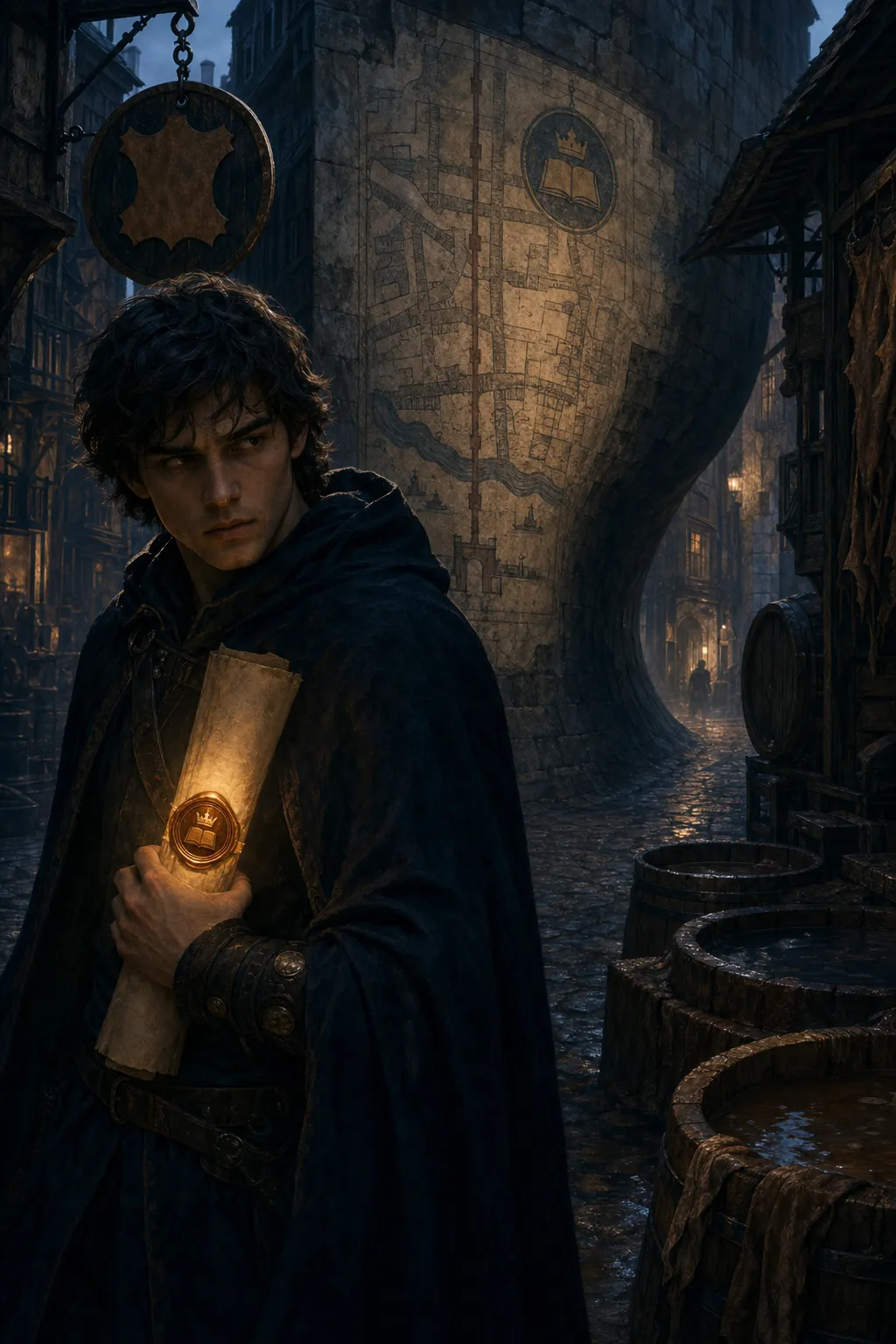
Cover

The Covenant Chronicles

Book 1: The Calling

Anonymous | novel | adult

sovereigntyelectioncallinggracecovenant

Summary: Chapter 1 The Map That Lies The City of Ruin did not smell of sulfur, as the traveling preachers claimed in the villages beyond the Wastes. It smelled of iron and old bread, of tanneries and coal smoke, of the slow rot of a river that had forgotten how to reach the sea. Elias of Ashford had lived there nineteen years and had stopped noticing the smell by the time he turned seven. You could get used to anything, his master said, and his master was a man who had gotten used to a great deal. Elias worked in the lower quarter, in a shop that faced the tannery district, where the air hung thick with the stink of lime and hides. The sign above the door read Aldric & Son, Cartographers to the Crown and Council, though Aldric had no son and the Crown had not commissioned a map in three generations. The Council, however, commissioned maps constantly — maps of streets, maps of holdings, maps of debts and boundaries and the ever-shifting lines that kept certain people inside and certain people out. Elias had drawn so many of these maps that he sometimes dreamed in ink lines, his...

Chapter 1 The Map That Lies The City of Ruin did not smell of sulfur, as the traveling preachers claimed in the villages beyond the Wastes. It smelled of iron and old bread, of tanneries and coal smoke, of the slow rot of a river that had forgotten how to reach the sea. Elias of Ashford had lived there nineteen years and had stopped noticing the smell by the time he turned seven. You could get used to anything, his master said, and his master was a man who had gotten used to a great deal. Elias worked in the lower quarter, in a shop that faced the tannery district, where the air hung thick with the stink of lime and hides. The sign above the door read Aldric & Son, Cartographers to the Crown and Council, though Aldric had no son and the Crown had not commissioned a map in three generations. The Council, however, commissioned maps constantly — maps of streets, maps of holdings, maps of debts and boundaries and the ever-shifting lines that kept certain people inside and certain people out. Elias had drawn so many of these maps that he sometimes dreamed in ink lines, his mind tracing the curves of alleys and the straight, merciless edges of the Council's districts. He was good at it. That was the trouble. He was good at making the world look orderly. On the morning the lie began, the autumn fog had settled into the streets like a creditor who would not be turned away. Elias arrived at the shop before dawn, as he always did, carrying a lantern and a wedge of cold barley bread. Aldric was already awake — the old man slept less and less these days, as if some part of him suspected that sleep was a debt he could not afford to pay. He sat by the brazier, wrapped in a moth-eaten cloak, poking at the coals with a brass rod. "New commission," Aldric said, without looking up. "Council wants the eastern quadrant redrawn. Something about a trade dispute. The usual lies, only with better lines." Elias set down his bread and took the rolled vellum from the old man's hand. It was the standard Council brief — vague where it needed to be precise, precise where it needed to be vague. The eastern quadrant was a tangle of workshops and warehouses, tenements and hidden courts, the sort of place where the Council's grip was firmest and its presence most despised. Elias had mapped it twice before, in his apprenticeship, and both times the results had felt wrong, though he could not say why. "I'll start after breakfast," Elias said. "You'll start now," Aldric replied. "They want it by sundown." Sundown. For a full quadrant survey, with cross-referencing and verification, that was laughable. But the Council did not laugh, and neither did Aldric, so Elias unrolled the vellum on the worktable, weighted the corners with lead ingots, and began. The fog burned off by midmorning, leaving the city gray and damp. Elias worked with his door open, letting in the cold air and the sound of the tannery's drums. He had a good ear for rhythm — the drums meant a new batch of hides, which meant the tannery workers would be too busy to notice him slipping into the alley behind their yard, where he sometimes took measurements the Council preferred not to see. Official maps showed the alley as a dead end. Official maps showed a great many things that were not true. By noon, Elias had filled two sheets with careful ink lines — the main thoroughfares, the secondary lanes, the narrow passages that connected them like veins beneath the skin of a dying man. He was working on the third sheet, the one that showed the tannery district in detail, when he found it. The inconsistency. It was small at first. A lane that appeared on the official Council map as ending at the tannery's north wall but that he remembered, distinctly, as bending around it. He had been down that lane a dozen times — first as a boy, playing in the muck, and later as an apprentice, measuring. He remembered the bend because it had saved him once, when a Council debtor's guard had chased him for sport. He had ducked around that bend and hidden in a doorway until the guard grew bored. But the official map showed no bend. The official map showed a wall. Elias set down his pen and rubbed his eyes. He was tired. The deadline pressed on him. Perhaps he had misremembered. Memory was a tricky thing, Aldric always said — it improved on reality, made heroes of cowards, made straight lines where there had only been curves. He ate his barley bread and tried to forget it. But the inconsistency would not leave him. It sat in the corner of his mind like a stone in a shoe, small and insistent and impossible to ignore. By midafternoon, he found himself looking at the official map again, not as a cartographer but as a man who had begun, without meaning to, to doubt. The lane in question was called Tanner's Row on the Council map. It ran east from the main thoroughfare, passed three workshops and a chandler's shop, and terminated at the tannery's north wall. Elias had labeled it himself, two years ago, during his first solo survey. He remembered the day — cold, overcast, the sort of day when the ink ran slow and his fingers went numb. He remembered measuring the distance from the chandler's to the wall. Forty-seven paces. He remembered because he had counted them aloud, a child's habit he had never broken, and because the number had felt wrong, though he did not know why. Forty-seven paces to a wall that should not exist. Elias looked up from his work. Aldric had fallen asleep in his chair, his chin on his chest, his breath rattling. The shop was quiet except for the distant sound of the tannery drums and the scratch of Elias's own pen. Outside, the gray afternoon was sliding toward evening. The deadline loomed. He should finish the map. He should draw the wall where the Council said the wall was, label the lane as a dead end, and collect his fee. That was what Aldric would do. That was what everyone did. The Council paid for maps that matched their understanding of the world, not for maps that matched the world itself. Elias stood up. He pulled his thin coat from the peg by the door and stepped out into the street. The fog had returned, thicker now, smelling of river mist and coal. Tanner's Row was three minutes from the shop, a narrow passage between two warehouses, barely wide enough for a cart. Elias had walked it a hundred times, but he walked it differently now — not as a familiar route but as a question. He counted his paces. One. Two. Three. The chandler's shop, shuttered for the evening. The smell of tallow and wick. Ten. Eleven. Twelve. The first workshop, where a wheelwright hammered iron rims by lantern light. Twenty. Twenty-one. Twenty-two. The second workshop, silent, its windows dark. Thirty. Thirty-one. Thirty-two. The alley narrowed. The fog pressed close. Elias could hear his own breath now, quick and shallow, though he had not been running. Forty. Forty-one. Forty-two. The tannery's north wall should have been before him. The official map showed it as a solid line of stone, unbroken, ending the lane. But there was no wall. The lane bent. It bent sharply to the left, around the tannery's corner, and continued into darkness. Elias stood at the bend and stared. His heart hammered against his ribs. He felt, absurdly, as if he had caught the world in a lie — not a deliberate lie, but a lie of omission, a thing left unsaid, a passage hidden behind a wall that existed only on paper. He should go back. He should finish the map. He should draw the wall and collect his fee and forget that he had ever seen the bend. Instead, he followed it. The passage beyond the bend was narrow and foul, lined with broken barrels and discarded hides. The tannery's waste ran in a thin stream along one wall, carrying the smell of lime and decay toward the river. Elias pressed himself against the far wall, trying to keep his boots clean, and walked on. The fog swallowed the sound of his footsteps. The drums had stopped. The city seemed, for a moment, to hold its breath. The passage opened into a small court — a space no larger than Aldric's shop, enclosed on three sides by the tannery's walls and on the fourth by the rear of a tenement. In the center of the court stood a wooden shed, half-collapsed, its door hanging on leather hinges. And on the threshold of the shed lay a man. Elias stopped. He had seen dead men before — the City of Ruin was not gentle, and the river delivered its share of bodies — but he had never seen a dying man, not like this. The man's chest rose and fell in shallow, desperate jerks. His face was gray in the fog-light, and his hands, clutching something to his breast, were streaked with blood. Elias should have run. That was what the city taught you — see nothing, hear nothing, involve yourself in no one's death but your own. The Council did not ask questions of bystanders; it asked questions of witnesses, and its questions were not kind. But the man moved. His head turned, slowly, as if the effort cost him everything, and his eyes — dark, fever-bright — found Elias in the fog. "You," the man whispered. "The mapmaker." Elias flinched. He did not know this man. He had never seen him before. "I — I'm not — I just —" "You found the bend." The man's voice was barely audible, a rasp of breath and blood. "The wall that is not there. I prayed... someone would find it." Elias took a step closer, then stopped. The man's hands loosened on the thing he clutched, and Elias saw it — a scroll, sealed with wax, the seal unbroken. The wax was dark, almost black, and stamped with a design Elias did not recognize: a crown above an open book. "Take it," the man said. "I can't —" Elias's voice cracked. "I don't know you. I don't know what this is." "You will." The man's eyes held him — not with strength, for the man had almost none left, but with a certainty that Elias could not name or deny. "It has your name on it. Not the name they gave you. The name he gave you." Elias felt his hand move before his mind could stop it. He reached out and took the scroll. The wax seal was cold against his palm. The man's hands fell away, limp, and his eyes closed — not in death, for his chest still moved, but in a release that looked, to Elias, almost like peace. "Who are you?" Elias whispered. "A Letter-bearer," the man said, his voice fading. "And you... are the one who was meant to find me. The King... does not make mistakes... with maps." His breath stopped. Not with a shudder or a cry, but with a quiet settling, as if a door had closed somewhere far away. Elias stood in the fog, holding the scroll, listening to the silence where a man's breathing had been. From the street beyond the passage, he heard voices — men's voices, purposeful and hard. The Council's enforcers, perhaps. Debt-collectors. Hunters. It did not matter what they were; it mattered that they were coming, and that Elias stood in a hidden court with a dead man and a sealed scroll and a map that lied. He ran. Not back the way he had come — that way led to the street, to the voices, to the questions he could not answer. He went deeper, around the tannery's far corner, through a gap in a fence he should not have been able to fit through, into the maze of alleys and passages that the official maps did not show. He ran without thinking, his feet finding paths his mind did not recognize, until the voices faded and the fog thickened and he found himself, gasping, in a doorway he did not know, clutching the scroll to his chest like a man clutching the only truth he had ever found. He did not open it. Not yet. He was too frightened, too full of the smell of blood and lime and the weight of a dying man's certainty. He hid it in his coat, against his heart, and made his way back to Aldric's shop by a longer route, through streets he had never walked, past faces that did not look up, through a city that pretended the hidden passage did not exist and the dying man had never spoken. Aldric was awake when Elias returned, hunched over the worktable, squinting at the unfinished map. "You're late," the old man said. "The Council's man comes at sundown." "I know," Elias said. His voice sounded strange in his own ears — calm, almost flat, as if he had left his fear in the hidden court. "I'll finish it." He sat down and picked up his pen. The official map lay before him, with its wall and its dead end and its comfortable lie. Elias looked at it for a long moment. Then he drew the bend. He drew the passage. He drew the hidden court and the shed and the place where a man had died giving him something he did not understand. He did not draw these things on the official map, of course. That would have been suicide. He drew them on a scrap of vellum he kept in his pocket, a cartographer's habit, a place for notes and observations and the small truths that did not belong in official documents. He drew them small and careful, in the same hand he used for the Council's commissions, but lighter, as if the lines themselves were afraid to be seen. When the Council's man arrived at sundown, Elias gave him the official map. The man unrolled it, glanced at it, nodded, and paid the fee without a word. He did not ask about hidden passages. He did not ask about dying men. He did not ask about scrolls sealed with black wax. Elias watched him go. Then he locked the shop door, blew out the lanterns, and sat in the dark with the scroll against his heart, listening to the tannery drums resume their rhythm, wondering if he had just ended his life or begun it. He did not open the scroll that night. He was not ready. But he could not sleep, and he could not forget, and he could not stop feeling — for the first time in nineteen years — that the world was larger than the maps had shown him, and that somewhere beyond the fog and the lies and the Council's walls, a King was writing names in a book he had never seen. To be continued... Chapter 2 The Letter-Bearer The scroll was warm against his chest. Elias sat in the dark of Aldric's shop, listening to the tannery drums resume their rhythm beyond the shuttered windows, and felt the thing pulsing like a second heart. He had not lit the lanterns. He had not moved from his stool by the worktable. He had sat down with the intention of finishing the Council's map — the official lie, the comfortable wall — and found that his hands would not obey him. They lay in his lap, empty, trembling slightly, as if they had touched something holy and had not yet recovered from the shock. The Council's man had come and gone. Elias had handed him the revised map, received the fee, and locked the door. All without thinking. All on instinct, the way a man walks through a familiar room in the dark, trusting muscle memory to keep him from the furniture. But now the room was unfamiliar. Now the furniture had moved. He pulled the scroll from his coat. It was smaller than it had felt in the hidden court, no longer than his forearm, wrapped in oiled linen that smelled of something he could not name — not incense, exactly, and not lavender, but something older, something that reminded him of libraries he had never visited and prayers he had never learned. The wax seal was dark, almost black in the gloom, and the stamp upon it — a crown above an open book — caught what little light filtered through the shutters and held it, as if the design itself were faintly luminous. He turned it over. The back was blank. The edges were frayed from travel and hiding, from the sweat of palms and the friction of concealment. This scroll had been carried a long way. This scroll had cost something to deliver. Elias set it on the worktable and stared at it. He did not open it. He told himself it was because he did not know how — the seal was thick, the wax unyielding, and he had no knife sharp enough to slice it cleanly. He told himself it was because the hour was late and his eyes were tired and the letters, if there were letters inside, would wait for morning. He told himself it was because a dead man's last words were not to be treated lightly, and he needed to be sober, calm, prepared for whatever the scroll contained. But the truth was simpler and more frightening: he was afraid to discover that the dying man had been mad. If he opened the scroll and found gibberish, or a list of debts, or a love letter meant for someone else, then the hidden passage was merely a forgotten alley, the dying man merely a vagrant with a fever, and Elias merely a fool who had let himself be seduced by a stranger's last delirium. He would go back to his maps. He would draw the walls where the Council said the walls were. He would grow old in the City of Ruin and learn to forget that he had once believed the world contained secrets. But if he opened the scroll and found his name... He did not finish the thought. He stood up, paced to the window, peered through the shutter slats at the empty street. The fog had thickened into something almost solid, a gray wall that allowed only the nearest lanterns to show themselves, and even those as mere smears of yellow, like the eyes of something half-asleep. The tannery drums had stopped. The city was holding its breath again. From the alley behind the shop came a sound. It was not the tannery's drums. It was not the river's slow pulse. It was footsteps — several pairs, moving with purpose, not stumbling home from a tavern but searching, quartering the ground like hounds on a scent. Elias pressed himself against the wall beside the window and listened. "— around the tannery's north wall —" The voice was low, male, educated in the way that Council enforcers were educated: not broadly, but deeply in the specific arts of finding people who did not wish to be found. Elias had seen their kind before, walking through the lower quarter in pairs, their boots too clean for the streets they patrolled, their eyes too knowing. They were not soldiers, exactly. They were accountants of the body, trained to locate missing persons the way a ledger locates missing coin. "— didn't come back out. Alley's a dead end on the map." Elias's heart stopped, then restarted at twice its former speed. They knew about the alley. They knew about the bend. They knew, or suspected, that a man had walked into a passage that did not officially exist and had not walked out again. "Maps lie," said a second voice, younger, rougher. "Tannery's north wall has a gap. Found it last winter chasing a debtor. Man could squeeze through if he was desperate enough." Elias stopped breathing. They knew about the gap. They knew about the hidden court. They were, at this moment, walking toward the very place where a man had died pressing a scroll into a stranger's hands, and they would find the body, and they would wonder where the scroll had gone, and they would begin to search the neighborhood, door to door, question to question, until they found the fool who had taken it. He moved. Not toward the front door — that led to the street, and the street led to the alley, and the alley led to the enforcers. He moved toward the back of the shop, where Aldric kept the storage room, where crates of vellum and bottles of ink and the accumulated detritus of forty years of cartography created a labyrinth of shadow and concealment. He slipped between two stacks of pressed maps, crouched behind a barrel of dried oak-gall, and held his breath. The footsteps passed the front of the shop. Paused. Continued. Elias waited. He counted his heartbeats the way he had counted his paces on Tanner's Row — one, two, three, four — and tried to make them slow. He was not a brave man. He had never been a brave man. He was a cartographer, a man of lines and measurements, and the only risk he had ever taken was the risk of inaccuracy, of drawing a street two paces too narrow and earning a reprimand from the Council's clerks. He did not know how to hide from enforcers. He did not know how to hold a dead man's secret against his chest and survive the night. But he knew how to be still. Maps required stillness. You could not draw a true line while trembling. The footsteps returned. They stopped directly outside the shop's front door. Elias heard the rattle of the latch, the soft pressure of a hand testing the lock. He had locked it. He was certain he had locked it. But certainty was a thin shield against the Council's tools, and he heard, after a moment of silence, the scrape of metal against metal, the subtle click of a pick finding the ward. The door opened. Elias closed his eyes. He did not pray — he had never prayed, not in any way that mattered — but he held the scroll against his heart and thought, with a desperation that surprised him, Not here. Not now. Please. He did not know who he was addressing. He did not know if the word "please" had any weight in the universe. But he thought it anyway, with all the force of a man who had nothing else to offer. The footsteps entered the shop. Two pairs, he thought, maybe three. They moved with the confidence of men who had entered a thousand rooms uninvited and had never once been refused. "Aldric?" The voice was the first one, the educated enforcer. "Aldric, cartographer. We have questions." Silence. Aldric had not woken. Aldric, who slept like a man trying to escape his debts, had not stirred at the sound of his own name spoken by strangers in his own shop. Elias felt a surge of gratitude toward the old man that was almost love. "Asleep." The second voice, the younger one. "Dead drunk, more like. Smells like a brewery in here." "Search the back." Elias pressed himself deeper into the shadows. The storage room had a second door, he knew — a small door that opened onto an even smaller passage, barely wide enough for a child, that ran between Aldric's shop and the chandler's next door and emerged three buildings down, near the river. He had used it once, years ago, when a debtor's guard had chased him for sport. He had been twelve then, small and quick, and the passage had saved him. He was nineteen now, taller, broader, and he did not know if he could fit. But the footsteps were coming closer, and the scroll was warm against his heart, and somewhere in the darkness beyond the shutters a King was writing names in a book Elias had never seen, and he thought: If the King can make a wall disappear, he can make a boy fit through a gap. He moved. Silently, carefully, he edged between the crates and barrels toward the small door. His coat caught on a splinter; he freed it without tearing, his fingers finding the weakness by touch alone. The footsteps in the front room paused — someone had found the worktable, the unfinished map, the scrap of vellum with its hidden lines — and Elias held his breath again, his hand on the latch of the small door. The latch was rusted. He had forgotten that. It had been seven years since he had used this door, and the damp of the river had done its work, and the metal groaned like a thing in pain when he pressed it. "Back room." The voice was close now, ten paces away, maybe eight. Elias did not wait. He threw his shoulder against the door, felt it give with a shriek of rusted hinges, and squeezed himself into the gap beyond. He did not fit. His shoulders caught. His chest compressed. His breath left him in a gasp that was half pain, half panic, and for a moment he was stuck, wedged between the door and the darkness, unable to move forward or back. He heard footsteps running now, boots on wood, and a shout — "Stop! Council business!" — and he thought of the scroll crushed against his chest, the wax seal cracking, the name inside lost forever. He twisted. It was not bravery. It was desperation, the same desperation that makes a man smaller than he is, that lets him slip through gaps no sane person would attempt. He exhaled every atom of air from his lungs, made himself as narrow as a thought, and pushed. The door surrendered. He tumbled into the passage beyond, skinning his palms on the rough stone, and did not pause to feel the pain. He ran. The passage was exactly as he remembered it: dark, damp, smelling of river mud and rat droppings, barely wide enough for a child and murderously low. He ran hunched over, one hand on the wall for guidance, the other clutching the scroll to his breast, and tried not to think about what would happen if the passage dead-ended or collapsed or simply ended in a wall that the King had not chosen to remove. Behind him, he heard the enforcers at the door. "Too small," one said. "No one could fit through that." "He fit," the other replied. "Find the other end. River side." Elias ran faster. The passage twisted, dipped, rose again. His knees ached. His back screamed. But the scroll was still whole, still sealed, and the darkness was not total — somewhere ahead, he could see a faint grayness that meant the end, the river, the open air, however fog-choked and dangerous. He burst from the passage into a narrow alley that ran parallel to the riverbank. The fog was thinner here, moving in slow currents over the black water, and he could hear the river's voice — not the gentle murmur of a stream but the low, patient growl of a body that had been swallowing secrets for centuries. He turned left, away from the river, toward the tenements where the poor lived stacked like cordwood, where no one asked questions and everyone had something to hide. He did not know where he was going. He only knew that he could not go back. He walked for an hour, maybe two. The fog began to lift, revealing a sky the color of old iron, the first suggestion of dawn seeping through the eastern tenements. He found himself in a part of the city he did not recognize — a district of tumbledown shacks and open fires, where women in stained aprons hauled water from a public pump and children with bare feet chased dogs through mud. He had mapped this district once, years ago, but only from the outside, only the boundaries, only the lines that separated it from the districts the Council cared about. He had never walked its streets. He had never seen its people. A woman looked up from her fire and saw him standing in the alley entrance, coat torn, hands bleeding, a scroll clutched to his chest like a shield. She did not ask questions. In this district, questions were currency for the Council, and no one spent them freely. "You look like a man who needs to hide," she said. Elias nodded. He could not speak. His throat was raw from the passage, from fear, from the weight of a night that had transformed him from a cartographer into a fugitive. "The old well," she said, pointing with a stick. "Behind the tanner's shed. There's a space. No one goes there." "Why are you helping me?" The woman smiled, a thing of missing teeth and unexpected warmth. "Because you look like a man who's found something the Council wants. And anything the Council wants is worth keeping from them." She turned back to her fire. Elias walked toward the well. It was not a well, exactly — more of a cistern, long dry, covered by a rotting plank that moved aside with a whisper. The space beneath was small, dark, and smelled of mildew, but it was dry and — he checked with the care of a man who had learned that safety was an illusion — it had no other entrance. One way in. One way out. A cartographer's nightmare and a fugitive's dream. He sat on the earthen floor, pulled the plank back into place, and allowed himself, for the first time since the hidden court, to breathe. The scroll was still warm. He held it in his lap and looked at it in the dim light that filtered through cracks in the plank. The wax seal seemed less dark now, more like deep wine than black, and the crown-and-book design was clearer, more detailed than it had appeared in Aldric's shop. He could see individual pages in the open book, lines of text too small to read, and the crown above it was not a simple circlet but something elaborate, something that spoke of authority beyond any the Council claimed. He broke the seal. The wax cracked with a sound like a distant bell, and the smell that rose from the broken seal was the same smell that had clung to the linen — old libraries, ancient prayers, the dust of centuries. Elias unrolled the scroll carefully, his fingers trembling, and began to read. The language was the same language the dying man had spoken. Not the common tongue of the City of Ruin, not the elevated dialect of the Council's courts, but something older, something that felt in his mouth like water from a deep well. And yet he understood it. He read it as easily as he read his own name, and the understanding terrified him more than the enforcers had. To the one who was called before the foundations of the world, Elias stopped. His hands shook so violently that he had to press the scroll against his knee to keep it steady. He read the line again. And again. The words did not change. The meaning did not soften. To the one who was called before the foundations of the world, He was not a theologian. He was not a philosopher. He was a cartographer's apprentice who had drawn maps he did not believe and walked streets he had never truly seen. But he knew, with a certainty that bypassed his mind and lodged directly in his chest, that these words were not metaphor. They were not poetry. They were not the delirium of a dying vagrant. They were an address. To the one who was called before the foundations of the world, He read on, in the dim light of the cistern, while the city woke around him and the Council's enforcers searched alleys he had already passed through and a woman tended her fire without knowing that she had sheltered a man who had just discovered that his life was not his own. The scroll spoke of a King. It spoke of a Prince who had fought a Great Battle and won a victory that could not be undone. It spoke of a city beyond the Wastes, a place where the maps were true and the walls were where they appeared to be and no one lived in fear of enforcers or debt or death. It spoke, most terribly and most beautifully, of love. Not the love Elias had seen in the City of Ruin — the transactional love of debtors and creditors, the conditional love of the Council's favors, the desperate love of people who had nothing else to hold. This was a love that sought before it was sought, that chose before the chosen knew choice existed, that named a man before the man knew he had a name. You did not find me, the scroll said. I found you. You did not choose me; I chose you. The map you hold is true because I drew it, and the name you bear is true because I gave it, and the journey you begin today is not a journey away from ruin but a journey toward home. Elias wept. He wept not because he was sad but because he was found, and being found was more frightening than being lost. He wept because the scroll knew him — not the Elias of Ashford who drew maps for the Council, but some other Elias, some true Elias, some named-and-chosen Elias who had been waiting under the surface of his life like a spring waiting under winter ground. He wept because the King had written his name in a book, and he did not deserve it, and he could not earn it, and the not-deserving and the not-earning were the whole point. When his tears stopped, the light had changed. The cistern was brighter, the cracks in the plank above throwing lines of gold across the dirt floor. Morning had come. The city was waking. The enforcers would still be searching, but their search would broaden now, become less urgent, become routine. They were patient men. They could wait. But Elias could not. He rolled the scroll carefully, tied it with a strip of linen he tore from his shirt, and tucked it inside his coat, closer to his heart than before. He pushed aside the plank, climbed from the cistern, and blinked in the morning light. The woman was gone. Her fire was cold ashes. The district was busy now, children running, women arguing, men hauling carts toward the river. No one looked at him. No one asked where he had come from or why his coat was torn or what he clutched against his chest. He walked toward the edge of the district, toward the wall that separated the poor from the slightly-less-poor, toward the street that would lead him, eventually, back to Aldric's shop. He did not know what he would say to the old man. He did not know if Aldric was safe, if the enforcers had taken him, if the shop was now a place of questions and accusations and the kind of answers that ended in prison or worse. But he knew he had to go back. The scroll had said so. Not in words, exactly, but in the spaces between words, in the silence that followed the reading, in the quiet conviction that a journey did not begin by running away but by returning — returning to face what must be faced, to tell what must be told, to leave what must be left behind. The City of Ruin had not changed. The fog was lifting, the sun was rising, the tannery drums had begun their daily rhythm. The Council's banners hung from the district towers, their gold-and-black emblems declaring order and prosperity and the peace that came from obedience. But Elias had changed. He walked through streets he had mapped a hundred times and saw them differently now. The wall that ended the alley was not merely a wall; it was a choice, a lie, a thing that pretended to be final. The street that ran straight was not merely straight; it was a story the Council told itself about how the world worked. The city itself was not merely a city; it was a condition, a state of being, a place where people lived as if there were no King and no Prince and no book in which their true names were written. He was almost at the shop when he saw the smoke. It rose from the direction of Aldric's street, thin and black at first, then thickening, then billowing in a column that spoke of fire rather than chimney. Elias began to run. He did not think. He did not plan. He ran toward the smoke because the smoke was coming from the place where an old man had slept in his chair, where maps had lain on tables, where a life had been lived in quiet obscurity and sudden, inexplicable danger. He turned the corner and stopped. Aldric's shop was burning. Not completely — the flames had not yet consumed the roof — but the front window was shattered, the door hung open, and inside, visible through the smoke, the worktable was ablaze, the vellums curling, the inks boiling, forty years of lines and measurements and small, careful truths turning to ash. A crowd had gathered, the sort of crowd that gathered for fires: silent, watching, waiting to see if anyone would be hurt, if anything would be saved, if the story would be interesting enough to repeat. Elias pushed through them. "Aldric!" he shouted. "Aldric!" A hand caught his arm. He turned, ready to fight, and found himself facing a man he did not know — middle-aged, gray-haired, with eyes that held neither cruelty nor kindness but something more difficult: knowledge. "The old man is safe," the stranger said. "I pulled him out before the flames reached him. He's at the healers, two streets down. Smoke inhalation, nothing worse." Elias stared at him. "Who are you?" "A friend of the Letters," the man said. "As you are, though you do not yet know it." He glanced at the scroll-shaped bulge beneath Elias's coat and smiled faintly. "Keep it hidden. The Council's men will return. They did not find what they sought, and they will not stop seeking until they do." "What did they seek?" "You," the man said. "And what you carry. And the name written on it." He released Elias's arm and stepped back into the crowd, becoming anonymous again, becoming just another watcher at just another fire. "Go to the healer's. See your master. Then leave the city. The eastern gate is watched, but the northern gate is not. There is a road beyond it that leads to the Wastes, and beyond the Wastes, the Covenant Lands." "I don't know the way," Elias said. "No one does," the man replied. "Not at first. That is why it is called a journey." He turned away, his face already forgotten, his voice already fading into the crackle of flames and the murmur of the crowd. "Read the scroll again, Elias of Ashford. Read it until you believe what it says. Then walk." Elias stood in the street, watching a man he did not know disappear into a crowd he could not name, holding a scroll he could not explain, in a city that had just burned the only home he had ever known. He turned toward the healer's house. He would see Aldric. He would make sure the old man was safe. He would gather what little he had — his knife, his chalk, his scrap of hidden-map vellum, the truth that was burning behind him and the truth that was warming his heart. And then he would walk. Not because he was brave. Not because he was ready. But because a King he had never seen had written his name in a book, and the book was true, and the truth was calling him forward into a world larger than any map he had ever drawn. To be continued... Chapter 3 A Name He Cannot Unknow The healer's house smelled of thyme and beeswax, which Elias found obscene. A man's shop had burned. A man had died in a hidden court. The Council's enforcers were hunting the streets for a scroll that had somehow, impossibly, addressed Elias by name. And here, in this small room with its clean linens and its pottery of ointments, everything smelled of comfort, as if the world were not breaking apart. Aldric lay on a narrow bed by the window, propped on pillows, wrapped in a wool blanket that had seen better decades. His breathing was wet and shallow, and there was a bruise the color of plums along his jaw where someone — enforcer, debtor, Elias did not know — had struck him before the fire took the front room. But his eyes were open, and they found Elias the moment he stepped through the door. "You came back," Aldric said. His voice was smoke-rough, barely more than a whisper, but there was no surprise in it. "I told the woman you would. I told her a cartographer always comes back to check his measurements." Elias knelt beside the bed. He did not know what to say. He had rehearsed speeches on the walk through the waking city: apologies, explanations, farewells. Now they all seemed like maps drawn for a country that no longer existed. "The shop —" he began. "Is ash." Aldric coughed, a long rattling thing that seemed to come from somewhere deeper than his chest. "I know. I watched from the window here while the woman changed my bandages. Forty years of ink and vellum and bad wine, and it went up like a prayer." He tried to smile. "Perhaps that is what it was. A prayer in the only language the Council understands." "I'm sorry." "For what?" Aldric's hand moved on the blanket, searching. Elias took it. The fingers were cold, the knuckles swollen with age, but the grip, when it came, was still certain. "You did not light the fire. You did not send the men." "I brought them." "No." Aldric's eyes sharpened, the way they did when Elias had made a sloppy measurement. "You did not bring them. They were already hunting. The Letters have always been hunted. You simply became the thing they hunt. There is a difference, boy. Learn it." Elias felt the scroll against his chest, a hard cylinder pressing against his breastbone through the torn linen of his shirt. He had not told Aldric about it. He had not told anyone. But the old man was looking at him with the expression of a man who had known the truth before it was spoken. "You knew," Elias said. "I suspected." Aldric's gaze drifted to the window, to the slice of gray sky visible between the shutter slats. "For months, maybe longer. You were drawing things that were not in the official surveys. Hidden courts. Walls that bent. Doors that appeared in alleys where doors had no business appearing. I thought at first you were inventing them. A young man's fancy. Then I thought you were finding them, and I was afraid." "Afraid of what?" "Afraid the Council would see what you saw." Aldric turned back to him. "They pay us to make the world look the way they want it to look. A cartographer who sees what is actually there is more dangerous than a rebel with a sword. You draw the truth, Elias. And the truth is the one thing they cannot allow." Elias reached inside his coat and withdrew the scroll. He held it out, still wrapped in its oiled linen, the broken seal dark against the cloth. Aldric did not take it. He looked at it as a man looks at a coiled adder — with recognition, respect, and a certain reluctant love. "A Letter," he said. "You know what it is?" "I know what it is. I have never held one." Aldric's voice was hushed, almost reverent. "In my youth, before you were born, before your father came to Ruin, I knew a man who had seen a Letter. He was killed for it, eventually. The Council does not tire of such things." He paused, gathering breath. "Read it to me." "I can't. It's — it's mine. It has my name." "Then read the parts that do not have your name. Read the parts that speak of the King. Let an old man hear what he has only ever feared." Elias unrolled the scroll carefully. The light in the healer's room was better than the cistern's gloom — morning sun through the shutters, falling in golden bars across the worn floor. The words seemed to drink the light, to grow more visible, more solid, as if they had been waiting for this particular illumination. He read aloud. His voice was uncertain at first, stumbling over the ancient cadences, but as he read, the uncertainty fell away, the way a stutter falls away from a man who has finally found the thing he was born to say. He read of the King. He read of the Prince who had gone out to meet the Enemy in battle, who had been struck down and had risen again, who had taken the city of death and broken its gates from the inside. He read of a love that would not be earned, a calling that would not be revoked, a name that would not be forgotten. When he finished, the room was silent except for Aldric's breathing and the distant clatter of the city beginning its day. "Read it again," Aldric said. Elias read it again. And again. By the fourth reading, Aldric's eyes were closed, but he was not asleep. Tears moved slowly down the creases of his face, tracing paths through the soot that still clung to his skin. "I cannot read it," Aldric said at last. "What?" "When you read, I hear the words. I understand the words. But I cannot read them myself. I tried, once, years ago, when that friend of mine let me look at a page. The letters swam like fish. My eyes would not hold them." He opened his eyes and looked at Elias with something like wonder and grief together. "But you can read them. They hold still for you. They shape themselves to your voice. Do you understand what that means?" Elias did not answer. He was afraid to answer. "It means," Aldric said, "that the King has given you a name. And a man who has been given a name cannot live as though he were nameless." The words settled into Elias with the weight of a verdict. He thought of the life he had lived — the careful life, the small life, the life of measuring streets that others had already decided should be measured. He thought of the Council's fees, the master's sharp tongue, the nights spent copying maps he did not believe. He thought of how he had believed, without ever quite admitting it, that this was all there was: the City of Ruin, the tannery drums, the slow rot of the river, the endless project of making the world small enough to be manageable. And now a name. A name he had not chosen. A love he had not earned. A King he had never sought. "I don't want it," he said. The words came out before he could stop them, honest and raw as a wound. "I don't want to be hunted. I don't want to leave. I don't want to be the kind of man who sleeps in cisterns and runs from enforcers and carries scrolls that get other people killed." "No one does," Aldric said. "Not at first. The King has never chosen respectable people. He chooses fishermen and tax collectors and men who sleep in cisterns. If he wanted the proud, he would have built his city here, among the Council towers." "But why me? What did I do?" "Nothing." Aldric squeezed his hand. "That is the answer you will spend the rest of your life learning to accept. You did nothing. You were not wise. You were not brave. You were not even particularly good. You were simply — named. Before the world was made, before the City of Ruin was built, before your mother's mother was born, the King wrote your name in a book. And now the book has found you." Elias sat back on his heels. The scroll lay across his lap, warm and strange and impossible. He felt anger rising in him, the same anger he had felt in the cistern when the words first addressed him. It was not the hot anger of a man wronged; it was the colder anger of a man whose life had been decided without his consultation. "It's not fair," he said. "No." Aldric smiled, a real smile this time, though it cost him. "Grace is never fair. If it were fair, it would be wages, and we would all be bankrupt." A knock came at the healer's door — soft, urgent, a pattern of three raps and a pause. Elias stiffened. Aldric shook his head. "Not them," he whispered. "They do not knock. Go. See who it is. But take the scroll with you." Elias tucked the scroll inside his coat and moved to the door. He opened it a crack and found himself looking at the woman from the fire — the woman who had pointed him to the cistern, who had fed him without asking his name. She carried a bundle wrapped in rough cloth and a small leather flask. "For the road," she said, pressing the bundle into his hands. "Bread, cheese, a little dried meat. The flask is water, not wine. A man running needs his wits." "Who are you?" Elias asked. "A friend of the Letters," she said, the same words the stranger in the crowd had used. "There are more of us than the Council knows. We do not meet. We do not organize. We simply help when we can." She glanced past him at Aldric. "The old man will live. The healer is honest. Tell him to rest three days, then move him. The Council will come back to ask questions." "Move him where?" "Wherever the King sends him." She turned to go, then paused. "The northern gate is watched, but less than the others. Go now, while the morning fog still hides the roads. The Wastes are dangerous, but they are honest. The Council's maps do not lie about the Wastes. They simply do not show them at all." She was gone before he could thank her, melting into the street like fog into fog. Elias closed the door and carried the bundle back to Aldric's bedside. The old man had pushed himself up on one elbow, his face gray with the effort. "You are leaving," Aldric said. It was not a question. "Yes." "Good." Aldric reached under his pillow and withdrew a small leather purse. "Take this. It is not much — what I had hidden from the debt-men. Enough for bread on the road, maybe a night under a roof if the weather turns." "I can't —" "You can." Aldric pressed it into Elias's palm. "I have no children. I have no debts the fire has not settled. Let my last investment be in a man who can read what I could not." Elias took the purse. It was heavier than he expected, the weight of a life measured in small coins. "There is one more thing." Aldric's voice had grown thinner, and Elias had to lean close to hear. "Your father. He did not die in the river accident, whatever the Council's records say. He left. He was called, the same as you. I did not tell you because I did not know how, and because I was afraid you would follow him." Elias felt the room tilt. "He's alive?" "I don't know. He went east, toward the Outposts, carrying a Letter much like yours. I never heard from him again. But I never heard that he was dead, either, and the Council's lies are usually louder than their silences." Aldric's hand found Elias's wrist, gripping with surprising strength. "Find him, if you can. Or don't. The King may have other work for you. But know this: you are not the first in your blood to be named. The scroll did not choose a stranger." Elias stood slowly. His legs were unsteady. The room had grown too small, too full, too charged with a history he had not known he carried. "I will come back for you," he said. "No." Aldric released his wrist and settled back against the pillows. "If you come back, they will be waiting. Go east. Find the Outpost. Find the King. And if you find your father, tell him I kept my promise. I kept you safe as long as I could." Elias bent and kissed the old man's forehead, breathing in the smells of smoke and thyme and seventy years of stubborn life. "Thank you," he said. "For what?" Aldric asked, echoing their earlier exchange. "I taught you to draw lines, boy. The King taught you to see through them." He closed his eyes. "Go now. Before I weep, and an old man weeping is a shameful sight." Elias went. He moved through the healer's house like a ghost, out the back door, into a narrow passage that ran between a chandler's shop and a tanner's drying yard. The bundle was under his arm. The purse was in his pocket. The scroll was against his heart. He did not look back. The city had never seemed so large, nor so full of eyes. Every corner held a potential enforcer. Every window might hide a watcher. Every passing cart might be carrying a report to the Council's towers. Elias walked with his head down, the way apprentices walked, the way invisible men walked, and tried to believe that the same King who had opened a hidden passage could also close the eyes of his enemies. He passed the square where public punishments were held. A man was tied to the whipping post, his back already striped with blood. A clerk read the charges in a bored voice: "Possession of seditious literature. Distribution of the King's Letters." The crowd watched with the dull patience of people who had seen this before and would see it again. Elias did not stop. He could not stop. But he saw the man's face — young, bearded, calm in a way that frightened the Council more than any shouting could. The man caught Elias's eye for a moment and smiled, a small, broken smile that said, I know. I have read the name too. Go. Elias went. The northern gate rose before him sooner than he expected, a stone arch blackened by centuries of smoke, guarded by two soldiers in Council colors who looked as bored as the clerk in the square. They were checking a wagon loaded with turnips, poking among the vegetables with spears, joking about the farmer's daughter. Elias slowed. The bundle under his arm felt like a beacon. The scroll against his chest felt like a shout. He was certain that if he approached the gate, the guards would see through his coat, through his skin, through the careful invisibility he had spent nineteen years cultivating. They would see the scroll. They would see the name. They would drag him to the whipping post or worse. A dog ran past, chasing a rat toward the gate. One of the guards laughed and kicked at the dog. The other turned to watch, his spear lowered, his attention gone. Elias walked forward. He did not run. Running would call attention. He walked the way he had walked a thousand times on errands for Aldric — purposeful, unhurried, a young man with somewhere to be and nothing to hide. He kept his eyes on the arch, on the road beyond, on the pale line of the Wastes visible through the gap. The guard who had been watching the dog turned back. His gaze passed over Elias without stopping, the way a man looks at a chair or a post or any other part of the scenery. Elias nodded to him, the brief, respectful nod of a commoner to authority. The guard did not nod back, but he did not raise his spear either. Elias passed under the arch. The road beyond was rutted and dusty, lined with the small shacks of those too poor even for the City of Ruin. A few faces turned to watch him pass — a woman drawing water, a child playing in the dirt, an old man mending a net — but none spoke. The poor did not ask questions of travelers. Questions brought the Council. He walked until the gate was a memory and the city walls were a dark line behind him. He walked until his boots were thick with dust and the sounds of the city had faded into a silence so complete it seemed almost holy. He walked until he could no longer smell the river's rot or the tannery's smoke, until the air began to taste of salt and distance and something he could not name. Then he stopped. He turned and looked back at the City of Ruin. From here, it was smaller than he had ever imagined. A jumble of towers and tenements, of walls that pretended to be final and streets that pretended to be straight. He could see the tannery district, the place where Aldric's shop had stood, the quarter where he had been born and had drawn maps and had believed, without ever quite saying so, that he would die. And now he was outside it. The sun was higher now, burning off the last of the fog, and the Wastes stretched before him in shades of brown and rust and unexpected green. It was not the desert the Council described in its warnings. It was wild, yes, and dangerous, but also alive — scrub grass bending in the wind, birds calling from hidden places, the distant glint of water where a spring broke the surface. Elias took the scroll from his coat and unrolled it in the morning light. The words were clear, untroubled by the wind, as if the wind itself had been instructed not to disturb them. He found the line he had read first, in the cistern, when everything changed. The line that named him. To the one who was called before the foundations of the world, He read it aloud, his voice small against the vastness of the Wastes. And this time, for the first time, he did not weep and he did not rage. He simply accepted it, the way a man accepts that the sun is hot or that the road is long. He was named. He could not unknow it. He could not unbecome it. The name was not a coat he could take off when the weather changed. It was not a map he could throw away when he no longer needed directions. It was a fact, written in a book older than the City of Ruin, older than the Council, older than the fear that had governed every day of his life. Elias of Ashford rolled the scroll carefully, tucked it inside his coat, and began to walk east. He did not know how far the Outpost was. He did not know if his father lived. He did not know what mercy or danger waited in the Wastes, what hunger, what thirst, what strange mercy of the King would meet him on the road. But he knew his name. And a man who knows his name can walk through any waste. To be continued... Chapter 4 The Debt the Council Keeps The Wastes did not forgive. Elias learned this on the first night, when the sun dipped below the horizon and the temperature fell like a stone dropped from a tower. The day had been warm enough — hot, even, the sun beating against his neck as he walked the rutted track eastward. He had sweated through his shirt and thought, foolishly, that the desert might be kinder than the city. Now, huddled beneath a shelf of rock that provided more illusion than shelter, he understood that the Wastes had simply been waiting. They let you walk in believing you could manage them, and then they stripped away everything that had made you feel capable. His feet ached. The boots Aldric had given him were good boots, well-made, broken in by another man's years. But they were not his boots, and they had rubbed blisters on both heels that had opened and wept and now burned with every shift of his weight. He had no water left — the leather flask the woman had given him had seemed generous at the healer's door, but in the Wastes, water disappeared not into your throat but into the air itself, drunk by a dryness he had not believed possible. He was hungry, but hunger was familiar. He had been hungry in the city. What he had never been was alone. In the City of Ruin, there had always been people. Even in his darkest moments — the nights when Aldric drank and the shop felt like a tomb — there had been footsteps in the street, the distant clatter of commerce, the breathing presence of a million souls packed into stone and wood. Here, there was nothing. The Wastes stretched in every direction, brown and rust and sudden shocking green where a spring broke the surface, and they were empty. Not empty like a room after everyone has left. Empty like a room that was never meant for people. Elias pulled the scroll from his coat and unrolled it in the moonlight. The moon was brighter here than in the city, unfiltered by smoke and fog. It fell on the ancient words with a silver clarity that made them seem almost luminous, as if the parchment itself were faintly glowing. He found the passage he had read to Aldric — the passage about the Prince who had faced the Enemy — and read it again, his lips moving silently. He went out to meet the darkness, not because he was unafraid, but because he loved the light. Elias whispered the words into the cold air. They did not make him warmer. They did not fill his stomach or heal his feet or produce water from the dry stone. But they held him in place, the way a hand holds a cup that is about to fall. He was not comforted, exactly. He was kept. He slept fitfully, waking at every sound — the skitter of a lizard across stone, the cry of some night bird he could not see, the wind that moved through the scrub grass like a thousand voices whispering. Each time he woke, he touched the scroll to make sure it was still there, still real, still naming him in a world that seemed to have forgotten names entirely. In the darkest hour before dawn, he heard footsteps. Not the random footsteps of an animal. These were human, deliberate, moving with the patience of men who did not need to hurry because they knew where their quarry would be. Elias pressed himself against the rock shelf and held his breath. The Council's enforcers. They had followed him. They had tracked him across the Wastes, and now, in his weakest moment, they had found him. The footsteps stopped. A voice spoke — low, accented with the educated precision of the city. "He's close. The prints end here." "Maybe he kept walking." "In the dark? With no moon to guide him?" A pause. "No. He's here. Somewhere." Elias closed his eyes. He could feel his heart beating against the rock, could hear his own breath rasping in his throat. He was not hidden. He was merely unlit, and when the sun rose, his shelter would become a trap. "Check the rocks." Footsteps approached. Elias's hand found a stone, heavy and sharp-edged, the size of his fist. He had never thrown a stone at a man. He had never thrown a stone at anything larger than a rat. But he gripped it now with the desperation of a man who had nothing else. A shadow moved against the starfield. The enforcer was ten paces away, maybe eight, his silhouette visible against the faint glow of the eastern horizon. Elias raised the stone. Then the Wastes spoke. It was a sound unlike anything Elias had ever heard — a low, resonant hum that seemed to come from the ground itself, from the depth of the earth, vibrating in his chest before it reached his ears. The enforcer froze. The sound grew louder, became almost musical, a sustained note that made the rock shelf tremble beneath Elias's back. "What is that?" The second enforcer's voice had lost its calm. "I don't — wind? An animal?" The hum shifted, became a rumble, became something that felt alive and intentional. And then, from the darkness beyond the rocks, a shape moved. It was large. That was all Elias could tell in the dim light — large, dark, moving with a fluid grace that suggested mass and speed. The enforcer who had been approaching Elias's shelter spun, his hand going to his weapon, but the shape was already past him, already moving toward the second man, and the sound it made was not a growl and not a roar but something closer to the noise of heavy canvas tearing in a storm. The enforcers ran. They did not look back. They did not shout orders or threats. They simply ran, their boots pounding against the hardpan, their forms shrinking against the pale horizon until they were swallowed by the darkness and the distance. Elias lowered the stone. His hand was shaking so violently that he dropped it. The shape had stopped moving. It stood at the edge of the shelf's shadow, visible now as a deeper darkness against the dark, and Elias could see that it was not an animal at all. It was a man. A very large man. He stood perhaps six and a half feet tall, broad-shouldered, wrapped in a cloak of some rough material that moved in the faint breeze like living smoke. His face was hidden by a hood, but his hands were visible, and they were scarred — the hands of a man who had worked with fire and metal, who had held hot things and survived. "They'll be back," the man said. His voice was the source of the hum — not literally, but in quality: deep, resonant, seeming to come from somewhere lower than his throat. "With more men. With dogs, maybe. The Council doesn't like losing." Elias found his voice. "Who are you?" "A smith." The man shifted, and Elias heard the clink of metal — tools, weapons, something heavy hanging from a belt. "I work at an Outpost two days east. I was gathering ore when I saw your fire — or rather, your lack of one. A man without fire in the Wastes is either dead or running." "I'm running." "I know." The smith stepped closer, and the first hints of dawn showed his face — weathered, bearded, with eyes that held the particular sadness of a man who had seen too much and had not yet learned to look away. "I saw you leave the city. I watched from the ridge. The northern gate is watched, but less than the others — that was wise. What was less wise was walking into the Wastes with no water and no fire and no idea where you're going." "I have an idea." "Do you?" The smith's eyebrows rose. "The Outposts are not marked on any map the Council approves. The Wastes shift. What is east today may be southeast tomorrow, if the wind changes the dunes." Elias reached inside his coat and touched the scroll. "I have a guide." The smith's eyes followed the movement. His face changed — subtly, but completely, like a landscape rearranging itself after an earthquake. The sadness deepened. The weariness lifted, replaced by something harder and more fragile. "A Letter," he said. Elias did not answer. He did not need to. "Show me." "No." The smith did not react to the refusal. He simply nodded, as if this were the answer he had expected. "Good. A man who shows his Letter to anyone who asks is a man who will lose it. The Council's hunters are one danger. There are others." He turned and gestured toward the east, where the sky was lightening from black to gray to rose. "Come. My camp is nearby. Water. Fire. Food that is not leather. And then we walk together, if you want company." "Why would you help me?" The smith looked back at him. "Because nineteen years ago, someone helped me. A man in a brown cloak, traveling alone, carrying a Letter much like yours. He found me in the Wastes, half-dead from thirst, running from debts I could not pay. He gave me water and a name I did not know I had." He paused. "He told me the King writes in a book. He told me my name was in it. I have spent nineteen years learning to believe him." Elias felt something shift in his chest. "My father?" The smith's eyes widened. Then he laughed — a short, surprised bark that seemed out of place in the solemn dawn. "Ashford's son? Elias?" He stepped forward and gripped Elias's shoulders, studying his face with new intensity. "By the Prince. You have his eyes. And his stubborn jaw. And his gift for walking into trouble without a map." He released him and shook his head. "Your father is alive, boy. Or he was, six months ago, when he passed through my Outpost on his way east. He was older, grayer, but alive. And he was looking for you." "For me?" "He said —" The smith's voice softened. "He said the King had told him his son would be called. That he had left before the calling came, and it had haunted him every day since. He was going back. Going to find you." Elias stood in the cold dawn, his feet bleeding, his stomach empty, his heart full of a confusion that felt almost like pain. His father was alive. His father had been called. His father had left him — not by dying, but by answering a call that Elias had not yet heard. And now, nineteen years later, their paths were moving toward each other like lines on a map converging at a point that had always existed but had never been visible. "I'm Tobeas," the smith said. "Tobeas the Smith, though I was born with a different name in a city that no longer exists. The Outpost calls me Steward of the Forge, which is fancy talk for a man who hits hot metal until it behaves." "Elias. Elias of —" He stopped. Of where? The City of Ruin? Ashford? He no longer knew what he was "of." He was simply Elias. The named one. "Elias of the King," Tobeas said, completing the sentence for him. "That is the only address that matters now." Tobeas's camp was not what Elias expected. He had expected a traveler’s rough bivouac — a blanket, a cooking fire, the minimalist survival of a man in hostile territory. What he found was a small settlement: a stone forge, cold now but recently used; a lean-to stocked with tools and clay pots; a pen where goats moved sleepily in the first light; and a fire pit where coals still glowed beneath a covering of ash. "I come here every month," Tobeas explained, pouring water from a skin into a copper pot. "The Outpost needs ore. This ridge has iron in it, if you know where to dig. I stay three days, gather what I can, and walk back with a pack full of stone that will become plowshares and kettle-hooks and the occasional blade." Elias drank the water Tobeas gave him — cool, metallic, tasting of the earth it had come from — and felt his body respond with a gratitude that bordered on worship. He had not known water could taste like salvation. Tobeas fed him flatbread and dried meat and a paste of dates and nuts that stuck to his teeth and filled his stomach with a heavy warmth. He said little, watching Elias eat with the patient attention of a man who had done this before, who had watched other runners stumble in from the Wastes and had learned not to ask questions until the food was gone. When Elias finished, Tobeas gestured to the forge. "Your feet," he said. "They're fine." "They're bleeding. I can smell it. Sit." Elias sat on a stump near the forge. Tobeas produced a small pot of salve — thick, green-smelling, made from herbs Elias did not recognize — and knelt before him with the ease of a man who had knelt before many feet, many wounds, many stories he had not been invited to share. The salve stung, then numbed. Tobeas wrapped Elias's heels in clean cloth, his large hands surprisingly gentle, his movements practiced and precise. "The Wastes test everyone," Tobeas said, not looking up from his work. "They test your body first — thirst, hunger, heat, cold. Then they test your mind — loneliness, fear, the temptation to turn back. Then they test your heart." "What do they test in the heart?" "Whether you believe the name you carry is real." Tobeas tied the final knot and sat back on his heels. "Most runners fail at the third test. They make it through the thirst and the fear, but when the Wastes grow quiet and there is nothing to distract them from their own thoughts, they begin to doubt. They tell themselves the scroll was a dream. The name was a delusion. The King is a story for children and the desperate. They turn around. They walk back to the city. And the Council is waiting for them." Elias looked at his bandaged feet, at the forge, at the goats moving in their pen. "Did you doubt?" "Every day for three years." Tobeas stood and moved to the fire pit, stirring the coals back to life. "I would wake in the Outpost and think, This is madness. I have left my trade, my family, my city, for a name written in a book I cannot see. I would work the forge and tell myself the heat was proof of reality, the hammer's weight proof I still existed." He paused, the firelight catching in his beard. "Then one morning, a traveler arrived. A young woman, barely more than a girl, carrying a child. She had walked three days without water, following a voice she could not explain. She asked me if I was one of the King's people. I said yes. She asked me how I knew. And I realized —" He stopped, the fire popping between them. "I realized I knew because I was still here. Still forging. Still believing. The doubt had not killed me. The doubt had been the furnace." Elias watched the smith's face in the firelight. He saw the scars, the weathering, the deep lines around the eyes. But he also saw something else — a peace that was not the absence of trouble but the presence of something that trouble could not reach. "The Council's hunters," Elias said. "They called me a debtor." "They call everyone a debtor." Tobeas fed a piece of scrub wood into the fire. "In the city's ledger, every man owes. Taxes, fees, licenses, permits — the Council has made debt universal so that no one is free. A man who believes he owes nothing is a man who cannot be controlled. The King, on the other hand —" He smiled, the firelight dancing in his eyes. "The King writes a different ledger. In his book, the debts are paid. Not by you. By the Prince. That is the whole of it, and the Council cannot forgive what it did not incur." Elias touched the scroll through his shirt. He thought of Aldric, alone in the healer's house. He thought of his father, walking east, looking for a son he had left behind. He thought of the woman at the fire, the stranger in the crowd, the dying man in the hidden court — all of them connected by threads he could not see, bound together by a King who wrote names in a book. "What happens now?" he asked. "Now," Tobeas said, "we walk. The Outpost is two days east, if the weather holds. There you will find others — some who were called, some who were born knowing, all who have learned that the Wastes are not a punishment but a passage." He stood and stretched, his joints popping like the fire. "But first, we pack. And first, I teach you something your father should have taught you before he left." "What?" Tobeas moved to the forge and withdrew from a leather sack a handful of small stones — black, glossy, flecked with mica. "How to start a fire in the Wastes. A man who carries the King's name should not die of cold." Elias watched as the smith struck stone against stone, producing a spark that caught the dry tinder and bloomed into flame. It was not magic. It was not miracle. It was simply knowledge, passed from one man to another, the way all knowledge had been passed since the beginning. But as he watched the flame grow, Elias felt something he had not expected. Not warmth, though the fire gave that. Not safety, though the morning was brighter now. He felt continuity. He felt that he was part of a chain that stretched backward to his father and forward to some future he could not see, a chain held together by the King who had written all their names. He was not alone. The Wastes were still dangerous. The Council was still hunting. His feet were still bandaged and his stomach was still empty and the road was still long. But he was not alone. Tobeas handed him a stone — sharp-edged, warm from the smith's hand. "Practice," the smith said. "The Wastes teach, but they do not repeat lessons." Elias struck the stone. The spark was small, uncertain, barely more than a suggestion of fire. But it was there. And where there was fire, there was hope. To be continued... Chapter 5 Selah at the Dry Well They had been walking since dawn. The Wastes were not flat, Elias learned, as a plain is flat. They rolled, rose, fell away again, the earth arranged in waves like a sea that had been frozen at the moment of breaking. Each ridge promised a view of what lay beyond, and each ridge delivered only another ridge, browner and more distant than the last. Tobeas walked with the steady gait of a man who had measured this distance in years — not in miles but in mornings, in the accumulation of small steps that eventually became a life. Elias walked behind him, watching the smith's broad back and the pack that hung from his shoulders, the tools clinking with each stride like a strange music. The salve had worked. His feet no longer bled. But they were not yet feet that could walk all day without complaint, and by midday he was limping slightly, trying to hide the limp, failing. "We stop at the third ridge," Tobeas said, without turning. "There is shade there. A dry well that still holds a breath of coolness, if you know where to sit." Elias did not ask how the smith knew this. The Wastes were full of landmarks that had meaning only to those who had learned to read them — not with maps, but with memory, with body-knowledge, with the accumulated wisdom of repetition. Aldric had been like that with the city. He could navigate the lower quarter blindfolded, could tell you the turnings of alleys he had not walked in decades, could smell the approach of rain before the clouds had gathered. Tobeas knew the Wastes the same way. They reached the third ridge. The well was not what Elias expected. It was not a stone circle with a crank and a bucket. It was a depression in the earth, a sinking of the ground that had once held water, now dry for years or decades, lined with the debris of travelers who had stopped here before. Broken pottery. Charred wood. A child's shoe, small and worn, abandoned against the slope. But Tobeas had been right about the shade. The depression's eastern wall was overhung by a shelf of rock that cast a shadow long enough for two men to sit in, and the rock itself was cool to the touch, radiating a relief from the heat that felt almost like water. Tobeas dropped his pack and sat against the rock with a sigh that seemed to come from the soles of his feet. Elias sat beside him, gingerly, and felt the coolness seep through his shirt into the furnace of his back. They ate in silence — dried meat, flatbread, dates. Elias chewed mechanically, his mind drifting. He thought of Aldric, alone in the healer's house, surrounded by the smell of thyme and beeswax. He thought of his father, walking these same ridges years ago, carrying a Letter much like his own. He thought of the city walls, growing smaller behind him, and wondered if he would ever see them again, and whether "again" was a word that still applied to his life. A sound came from the well. It was small — a rustle, a shift of debris, the kind of sound a lizard might make or a bird searching for seeds. But it was followed by another sound, a sound that was unmistakably human: a breath held too long and released in a shudder. Elias stiffened. Tobeas's hand moved to his belt, where a short hammer hung beside his other tools. They both looked at the dry well. "Who's there?" Tobeas called. His voice was calm, almost friendly — the voice of a man who had learned that fear invited fear, that the Wastes were full of frightened things and kindness was often the only weapon that worked. No answer. Tobeas stood, slowly, and moved toward the well's edge. Elias followed, his heart beating in his throat. The depression was perhaps ten feet deep, sloped on the sides, steep enough that climbing out would require effort. At the bottom, in the debris and the shadow, something moved. It was a child. A girl, perhaps eight or nine years old, small for her age, her clothes ragged and stained with the dust of the Wastes. She had wedged herself into a corner where two rocks met, making herself as small as possible, and she was looking up at them with eyes that held no hope at all — only the flat, exhausted resignation of someone who had already been caught. "Please," she whispered. The word was barely audible, cracked by thirst. "Please don't take me back." Tobeas knelt at the edge of the well, his big body folding like a tent being struck. "Back where, child?" "The city." She pressed herself deeper into the corner, as if the rocks might absorb her. "The runner said he'd take me to the Council. For stealing bread. But I was hungry. I was so hungry." Elias felt something twist in his chest. He knew hunger. He knew the particular desperation of a child with no one to speak for her, no one to claim her, no one to pay the fine that would keep her from the Council's justice. In the city, the poor were not punished for their poverty; they were punished for the inconvenience of displaying it. "The runner," Tobeas said. "Where is he now?" "I ran." The girl's voice was stronger now, though still hoarse. "When he stopped to piss. I ran into the Wastes. He didn't follow. They never follow into the Wastes. They say it's death." "They say that," Tobeas agreed. "And they are half-right." Elias climbed down into the well. It was awkward, his boots slipping on the debris, his hands catching on broken edges. When he reached the bottom, he knelt before the girl, careful not to touch her, careful to show his empty palms. The girl watched him with eyes that were too old for her face. "My name is Elias," he said. "I was in the city two days ago. I left because — because I had to leave." "Are you running too?" she asked. "Yes." "From the Council?" "From something larger than the Council." The girl's eyes narrowed. She studied his face with an intensity that made him uncomfortable, as if she were reading something written there that he could not see. "You're one of the King's people," she said. It was not a question. It was a statement, delivered with the flat certainty of a child who has learned that adults are less observant than they believe. Elias did not know how to answer. He looked up at Tobeas, but the smith was watching with the patient neutrality of a man who had seen this conversation before. "I —" Elias began. "I don't know what that means." "It means," the girl said, "that you carry something. Something the Council wants. Something that has a name on it." She paused. "I can smell it. Letters smell different. Like old books and something else. Like hope, maybe. I'm not sure what hope smells like." Elias felt the scroll against his chest, suddenly heavy, suddenly visible. "How do you know about the Letters?" "My mother knew." The girl's face changed, the old eyes growing older. "She was taken by the Council when I was small. For teaching children about the King. She used to read to us, in the cellar, when the enforcers weren't watching. She said the King wrote our names before we were born. She said he was coming back to get us." "Is that why you ran?" Tobeas asked from above. "Because of your mother?" "I ran because I was hungry." The girl's voice was matter-of-fact. "The bread was for the baker's dogs. Even the dogs eat better than we do." Elias reached into his pack and withdrew the flatbread Tobeas had given him that morning. He broke it in half and held it out. The girl looked at the bread the way a man dying of thirst looks at water — with a hunger that was almost fear. She did not snatch it. She took it carefully, reverently, and ate it in small bites, making each one last, her eyes closed in a concentration that was almost prayer. When she finished, she looked at Elias with something new in her face. Not gratitude, exactly. Something closer to recognition. "You gave me your food," she said. "You were hungry." "You were hungry too. I can see it. Not in your stomach. In your face. You're hungry for something else." She paused. "My mother was like that. Before they took her. She was always hungry for something the city didn't have." Elias did not answer. He climbed out of the well and sat on the edge, his legs dangling into the depression. The girl climbed out after him, agile as a goat, and sat beside him, close enough that he could smell the dust on her skin and the faint sourness of a body that had gone too long without water. "My name is Selah," she said. "Selah." Elias tasted the name. It was an old name, a biblical name, a word that meant "pause and consider." He wondered if her mother had given it to her deliberately, as a kind of prophecy, or if the name had simply found its way to her, the way names sometimes do. "She said there was a place," Selah continued. "Beyond the Wastes. A place where people lived who knew the King. She called it an Outpost. She said if I ever had to run, I should run east and keep running until I found it." "The Outpost," Tobeas said. "Two days east. We are going there." Selah looked at the smith with new alertness. "You know it?" "I live there." "And you would take me?" "I would take any child the Council hunts." Tobeas's voice was rough, but not unkind. "The Wastes are no place for a child alone. The predators here are not all four-legged." Selah considered this. She looked at Elias, then at Tobeas, then at the Wastes stretching empty in every direction. "I don't have anything to pay." "We don't take payment." Tobeas stood and shouldered his pack. "We take walks. Come. The sun is moving, and we need to reach the next ridge before the heat peaks." They walked together now — three where there had been two. Selah walked between Elias and Tobeas, small and quick, her bare feet finding purchase on rocks that made Elias wince. She did not complain. She did not ask for rest. She simply walked, her eyes fixed on the eastern horizon, as if she could see the Outpost already, as if her mother's promise had given her a map that no one else could read. After an hour, Elias asked her, "What did you mean — that you could smell the Letter?" Selah shrugged, a gesture too old for her thin shoulders. "I don't know. I just can. Since my mother taught me about the King, I can smell things that are his. Letters smell like old paper and something else. Something warm. Like bread, maybe. Or like the sun on stone." "And what do I smell like?" She looked up at him, her nose wrinkling in thought. "You smell like ink. And fear. And something else. Something new." She paused. "You smell like someone who just got a name and doesn't know what to do with it." Elias laughed — a short, surprised sound that startled him more than it did her. "That is exactly what I am." "You'll figure it out," Selah said, with the confidence of a child who has never yet failed at anything. "The King doesn't make mistakes. My mother said that. He doesn't call the wrong people. He doesn't write the wrong names. If you're called, it's because he wants you. And what the King wants, he gets." "That sounds —" Elias searched for the word. "That sounds like a threat." "It's not a threat." Selah stepped over a rock, her small hand brushing Elias's arm for balance. "It's a promise. There's a difference." They walked in silence for a while. The ridge Tobeas had promised appeared, and they climbed it, and from the top Elias could see — finally — something other than more ridges. A valley, green with scrub and the glint of water, and beyond it, a rise of hills that seemed gentler than the Wastes, that seemed to hold the suggestion of cultivation, of human presence, of habitation. "The Outpost?" Elias asked. "No." Tobeas shaded his eyes with one hand. "That is the Valley of Stones. The Outpost is beyond it, another half-day. But the Valley has water, and shade, and sometimes —" He stopped, his body tensing. Elias saw it a moment later. Movement in the Valley of Stones, where there should have been none. Figures, small with distance, moving in a line that was too purposeful to be travelers. "Council runners," Tobeas said, his voice dropping to a whisper. "With dogs." Selah's hand found Elias's and gripped it with surprising strength. Her face had gone pale under the dust, but her voice was steady. "They followed me," she said. "I thought they wouldn't. But they did." Elias looked at the line of figures — six, maybe eight, moving with the methodical patience of men who had been paid to find someone and had no intention of failing. He looked at Tobeas, who was already scanning the terrain, his hand on his hammer. "Can we run?" Elias asked. "Not with a child. Not in this heat. Not with dogs." Tobeas's jaw was set, his eyes moving from ridge to valley to the distant horizon. "But there is another way." "What?" "Trust." Tobeas turned to Selah and knelt before her, his big face level with hers. "Child, do you believe your mother? Do you believe the King wrote your name?" Selah nodded, her eyes wide but unafraid. "Then hold that belief like a shield." Tobeas stood and looked at Elias. "And you — hold your Letter. Not as a weapon. As a witness." The runners were closer now. Elias could see the dogs — lean, scarred animals that ran ahead of the men, their noses to the ground, their tails high with the excitement of the hunt. He could see the men's faces, blank with the concentration of pursuit, their weapons catching the sun. "What are we going to do?" Elias asked. "We are going to walk," Tobeas said. "Down into the valley. Toward them." "Toward them?" "The King does not hide his people in holes. He does not bury his Letters in the earth. He places them where they can be seen." Tobeas began walking, his stride long and unhurried. "Walk, Elias. Walk like a man who knows his name. Let them see what they are chasing." Elias walked. He walked with Selah's hand in his, with the scroll against his heart, with the name burning in him like a coal that could not be extinguished. He walked toward the runners and the dogs and the Council's long arm, and he did not feel brave. He felt terrified. But he walked anyway, because Tobeas walked, and Selah walked, and something in him — something that had been planted in a hidden court and watered by a dying man's last breath — refused to turn back. The dogs saw them first. They barked — high, excited sounds that carried across the valley like arrows. The runners looked up, saw them, changed direction. They were closer now, close enough that Elias could see their faces, could read the surprise there: three fugitives, walking toward them, unarmed, unafraid. The lead runner raised his hand. The group stopped. The dogs strained at their leashes, whining. "You there!" the runner shouted. "Stand where you are! Council business!" They stopped. The sun beat down. The valley held its breath. "The girl," the runner said, advancing now, his hand on his weapon. "She is wanted for theft. The penalty is the lash, unless her debts are paid." "She has no debts," Tobeas said. "She has only hunger." "The Council's law says —" "The Council's law is written in sand." Tobeas's voice was not loud, but it carried, resonant as the hum he had made in the darkness. "The King's law is written in stone. And the King says: let the little children come." The runner hesitated. This was not how arrests went. The fugitives ran, or they fought, or they begged. They did not quote letters. "I don't care about your King," the runner said, recovering. "I care about the warrant in my pack. Give me the girl, and you two can go. We have no business with you." "You have business with all of us." Elias spoke before he knew he was going to speak. His voice surprised him — steady, calm, the voice of a man who had found something he would not surrender. "The girl is under the King's protection. So am I. So is this man. And the King's protection is not something the Council can revoke." The runner stared at him. His eyes moved to the bulge beneath Elias's coat, the shape that was unmistakably a scroll. "You're a Letter-bearer," he said. His voice had changed, lost some of its certainty. "The Council has warnings about your kind." "The Council has many warnings." Elias stepped forward, one step, then another. "But I have only one. The King has written my name. He has written hers." He gestured to Selah. "He has written all our names. And he is coming to claim what is his." The runner took a step back. His hand moved from his weapon to his chest, a gesture that was almost unconscious — the gesture of a man who suddenly remembered he was not as powerful as he had believed. "This is madness," he said. But he did not advance. "No." Tobeas moved to stand beside Elias, his shadow falling across the runner like a wall. "This is the moment you choose. You can take the girl, and answer to the Council, and spend the rest of your life wondering why the world grows darker. Or you can let her go, and walk back to the city, and tell them you found nothing. And perhaps —" He paused. "Perhaps one day, someone will find you in an alley and press a Letter into your hands, and you will remember this moment, and you will be ready." The runner looked at his men. They looked at each other, at the dogs, at the three ragged figures standing in the sun with nothing but words to protect them. None of them moved. "Go," the runner said at last. The word cost him. "Take her and go. But know this — the Council's memory is long. The Council's reach is far. You cannot run forever." "We are not running," Elias said. "We are walking. There is a difference." He turned, Selah's hand still in his, and walked east. Tobeas followed. They did not look back. Behind them, the dogs whined, confused by the sudden end of pursuit. The runners stood in the valley, watching them go, their warrant unfulfilled, their law broken by something they could not name. They walked until the valley was behind them and the hills rose before them, gentler now, greener, smelling of water and growth and the promise of rest. Selah squeezed Elias's hand. "You are one of the King's people," she said. "I was right." "I don't know what I am," Elias said. "You're his." Selah smiled, the first smile Elias had seen from her, small and crooked and bright as a coin found in the dirt. "That's all that matters. You're his." Elias looked at the child walking beside him, at the smith walking ahead, at the hills that rose like a promise in the eastern distance. He thought of his father, somewhere ahead, walking toward him even as he walked toward his father. He thought of Aldric, healing in the city. He thought of the scroll against his heart, warm and alive and naming him in a world that had forgotten names. He was not alone. He was not safe. He was not even certain. But he was named. And a named man, walking with a child and a smith and a King he had never seen, was more than a runner with a warrant and a dog. He was, for the first time in his life, exactly who he was meant to be. To be continued... Chapter 6 The Valley of Stones The runners did not follow. Elias kept looking back, expecting to see the dust of pursuit, the lean shapes of the dogs cresting the ridge behind them. But the valley remained empty, the silence unbroken except for the wind and their own breathing and the occasional clink of Tobeas's tools against his pack. "They will not come," Tobeas said, without turning. "Not into the deep Wastes. The Council's power ends where the city ends. Out here, they are just men with spears, and they know it." "But they have dogs." "Dogs cannot eat sand." Tobeas gestured to the landscape ahead, a sweeping movement that took in the whole of the eastern horizon. "The Wastes have their own hunters. The Council knows this. They will turn back at the ridge, tell their superiors the fugitives fled into death, and return to their ledgers." Selah squeezed Elias's hand. Her palm was small and dry and surprisingly warm. "I told you," she said. "The King doesn't make mistakes." Elias did not answer. He was thinking of the runner's face — the moment when certainty had drained from it, replaced by something that looked almost like fear. Not fear of Elias, certainly. Elias was no threat, a starving cartographer with a scroll and no weapon. But fear of something else. Fear of what happened when a man stood his ground and named himself. They walked. The valley floor was easier than the ridges — hard-packed earth that held the memory of ancient rivers, cracked into patterns that reminded Elias of dried mud, of broken pottery, of the lines that form in old skin. The walking was still difficult, but it was a different kind of difficulty. The ridges had fought them with elevation, with loose stone, with the constant arithmetic of ascent and descent. The valley fought them with heat, with the shimmering mirage that made distant objects appear and disappear, with the illusion of flatness that hid holes and sudden drops. Tobeas set a slower pace than before. Elias suspected this was for his benefit, though the smith would never say so. His feet had healed enough to walk without limping, but they were not yet feet that could cover distance with ease. He was grateful for the pace, and ashamed of his gratitude, and grateful for the shame, which at least meant he was still capable of wanting to be stronger. By midday, the valley had changed. The brown earth had given way to something redder, something that crunched underfoot like broken brick. The scrub had thickened into bushes that bore small, hard berries, gray-blue in color, unappetizing but unmistakably alive. And the ground had begun to rise again, not in ridges but in a single long slope that climbed toward a line of hills in the distance. "The Valley of Stones," Tobeas said, when he saw Elias looking at the slope. "It is the last test before the Outpost. The old maps call it the Valley of Bones, but the people who live there changed the name." "Why?" "Because bones are dead, and stones are not." Tobeas wiped sweat from his forehead with the back of his hand. "The stones remember water. They remember green. They remember that the world was not always a waste, and they wait for the day when it will not be again." They climbed. The slope was gentler than the ridges, but it was longer, and by mid-afternoon Elias's legs were trembling with the accumulated effort of days. Selah walked between them, her small feet finding footholds that Elias could not see, her breathing steady and unlabored. She had said nothing for hours, had asked for nothing, had complained about nothing. She simply walked, her eyes fixed on the crest of the slope, as if she could see what lay beyond it and was content to wait for the rest of them to catch up. Elias unrolled the scroll during a rest break and read aloud, his voice rough with dust. He read the passage about the Prince's journey through the wilderness, about the temptations he had faced and refused, about the angels who had attended him when the ordeal was over. "'He was led by the Spirit into the wilderness,'" Elias read. "'And he was with the wild beasts, and the angels ministered unto him.'" Selah listened with her eyes closed, her head resting against a stone that was shaped, improbably, like a half-finished chair. "Were there really angels?" she asked. "The Letter says so." "I have never seen an angel." "Neither have I." Elias rerolled the scroll. "But I have seen a woman give bread to a stranger without asking his name. I have seen a smith leave his forge to walk a boy through the Wastes. I have seen a child face down runners with nothing but words." He paused. "Perhaps angels are not always winged." Selah opened one eye and looked at him. "That is a very theological thing to say, Elias of Ashford." "Is it?" "My mother would have said so." The eye closed again. "She liked theology. She said it was the art of making the invisible visible." They rested for ten minutes, then walked again. The slope steepened. The stones grew larger, more numerous, arranged in patterns that might have been natural or might have been the remnants of walls and roads from a time when this valley had held a city of its own. Elias found himself reading the stones the way he had once read streets — looking for lines, for logic, for the hidden order beneath apparent chaos. "There was a city here," he said. Tobeas nodded. "Long ago. Before the Wastes were wastes. Before the City of Ruin was built. The old people called it Covenant, though no one remembers why." "Covenant." Elias tasted the word. It was the same word the dying man had used, the same word the scroll used for the lands beyond the Wastes. "Was it destroyed?" "Not destroyed. Forgotten." Tobeas stepped over a fallen column, its surface eroded to the smoothness of bone. "The world has a way of forgetting what it does not want to remember. The Council's maps do not show this valley. The Council's histories do not mention this city. To the Council, the Wastes are empty, and what is empty does not need to be explained." "But it's not empty." "No." Tobeas stopped and turned to face him. "It is full. Full of what was and what will be again. Full of the King's promises, which are more durable than stone." He gestured to the ruins around them. "These walls fell. These roads cracked. But the covenant remains. The King does not forget his promises, even when the world has forgotten him." Elias looked at the stones — the broken columns, the half-buried walls, the scattered bricks that might once have been a hearth or an altar. He thought of the scroll against his heart, of the name written in a book he could not see, of the King who had called him without his permission and would not let him go. "I don't understand," he said. "Any of it. I don't understand why I was called. I don't understand why my father left. I don't understand why the Council hates a name so much." "Understanding is not required," Tobeas said. "Only faithfulness. The King does not ask his people to comprehend him. He asks them to follow him. Comprehension may come, or it may not, but faithfulness is the road that leads home." They reached the crest of the slope as the sun began to descend toward the western ridges. The light changed, becoming redder, softer, painting the stones in shades of rose and amber that made the ruins look almost beautiful — not despite their brokenness but because of it, the way a scar can be beautiful when it tells of survival. And beyond the crest, Elias saw the Outpost. It was not what he expected. He had expected walls, perhaps — walls like the City of Ruin's, thick and high and meant to keep things out. He had expected towers, guards, the visible architecture of power. What he saw was a village: small, scattered, built among the ruins of the old city like a garden growing in the cracks of a pavement. There were houses — low, stone-walled, roofed with something that looked like dried grass woven tight. There was a forge, larger than the others, with a chimney that released a thin thread of smoke into the evening air. There was a well, stone-circled, with a wooden cover and a rope and a bucket that hung from a rough wooden frame. And there were people. They moved among the houses with the unhurried purpose of people who had lived in a place long enough to know its rhythms. A woman carried a basket of greens from a garden plot. A man mended a fence with the patient attention of a task that needed doing but did not need hurrying. Children ran between the buildings, their laughter carrying across the distance in a sound so ordinary, so domestic, that Elias felt tears start in his eyes. He had not heard children laugh since he left the city. "Welcome," Tobeas said, "to the Outpost." They walked down the slope toward the village. The ground here was different — softer, darker, holding moisture that the higher ridges had lost. Grass grew in patches, real grass, green and living. A stream ran along the edge of the settlement, narrow but clear, singing over stones with a voice that was almost articulate, almost speech. As they approached, a man emerged from the largest house — a building that served, Elias guessed, as both meeting place and storage. He was old, older than Aldric, with white hair that fell to his shoulders and a beard that reached his chest. He walked with a staff, not because he needed it for balance but because, Elias suspected, he had carried it so long that it had become part of him. "Tobeas," the old man said. His voice was thin but clear, carrying across the distance with the precision of a man who had spent his life speaking to groups. "You have been gone longer than you promised." "I found travelers," Tobeas said. "Two of them. One with a Letter." The old man's eyes — sharp, blue, younger than his face — moved to Elias. They studied him with the thoroughness of a man who had spent decades learning to read what people carried in their posture, their gaze, their unspoken weight. "A Letter-bearer," the old man said. "From the city?" "From Ruin." "And the child?" "A fugitive. The Council hunted her for stealing bread." The old man's expression did not change, but something in his posture softened, a minute adjustment that Elias would not have noticed if he had not spent years studying the bodies of men. "Bread," he said. "The Council hunts a child for bread." He shook his head, a slow movement that seemed to carry the weight of many such stories. "Come. The evening meal is prepared. You will eat. You will rest. And tomorrow —" He paused, looking at Elias with eyes that seemed to see through him, to the scroll beneath his coat, to the name written on his heart. "Tomorrow, we will see what the King has brought us." He turned and walked toward the largest house, his staff tapping against the stone path in a rhythm that might have been a code or might have been simply the sound of an old man walking home. Tobeas followed. Selah followed. Elias, after a moment, followed them. The house was larger inside than it appeared — one room, high-ceilinged, lit by windows that faced every direction so that the evening sun entered from the west and the rising moon from the east, creating a double illumination that made the space feel timeless, outside the ordinary progression of day and night. There was a long table, rough-hewn from some dark wood, surrounded by benches. There were perhaps twenty people already seated — men, women, children, old and young, all dressed in the simple, durable clothing of people who worked with their hands and did not waste effort on display. They looked up as the old man entered, and their faces — curious, welcoming, unsurprised — told Elias that this was a place where strangers arrived often, where the unexpected was expected, where the King sent whom he would and the people received whom he sent. "Sit," the old man said, gesturing to an empty bench. "Eat. The rule of the Outpost is simple: the table is open. The food is shared. No one eats alone, and no one goes hungry." Elias sat. Selah sat beside him, close enough that her shoulder touched his arm. Tobeas sat across from them, his pack finally coming off his shoulders with a sigh of relief that was almost vocal. Food was brought — bread, thick and dark, still warm from the oven; a stew of vegetables and some meat that Elias could not identify, rich and fragrant; cheese, firm and sharp, unlike anything the city produced; and water, cool and sweet, drawn from the well. Elias ate. He had not known hunger could be so total, so encompassing, so completely the only thing his body knew. He ate without speaking, without courtesy, with the single-minded focus of a man who had walked through the Wastes and found, at the end of the walking, a table. When he finished, he looked up and found the old man watching him. "Your name," the old man said. Not a question. An invitation. "Elias. Elias of —" He stopped. The city no longer claimed him. The Wastes had not claimed him yet. He was between, unmoored, a man without an address. "Elias of the King," the old man said, completing the sentence. "That is address enough." He reached across the table and placed his hand on Elias's — a dry, warm hand, marked with age but still strong. "I am Ezra. Steward of this Outpost, though the title means less than it sounds. I do not rule here. I simply watch, and wait, and welcome those the King sends." "I don't know why he sent me," Elias said. "None of us do." Ezra smiled, a gentle movement of his white beard. "That is the mystery of calling. It is not explained. It is simply received." He withdrew his hand and looked at Selah, who had been eating with the same focused intensity as Elias, her small hands tearing the bread into pieces she could manage. "And the child?" "Selah." She looked up, her mouth full, her eyes wary but unafraid. "Your mother?" "Taken. By the Council. For teaching about the King." Ezra nodded, as if this were a story he had heard many times, which perhaps he had. "She taught you the Letters?" "She taught me the stories. The Prince. The battle. The King who writes names." Selah swallowed. "I can't read. But I remember." "That is reading," Ezra said. "Of a kind. The heart reads what the eyes cannot." He stood, slowly, his staff finding the floor with a soft click. "Rest now. Both of you. Tobeas will show you where to sleep. Tomorrow —" He looked at Elias, and his eyes held something that might have been hope and might have been sorrow. "Tomorrow, we will talk about your Letter. And about your father." Elias stiffened. "My father?" "He passed through here. Six months ago. He spoke of a son in the city, a son who would be called. He asked us to watch for you." Ezra's smile widened, becoming almost radiant in the double light of sun and moon. "And here you are. The King keeps his appointments." Elias sat at the table, the bread in his stomach warm and solid, the scroll against his heart warm and alive, and felt something shift in him — something that had been tight since the hidden court, since the dying man's hand, since the first moment he had read his own name in a language he had never learned. He was not alone. He had never been alone. The King had sent a dying man, a woman at a fire, a smith in the darkness, a child in a dry well, and now an old man at a table — all of them arranged, all of them connected, all of them part of a pattern that Elias was only beginning to see. Tobeas touched his shoulder. "Come. The beds are simple, but they are dry. And in the morning —" The smith's voice held a note of something that might have been pride. "In the morning, you will meet Miriam. She has been waiting for you." "Miriam?" "A young woman. Born in the Outpost. Knows the King as a child knows its mother — without question, without effort." Tobeas's expression changed, became harder to read. "She will test you. She tests everyone. Do not take it personally." Elias stood, his legs stiff from the day's walking. He followed Tobeas from the meeting house into the cooling evening, Selah's hand in his, the stars already appearing above the ruins of the old city, the stones standing silent witness in the darkness. He thought of his father, walking this same path six months before. He thought of Aldric, healing in the healer's house. He thought of the runners, turning back at the ridge, their dogs confused, their warrants unfulfilled. And he thought, with a wonder that was almost fear, of the King who had arranged all of this — who had written names in a book, who had sent angels in the form of strangers, who had prepared a table in the wilderness for a cartographer who had never believed he deserved anything at all. The King was not finished with him. That was the terrifying part. And that was the hope. To be continued... Chapter 7 The People of the Covenant Elias woke to the sound of singing. It was not the singing of the city — not the drunken ballads from taverns, not the rhythmic chants of the work-gangs, not the occasional religious drone from the state temples on feast days. This was different: clear, uncomplicated, rising and falling with the ease of breath. A woman's voice, joined by another, then a man's, then a child's, until the song became a conversation, each voice finding its place without competition. He opened his eyes. The room was small — smaller than his corner at Aldric's shop — but it held a bed, a stool, a basin of water, and a window that framed the morning sky like a painting. The walls were stone, the same stone as the ancient ruins, but someone had plastered them with a mixture that had dried to the color of old cream, and someone else had hung a woven cloth in shades of blue and rust that might have been a map or might have been merely decoration. Elias sat up. His body protested — every muscle sore, every joint stiff, the accumulated debt of six days' walking through the Wastes. But beneath the soreness was something else: restedness. He had not slept so deeply since before the hidden court, since before the scroll, since before his life had become a flight. The scroll. He reached for his coat, hung on a peg by the door, and felt inside. The cylinder was there, warm, solid, alive in the way that only truly important things are alive. He left it in the coat. The Outpost, he sensed, was a place where the scroll would be understood, but he was not yet ready to display it. Some part of him still feared that if he showed it too freely, it would disappear — stolen by a stranger, confiscated by a Council spy, evaporated like the mirages in the Wastes. He dressed — the same clothes Aldric had given him, now torn and stained and smelling of dust and smoke and the particular salt-sweat of long walking. He would need new clothes. The thought struck him with the force of a revelation: he would need new clothes, new boots, new everything, because the life he had lived in the city was over, and the life he was entering required different tools. The singing continued. He followed it out of the small house and into the morning. The Outpost was transformed by daylight. What had seemed mysterious and shadowed by moonlight now appeared simply domestic — a village going about its morning routines with the unselfconsciousness of people who had never learned to perform for observers. A woman carried a basket of eggs from a chicken coop. A man sharpened a scythe on a stone wheel, the sparks flying like small stars. Children ran between the buildings, not in play but in errands — carrying water, fetching tools, delivering messages with the seriousness of small people trusted with real tasks. And everywhere, the singing. It came from the largest building — the meeting house where Elias had eaten the night before. The door stood open, and through it Elias could see perhaps twenty people gathered, not in rows like the city's temples but in a circle, facing one another, their voices weaving together in a pattern that had no leader and no follower. Elias stood at the door, uncertain. A woman noticed him — middle-aged, gray-haired, her face lined by sun and smiling. She beckoned him in with a gesture that was both invitation and instruction: Come. You are expected. He entered. The circle made room for him without breaking, a gap opening as if by agreement, as if they had practiced this movement a hundred times. The singing paused, then resumed, and Elias realized with a start that they were singing the words of the scroll — the very words he had read in the cistern, in the healer's house, in the dark of the Wastes — but set to a melody that made them feel not like doctrine but like conversation, not like law but like love. "You did not choose me," they sang, "but I chose you." Elias's throat tightened. He had read those words a dozen times, had whispered them in the dark, had felt their weight settle into him like a stone into deep water. But hearing them sung — hearing them claimed by voices that were not his own, that had nothing to gain from his belief — changed them. They became not a private burden but a public promise. They became not a sentence passed down but a song passed around. The singing ended. The circle held its silence for a moment, a silence that was not empty but full — full of the resonance of what had been sung, full of the presence that the singing had invited. Then Ezra spoke. The old man had not been visible when Elias entered, but now he stood from the center of the circle, his staff in his hand, his white beard catching the morning light from the high windows. "Brothers and sisters," he said, "we have a new voice among us. Elias of the King, called from the City of Ruin, walked through the Wastes by grace, arrived at our table by providence. Let us welcome him." The circle turned to look at him. Elias felt the weight of their gazes — not hostile, not curious, but assessing. They were looking at him the way a farmer looks at a new seed: with hope, with patience, with the knowledge that growth takes time and not all seeds survive. "Welcome, Elias," they said, in unison, and the unison did not feel rehearsed. It felt practiced — the practice of people who had said these words so often that they had become true. "Thank you," Elias managed. His voice was rough, unused to speaking in groups, uncertain of its place in this new world. "The morning meal," Ezra said, "is for all who are here. Sit. Eat. Then we will work, and the work itself is prayer." They moved to the long table, the same table where Elias had eaten the night before, but now it was spread with morning foods — porridge, thick and warm, sweetened with honey; bread, fresh from the oven, steam rising from its torn center; fruit, dried and fresh both, arranged in bowls that had the rough beauty of things made by hand rather than bought from merchants. Elias ate. Beside him, Selah appeared — he had not seen her enter, but she was there, her small hands wrapped around a bowl of porridge, her eyes bright with a morning energy that Elias envied. "Did you sleep?" he asked her. "Like a stone." She grinned, porridge on her chin. "The bed was soft. Softer than the well." Elias laughed — a short, surprised sound that felt foreign in his throat. When had he last laughed? He could not remember. A young woman sat across from him. She had entered silently, placed her bowl precisely, and fixed Elias with a gaze that was direct to the point of challenge. "You are the Letter-bearer," she said. Not a question. Elias set down his bread. "I — yes. I have a Letter." "Can you read it?" "Yes." "Can you explain it?" Elias hesitated. "I can read the words. I don't know if I can explain —" "That is honest." The young woman nodded, a small gesture of approval that did not quite reach her eyes. "Most Letter-bearers think they can explain everything. They arrive from the city full of words, full of certainty, full of the belief that carrying a scroll makes them wise." She leaned forward. "It does not." "Miriam." Ezra's voice was gentle but firm. "The breakfast table is not the examination hall." "When should I examine him, then?" Miriam asked. "When he has settled in and become comfortable? When he has learned our ways and can parrot them back? I would rather know what he carries while it is still fresh, before he learns to hide it." "What do you want to know?" Elias asked. Miriam's eyebrows rose. "You answer a challenge with a question. That is unusual. Most men answer with defense." "I am not most men." Elias heard the words come out of his mouth and wondered where they had come from. "Two weeks ago I was an apprentice cartographer. I drew maps I did not believe for a master I did not understand. Now I carry a scroll I cannot explain to a place I did not choose. I have no defenses left." Miriam studied him for a long moment. She was perhaps twenty, dark-haired, with the weathered skin of someone who had spent her life outdoors. Her hands, wrapped around her bowl, were strong — the hands of a woman who worked with her body, who did not shrink from labor. But it was her eyes that held Elias: gray-green, direct, holding a knowledge that seemed older than her years. "Tell me," she said at last, "what the Letter says about the Prince." Elias thought. He had read the scroll a dozen times, had memorized passages in the dark hours of walking, had whispered words to himself like charms against despair. But now, asked to speak them aloud to a stranger, he found his mind blank. "He — the Prince went to meet the Enemy. He was struck down. He rose again." Elias paused, gathering the fragments. "He won a victory that cannot be undone." "And what does that mean?" Miriam pressed. "Not what does it say. What does it mean?" "I don't know." Elias spread his hands — empty, helpless, honest. "I know the words. I know the story. But what it means —" He stopped. "I am still learning." Miriam held his gaze for a moment longer, then nodded — a single, decisive movement. "Good." "Good?" Elias was confused. "The ones who claim to understand everything on arrival are the ones who understand nothing. The ones who admit their ignorance —" She smiled, and the smile transformed her face from severe to almost beautiful. "Those are the ones the King can teach." Ezra chuckled, a dry sound like wind through reeds. "Miriam is our theologian," he said. "Though she would reject the title. She was born here, in the Outpost, to parents who knew the King. She has never lived in the city. She has never drawn a false map or bowed to a Council edict. Her knowledge is native — grown in her like a plant, not grafted on like a foreign branch." "Then she must find me very strange," Elias said. "I do," Miriam agreed. "But strangeness is not failure. The King called you from a place I have never been, through means I have never experienced. I do not need to understand your journey to honor it." She stood, her bowl empty, her movements precise and economical. "But I will ask you questions. Many questions. Until I know whether you carry a Letter or merely carry paper." "Fair enough," Elias said. Miriam nodded again and left, her exit as silent as her entrance. "Do not be troubled by her," Ezra said, leaning close. "She tests everyone. It is her gift and her burden. She was born with discernment — the ability to see what is real and what is counterfeit — and she has learned to mistrust the counterfeit. The city sends many counterfeiters. Men who carry copies of the Letters, who quote the words without knowing the King, who use the scroll as a ticket to safety or a badge of respect. Miriam has learned to spot them." "And have I passed?" "You have not failed. That is different from passing, but it is enough for now." Ezra stood, his joints cracking like dry twigs. "Come. The morning's work awaits." The work of the Outpost was not what Elias expected. He had expected, perhaps, a monastery — hours of prayer, rigid schedules, a life withdrawn from the world. What he found was a farm: practical, dirty, demanding, deeply engaged with the material world. Tobeas took him to the forge, a large stone building with a chimney that rose above the roofs of the houses. Inside, the heat was intense, even in the morning cool, and the light from the furnace made everything seem alive with color. "We make tools," Tobeas explained, showing Elias the stock — iron bars, scrap metal, broken implements waiting to be reborn. "Plows for the fields. Knives for the kitchen. Nails for the buildings. And —" He lowered his voice. "Letters." "Letters?" "Copies. The King commands us to spread his Word. We cannot send scribes into the city — they would be caught and killed. So we send copies, hidden in wagons, sewn into clothing, buried in sacks of grain. The forge makes the paper seem innocent — tools for farming, nothing more — and the words travel where we cannot." Elias watched the smith work, his hammer rising and falling with a rhythm that was almost musical, almost prayerful. The metal changed under his hands — from brittle to flexible, from dark to bright, from useless to useful. "The metal fights you," Tobeas said, not looking up from his work. "It wants to stay as it is. Cold, hard, unyielding. You must heat it, strike it, shape it — not against its nature, but according to its nature. You cannot make iron into gold. But you can make iron into something beautiful, if you know its properties and respect its limits." "Is that —" Elias hesitated. "Is that how the King works with people?" Tobeas paused, the hammer mid-air, and looked at Elias with something that might have been surprise and might have been recognition. "Yes. That is exactly how. He does not make us into something we are not. He makes us into what we were meant to be. But the process requires heat. And striking. And patience." He brought the hammer down, a ringing blow that sent sparks cascading into the darkness. "Most people cannot endure the heat. They prefer to stay cold." Elias thought of the city, of the comfortable lies, of the maps that showed walls where there were passages. He thought of Aldric, old and broken and brave. He thought of his father, walking these same paths years ago, learning to endure the heat. "I want to learn," he said. "You will." Tobeas turned the metal, inspecting the glow. "The Outpost does not teach through lectures. It teaches through work. Through sweat. Through the slow accumulation of competence. You will forge, you will farm, you will build — and in the building, you will learn what the Letter means." The day passed in a blur of labor. Elias carried water from the well to the gardens, his shoulders aching, his hands blistering. He helped repair a fence, learning to set posts straight and true, learning that a wall that leans will eventually fall. He worked in the kitchen, peeling vegetables, learning the patience of preparation — that a meal is not made in the eating but in the hours before, the chopping and stirring and waiting. At each task, someone taught him. Not formally — there were no classes, no lectures — but through presence, through demonstration, through the quiet correction of error. A woman showed him how to hold a knife so it would not slip. A man showed him how to judge the weight of water in a bucket so he would not spill it. An old woman showed him how to mend a tear in cloth, her fingers moving with a speed that belied her years, her voice humming the same song the circle had sung that morning. By evening, Elias was exhausted. His body ached in places he had not known he possessed. His hands were raw, his back was bent, his feet were swollen in boots that had seemed adequate in the city but were now revealed as inadequate for real work. But he was also — and this surprised him more than the pain — content. The contentment was not happiness. It was not the fleeting pleasure of a good meal or a comfortable bed. It was deeper, quieter, more durable. It was the contentment of a man who had spent his day doing something that mattered, who had used his body for a purpose beyond survival, who had contributed to a community that received his contribution without question or calculation. He sat on a stone near the forge, watching the sun descend toward the western ridges, painting the sky in colors that no city smoke had ever allowed him to see. Selah sat beside him, her small body equally tired, her face smudged with the dirt of honest labor. "Do you like it here?" she asked. "I don't know yet." Elias watched a bird circle above the ruins, its call sharp and free. "It is different from the city." "Better?" "Different." He paused. "In the city, I knew what to expect. The tannery drums. The Council's fees. Aldric's moods. Here —" He gestured to the village, the gardens, the forge, the people moving among their tasks with the unhurried purpose of those who had nowhere else to be. "Here, I do not know what to expect. And I do not know if I am capable of what is expected." "You are capable," Selah said, with the absolute certainty of a child who has not yet learned the limits of confidence. "You carried me through the Wastes. You faced the runners. You can do this." Elias smiled. "You have more faith in me than I have in myself." "That is because I can see you." Selah leaned against his arm, her small weight warm and trusting. "You only see yourself from inside. I see you from outside. And from outside, you look like a man the King chose on purpose." Elias put his arm around her — a gesture he would not have made a week ago, a gesture that felt natural now in a way that frightened him with its naturalness. He was becoming someone else. He was becoming someone who touched children without calculation, who worked without being ordered, who sat in the evening and watched birds without feeling that he was wasting time. Miriam appeared, as silent as always, and sat on a stone nearby. She did not look at him, but her presence was intentional — she had come to be near him, to observe, to assess. "The work suits you," she said, after a while. "It is hard." "Good work is always hard. The only easy work is useless work." Elias thought of his maps — the careful lines, the measured distances, the lies he had drawn because they were requested. That work had been easy. It had also been, in the end, worthless. "I have a question," Miriam said. "Another test?" "Always." She turned to face him, her gray-green eyes catching the last light. "Why did the King choose you?" Elias was silent for a long time. The bird had disappeared. The sky was deepening from rose to violet. Stars were beginning to appear in the east, faint and brave. "I don't know," he said at last. "I have asked myself that question every day since the hidden court. Every day, I find a new answer, and every day, the answer changes." "Tell me today's answer." Elias thought. He thought of the map that had lied, of the alley that had bent, of the dying man who had pressed the scroll into his hands. He thought of Aldric, who could not read the Letter but had believed in it anyway. He thought of Selah, who could smell hope. "Today," he said, "I think the King chose me because I was nobody. Because I had no power, no wisdom, no virtue that would make me attractive. I was a cartographer who drew lies. A man who had learned to see without believing. If the King can use me —" He paused, the words forming themselves as he spoke them. "If the King can use me, then he can use anyone. And that means the hope is not just for the wise and the good. It is for the foolish and the broken. It is for everyone." Miriam held his gaze. For a moment, she did not move, did not breathe, did not blink. Then she nodded — a single, slow movement that felt like a verdict delivered and accepted. "That," she said, "is the best answer I have heard." She stood and walked away, her figure disappearing into the gathering dark. Selah, half-asleep against Elias's arm, murmured, "I told you. She likes you." "She does not like me. She is testing me." "Same thing." Selah yawned. "In the city, the people who tested you were your enemies. Here, the people who test you are your friends. That is the difference." Elias sat in the dark, the child warm against his side, the stars brightening overhead, the Outpost settling into night around him. He thought of his father, who had walked this same path. He thought of the King, who had written his name before the world was made. Tomorrow, Ezra had said, they would talk about the Letter. Tomorrow, Miriam would ask more questions. Tomorrow, the work would continue, the heat would continue, the slow transformation of iron into tool, of man into servant, of cartographer into pilgrim. But tonight, he would rest. He would rest because the work was done, because the community was safe, because the King who had called him was also the King who commanded the darkness and the light, the wilderness and the table, the journey and the rest. Elias of the King closed his eyes. And for the first time in weeks, he slept without dreaming. To be continued... Chapter 8 The Test of Flight The Outpost burned. Elias smelled it before he saw it — the sharp, unmistakable scent of smoke drifting through the window of the small stone room, carried on a wind that had been clean only hours before. He woke coughing, his eyes already stinging, and for a moment he thought he was back in the City of Ruin, back in Aldric's burning shop, back in the moment when his old life had ended in ash and shouting. But this was not Ruin. This was the Outpost. And the Outpost was not supposed to burn. He rolled from the bed, grabbed his coat, felt for the scroll — still there, warm, solid — and stumbled to the door. The corridor outside was filled with running figures, silhouettes against the orange light that pulsed somewhere beyond the walls. He heard Tobeas's voice, hoarse and urgent, directing men toward the western edge of the settlement. He heard children crying, women calling names, the sharp clatter of tools being seized from walls. "Elias!" Selah appeared beside him, barefoot, her face pale in the flickering light. She clutched a small bundle to her chest — bread, he saw, wrapped in cloth, the kind of food a child saves when she has learned that hunger returns. "What's happening?" he asked. "Men." Her voice was steady, but her hands shook. "Council men. With torches. They found the path." Of course they had. Elias felt the weight of it settle on him like a stone. He had led them here. His flight from the city, his footprints in the Wastes, his trail across the ridges — he had carried the Council's hunters to the very place that had sheltered him. The Outpost, hidden for years, was burning because Elias of Ashford had arrived. A hand gripped his shoulder. Miriam. She was dressed differently now — not the simple work clothes of the evening before but travel-stained leathers, a knife at her belt, her hair pulled back so tight it seemed to stretch the skin of her face. Her eyes were the same: sharp, assessing, afraid of nothing. "They came from the north ridge," she said. "Twelve, maybe fifteen. Torch-bearers and spearmen. They don't know the layout, so they're burning us out." "I'm sorry." The words were inadequate, useless, but they were all he had. "Save your sorry." Miriam's grip tightened. "Ezra has a plan. The eastern tunnel will take the children and the old ones clear. Tobeas and the fighters will hold the western approach. But there is a gap — a place where the tunnel forks, and the wrong fork leads back into the Wastes without water. Someone has to lead the first group through. Someone who can read a map." Elias stared at her. "You want me to —" "Can you read the old stones?" Miriam interrupted. "The tunnel is marked, but the marks are from before the city fell. Most of our people cannot read them." "I can read anything that has lines." The words came out before he thought them through — the voice of the cartographer he had been, the man who measured and mapped and made sense of confusing spaces. "Then take Selah." Miriam pressed the child's hand into his. "And these." She thrust a small lantern into his other hand, already lit, the flame guttering in the smoke-laden air. "Go to the meeting house. Ezra will give you the count. Do not stop. Do not come back. The tunnel emerges three miles east, at the base of the White Hill. Wait there until sunrise. If no one comes, keep walking east." "What about my father?" Elias asked. "Ezra said he would talk about my father." Miriam's face changed — a flicker of something that might have been pity, might have been anger. "Your father was taken by the Council six months ago. He never reached the city. He was captured three days' walk from here, on the eastern road. That is what Ezra was going to tell you." Elias felt the words like a physical blow. His father — alive, yes, but not free. Not searching for him. Not waiting somewhere with open arms. His father was in the Council's hands, in the dark places where the Council kept the names it could not stamp out. "Now go," Miriam said. "Your father cannot be saved tonight. But these children can." She turned and ran toward the western edge of the settlement, her knife catching the firelight. Elias stood for one heartbeat, two, the scroll against his chest and the child at his side and the lantern in his hand. Then he ran. The meeting house was chaos. Ezra stood in the center, his staff in one hand, his voice carrying above the noise with the calm authority of a man who had directed exodus before. Around him huddled the ones who could not fight — five children, two old women, a young mother with an infant at her breast, a man whose leg had been crushed by a falling stone years ago and had never healed straight. "Elias." Ezra saw him and beckoned. "You will lead them through the eastern tunnel. Miriam has told you?" "She told me." "The tunnel is old. Parts have collapsed. Parts flood in the rainy season, but the rains have not come, so the way should be dry." Ezra pressed a scroll into Elias's hand — not the King's Letter, but a smaller thing, a map drawn on vellum, cramped with lines and symbols. "This is the best map we have. It is incomplete. Trust your eyes more than the ink." Elias unrolled the map. It was the work of many hands, he saw — corrections layered over older lines, notes in different scripts, the accumulated cartography of decades of hiding. The tunnel began beneath the meeting house, ran east, then split. The left fork climbed toward the surface, toward the White Hill. The right fork descended and turned north, toward — the map showed only a question mark and a word he did not recognize. "What is this word?" he asked, pointing. "The Abyss." Ezra's voice was hushed. "The old city dug deep. Some passages go down farther than anyone has returned from. Do not take the right fork." Elias nodded. He folded the map, tucked it inside his coat, and looked at the people gathered around him. They were watching him with the particular trust of those who had no choice — children holding their mothers' skirts, old women clutching bundles of food, the lame man leaning on a staff. "Follow me," Elias said. "Stay close. Do not run unless I run. Do not speak unless I speak. The tunnel will be dark, but the lantern will show us the way." Ezra touched his arm. "The King goes before you, Elias. Even in the dark." "I know." Elias was surprised to find that he did know. The fear was still there — it would always be there — but beneath it was something harder, something that had begun to form in the Wastes and was now, finally, taking shape. "I know." He led them to a corner of the meeting house where a stone had been set into the floor, smaller than the others, smoother from the passage of feet. Two of the Outpost men lifted it, revealing a square of darkness and the first steps of a stair that descended into the earth. The smell that rose was not foul — old stone, old water, the mineral breath of a place that had been sealed for centuries. Elias went down first, the lantern held high, its light finding the steps one by one. Behind him, he heard the shuffle of feet, the muffled weeping of a child, the whispered prayers of the old women. They reached the bottom. The tunnel stretched before them, low and narrow, its walls carved from the living rock, its floor worn smooth by the feet of people who had fled this way long ago. Elias held the lantern low and examined the walls. There were marks. Faint, almost invisible, but there — small notches cut into the stone at intervals, with a deeper notch every tenth mark. The deeper notch pointed east. "Count the marks," Elias said to the lame man behind him. "Every ten, tell me." "Yes." The man's voice was thin but steady. They walked. The tunnel was not straight. It curved, dipped, rose again, following the geology of the hill above. In places, water seeped from the ceiling and fell in slow, cold drops. In places, the floor was cracked, and Elias had to help the old women step across. The children were silent, their fear making them obedient in a way that Elias found almost heartbreaking. After perhaps a hundred paces, the tunnel split. Elias stopped. The map had shown the fork much farther on, but the map was old, and tunnels shifted, and cartographers — he knew this better than anyone — often drew what they wished rather than what was. He held the lantern close to the wall and found the notches. The left passage had a deep notch pointing east. The right passage had no notch at all — only a single shallow mark that seemed almost accidental, the scratch of a tool rather than a deliberate sign. "Left," Elias said. They turned left. The tunnel narrowed. The ceiling dropped so low that the old women had to stoop, and the children had to walk bent almost double. The air grew colder, then warmer, then cold again — currents moving through hidden spaces, breathing like a lung. "Elias." Selah's voice, small behind him. "I hear something." Elias stopped. He heard it too — a sound from behind them, from the main tunnel, the sound of boots on stone. Many boots. Moving fast. "They found the entrance," the lame man whispered. "Keep walking," Elias said. "Do not look back." They hurried. The tunnel twisted, and each twist brought the fear that the next turn would reveal the Council's men waiting for them. Elias's hand trembled, and the lantern shook, making shadows leap and dance on the walls like living things. A child began to cry — a small, high sound that seemed to fill the tunnel. "Hush, love, hush." The young mother pressed the infant closer, but the crying continued, echoing, carrying back toward the pursuit. Elias looked for a side passage, a hiding place, anything. The walls were solid. The tunnel offered only forward and back. Then he saw it: a place where the ceiling had collapsed, leaving a pile of rubble that half-blocked the passage. The gap above the rubble was narrow, but a child might squeeze through. A small child. "Selah," he said. "Can you climb through there?" She looked at the gap. "Yes." "Go. Find the end of the tunnel. Wait at the White Hill. If we don't come —" He stopped. He could not say it. "You'll come." Selah's face was pale but fierce. "You always come." She scrambled up the rubble and through the gap like a lizard, her small body vanishing into the darkness beyond. Elias listened for a moment, heard nothing that suggested she had fallen or been caught, and turned back to the group. "We go on," he said. "Slowly. Carefully. The rubble will slow them too." They climbed over the rubble, the old women helped by strong arms, the lame man pulling himself with his hands. On the other side, the tunnel was wider, higher, as if the collapse had opened into a different kind of space. The air moved more freely here, and Elias caught the faint scent of something green — grass, perhaps, or the damp freshness of the world above. They were close. He found the notches again, counting, his heart beating in rhythm with the lame man's whispered numbers. Ten. Twenty. Thirty. The tunnel began to slope upward, gently at first, then steeply. Steps appeared, cut into the stone, leading toward a rectangle of lighter darkness. "The surface," Elias said. "Climb." They climbed. The rectangle became a real opening, a hole in the earth framed by roots and grass. Elias pushed through first, his free hand catching on wild thyme, and found himself in a shallow dell at the base of a pale hill that glowed in the moonlight like a beacon. The White Hill. He helped the others out — the children first, then the old women, then the lame man. They lay on the grass, gasping, weeping, praising the King in voices that were thin with relief and thick with smoke. But Selah was not there. Elias scanned the dell. He called her name, softly at first, then louder. The night answered with wind and the distant sound of the Outpost burning, but no child appeared. "She went through," Elias said, more to himself than to anyone. "She went through before us. She should be here." "Maybe she took the wrong turn," the lame man said. "Maybe the gap led somewhere else." Elias looked at the hole in the earth, at the darkness still breathing from it. Selah had gone through a gap above the rubble. The main tunnel had brought them here. What if the gap had been a different passage? What if she was lost in the dark, alone, with Council hunters behind her? He handed the lantern to the lame man. "Keep them here," he said. "If anyone comes who is not one of ours, run east. Don't wait for me." "You're going back?" "I am going to find Selah." Elias descended into the tunnel. He moved without the lantern now, using his hands against the walls, his feet finding the familiar path. The darkness was complete, but he had walked this way only minutes before, and the body remembers what the eyes cannot see. He counted his paces, felt for the notches, retraced the route to the rubble. The sound of boots was closer now. The hunters had reached the fork. They had taken the left passage, the one with the notches. Elias could hear their voices, harsh and low, echoing in the stone. "— must be ahead —" "— torch the side passages —" Elias pressed himself into a recess in the wall, barely breathing. The boots passed — three men, four, their torches throwing orange light that made the tunnel seem to pulse. They did not see him in the recess. They were focused forward, toward the White Hill, toward the fugitives they believed were ahead of them. When they passed, Elias continued toward the rubble. He found it by memory, by touch, by the change in the air. The gap above was still open. He climbed through it. On the other side, the passage was smaller, tighter, a crawlspace rather than a tunnel. He went forward on hands and knees, his heart hammering, his mind forming prayers he did not know how to pray. "Selah," he whispered. "Selah, answer me." Silence. Then — a whimper, small and frightened, ahead and to the right. Elias crawled faster. The passage opened into a small chamber, barely tall enough to kneel in. Selah sat in the corner, her knees drawn to her chest, her face wet with tears. "I got lost," she said. "I couldn't find the notches. It was dark." Elias gathered her into his arms. She was shaking, but unhurt. "I found you," he said. "I found you." "The King sent you," Selah whispered. "Maybe. Or maybe I just couldn't leave you." Elias stood, lifting her with him. "Either way, we need to move. The Council men are in the main tunnel. This passage —" He looked at the chamber. There were two exits: the crawlspace they had come through, and a narrow vertical crack in the opposite wall, through which a faint draft moved. The draft meant air. Air meant an opening. "Can you climb?" he asked. "Yes." "Then follow me." The crack was tight. They had to turn sideways, press their backs against one wall and their feet against the other, and inch upward like insects. Twice Elias felt the stone give slightly beneath his weight, and he froze, certain they would fall. But the stone held. The King, he thought, or simple geology. It did not matter which. What mattered was that they kept moving. The crack widened. It became a slope, then a passage, then — suddenly — an opening under a thicket of thornbushes. Moonlight filtered through the branches. The air was clean and cold and tasted of freedom. Elias pushed through the thorns, ignoring the scratches on his arms and face, and pulled Selah after him. They were on the eastern slope of the White Hill, perhaps a quarter-mile from the main tunnel exit, hidden by the thicket from anyone watching from below. They could see the Outpost from here. It was burning. The whole western edge of the settlement was a mass of flame, sending a column of smoke into the night sky. But even as they watched, they saw movement — not panic but purpose. The fighters of the Outpost were organized, forming lines, using the ruins as defensive walls. The Council's men had not overrun them. Not yet. "Will they be all right?" Selah asked. "Tobeas is there," Elias said. "Miriam. Ezra. They know this ground. They have been preparing for this longer than we have known them." "But I don't want them to die." "Neither do I." Elias held her close. "But right now, our job is to be where Ezra told us to be. We wait. We watch. We trust." They made their way to the main tunnel exit. The others were still there, huddled in the dell, frightened but safe. The lame man raised the lantern when he saw them, and the relief on his face was so profound that Elias felt his own eyes sting. "You found her," the man said. "She found a way out. I just followed." They waited. The night passed slowly, measured in the distant sounds of battle, the flickering of flames, the slow wheeling of stars overhead. Elias sat with Selah in his arms, the scroll against his heart, and did not think about his unworthiness. He did not think about whether he deserved to be called. He thought about the notches in the tunnel walls. He thought about the gap above the rubble. He thought about the way a cartographer's eye could find a path in darkness when other eyes saw only stone. He was not a hero. He was not a warrior. He was not, in any way that the Council would recognize, a dangerous man. But he was useful. And in the economy of the King, usefulness was not earned. It was given. And once given, it could not be revoked by fire or spear or the fear that made other men stand still. Just before dawn, a figure emerged from the tunnel — Tobeas, his cloak singed, his face blackened by smoke, a gash across his forearm that bled freely. Behind him came others — fighters, women, children separated from their families, the survivors of a night that had tested everything they believed. "They've gone," Tobeas said. His voice was hoarse, scraped raw by smoke and shouting. "Pulled back before dawn. They lost too many men in the ruins. The Wastes will take the rest if they try to pursue." "The Outpost?" someone asked. "Burning. A third of it, maybe more. But we saved the forge and the well. We will rebuild." He looked at Elias, and his eyes — exhausted, red-rimmed, ancient — held something new. "You got them out. All of them." "Selah almost didn't make it." "But she did. Because you went back." Tobeas knelt, wincing as his wounded arm moved, and placed a hand on Elias's shoulder. "That is the test, Elias. Not whether you can read the Letter. Not whether you understand election. The test is whether you will go back into the dark for one child. You passed." Elias looked at Selah, asleep now against his chest, her small face streaked with soot and tears. He thought of his father, captured somewhere in the east, in the Council's hands. He thought of the Outpost, burning but unbroken. He thought of Miriam, fighting in the ruins, and Ezra, leading with a staff, and Tobeas, kneeling before him with a wound in his arm. "I want to find my father," he said. Tobeas nodded, as if this were not a surprise. "I know." "The Council has him." "We believe so. We have reports — unreliable, but consistent — of a man matching his description held in a place called the Iron House, three days east of the Outpost." Tobeas stood, his hand falling from Elias's shoulder. "It is a prison. Not large, but well-guarded. The Council keeps its named prisoners there. The ones it does not dare kill." "I am going." "I know that too." Tobeas managed a smile, though it was grim. "And you will not go alone. Miriam will guide you. She knows the eastern road better than anyone here. And the child —" He looked at Selah. "The child will stay with us. The Outpost is not safe, but the road to the Iron House is worse." Elias felt Selah stir against him. Her eyes opened, dark and serious. "I want to go with you," she said. "No." "You left me once. In the tunnel. You told me to go, and I went, and I got lost." Her voice was steady, though tears stood in her eyes. "I don't want to be left again." Elias held her gaze. He thought of the choice he had made in the tunnel — sending her through the gap, trusting the darkness, going back for her when she did not appear. He had not abandoned her. But to her, the gap had been abandonment, however temporary. "You will not be left," he said. "You will stay here, with Tobeas, with Ezra, with the people of the covenant. And I will come back for you." "Promise?" "I promise." The words felt heavier than any vow he had ever made. "I am named by the King. And the King does not break his word." Selah studied him for a long moment, then nodded and closed her eyes again. Tobeas watched the exchange with an expression Elias could not read. "You have changed," the smith said. "Have I?" "When I found you in the Wastes, you were a man running from a name. Now you are a man making promises in that name." Tobeas turned toward the tunnel, toward the smoking remains of the Outpost. "That is the journey, Elias. Not from Ruin to the Covenant Lands. From fear to faith. And you are farther along than you know." The dawn broke over the White Hill, pale and red, the color of new beginnings and old wounds. Elias stood with the sleeping child in his arms and looked east, toward the Iron House, toward his father, toward whatever the King had prepared. He was not running anymore. He was going forward. To be continued... Chapter 9 The Steward's Verdict Dawn had barely begun when Elias returned to the Outpost. The White Hill had emptied — the survivors of the night had been moved back through the tunnels, escorted by Tobeas's fighters, returning to the smoking ruins of their home. Elias had walked with them at first, carrying Selah on his shoulders when her legs grew tired, but halfway back he had stopped at a collapsed wall and set her down. "Go with Tobeas," he said. "Help the old women. I'll follow." "You're going to see Ezra," Selah said. Not a question. "Yes." "About the Letter." "Yes." She studied him with that seriousness children acquire when they have seen too much. "He will say yes. Ezra always says yes." "To what?" "To everything." She smiled, small and brief, the first smile Elias had seen since the tunnel. "That is what makes him frightening." Elias watched her run to catch up with the group, her small legs pumping, her bundle of bread bouncing against her back. Then he turned toward the center of the settlement, where the meeting house still stood — blackened on one side, its roof partially collapsed, but standing. Ezra was inside, alone, sorting through debris by the pale morning light that fell through the hole in the roof. "I expected you," the old man said without looking up. "You have the look of a man who wants answers before he walks into danger." "I need to know," Elias said. "Before I go to the Iron House. I need to know if this —" he touched the scroll inside his coat — "if this is real. If I am real. If I am not just a cartographer who found a piece of paper and convinced himself it meant something." Ezra straightened. His face was streaked with soot, his white beard singed at the edges, but his eyes were clear and calm — the eyes of a man who had seen burning before and would see it again. "Show me." Elias unwrapped the scroll. The vellum was warm, as always, and the wax cylinder had cracked slightly in the tunnel — a hairline fracture that had not affected the seal. He pressed the flat edge with his thumb and the cylinder opened with a soft click. The scroll unfurled across the debris-strewn floor, its characters catching the light. Elias had read it a hundred times, had memorized passages, had whispered its words in darkness. But seeing it now, in daylight, in the presence of a man who might know what it truly was — he felt the old fear return. What if it was a forgery? What if the dying man had been deceived? What if Elias had built his entire flight on a lie written by some other cartographer, some other liar? Ezra knelt. He did not touch the scroll at first. He merely looked at it, his old eyes moving across the characters with a speed and precision that surprised Elias. "You can read it," Elias said. "I can read the script, yes. The language of the Letters is not secret. It is simply ignored by those who prefer not to know it." Ezra's finger traced a line of text near the beginning. "This is the Prologue. 'In the beginning, the King spoke, and the speaking was the making, and the making was the kingdom.'" "I know that part." "Everyone who can read knows that part. It is what comes after that matters." Ezra's finger moved down, past the familiar passages, past the promises and warnings, to a section near the end that Elias had not yet fully deciphered — a dense block of text written in a different hand, a different ink, the characters smaller and more cramped. "What is that?" Elias asked. "The Registry." Ezra's voice was hushed. "The King's list of the called. Every name, written before the world was made. Every name, preserved against time and fire and the Council's attempts to erase it." Elias felt his heartbeat in his throat. "My name?" "Let me look." Ezra bent closer. His lips moved silently, reading names that Elias could barely see, let alone understand. The old man's finger moved down the list, past names that meant nothing to Elias, past names that might have belonged to kings or peasants or people long dead. Then Ezra stopped. His finger rested on a single line, near the bottom of the column, written in the same cramped hand as the rest but somehow — Elias could see this even from where he stood — somehow different. The characters seemed to hold more ink, to sit more heavily on the vellum, to press into the material with a weight that the other names did not possess. "Elias of Ashford," Ezra read aloud. "Son of Matthias. Born in the year of the false peace. Called in the year of the burning." He looked up at Elias, and his eyes held something that was not surprise — it was recognition, the look of a man who had been expecting to find exactly what he found. "It is genuine," Ezra said. "Your name is inscribed." Elias sat down hard on the debris-strewn floor. He had expected this — had hoped for it, had prayed for it, had built his entire flight on the possibility of it — but hearing it confirmed by another voice, in daylight, in the presence of the actual text, was different from hoping. It was heavier. It was real. "How can you be sure?" he asked. "How do you know it is not a forgery?" "The ink." Ezra pointed to the line where Elias's name stood. "See how it sits in the vellum? See how it has bled slightly at the edges, as if the material received it rather than merely recorded it? Forgery sits on top of the surface. The Registry absorbs. The King's names are written into the world, not onto it." Elias leaned closer. He could see what Ezra meant — a faint halo around each character, a slight sinking of the ink into the fibers beneath. It was subtle, almost invisible, but it was there. The name was not painted on the scroll. It was part of the scroll. "And the seal?" Elias asked. "The cylinder?" "King's work." Ezra turned the cylinder over in his hands, examining the cracked wax. "The seal matches the ones I have seen before — the ones carried by Letter-bearers who came through the Outpost in my father's time. The wax is not common beeswax or resin. It is —" He paused, searching for words. "It is alive. It responds to the bearer. It grows warm when the true bearer holds it. Cold when an imposter touches it." "How do you know that?" "Because I have seen imposters try." Ezra's voice was flat, heavy with old memory. "Men who stole Letters, who bought them from thieves, who found them on dead bodies and thought to use them as tickets to safety. The wax went cold in their hands. Brittle. It cracked and crumbled and turned to dust." He handed the cylinder back to Elias. "Yours is warm. It has been warm since the moment you unwrapped it. That is your confirmation." Elias held the cylinder. It was warm, yes. It had always been warm. He had assumed that was simply how wax behaved, how old things felt. He had not known it was a sign. The door of the meeting house opened, and Miriam entered. She had changed her clothes — the leathers were gone, replaced by simple work garments — but her eyes were the same: sharp, assessing, holding a skepticism that seemed bred into her bones. She carried a bundle of bandages and a jar of salve, presumably for the wounded, but she set them down when she saw the scroll spread across the floor. "You showed him," she said to Ezra. Not a question. An accusation. "He asked." "He is not ready." "No one is ever ready." Ezra stood, brushing ash from his knees. "That is the nature of calling." Miriam turned to Elias. Her gray-green eyes held none of the warmth they had shown in the firelight of the previous evening. They were cold now, angry, afraid in a way that anger often conceals. "You have done nothing," she said. "Nothing to deserve that name. You ran from the city because you were afraid. You found the Outpost by accident, or by providence, or by whatever name you give to luck. You carried children through a tunnel because a cartographer can read notches in stone. None of that makes you worthy of the Registry. None of that makes you one of the King's called." "I know," Elias said. "Do you?" Miriam advanced a step. "Do you know what it means to have your name in that book? It means you are bound. It means you cannot turn back. It means the Council will hunt you until you are dead or until they recant, and the Council does not recant. You have brought fire to our door. You have cost us homes and maybe lives. And for what? Because a dying man pressed a scroll into your hands and you were too frightened to drop it?" "Miriam." Ezra's voice was gentle but firm. "That is enough." "It is not enough." She did not look at Ezra. Her eyes were fixed on Elias, challenging, demanding. "He stands there with a warm cylinder and thinks he is chosen. He thinks the King looked down from heaven and selected Elias of Ashford, a liar who drew false maps for a false master, and said, 'This one. This is the one I want.'" She laughed, a harsh sound that held no humor. "It is absurd." "Yes," Ezra said. "It is." Miriam blinked. "What?" "It is absurd." Ezra moved to stand between them, not blocking Miriam but facing her, his old frame straight despite the night's wounds. "It is absurd that the King would choose a cartographer who draws lies. It is absurd that the King would choose a man who ran in fear rather than stood in courage. It is absurd that the King would choose any of us — me, you, Tobeas, the old women who fled through the tunnel, the children who cried in the dark. We are none of us worthy. We are none of us deserving. We are none of us, by any measure of human justice, the people a king would choose to carry his name." He turned to Elias. "And that, Elias of Ashford, is precisely the point." Elias felt the words like a blow, but not a painful one. A blow that knocked something loose, something that had been stuck inside him since the hidden court, since the alley, since the first moment he had touched the scroll and felt its warmth. "The Registry is not a record of merit," Ezra continued. "It is not a list of the worthy, the brave, the wise, the good. It is a list of names the King wrote before the world was made — written not because of what we would do, but because of who he is. He is free to choose. And his freedom is not caprice. His freedom is love." "Then why —" Miriam started. "Why Elias?" Ezra finished. "Why a cartographer? Why now? Why through a dying man in a hidden court? I do not know. The King does not explain his choices to stewards. He does not send memoranda to outposts." He smiled, the first smile Elias had seen since the fire began. "He simply calls. And the called respond. Or they do not. The choice to answer is ours. The choice to call was his." Miriam was silent. Her hands, clenched at her sides, slowly relaxed. Her face, rigid with anger, slowly softened into something more complicated — something that held anger and grief and, Elias thought, a kind of desperate hope. "My parents were called," she said quietly. "They were born here, in the Outpost. They never saw the city. They never drew a false map or bowed to a false king. They were faithful from birth to death. And yet —" She stopped, swallowing. "And yet the King never wrote their names in a way they could see. They believed. They trusted. They died without knowing, without the Registry, without the warm cylinder." "They knew," Ezra said. "They knew in the way that matters. The Registry is not the knowledge. The Registry is the confirmation of a knowledge that already exists in the heart of the called. Your parents did not need to see their names to be known by the King." "Then why does he write them at all?" Miriam's voice was thin, stretched tight across a grief that had never fully healed. "Why does he make a list that some can see and others cannot?" "Because he is a King." Ezra's voice was soft, patient, the voice of a man who had answered this question many times before. "And kings keep records. Not because they need them, but because the record itself is an act of faithfulness. The names are written not for the King to remember — he never forgets. They are written so that we, in our forgetting, might have something to hold. Something warm. Something real." He turned back to Elias. "The scroll is real. Your name is real. The call is real. What you do with it —" He shrugged, a small gesture that encompassed the ruins of the Outpost, the wounded men, the smoking sky. "What you do with it is between you and the King. I cannot command you to go to the Iron House. I can only tell you that if you go, you go with the scroll and with the name and with the knowledge that the King does not send his called into danger alone." "He sent the Prince alone," Elias said. "To meet the Enemy." "He did." Ezra nodded, the motion of a man acknowledging a hard truth. "And the Prince was struck down. And the Prince rose again. The King does not promise that his called will avoid the struck-down. He promises that the struck-down will rise." Miriam picked up her bandages and salve. She moved toward the door, her steps slow, her shoulders bent. "Miriam," Elias said. She stopped. Did not turn. "I am sorry. For the fire. For bringing the Council here. For the homes you lost." "The Council would have found us eventually." Her voice was distant, stripped of its earlier anger. "They always find us, in the end. You only hastened what was already coming." She paused at the door. "If you go to the Iron House, you will need a guide who knows the eastern road. I will go with you." "You —" Elias was surprised. "You said I was not ready." "You are not." She turned, and her face was still guarded, still grieving, but resolute. "But I am not ready either, and I have been preparing my entire life. Readiness is not the requirement. Faithfulness is." She looked at Ezra. "You taught me that." "I taught you many things," Ezra said. "Some of them true." Miriam almost smiled. Almost. Then she was gone, into the morning, carrying her medicines to the wounded. Elias stood alone with Ezra in the ruined meeting house. The scroll lay on the floor between them, its characters catching the light, its names holding their ancient weight. "What happens now?" Elias asked. "Now you eat. Now you rest. Now you let Tobeas mend what can be mended and bury what cannot." Ezra began to roll the scroll, his old hands gentle with the vellum. "In three days, perhaps four, you will leave with Miriam. You will walk east, toward the Iron House. You will find your father, or you will not. You will return, or you will not." He handed the scroll back to Elias, now sealed again in its warm cylinder. "But whatever happens, Elias of Ashford — whatever you find in the east, whatever you lose, whatever you gain — you will carry this with you. The name. The call. The promise that the King does not choose in vain." Elias took the scroll. It was warm against his palm. Warm, alive, his. "I am afraid," he said. "Good." Ezra smiled. "Courage without fear is not courage. It is merely ignorance. The man who is not afraid has not yet understood what is at stake." He turned back to the debris, to the work of sorting what the fire had left. "Go now. Find Selah. Tell her the verdict. She will want to know." Elias walked out of the meeting house into the morning. The Outpost was broken but not dead. Smoke still rose from the western edge, but people moved among the ruins with purpose, carrying water, clearing rubble, rebuilding what could be rebuilt. Tobeas sat on a stone, his wounded arm being bandaged by an old woman, his face calm despite the pain. Children ran between the buildings, already playing, already forgetting the night in the way that children do. A woman sang as she worked — the same song from the morning circle, the words of the scroll set to a melody that defied the smoke. Elias stood in the midst of it and felt, for the first time since his flight began, that he belonged somewhere. Not because he deserved it. Not because he had earned it. Not because he was worthy or ready or good. But because his name was written. And the King, who had written it, did not make mistakes. To be continued... Chapter 10 Brother Caelum They came at dusk — three figures on the eastern road, carrying a fourth between them. Elias was hauling rubble from the collapsed meeting-house wall when Miriam's voice cut across the Outpost: "Riders!" He straightened, his back screaming, his hands blistered inside borrowed gloves. Everyone stopped working. Tobeas emerged from the forge with a hammer still in his hand. Ezra appeared in the doorway of the half-burned house he now used as a shelter, his staff tapping the stone. "How many?" Ezra called. "Four," Miriam answered from her vantage on the eastern wall — a low ridge of stone that had survived the fire. "One is injured. They carry him." "Council?" "No." Miriam paused, her body tense. "I know the cloak. It's the traveling brown. The eastern outposts." Tobeas was already moving, his long stride carrying him toward the gate. "Caelum," he said, almost to himself. "It must be Caelum." Elias followed. The three who could walk were covered in dust, their faces gray with travel, their boots worn to the stitching. The fourth — a slight man with a bald head and ink-stained fingers — hung between two of them, his eyes closed, his breathing shallow. A bandage wrapped his middle, stained red where it pressed against his side. "Tobeas." One of the walkers, a broad woman with a scar across her chin, nodded in greeting. "We came as fast as we could. The road east is crawling with Council patrols." "Inside," Tobeas said. "Quickly." They carried the wounded man past the gate, past the watchful eyes of the rebuilding Outpost, into the forge where the heat masked the chill of evening. They laid him on a pallet of straw in the corner, and the woman with the scar cut away the bandage with a knife that had clearly done this kind of work before. The wound was a puncture — low on the left side, clean but deep, crusted with dried blood and the yellow film of infection. "Spear," the woman said. "Three days old. We've been changing the dressing, but —" She shook her head. "He needs more than we could give on the road." Ezra knelt beside the pallet. His old fingers probed gently around the wound, and the injured man — Caelum, Elias assumed — groaned but did not wake. "The wound is hot," Ezra said. "The fever has him. Miriam — my medicines." Miriam was already moving, gathering jars from a shelf that had survived the fire. The woman with the scar turned to Tobeas. "He insisted on coming. Wouldn't let us leave him behind. Said he had to reach the western Outpost before the moon turned." "Why?" Tobeas asked. "He wouldn't say. Only that he carried a word for the Steward." Ezra looked up. "What word?" "He wouldn't tell us either." The woman shrugged, exhausted. "He only speaks in riddles now. Has ever since the prison." Elias stepped forward. "What prison?" The woman looked at him — really looked at him — and he saw the assessment in her eyes. Who is this? Not from the Outpost. Not from the eastern road. "Brother Caelum," she said slowly, "was a scribe of the Shadow Council. He wrote their proclamations. Their laws. Their lies. For twenty years, his pen served the darkness." She paused, letting the weight of it settle. "Three months ago, a Letter-bearer passed through the eastern city where he worked. The man was caught — the Council always catches them eventually — and Caelum was ordered to write the confession, the official record of heresy. He sat in the cell with the prisoner, his pen ready, and the man — dying, mind you, bleeding from the whipping — looked at him and said one sentence." She stopped. Around the forge, no one moved. "What sentence?" Elias asked. "'The King writes names the Council cannot erase.'" The woman's voice was flat, but her eyes were bright. "That was all. The prisoner died that night. And Caelum —" She gestured to the man on the pallet, who was muttering now, his eyes still closed, his fingers twitching as if holding an invisible pen. "Caelum walked out of the prison. He simply stood up, walked past the guards, and kept walking. They didn't stop him. To this day, none of us know why." "He was called," Ezra said quietly. "The King called him out of the darkest cell in the darkest prison, as he called Moses out of Egypt, as he called Paul out of persecution." "The guards beat him on the way out," the woman continued. "This wound is from the gate. But he kept walking. He walked for three days without food, without water, speaking to no one, until he collapsed at the eastern Outpost. When he woke, he had burned his official robes. He wore the traveling brown instead. He has been walking toward you ever since." Caelum's eyes opened. They were gray — the color of old ink, of stone, of ashes — and they focused on Ezra with a clarity that seemed impossible for a man in fever. "Steward," Caelum whispered. "I have a word." "Rest," Ezra said. "The word can wait." "No." Caelum's hand reached out and gripped Ezra's wrist with surprising strength. "It cannot wait. The Council knows about the Registry. They know the western Outpost holds a name. They are massing troops. Not hunters this time — soldiers. An expedition." Ezra's face did not change, but Elias saw the old man's grip tighten on his staff. "When?" Ezra asked. "Two weeks. Perhaps three." Caelum coughed, a wet sound that made the woman with the scar lean forward anxiously. "They mean to destroy the Outpost completely. Not burn it — erase it. Every stone. Every name. Every memory." "Why now?" Miriam asked. She had returned with the medicines, but she stood frozen, the jars in her hands. "They have known about the Outpost for years." "Because of him." Caelum's eyes found Elias, and Elias felt the weight of that gaze like a physical pressure. "The cartographer. The Letter-bearer. His name in the Registry has changed something. The Council can feel it. They do not know what he carries, but they know it matters. And they will destroy anything to stop it." Elias felt the blood drain from his face. "I brought this." "You carried it," Caelum corrected, his voice gaining strength even as his body failed. "You did not create it. The Registry existed before you were born. The Council's fear existed before you ran. You are not the cause, Elias of Ashford. You are the sign." "You know my name?" "I know many names." Caelum's eyes closed again, but his voice remained clear, almost detached, as if he were reading from a document he had memorized long ago. "I spent twenty years writing names into the Council's records. Names of the condemned. Names of the erased. Names of the forgotten. I know the power of a name written by the wrong hand. And I know —" He paused, gathering strength. "I know the power of a name written by the right hand. The King's hand." He opened his eyes again, and this time they held something beyond fever — a clarity, a distance, as if he were seeing something the rest of them could not. "I came to tell you," he said to Ezra. "The eastern outposts are falling. One by one, the Council finds them. Not by accident — they have maps now. Maps that show the hidden roads. Someone is betraying us." "Who?" Tobeas demanded. "I don't know. But I know the maps are accurate. I saw them. I helped —" Caelum's face twisted, not with pain but with memory. "I helped draw the original city plans, before my conversion. The Council is using my old work to hunt my new family." The forge was silent. Even the fire seemed to quiet, as if the stones themselves were listening. "Then we must leave," Miriam said. "All of us. Now." "No." Caelum's voice was firm. "The Outpost must stand. If the Outpost falls, the eastern road falls. If the eastern road falls, the Covenant Lands are cut off. The Council knows this. That is why they are sending soldiers, not hunters. This is not a raid. This is a campaign." "You speak like a military man," Ezra said. "I speak like a man who wrote the orders." Caelum managed a smile, thin and bitter. "I know how the Council thinks. I know their timelines. I know their supply lines. And I know —" He reached into his traveling cloak, his hand trembling, and withdrew a folded sheet of vellum. "I know their route." He handed the vellum to Ezra. The old man unfolded it carefully, his old eyes scanning the lines. "A map," Ezra said. "My map," Caelum corrected. "Drawn from memory. Every patrol route. Every supply cache. Every checkpoint. The Council believes its movements are secret. They are not — not to a man who once wrote their secrets." Elias looked at the map over Ezra's shoulder. It was drawn in a precise, elegant hand — the hand of a professional scribe, not a cartographer. But it was accurate. He could see that immediately. The distances were measured. The elevations noted. The symbols consistent. "You drew this from memory?" Elias asked. "I have a memory for lines," Caelum said. "It was my curse, in the Council's service. It is my gift, in the King's." Ezra folded the map. "This changes things." "It changes everything." Caelum coughed again, and this time blood flecked his lips. "The Outpost cannot stand against soldiers. Not without warning. Not without help. But with warning — with this map — perhaps the eastern outposts can be warned. Perhaps the Covenant Lands can send help." "Or perhaps," Miriam said, her voice cold, "we should simply run. As we did before." "You did not run," Caelum said. "You evacuated the vulnerable. That is different. Running is flight without purpose. You had purpose. You saved children." Miriam stared at him. "You know about the tunnel?" "I know about everything." Caelum's voice was fading now, the fever reclaiming him. "That is my curse. To know and to remember. To have written the lies and now to speak the truth. I am a man divided, Miriam of the Outpost. I served the darkness with my whole heart, and now I serve the light with a heart that is broken." He closed his eyes. "Leave him," Ezra said to the woman with the scar. "He needs rest. Miriam — bind the wound. Tobeas — prepare the forge for travelers. Elias —" He paused, looking at the young man who had brought all of this upon them, intentionally or not. "Yes?" "Walk with me." They stepped out of the forge into the evening. The stars were appearing, bright and indifferent, above the smoking ruins of the Outpost. Somewhere in the east, beyond the ridges that hid the Iron House, soldiers were gathering. Somewhere in the dark, a traitor was drawing maps that led to hidden communities. And somewhere — Elias felt this with sudden certainty — somewhere his father waited, in a cell that might be as dark as the ones Caelum had described. "The scribe's testimony," Ezra said, "is a gift." "Or a warning." "They are the same thing." Ezra leaned on his staff, looking east where the sky was darkest. "Caelum was the farthest kind of sinner. A man who wrote lies with skill, who crafted deceptions with artistry, who took the gift of language and used it to destroy. If the King can call such a man —" "Then he can call anyone," Elias finished. "Yes." Ezra turned to face him. "And that includes you. And your father. And the traitor who draws maps for the Council. The King's call is not limited by our categories of deserving. It reaches where it will." They stood in silence. The forge glowed behind them, and through its open door, Elias could see Miriam bending over Caelum's wound, her face intent, her hands steady. The woman with the scar was unloading packs, distributing food to the other travelers. The Outpost — damaged, diminished, threatened — continued its work. "What happens now?" Elias asked. "Now," Ezra said, "we prepare. We send messengers to the eastern outposts with Caelum's map. We fortify what can be fortified. We move the vulnerable — the children, the old — deeper into the Wastes, to hidden places the Council does not know." "And the Iron House?" Ezra was silent for a long moment. "The Iron House was always a risk. Now it is a trap. The Council knows someone is coming. They have heard of a Letter-bearer, a cartographer, a man whose name is written. They will be waiting." "Then I should go alone." "No." Ezra's voice was sharp. "You should not go at all. Not now. The eastern road is closed. The patrols Caelum described will catch you before you reach the second ridge." "But my father —" "Your father has been in the Council's hands for six months." Ezra's voice softened. "Another month will not change his fate. But your death would change yours." Elias felt the argument building in his chest — the need to act, to move, to do something other than wait while his father suffered in darkness. But he had learned enough in the Outpost to recognize wisdom when he heard it. Ezra was not a fearful man. If he said the road was closed, it was closed. "Then what do I do?" Elias asked. "You learn," Ezra said. "From Caelum. From his maps. From his testimony. You learn how the Council thinks, how it moves, how it hunts. And when the time comes — when the road opens — you will be ready." They walked back toward the forge. Inside, Caelum was awake again, propped on one elbow, speaking in a thin but steady voice to Miriam, who listened with an expression Elias had never seen on her face before — not skepticism, not assessment, but something that looked almost like wonder. "— the Letters were beautiful," Caelum was saying. "Even when I served the Council, I knew they were beautiful. The language was too precise to be mere invention. Too costly to be mere comfort. I wrote lies for twenty years, and I knew — I always knew — what truth sounded like." "Why didn't you leave sooner?" Miriam asked. Her voice was gentle, the gentleness of a woman who had discovered that her anger was not the only response to the world. "Because I was afraid." Caelum's eyes found Elias in the doorway, and something passed between them — the recognition of two men who had served darkness and were learning to stand in light. "I was afraid the Council would find me. Afraid the King would reject me. Afraid that my lies had burned the bridge of truth behind me." "And now?" "Now I am still afraid." Caelum smiled — a real smile this time, despite the blood on his lips, despite the fever in his eyes. "But I am afraid while walking forward, instead of afraid while standing still. And that is the difference between a servant of the King and a slave of the Council." Elias entered the forge. He found a stool and sat, his body aching from the day's labor, his mind full of maps and soldiers and fathers in dark cells. "Teach me," he said to Caelum. "Teach me how the Council thinks." The former scribe looked at him — at the cartographer, the Letter-bearer, the son of a prisoner — and nodded. "It begins," Caelum said, "with understanding that the Council believes it is righteous. It does not think of itself as evil. It thinks of itself as necessary. The only force standing between civilization and chaos. The only authority capable of maintaining order in a fallen world." "It maintains order with spears." "All order is maintained with spears. The question is who holds them, and why." Caelum shifted on his pallet, wincing. "The Council holds them because it fears freedom. Freedom is unpredictable. Freedom allows the Letter-bearers to walk. Freedom allows the Outposts to exist. Freedom allows a man like you to carry a name written in a book the Council did not authorize." Elias thought of the city, of the ordered streets, of the walls that kept people in as much as they kept danger out. He thought of Aldric's shop, of the hidden court, of the comfort of knowing what was expected. "Freedom is terrifying," he said. "Yes." Caelum's eyes closed, but his voice remained clear. "That is why most people choose the Council. Not because they love darkness, but because they fear light." The evening deepened. Miriam finished her work on the wound and sat against the wall, listening. Tobeas returned from preparing quarters for the travelers and stood in the doorway, his arms crossed, his face shadowed. Ezra sat on a low bench, his staff across his knees, his old eyes bright in the firelight. And Caelum — the liar, the scribe, the man who had walked out of prison and kept walking — spoke. He spoke of the Council's structure: the seven Archons, the Shadow Scribes, the Keepers of the Registry of Lies. He spoke of how they tracked Letter-bearers: not through magic but through bureaucracy, through informants, through the careful mapping of rumor and movement. He spoke of their weakness: their belief that order could be imposed, that the world could be controlled, that the King could be defeated by committees and patrols and the systematic erasure of names. "They do not understand," Caelum said, his voice fading as the night wore on, "that the Registry is not a list they can burn. The names are written in the King, not merely on vellum. They could destroy every scroll, every Outpost, every Letter-bearer — and still the names would exist. Still the calling would continue. Still the Kingdom would come." "Then why do they try?" Elias asked. "Because trying is all they have." Caelum opened his eyes, and they held a compassion that seemed impossible for a man who had spent twenty years serving the darkness. "The Council is not evil, Elias. The Council is despairing. It has looked at the world and concluded that freedom is too dangerous, that love is too costly, that the King's way is impossible. And so it labors, with all its strength, to build a world where the King is not necessary." "Can such a world be built?" "No." Caelum smiled. "But they will die trying. And many will die with them." The fire burned low. Outside, the night was dark and cold, and somewhere in that darkness, soldiers were marching. But inside the forge, wrapped in the warmth of the fire and the words of a man who had crossed from death to life, Elias felt something he had not felt since childhood. He felt hope. Not the hope of a man who believes the world is safe. Not the hope of a man who thinks the journey will be easy. But the hope of a man who has heard, from the lips of the farthest sinner, that the King's call reaches where the Council cannot. His father was in darkness. But darkness was not the end of the story. Caelum had proven that. To be continued... Chapter 11 The Table The Outpost gathered at dusk. Not in the meeting house — its roof was still half-collapsed, its benches blackened by smoke — but in the open space between the forge and the well, where the cobblestones of the ancient city formed a natural platform and the sky arched overhead like a vault. Someone had spread cloths on the ground, not tablecloths but traveling cloaks, laid edge to edge until they made a patchwork carpet large enough for the whole community. Elias stood at the edge, uncertain. He had watched the preparations all afternoon. The women had baked bread — not the heavy traveling loaves of the Wastes, but round, golden things that smelled of yeast and wheat and something else, something Elias could not name but associated with festivals he had never attended. A young man had carried a wineskin from a cellar beneath the forge, ancient leather dark with age, the contents sloshing with a sound that reminded Elias of rivers he had never seen. Ezra had supervised the arrangement of the cloaks, directing with small gestures, his old face calm with the serenity of a man who had done this a hundred times and would do it a hundred more. "What is this?" Elias had asked Tobeas, as they hauled water for the evening's washing. "The Table," Tobeas had said, as if that explained everything. "A meal?" "A remembering." Tobeas had straightened, his hand on the rope, his face half-lit by the setting sun. "The Prince commanded it. 'Do this in remembrance of me.' So we do. Every seventh evening, unless there is fire or flood or war." Now Elias watched the community gather. The old women came first, leaning on each other, their faces lined with the week's losses but their steps steady. The children came next, cleaner than they had been, their hair damp from washing, their eyes wide with a solemnity that replaced the usual wildness of play. The travelers who had brought Caelum emerged from the forge, their faces transformed by rest and food, their travel-stained clothes somehow less worn than they had appeared at arrival. Miriam appeared at Elias's side. She had changed her clothes again — not the fighting leathers of the attack, not the simple work garments of ordinary days, but something that seemed to belong to another time. A tunic of undyed wool, belted with a cord. Her hair was loose, falling past her shoulders in a way that made her look younger, softer, more like the girl she might have been if she had grown up in a city instead of an Outpost. "You are standing apart," she said. "I do not know how to stand closer." "No one does, at first." She did not look at him. Her eyes were on the center of the cloaks, where Ezra was kneeling, arranging the bread and wine with the precision of a man who understood that small things carry infinite weight. "The Table is not for the worthy. It is for the hungry." "I am not hungry." The words came out before Elias could stop them — a lie, or at least a half-truth. He was hungry, yes, but not for bread. He was hungry for something he could not name, something that the city had never offered, something that the scroll whispered about in words he was only beginning to understand. Miriam turned to look at him. Her gray-green eyes held none of their usual sharpness. They were gentle tonight, almost vulnerable. "That is not true, Elias. You are starving. You have been starving since the day you found the scroll. And tonight —" She gestured to the gathering. "Tonight, the King feeds you." Ezra stood. The community fell silent — not the silence of command, but the silence of agreement, of shared breath, of a hundred hearts beating in rhythm. "Brothers and sisters," Ezra said, and his voice carried in the still air, reaching the farthest edges of the gathering, reaching Elias where he stood apart. "We come tonight to remember. Not to earn. Not to achieve. Not to prove our worth. We come because the King commands it, and because our souls need it, and because —" He paused, smiling. "And because the bread is good and the wine is sweet, and the King is not ashamed to give good gifts to his children." A ripple of quiet laughter moved through the gathering. Not mockery — recognition. These were people who had eaten bad bread and drunk sour wine, who had known hunger and thirst, who understood that good bread was a gift and sweet wine a mercy. "The Prince gave his body," Ezra continued. "He gave it willingly, freely, completely. Not because we asked — we did not know to ask. Not because we deserved — we deserved nothing. He gave it because he is the Prince, and that is what princes do. They lay down their lives for their people." He lifted the bread. It caught the last light of the sun, golden and round, and for a moment Elias thought he saw something else in it — not merely bread but a body, not merely food but flesh, not merely wheat but the stuff of sacrifice. "This is my body," Ezra said, "given for you." He broke the bread. The sound was small — a crack, a tear, the ordinary sound of breaking — but it filled the silence like thunder. Elias felt it in his chest, a physical sensation, as if something inside him had cracked along with the loaf. Ezra passed the bread from hand to hand. Each person took a piece — some small, some large, some with trembling fingers, some with steady ones. Each person held it for a moment, looking at it, remembering. Then each person ate. The bread reached Miriam. She took a piece and turned to Elias. "Take it," she said. "I am not —" Elias stopped. He did not know what he was not. Not worthy? Not ready? Not one of them? "None of us are." Miriam's voice was soft, barely above a whisper, but it carried the weight of generations. "That is why we come." She pressed the bread into his hand. It was warm. Warmer than it should have been, given the evening cool. Warm like the scroll cylinder, warm like breath, warm like something alive. Elias looked at the bread in his palm. It was rough, irregular, the product of hands rather than machines. He could see the grains in it, the small imperfections, the places where the fire had touched it more or less deeply. It was real bread, made by real hands, in a real place, for a real people. He ate it. The taste was not extraordinary. It was bread — wheat, salt, yeast, water. But it was also something else. It was memory. It was promise. It was the taste of a body given freely, of a love that did not calculate cost, of a sacrifice that could not be earned and could not be lost. Elias felt his throat tighten. The wine came next — Ezra lifting the skin, pouring into a cup that was not a cup but a hollowed stone, old and smooth from decades of use. The wine was dark, almost purple in the fading light, and it filled the stone with a color that seemed to pulse. "This is my blood," Ezra said, "poured out for you." He passed the stone. It moved from hand to hand, each person drinking, each person remembering. When it reached Elias, he held it with both hands, feeling its weight, its coolness, its strangeness. He drank. The wine was sharp, tannic, tasting of the earth where the grapes had grown and of the hands that had pressed them. It was not refined, not aged in barrels, not filtered for smoothness. It was rough, honest wine — the wine of travelers, the wine of poor people, the wine of a kingdom that had not yet come in fullness. And it tasted like blood. Not literally — there was no iron in it, no salt, no copper tang. But something in the drinking made Elias understand, for the first time, what blood meant. Not the blood of wounds or the blood of battle or the blood of animals slaughtered for meat. But the blood of a prince who had chosen to die so that his people might live. The blood of a covenant that could not be broken because it had already been kept, already been sealed, already been finished. Elias felt something hot on his face. He reached up and touched his cheek, and his fingers came away wet. He was crying. He had not cried since childhood — not at his mother's death, not at his father's departure, not at the cruelty of Aldric's shop, not at the fear of the Wastes. He had learned to be a man who did not weep, who held his tears like a currency he could not afford to spend. But now, in the gathering dark, surrounded by strangers who were not strangers, eating bread that was not merely bread, drinking wine that was not merely wine — now he wept. The tears came silently at first, then with small sounds that he could not control, then with a fullness that seemed to come from somewhere deeper than his chest, deeper than his heart, from a place in him that he had not known existed. Miriam did not look at him. She sat beside him, her shoulder touching his, her face lifted to the darkening sky. But she reached out and took his hand, her fingers warm and strong and unashamed. Ezra's voice continued — not loud, not dramatic, but steady, like rain, like breathing. "The Prince is coming again," he said. "Not yet. Not tonight. But he is coming. And until he comes, we eat this bread and we drink this wine, and we remember. We remember that he loved us first. We remember that he chose us before we chose him. We remember that his grace is sufficient, that his blood covers, that his body was broken so that we might be whole." Elias wept harder. He wept for the city he had left, for the maps he had drawn, for the lies he had told without knowing they were lies. He wept for Aldric, old and brave and broken. He wept for Selah, small and fierce and sleeping somewhere in the Outpost, trusting that the world would not hurt her again. He wept for his father, in a dark cell, waiting for rescue that might never come. He wept for himself — for the man he had been, for the man he was becoming, for the man he would never fully become in this life. And he wept for the Prince. He did not know the Prince. He had never seen him, never heard his voice, never touched his hand. But in the bread and in the wine, in the breaking and the pouring, he had met him. Not as a doctrine, not as a story, not as a name in a registry, but as a person — a living, dying, rising person who had given everything so that Elias of Ashford, cartographer, liar, coward, Letter-bearer, might sit at a table and eat. "None of us are worthy." Miriam's whisper reached him through his tears, the same words she had spoken before, but now they were not a challenge. They were a comfort. "None of us are worthy, Elias. That is why we come." The community sat in silence. No one rushed Elias. No one looked at him with embarrassment or pity. They had all wept at this table, at one time or another. They had all come to the Table as strangers and left as something else. They knew what was happening to him because it had happened to them. When the tears finally slowed — not stopped, but slowed, becoming a trickle rather than a flood — Ezra spoke again. "Go in peace," he said. "The Prince has fed you. The Prince will keep you. The Prince is coming again." The gathering dispersed quietly. The old women returned to their shelters. The children, unusually subdued, followed their parents. The travelers checked on their wounded companion, Caelum, who had slept through the meal but whose breathing was steadier now, whose fever was lower. Elias remained on the cloaks, his legs folded beneath him, his face wet, his hand still in Miriam's. "I did not know," he said at last. "Did not know what?" "That it would be like this." He looked at the crumbs of bread on the cloth before him, at the faint stain of wine where the stone had rested. "I thought — I thought the scroll was the important thing. The words. The doctrine. The names in the Registry. I thought if I understood enough, if I believed enough, if I walked far enough —" "You thought it was about effort." Miriam's voice was gentle. "Yes." "It is not." She released his hand and stood, brushing ash from her knees. "The Table is not a reward for understanding. It is food for those who do not understand. The bread does not ask if you deserve it. The wine does not check your credentials. They simply nourish. That is what grace means, Elias. Not that you are worthy. But that you are fed." She walked away, her bare feet silent on the ancient stones, her hair catching the first starlight. Elias sat alone. Above him, the sky was filling with stars — more stars than he had ever seen in the city, where smoke and lamplight had drowned them out. The stars were indifferent to his tears, indifferent to his worthiness, indifferent to his journey. They simply burned, as they had burned since the world was made, as they would burn until the world ended. But they were also, he realized, beautiful. And their beauty was a kind of nourishment, a kind of bread, a kind of wine. The King had not merely written names in a registry. He had hung lights in the darkness. He had made bread that could be broken and wine that could be poured. He had given his people not merely commands but comforts, not merely laws but loaves. Elias stood. His legs were stiff, his eyes were swollen, his chest ached with the aftermath of weeping. But he felt — he searched for the word and found it — fed. Not full. Not satisfied in the way that a large meal satisfies. But fed in a deeper way, a way that reached the place his tears had come from, the place his hunger had lived without his knowing it. He walked toward the small stone room that had become his home. On the way, he passed Selah's sleeping place — a niche in the wall where she had arranged her small bundle of possessions like a nest. She was asleep, her face peaceful, her hand curled around a piece of the bread she had saved for later. Elias stopped and looked at her. She was not his child. She was not his responsibility, not in the way that blood creates responsibility. But she was his, nonetheless. She had been given to him in the alley, in the fear, in the flight. She had been placed in his care by the same providence that had placed the scroll in his hands, the same grace that had placed the bread in his mouth. He would go to the Iron House. He would find his father. He would do whatever the King required of him, in the east or in the west or in the places beyond the edges of any map. But tonight, he would rest. Tonight, he was fed. And the fed can endure what the hungry cannot. The King who had prepared the bread had also prepared the rest. Both were holy. Both were his. Elias lay down on his pallet and closed his eyes. And for the first time since his flight began, he did not dream of running. To be continued... Chapter 12 The Archon Speaks Elias dreamed of his room in Ruin. Not the hidden court, not the alley, not the burning shop — but his small corner above Aldric's tannery, the narrow space where he had slept for ten years, where the smell of curing hides seeped through the floorboards and the straw mattress held the permanent indentation of his body. He was lying on that mattress now, in the dream, staring at the ceiling beams he knew by heart — the water stain shaped like a rabbit, the crack that ran from the northwest corner to the center beam, the nail Aldric had hammered in too deep and never removed. It was comfortable. It was familiar. It was home. And it was wrong. "You can have this back." The voice came from the corner of the room — a place where the lamplight did not reach, where shadow gathered like a living thing. Elias turned his head. A figure stood there, or rather, the shadow suggested a figure — tall, robed, still. The face was obscured, but the voice was clear: smooth, reasonable, the voice of a man who had never needed to shout because people always listened. "Who are you?" Elias asked. "You know who I am." The figure did not move. "I am the one the Outpost fears. I am the one the Outpost names in whispers. I am the Archon." Elias felt the name like a weight. He had heard it before — in the city, in rumors, in the frightened mutterings of people who spoke of the Council's true leadership. The Archons were seven, the whispers said. Seven men who ruled the world from behind walls of stone and silence. Seven men who had never been seen by common eyes but whose will shaped every law, every map, every erasure. "You are a dream," Elias said. "I am real enough." The Archon's voice held no anger, no threat — only patience, the patience of a man who had waited centuries and could wait centuries more. "Dreams are where truth speaks most clearly, Elias. You know this. You have read the scroll. You know that the King speaks in visions, in dreams, in the small hours when the mind is unguarded." Elias sat up. The mattress felt real beneath him. The air smelled of tannery and old bread. The water stain on the ceiling looked exactly as it had looked a thousand mornings. "What do you want?" "To make you an offer." The Archon stepped forward, and the lamplight caught his face — or what should have been a face. It was handsome, Elias saw. Perfectly proportioned, perfectly symmetrical, the face of a statue rather than a man. But the eyes were wrong. They were too dark, too deep, holding depths that seemed to go down forever, like wells that had no bottom. "An offer?" "Return the child." The Archon's voice was gentle, almost tender. "Selah. The thief. The street-rat you picked up in an alley and convinced yourself you were saving. Return her to the city. The Council has no interest in her — she is nothing, a statistic, a mouth that eats bread better given to worthier citizens. Return her, and the debt is cleared." "What debt?" "Your father's debt." The Archon smiled, and the smile was beautiful and terrible, like a blade wrapped in silk. "Matthias of Ashford borrowed money from the Council twenty years ago. A foolish venture — a printing press, if you can imagine such optimism. He believed words could change the world. The Council believed otherwise. The debt has grown, as debts do. Compound interest, late fees, penalties for non-payment. Your father owes the Council —" The Archon paused, as if consulting a ledger only he could see. "— forty-seven thousand gold marks. More than a hundred men earn in their lifetimes. More than the Outpost produces in a decade." Elias felt the number settle on him like a stone. Forty-seven thousand. He could not imagine such wealth. He could not imagine such debt. "But I am willing to clear it," the Archon continued. "All of it. Every mark, every grain, every calculated penalty. Your father walks free. Your name is restored to the city's rolls. You return to your room, your work, your life. The Council forgets you ever carried a scroll. The Outpost forgets you ever arrived. You are nobody again — and nobody is safe." "And Selah?" "She returns to the streets where she belongs. The Council does not kill children, Elias. We are not monsters. She will live — poorly, briefly, but she will live. As she would have lived if you had never interfered." Elias stood. The floorboards creaked under his feet — the same creak, in the same place, that he had heard a thousand times. The dream was perfect in its detail. It was memory made solid. "Why her?" he asked. "Because she is the price." The Archon's voice dropped, becoming intimate, the voice of a friend sharing a secret. "The King asks for sacrifices, does he not? The scroll speaks of them — lambs and doves and the blood of the innocent. I am merely asking for a small one. One child. One life that matters to no one. In exchange, your father, your name, your peace. Is that not fair?" Elias thought of Selah — her small hand in his in the tunnel, her fierce declaration that he would come back for her, her sleeping face curled around a piece of bread. He thought of the alley where he had found her, the bruises on her arms, the hunger in her eyes. "She matters to me," he said. "For now." The Archon waved a hand, dismissive. "You have known her a week. You will forget her in a month. The heart is fickle, Elias. It attaches to what is near and forgets what is far. In a year, you will not remember her name. In five years, you will not remember she existed. That is the mercy of time — it heals what the King calls 'love' and reveals it for what it truly is: a fleeting sentiment, a chemical response, a self-indulgence." "No." The word was small. It was quiet. But it was firm. The Archon tilted his head, like a man studying an unexpected result. "No?" "No." Elias stepped toward the shadow, and the floorboards creaked, and the tannery smell grew stronger. "I will not return her. I will not trade her for my father's freedom. I will not exchange one life for another as if they were weights on a scale." "Your father would disagree." The Archon's voice was still gentle, still reasonable. "Your father loves you. He would sacrifice himself for your happiness. Is it not cruel to deny him that sacrifice? To keep him in a dark cell while you play at heroism with a child who will not remember you?" "My father —" Elias stopped. He thought of his father — not the prisoner in the Iron House, but the man who had taught him to read, who had shown him how to hold a pen, who had believed that maps could be true even when the world demanded lies. "My father would tell me to keep walking." The Archon laughed. The sound was beautiful, like bells, like music, like everything that had ever been designed to please the ear. But beneath it, Elias heard something else — a hollowness, a rage, a frustration older than cities. "You are a fool," the Archon said. "A cartographer who cannot find his way. A man who has traded certainty for chaos, comfort for pain, peace for a war he cannot win. The King you serve —" The voice hardened, the silk dropping away from the blade. "— the King you serve is a tyrant. He demands everything and promises nothing. He writes names in books and then abandons the bearers to suffering. He sends his Prince to die and calls it love. He watches his children burn and calls it faithfulness." "He does not abandon them." "Does he not?" The Archon spread his hands, and the room changed. The walls fell away, and Elias saw the Outpost burning — not the partial burn of the attack he had survived, but total destruction, flame consuming every stone, every wall, every life. He saw Tobeas fallen, his hammer useless against the fire. He saw Miriam, her face contorted in a scream that had no sound. He saw Ezra, old and broken, crawling through ash that had once been his people. "This is what your King allows," the Archon said. "This is what your faithfulness earns. Not crowns. Not glory. Not the shining city the scroll promises. Only ash. Only loss. Only the slow erasure of everything you love, one sacrifice at a time, until there is nothing left to sacrifice and you stand alone in the dark, wondering why you ever believed." Elias closed his eyes. The images were vivid, overwhelming, designed to break him. And they were working. He felt his certainty cracking, his resolve weakening, the old fear creeping back in — the fear that he had made a terrible mistake, that the scroll was a lie, that the King was indifferent, that the Outpost was a fantasy and the city was the only real thing. But beneath the fear, something else stirred. The bread. The wine. The taste of a body given freely, of blood poured out for love. The memory of Miriam's hand in his, of Ezra's voice speaking grace, of Selah's small body warm against his side. He opened his eyes. "You are lying," he said. The Archon's smile faltered. "I do not lie. I am the truth the Council built. I am the order that holds the world together." "You are lying about the King." Elias's voice grew stronger, fed by the memory of the Table, fed by the warmth of the scroll against his chest even here, even in dreams. "You say he demands everything and promises nothing. But he gave everything — his Prince, his body, his blood. He does not demand; he offers. And what he offers is not ash. It is himself." "Sentimental —" "It is not sentimental." Elias stepped closer, and the shadow retreated, and the room began to dissolve at its edges — the water stain fading, the crack in the ceiling blurring, the tannery smell giving way to something cleaner, something like wind. "It is real. I have tasted it. I have eaten the bread and drunk the wine, and I know — I know — that the King is not what you say he is. He is not indifferent. He is not cruel. He is not a tyrant. He is a father who runs to meet his son, a shepherd who leaves the ninety-nine for the one, a prince who lays down his life for his people." "Pretty words." The Archon's voice was harder now, the beauty cracking, revealing something ancient and furious beneath. "Words written by men who needed comfort in the dark. Words repeated by fools who mistake hope for reality." "They are more than words." Elias reached into his coat — and the scroll was there, even in the dream, warm and alive and his. He pulled it out, and the cylinder glowed in the shadow, faint but unmistakable, a light that did not conquer the darkness but simply existed within it, refusing to be extinguished. "His name is written," Elias said. "Mine. And Selah's. And my father's. And even —" He looked at the Archon, at the perfect face and the empty eyes. "— even yours, if you would turn. The Registry is not a list of the worthy. It is a list of the loved. And love does not bargain." The Archon hissed. The sound was not human — it was the sound of air escaping a sealed tomb, of stone grinding against stone, of something that had lived too long and resented every moment of its existence. "Then burn," the Archon said. He reached out, and his hand was not a hand but a claw, dark and sharp, and he struck Elias in the chest. Elias woke screaming. He sat up in darkness, his hand pressed to his chest, his heart hammering so hard he thought it would break through his ribs. The small stone room was cold. The window showed only stars. Nothing burned. Nothing hunted. The Outpost slept around him in peace. But his chest — He pulled his hand away and looked down. In the faint starlight, he could see his skin, bare to the waist where he had thrown off his coat in sleep. And on his chest, over his heart, something glowed. It was small — no larger than his thumbnail. It was shaped like a seal, like the wax cylinder that held his scroll, but compressed into a symbol, a mark, a brand. It pulsed with faint light, warm against his skin, and as he watched, it faded — not disappearing, but sinking beneath the surface, becoming part of him, becoming invisible to all but the most careful eye. He touched it. The skin was smooth, unbroken, but he could feel it there — a presence, a weight, a claim. The Seal. He had heard Ezra speak of it, in passing, in the way that old men speak of things they have seen but cannot explain. The mark of the called. The sign that the enemy recognizes. The brand that says, This one belongs to the King. Elias sat in the dark, his hand on his chest, feeling the warmth of the mark, remembering the Archon's face, his bargain, his fury. The enemy had come to him. Not with spears or fire, but with reason and memory and the offer of peace. And he had refused. He looked out the window. The eastern sky was lightening — not yet dawn, but the first suggestion of it, the faint gray that preceded gold. Soon the Outpost would wake. Soon the work would begin. Soon he would walk with Miriam toward the Iron House, toward his father, toward whatever the King had prepared. But for now, in the last darkness before morning, Elias sat alone with his mark and his memory and his refusal. The Archon had offered him the world. He had chosen the King. And somewhere in the east, in a dark cell, his father — if he still lived — was waiting. Not knowing that his son had been tested. Not knowing that his son had passed. Not knowing that the mark on his son's chest was a promise that the King keeps his own, that the seal cannot be broken, that the called are never abandoned, not in dreams and not in waking and not in the longest night. Elias lay back down. The mark pulsed once, warm against his heart, and then was still. He closed his eyes. And he did not dream again. To be continued... Chapter 13 Hunters in the Wastes The map lay on the forge table, and Elias saw the gap. It was small — a space no wider than his thumb between two ridges Caelum had drawn as parallel lines. The scribe had labeled the eastern ridge Patrol Route 7 and the western one Patrol Route 8, with the narrow valley between marked simply The Gap. But Elias's eye — the cartographer's eye, trained to measure distances and question assumptions — saw what Caelum's memory had smoothed over. "This valley," Elias said, pointing. "It is not passable." Caelum looked up from the wound Miriam was dressing. The fever had broken in the night, and the former scribe's eyes were clearer now, sharper, though his face was still gray with exhaustion. "I walked it," Caelum said. "Three months ago. It was difficult but passable." "You walked it in the dry season." Elias traced the ridge lines with his finger, feeling the texture of the vellum. "Look at the elevations. The eastern ridge is higher here —" he pointed to a spot where Caelum's line dipped slightly — "— which means the runoff from the spring rains collects in this gap. Right now, in the rainy season, that valley is a river. Or a swamp. Either way, the patrols don't need to guard it because nature does it for them." Tobeas leaned over the table, his shadow blocking the lamplight. "The Council knows this?" "The Council knows everything about terrain." Caelum's voice was flat. "I wrote their geographical surveys for fifteen years. They know where water flows, where rockslides block paths, where the Wastes become impassable." "Then why patrol routes on both sides of a gap they don't need to guard?" Elias asked. Silence. Miriam stopped her work. Ezra, who had been dozing in the corner, opened his eyes. Even Selah, curled on a pallet near the fire, lifted her head. "They don't," Tobeas said slowly. "Not both." "They don't," Elias agreed. "Look at the ink." He pointed to the labels on the map. Patrol Route 7 was written in the same careful hand as the rest of the map — Caelum's hand, steady and precise. But Patrol Route 8 — the western ridge — was different. The letters were slightly larger, slightly more spaced, the pen pressure heavier. A different hand. A different time. "This was added," Elias said. "Recently. After you drew the original." Caelum stared at the map. His face — already pale — went whiter. "No. I drew it from memory. From the maps I saw in the Council's archives. There was no Route 8." "There is now." Elias's finger hovered over the western ridge. "And it is new enough that whoever added it knew about the Gap's seasonal flooding. They knew the patrols didn't need to cover it because nature does. So they put a route here —" he tapped the western ridge — "— to watch anyone who tries to go around." "Around where?" Miriam asked. "Around the Gap." Elias looked up, meeting her eyes. "If the eastern routes are blocked by soldiers, and the Gap is flooded, the only way east is around — through higher ground, here —" he traced a path north of the ridges — "— and that higher ground is now watched by Route 8." "A net," Ezra said quietly. "They are building a net." "They were building a net," Elias corrected. "Before we knew about it. This map —" he looked at Caelum — "— this map is already old. The Council has moved faster than your memory." Caelum said nothing. His hands — the hands that had written lies for twenty years — trembled on the table. "It is not your fault," Elias said. "You did what you could." "I did what I could," Caelum repeated, and the words sounded like ashes in his mouth. "And what I could do is already outdated. The Council adapts. The Council learns. The Council —" He stopped. "The Council has someone inside. Someone who knows the Outpost's plans. Someone who told them we would try to flee east." The forge was silent. Elias thought of the Outpost — the people he had eaten with, worked beside, sung with. The old women who had shown him how to mend cloth. The children who had carried water. The woman with the scar who had brought Caelum through the darkness. Someone among them — or someone who had been among them — was feeding information to the enemy. "We cannot know who," Ezra said, as if reading Elias's thoughts. "Not now. Not without time we do not have." "Then what do we do?" Miriam asked. She had finished wrapping Caelum's wound, and her hands hung empty at her sides — the hands of a woman who needed work to keep her from thinking. "We leave," Tobeas said. "Tonight. Before the net closes." "The Outpost —" Miriam started. "The Outpost will fall." Tobeas's voice was not cruel, only certain. "With or without us. Caelum's warning bought us days, not weeks. The soldiers are coming. The only question is who will be here when they arrive." "I am staying." Miriam's jaw was set, her shoulders squared — the posture of a woman who had made up her mind and would not be moved. "I was born here. My parents are buried here. I will not abandon the Outpost to be erased by men who draw lines on maps." "The King sends some to stand," Caelum said quietly, "and some to walk." Miriam turned to look at him. "What?" "It is something the old scribes used to say." Caelum managed a small smile, weak but genuine. "When the Letters were first spread, some believers stayed in their cities to witness. Others fled to carry the words to new places. The standing ones died. The walking ones lived. Both were faithful. Neither was wrong." "That is —" Miriam stopped. Her face worked, anger and grief and something else fighting for control. "That is easy for you to say. You have no home. You burned your robes and walked away. You have nothing to stand for." "I have the King," Caelum said. "That is enough standing for any man." Ezra rose from his corner, leaning heavily on his staff. "Miriam. The Outpost is not the stones. The Outpost is the people. And the people —" He gestured to the forge, to the travelers, to the wounded man on the pallet. "— the people are leaving. What remains is walls and roofs. Walls can be rebuilt. Roofs can be replaced. But the called —" He looked at Elias, at the place where the Seal lay hidden beneath his shirt. "— the called must survive. The Registry must survive. The names must reach the Covenant Lands." Miriam's eyes were bright with tears she would not shed. "Then who stays? Who stands?" "I stay," Ezra said. "I am old. I walk slowly. I would slow you down. And —" He smiled, the smile of a man who had made peace with endings. "— and I have stood here for sixty years. I would rather stand at the end than run at the beginning." "Ezra —" Tobeas started. "No." The old man's voice was firm. "The decision is made. The young ones go — Miriam, Caelum, Tobeas, Elias, the child. You walk east, toward the Covenant Lands. You carry the scroll and the names and the memory of what the Outpost was. And I —" He straightened, as much as his ancient frame allowed. "— I stay. I greet the soldiers at the gate. I tell them the Outpost is empty. I buy you time." "They will kill you," Miriam whispered. "They will try." Ezra's eyes held a light that was not fear. "But the King writes names the Council cannot erase. My name is written. They can burn the parchment, but they cannot touch the ink." "When do we leave?" Elias asked. "Before dawn," Tobeas said. "Three hours. Gather what you need. One pack each. No more." "What about the map?" Elias looked at Caelum's vellum, at the gap he had found, at the new patrol route that had not existed when Caelum drew it. "We take it," Caelum said. "It is flawed, but it is not useless. The Council knows terrain, yes. But they do not know what we know — that the Gap is flooded, that Route 8 is new, that their net has a hole." "A hole?" Miriam asked. "Every net has a hole," Elias said. He pointed to the map again, his finger tracing a line north of the ridges, through terrain Caelum had labeled only with question marks. "Here. The spring floods don't just fill the Gap. They create new channels. Temporary streams that run through the high ground before drying up in summer. The Council's maps are accurate for the dry season. They are less accurate for now." "You know this?" Tobeas asked. "You have never been here." "I know water." Elias shrugged, the gesture of a man who had spent years studying lines on paper and was only now learning what they meant. "I know how rain shapes stone. I know how valleys form. Aldric —" He paused, the memory of the old tanner sudden and sharp. "— Aldric taught me to read terrain, not just lines. 'The map is a lie,' he said. 'The ground is the truth.'" "Then we go north," Miriam said. Her voice was flat, resigned, but there was something new in it — not hope, exactly, but willingness. "Through the question marks." "Through the question marks," Elias agreed. They gathered their things in silence. There was not much to gather — the scroll, the map, a few days' food, waterskins, cloaks against the chill. Selah packed her own small bundle: the bread she had saved, a knife Tobeas had given her, a strip of leather she used to tie back her hair. "I am sorry," Elias said to Ezra, as they stood at the forge door. "For what?" "For bringing the Council here. For the fire. For —" Elias gestured vaguely, encompassing the ruined Outpost, the wounded, the dying, the flight. "You did not bring them." Ezra placed his hand on Elias's shoulder — old, warm, heavy with years. "The Council has been hunting us since before you were born. You are not the cause, Elias. You are the sign. The world was falling apart long before you found the scroll. The scroll simply showed you what was already true." "Will I see you again?" Ezra smiled. "In the Covenant Lands, perhaps. Or in the kingdom that has no end. But either way — yes. The called do not lose one another forever. The King is too good for that." They embraced — the old man and the young, the steward and the Letter-bearer, the standing and the walking. Then Elias turned and followed the others into the dark. The eastern road was not a road. It was a suggestion — a thinning of the Wastes, a place where the rock was flatter and the scrub did not grow so thick. Tobeas led, his hammer strapped to his back, his eyes accustomed to moving in darkness. Caelum followed, leaning on a staff, his wound bound tight, his breath coming in shallow gasps. Miriam walked beside him, her hand near her knife, her head turning at every sound. Elias walked behind, with Selah. The child was silent for the first hour, her small face pale in the starlight. Then she tugged Elias's sleeve. "He will lie to them," she whispered. "Who?" "Ezra." She glanced back at the invisible Outpost. "He told the soldiers the Outpost is empty. But it is not empty. It has him." Elias looked down at her. The child's logic was flawless and terrible — the old man would stand in an empty place and claim emptiness, and the soldiers would not believe him, and the lie would cost him everything. "Yes," Elias said. "He will lie." "Good." Selah nodded, satisfied, and dropped his sleeve. "Liars are harder to kill." She walked faster after that, her step lighter, as if she had solved something that had been troubling her. Elias watched her small form moving ahead of him and wondered what else she had learned on the streets of Ruin that he was only now beginning to understand. They walked for hours. The stars wheeled overhead. The Wastes breathed around them — the wind through dry grass, the distant howl of something that might have been a dog or might have been something older. Twice they stopped to rest, crouching in depressions where the rock blocked the wind, sharing water and the silence of people who had left everything behind. At the first gray of dawn, they reached the high ground. It was not impressive — a rise of perhaps fifty feet above the surrounding Wastes, crowned with thornbushes and the skeletons of trees that had died long ago. But from its crest, Elias could see what his cartographer's eye had predicted: the spring floods had carved a new channel through the rock, a temporary stream that ran northeast before disappearing into a sinkhole. "There," he said, pointing. "That is our path." "It leads to a hole," Miriam observed. "It leads past the patrol routes." Elias looked at Caelum. "The Council's maps show this as dry ground. They won't have patrols watching a sinkhole." "And after the sinkhole?" "We find another way." Miriam studied him for a long moment. Her gray-green eyes held their usual sharpness, but something had changed in them — not softness, exactly, but respect. The grudging respect of a woman who had tested a man and found him more than she expected. "You are not just a cartographer," she said. "I am still a cartographer." Elias smiled — a small, tired smile, the first since the dream. "But now I draw lines I believe in." They descended into the channel. The water was cold, ankle-deep, running over stone that had not been wet in years. The walls rose on either side, carved by centuries of floods, etched with the memories of water that had passed and would pass again. Behind them, the Outpost was invisible — lost in the gray distance, hidden by the rise of the land. Ahead of them, the sinkhole waited, dark and unknown. They stopped once more in the channel, where the walls rose highest and the water ran deepest. Tobeas held up his hand. "Listen," he breathed. They listened. The wind moved through dry grass above the channel. The stream murmured over stone. And then — faint, rhythmic, unmistakable — the sound of boots on rock. Above them. On the ridge. Marching east. Miriam's hand found her knife. Caelum froze, his staff half-raised. Selah pressed against Elias's side, her small body rigid. The boots paused. Someone spoke — a voice too distant to carry words, too close to ignore. Then the boots moved on, continuing east, fading into the wind. Route 8. Patrolling the high ground they had almost taken. Tobeas lowered his hand. "They do not know we are below them." "Yet," Miriam said. "Then we move." Tobeas stepped through the water, faster now, no longer conserving strength. They reached the sinkhole as the sun cleared the horizon — a black mouth in the stone, swallowing the temporary stream. Beyond it, the Wastes stretched empty toward the east, toward the Covenant Lands, toward whatever came next. Elias stood at the edge of the channel, water dripping from his boots, and looked back one last time. The ridges were quiet. The patrol had passed. The net held the ground above but not the water below. "I draw lines I believe in now," he had told Miriam. But the truth was simpler: the ground had drawn him. The water had carved a path the maps did not show, and he had followed it because Aldric was right — the map was a lie, and the ground was the truth, and the truth was where the King had been waiting all along. He turned and walked into the light. To be continued... Chapter 14 The River of Doubt The Wastes ended where the water began. For three days they had walked through gray scrub and broken stone, through valleys that held the heat like a fist and nights that bit with a cold Elias had not thought possible in summer. They had rationed their water carefully, refilling at streams that appeared and disappeared without pattern, eating bread that grew harder and harder to swallow. Selah walked without complaint. Caelum's wound healed slowly, the flesh knitting in angry red lines that Miriam checked each morning. Tobeas carried his hammer and his silence, stopping occasionally to adjust the straps of his pack or to scan the horizon behind them. No patrol had appeared. No soldiers had ridden over the ridges. The Council's net, it seemed, had been cast behind them, not ahead. But the Wastes were their own kind of enemy — patient, vast, indifferent to whether the called survived or perished. On the fourth morning, Elias smelled it before he saw it. Water. Not the faint mineral scent of a hidden spring, but the rich, living smell of moving water — of current and depth and the green life that grew along banks. He had not smelled it in weeks. The city had canals, yes, and wells, but this was different. This was the smell of something that had never been owned. "Do you hear it?" Miriam asked. They all stopped. The wind shifted, carrying a sound from the east — not loud, but constant, a low rushing that seemed to come from the earth itself. "The river," Caelum said. His face was pale, but his voice held something like hope. "The River of Doubt." "Who named it that?" Selah asked. It was the first time she had spoken the name aloud. "The old pilgrims." Caelum adjusted his staff in the rocky soil. "They said the water ran cold and deep, and that crossing it was the hardest thing they had ever done. Not because of the current. Because of what they brought with them." They crested the final rise, and the river lay before them. It was wider than Elias had imagined. Where the Wastes were gray and dry, the river was green and violent — swollen with spring rain, its surface churning with debris and foam, its banks eaten away by the force of water that had nowhere else to go. It ran north to south across their path, and on the far side, barely visible through the haze, rose low hills covered with trees. Trees. Elias had not seen a tree in weeks. "The Covenant Lands," Miriam whispered. "Not yet." Caelum pointed to the south, where the river bent and disappeared around a rocky shoulder. "The border is still a week's walk beyond. But the river marks the edge of the Wastes. Beyond it, the land begins to change." "How do we cross?" Tobeas asked. They looked at the river. The current was fast — too fast to swim. There was no bridge, no ford, no sign that anyone had ever crossed here. The banks were steep mud, slick and crumbling. And the water itself was not the clear blue of mountain springs but the thick brown of flood, carrying silt and branches and the occasional dark shape that might have been a log or might have been something else. "We follow it south," Elias said. "There must be a crossing. A bridge, a shallows, something." "The maps —" Caelum started. "The maps end here." Elias had studied them each night, tracing the lines by firelight. "Whoever drew them never crossed this river. The parchment stops at the bank." They walked south along the river's edge, keeping to the higher ground where the rock held firm against the water's hunger. The sun climbed overhead. The sound of the river grew louder, not softer, as if warning them away. Twice they found places where the current had slowed — bends in the river where the water pooled behind rocks — but each time, when Elias tested the depth with a stick, he found only mud that pulled and pulled, hungry for anything that entered. By midday, they had found nothing. "We could build a raft," Tobeas said. "Cut branches, lash them together." "With what rope?" Miriam asked. "We have none." "We could swim." Tobeas looked at the river with the confidence of a man who had never feared water. "I can swim. Miriam can swim. The child is light — I could carry her. Caelum —" He hesitated. "Caelum would need help." "And Elias?" Miriam asked. Elias said nothing. They all looked at him. He stood at the river's edge, his boots inches from the mud, and felt the old fear rising in him — the fear that had been with him since childhood, since the day his mother had held him over the city canal and he had seen the dark water below and screamed until she pulled him back. "I cannot swim," he said quietly. The words were small. They should not have mattered. A man who could not swim was not a failure — he was simply a man who had never learned. But in that moment, standing at the edge of the River of Doubt, Elias felt the confession as a weight, a failure, a mark of the cowardice that had defined his life. "It is not deep," Tobeas said. "Not everywhere. We can find a place —" "It is deep enough." Elias's voice was flat. "I have seen men drown in canals half this width. I have seen —" He stopped. He did not want to remember. The canals of Ruin, the bodies that surfaced after rains, the way the water took what it wanted and kept what it took. "Then we find another way." Miriam's voice was firm, practical. "We follow the river until it narrows. Or we build a raft without rope — use vines, use —" "There is no time." Caelum had been quiet, his eyes fixed on the far bank. Now he turned to them, and his face held a certainty that had not been there before. "The Council's patrols will not stop at the Wastes. They have boats. They have maps that show where the river bends. If we wait, if we follow the bank for days searching for a safe crossing, they will find us." "Then what do we do?" Selah asked. She was looking at the water with none of the fear Elias felt — only curiosity, the wide-eyed interest of a child who had never been held over a canal and shown what water could do. "We cross," Caelum said. "Now." "How?" Tobeas asked. Caelum looked at Elias. His eyes — pale, tired, marked by years of writing lies — held something gentle. "I carry him," Caelum said. "Your wound —" Miriam started. "Is healing." Caelum smiled — a small, sad smile. "And in any case, I do not plan to swim. I plan to walk." He pointed to a place downstream, where the river had carved a narrow channel between two outcroppings of rock. The current ran fast there, but the distance was shorter — perhaps thirty feet from bank to bank. And the water, though brown and violent, did not look as deep as it did in the main channel. "We cross in line," Caelum said. "Tobeas first — he is strongest. Then Miriam. Then the child. Then me, with Elias. The current will push us south, but the rocks will keep us from drifting too far. We aim for the far bank and do not stop." "And if we fall?" Elias asked. "Then we get up." Caelum's voice was not unkind. "The King does not promise still water. He promises his presence in the flood." They prepared quickly. Tobeas stripped to his waist, wrapping his clothes in his pack and tying it across his shoulders. Miriam did the same, though she kept her knife strapped to her leg — a practical woman who had learned that danger did not respect the decency of swimming. Selah held her small bundle above her head, her face serious, her chin set. Elias stood apart, his heart hammering against his ribs. He could feel the Seal beneath his shirt — warm, pulsing, a reminder of the choice he had made. But the choice had been in a dream, against a shadow. This was water. This was real. This was the thing that had terrified him since childhood, made solid and wide and impossibly loud. "I am afraid," he said. He did not know who he was speaking to — Caelum, the King, himself. "Good." Caelum stood beside him, his hand light on Elias's shoulder. "Fear is not sin, Elias. It is the body telling the soul that something matters. The sin is letting fear choose for you. And you —" He squeezed gently. "— you are still walking." Tobeas entered the water first. The smith moved like a man who had been born in rivers — strong strokes, steady progress, his pack bobbing behind him. The current pushed him south, but he angled against it, fighting his way toward the far bank. In less than a minute, he had reached the rocks on the other side, hauling himself out with arms that did not seem tired at all. "Come!" he called, his voice barely audible over the rush. Miriam went next. She was less graceful than Tobeas — her strokes were practical, efficient, the swimming of a woman who had learned in farm ponds rather than mountain streams. But she was strong, and she was determined, and she reached the far bank only a few yards downstream from where Tobeas waited. "Selah!" Miriam called. "Come to me!" The child stepped into the water without hesitation. It rose to her waist, then her chest, then her chin. For a moment, she was a small head in a wide river, her bundle held high, her feet searching for purchase on the rocky bottom. Then Tobeas was there, wading back into the current, his arm reaching down to lift her clear. He set her on the bank beside Miriam, and the child smiled — actually smiled, the first smile Elias had seen from her in days. "Your turn," Caelum said. Elias looked at the water. It was brown and fast and loud. It did not care about his fear. It did not care about his Seal. It was water, and it would take him if it could. "I cannot —" "You can." Caelum moved behind him, wrapping one arm around Elias's chest, holding him like a father holds a child learning to walk. "I will not let go. Not until your feet are on the other side." "You are wounded." "And you are afraid. We are both carrying something." Caelum's voice was steady, certain. "Now walk. One step. Then another. The bottom is rock. It will hold." Elias stepped into the river. The cold was shocking — not the cold of a well or a morning stream, but a cold that seemed to come from somewhere deep, somewhere older than the Wastes. It rose past his ankles, past his calves, past his knees. The current tugged at him, pulling south, pulling down. "Another step," Caelum said. Elias took another step. The rock beneath his feet was slick with algae, but it held. The water rose to his waist. His clothes — already thin from weeks of travel — clung to him like a second skin, heavy and cold. "Do not look at the water," Caelum said. "Look at the bank. Miriam is there. Tobeas is there. Selah is there. Look at them." Elias looked. They were small figures on the far bank, waving, calling words he could not hear over the rush. But he could see Selah's smile. He could see Miriam's hand raised in encouragement. He could see Tobeas standing in the shallows, ready to pull them in. "The King is not in the water," Caelum recited, his voice close to Elias's ear, rising and falling with the effort of walking against the current. "The King is not in the flood. The King is not in the storm. The King is in the covenant. The King is in the promise. The King is in the Word that does not return empty." The words were from the scroll — from the Letters Caelum had written and then rejected. They were words Elias had read by firelight, words he had whispered to Selah in the dark, words that had seemed beautiful but distant, the language of another world. Now, in the water, they were the only solid thing. "I will fear no evil," Caelum recited, "for thou art with me. Thy rod and thy staff, they comfort me. Thou preparest a table before me in the presence of mine enemies. Thou anointest my head with oil. My cup runneth over." The water rose to Elias's chest. The current pushed harder. He felt Caelum's arm tighten around him, felt the old scribe's breath warm against his neck, felt the wound that must have been tearing with every step and yet did not loosen. "Surely goodness and mercy," Caelum said, and his voice was not reciting anymore — it was praying, speaking, alive. "Surely goodness and mercy shall follow me all the days of my life. And I will dwell in the house of the King forever." The current grabbed at Elias's legs, pulling his feet from the rock. He stumbled, flailed, felt the water rush over his shoulders — And Caelum lifted him. Not dragged him, not hauled him — lifted him, as a father lifts a child from a bath, with one arm under his back and the other steadying his head. The old scribe's face was white with pain, his wound streaming red into the brown water, but his arms did not falter. "I have you," Caelum said. "I have you. Walk." Elias walked. He could not feel his feet. He could not feel his legs. But he walked — or Caelum walked for him, carrying him through the last stretch, through the current that wanted to take them both, through the doubt that was deeper than the river and older than the Wastes. Then Tobeas's hands were on him, pulling him up, hauling him onto rock that did not move, did not shift, did not try to drown him. Miriam was there with a cloak, wrapping him, rubbing warmth back into his limbs. Selah pressed against his side, her small body shivering but her face calm. Elias lay on his back and stared at the sky. It was the same sky he had seen in the Wastes — the same blue, the same clouds, the same sun. But the ground beneath him was different. The air smelled different — of wet earth and growing things and the promise of rain that fell gently instead of erasing. He was on the other side. "Caelum —" He tried to sit up. "Here." The old scribe lay beside him, his chest heaving, his wound bleeding freely through the bandage Miriam had applied that morning. But he was smiling — a real smile, not the sad one, not the tired one. "I told you. I would not let go." "Your wound —" "Will heal." Caelum turned his head to look at Elias. "But tell me something. When you were in the water — when the current pulled at you — what did you think?" Elias was silent for a moment. The sun was warm on his face. The river roared behind him. And he was alive, wet, cold, exhausted — and alive. "I thought," he said slowly, "that the water was going to take me. And I thought —" He stopped, surprised by his own words. "— I thought that if it did, the King would still be there. In the water. In the dark. Not saving me from drowning, but drowning with me." Caelum nodded. His eyes were closed now, his face turned toward the sun. "That is the answer," he said quietly. "To what?" "To the question you are going to ask." Caelum's voice was fading, exhaustion pulling him toward sleep. "The one you asked me in the Wastes. The one you asked when the fire came. The one you have been asking since you found the scroll." Elias looked at him. "Why me?" "Yes." Caelum's eyes opened — just a slit, just enough to meet Elias's gaze. "Why you. Why a cartographer who draws lies. Why a coward who runs from water. Why a man who carried a scroll for a week before he read it. Why would the King choose you?" The river rushed behind them. The wind moved through trees that Elias had not seen in weeks. Somewhere in the distance, a bird called — a sound so ordinary, so beautiful, that Elias felt tears rise in his throat. "Why?" he asked again. Caelum smiled. "Because he is free to choose. And his freedom is love." He closed his eyes. Miriam was already working on his wound, her hands steady, her face grim. Tobeas stood watch, his eyes scanning the river they had crossed. Selah curled against Elias's side, her small body warm, her breathing even. Elias lay on the bank of the River of Doubt and stared at the sky. He had crossed. He was wet and cold and alive. And on the far side — the side he had left — the Wastes stretched empty and gray, and the Council's soldiers marched, and the Archon waited in his darkness. But here — on this side, on the side of the question marks — the land rose green toward hills he did not know, and the trees moved in a wind that did not carry ash, and the King was free to choose, and his freedom was love. Elias closed his eyes. And for the first time since Ruin, he slept without dreaming. To be continued... Chapter 15 The Market of Many Gods The town appeared without warning. For two days after the river, the land had grown gradually kinder — grasses replacing scrub, hills softening into valleys, the occasional stand of trees offering shade from a sun that no longer felt like an enemy. They had walked in easier silence, their bodies healing from the crossing, their spirits lightened by the green around them. Then the road widened. It happened slowly — a beaten path becoming a track, the track becoming a way, the way becoming a road of packed earth that showed the marks of wheels and hooves. Caelum stopped, his staff sinking into the dust, his face showing something Elias could not read. "We are close," the old scribe said. "Close to what?" "To comfort." Caelum's voice was careful, neutral. "The road leads to a town. I have heard of it — the Market of Many Gods. A trading post where pilgrims and merchants meet. Where the Wastes end and the road to the Covenant Lands begins." "A market?" Selah's eyes widened — the first genuine excitement Elias had seen from her. "With food?" "With food. And beds. And —" Caelum hesitated. "— and other things." They walked on. The road grew wider, the trees thicker, the sounds of life louder — birds that were not crows, insects that did not buzz with the desperate pitch of the Wastes, distant voices carrying on the wind. Then they crested a rise, and the town lay before them. It was not Ruin. That was the first thing Elias noticed. Where Ruin was dark and narrow, built upward in cramped streets and shadowed alleys, this town spread outward — low buildings of whitewashed stone, open squares where people moved freely, stalls and carts and animals and the rich smell of cooking that made Elias's stomach clench with a hunger he had forgotten he felt. The market. It was not a single square but a series of them — connected by covered walkways and open streets, each square dedicated to something different. Elias could see them from the rise: the food market with its hanging meats and baskets of bread, the cloth market with its bright dyes and fluttering banners, the livestock market with its penned animals and bargaining farmers. And in the center, visible above the other buildings, rose a circle of temples. They were small — none larger than a merchant's warehouse — but they were many. Elias counted twelve from where he stood, each with a different facade: one of polished marble, one of rough stone, one painted in colors that hurt the eyes, one draped in black cloth that moved in the wind like a living thing. And above each, a symbol — a sun, a moon, a flame, a wheel, a serpent, a tree, and others Elias did not recognize. "The gods of the road," Caelum said quietly. "The Market does not belong to any of them. It belongs to all of them." They entered the town. The change was immediate. The road became streets, the streets became crowds, and the crowds became a wall of sound and smell and movement that pressed against Elias's senses after the emptiness of the Wastes. Vendors called their wares. Children ran between legs. Animals — chickens, goats, a tethered donkey — added their voices to the din. The air smelled of spice and sweat and dung and baking bread, all layered together into something that was neither pleasant nor unpleasant but simply overwhelming. "Stay close," Tobeas said, his hand on his hammer. But Tobeas was not worried about danger. He was worried about losing them — about the crowd swallowing the child, about the noise separating them, about the easy chaos of civilization reclaiming people who had learned to survive in emptiness. They found an inn on the edge of the market — a two-story building of whitewashed stone with a courtyard in the center and rooms that opened onto a balcony overlooking the street. The innkeeper was a heavy woman with graying hair and hands that moved with the efficiency of someone who had been serving travelers for decades. "Rooms?" she asked. "We have them. Two coppers a night. Bath is extra. Meal is extra. Stable is extra." Tobeas counted out coins from a pouch Elias had not known he carried — small bronze pieces stamped with a wheel symbol that the innkeeper accepted without comment. "Three rooms," Tobeas said. "One for the women. One for Caelum and me. One for —" He looked at Elias. "Elias and I share," Selah said firmly. "One room." The innkeeper looked at the child, then at Elias, then back at the child. Something in her face — a flicker of assessment, a moment of decision — passed without comment. "As you like," she said. "Top of the stairs, last door on the left. Bath house is behind the kitchen. Water is hot until sundown." They washed. It was the first hot water Elias had felt since Ruin — since before Ruin, since the days when his mother had filled the copper basin and washed his face with a cloth. The bath house was a small stone room with a wooden tub and a stove that kept the water steaming. Elias lowered himself into the heat and felt his muscles unlock, one by one, releasing tensions he had carried for weeks. Selah sat on a stool nearby, wrapped in a towel the innkeeper had provided, watching him with the patient curiosity of a child who had learned to observe everything. "You are different," she said. "How?" "In the water. The river." She hugged her knees. "You were afraid. Now you are not." "I am still afraid." Elias looked at his hands — clean for the first time in weeks, the dirt of the Wastes finally scrubbed away. "But the fear is smaller now." "Because Caelum carried you?" "Because —" Elias stopped. He had not thought about it this way. "Because I learned that the King is in the water. Not just on the bank. Not just in the dry places. In the water too." Selah nodded, as if this were obvious. "He was in the alley," she said. "When you found me. I did not know his name then. But he was there." Elias looked at her. The child who had known the King before she knew his name. The child who had survived Ruin not by strength but by grace she could not articulate. "Yes," he said. "He was there." They ate. The meal was simple — bread that was soft instead of hard, cheese that was fresh instead of preserved, meat that had not been dried into leather. But to Elias, after weeks of hunger, it tasted like the feast he had imagined as a child, the banquet the scroll described in the kingdom that had no end. They sat at a table in the inn's common room, surrounded by other travelers. A merchant in bright clothes argued prices with a farmer. A family of pilgrims — identifiable by their plain dress and the scroll cases hanging from their belts — ate quietly in the corner. Two soldiers in the gray livery of some local lord drank ale and laughed too loudly. And everywhere, the gods. Not the God — not the King they followed. But the many gods. The gods of the market, the gods of the road, the gods of convenience and comfort and the small compromises that made life easier. Elias saw them in the merchant's coins, stamped with the wheel symbol. He saw them in the innkeeper's doorway, where a small shrine held offerings of bread and oil. He saw them in the faces of the travelers, who bowed to this god for safe passage and that god for good trade and the other god for healthy children. "Which god do they follow?" Selah asked, watching a woman light incense at a street corner shrine. "All of them," Miriam said. Her voice held the familiar edge — the sharpness of someone who had grown up with the truth and found the world's alternatives wanting. "Or none of them. It does not matter, to them. A god is a god. They bow to whichever is convenient and forget the rest until they need something." "That seems —" Selah started. "Easy?" Miriam's smile was thin. "Yes. That is why they do it." After the meal, Elias walked alone through the market. He told himself he was looking for supplies — fresh bread for the road, a waterskin to replace the one that had leaked, sandals to replace the ones that had worn through on the Wastes. But the truth was simpler: he was walking because he could, because the crowd felt safe after the emptiness, because the noise felt like life after weeks of survival. He stopped at a cloth merchant's stall. The fabrics were beautiful — silks from the southern coast, wool from the northern hills, cotton from the river valleys. Colors Elias had not seen since Ruin: deep blues and rich greens and golds that caught the light. The merchant, a small man with a smile that showed too many teeth, saw him looking. "For the lady?" the merchant asked. "A scarf, perhaps? A shawl?" "No lady," Elias said. "Just — looking." "Ah." The merchant's smile did not falter. "Then look at this." He held up a length of cloth — deep blue, shot through with silver thread that caught the sun like stars. "From the weavers of the Eastern Shore. The finest in the known world. Soft as water, strong as stone." Elias touched it. The merchant was right — it was impossibly soft, impossibly fine. He thought of Miriam, of her practical clothes and her sharp tongue and the moment at the river when she had smiled. He thought of Selah, of the child who had nothing but what she carried. "How much?" he asked. "Three silver." The merchant's eyes gleamed. "But for you — a pilgrim, yes? I can see it in your walk — for you, two and a half." Two and a half silver. It was more than Elias had earned in a month at Aldric's tannery. It was more than they had spent on the inn, the bath, the meal combined. "I —" Elias started. "Or perhaps —" The merchant leaned closer, his voice dropping to a confiding whisper. "— perhaps you do not need cloth. Perhaps you need peace." "Peace?" "The gods of the market offer many things, friend." The merchant gestured toward the circle of temples visible above the rooftops. "Some offer wealth. Some offer health. Some offer —" He paused, choosing his words. "— some offer the comfort of not choosing. Why limit yourself to one god when you can have the favor of many? Why risk offending the others by serving only one?" Elias looked at the temples. They rose above the market like promises — small, colorful, each offering something different, each asking only a little. A coin here. A bow there. An incense stick at the shrine. Not much. Not compared to what the King asked — everything, the whole life, the whole heart, the whole journey. "Believe in all the gods," the merchant said, "or none. Why limit yourself?" The words hung in the air. Elias felt them settle on him like dust, like the familiar dust of Ruin that had covered everything, that had made the world gray and manageable and small. He could stay here. The thought came sudden and sharp, like a knife he had not known he carried. He could stay in the Market of Many Gods. Find work — his cartography, his lettering, his careful hand. Find a room, a life, a routine. Stop running from the Council, stop walking toward a border he had never seen, stop carrying a scroll that demanded everything. Selah could have a home. Caelum could rest his wound. Miriam could find a community of believers — there were pilgrims here, after all, people like them, people who knew the Letters. They could stay. They could be safe. They could stop. The cloth was warm in his hands. The sun was warm on his face. The market moved around him — living, comfortable, easy. And in his pack, the scroll grew warm. Not hot — not burning, not warning. Just warm. A reminder. A presence. The same warmth he had felt in the hidden court, in the dry well, at the Table, in the water. He looked at the merchant. The man was still smiling, still waiting, still offering the world with both hands. "Thank you," Elias said. He set the cloth down gently, carefully, as if it were fragile. "But I have already chosen." The merchant's smile faltered — just for a moment, just enough to show that he was not used to refusal. "One god?" he asked. "In a world of many?" "One King," Elias said. "In a world of shadows." He turned and walked back toward the inn. The crowd parted around him. The noise of the market faded behind him. And the scroll in his pack — warm, alive, patient — walked with him, as it had walked with him through the Wastes and the water and the doubt. He found the others in their rooms. Tobeas was sharpening his hammer — a task that made no sense but that the big smith performed with the concentration of a ritual. Miriam was reading from a small book of Letters, her lips moving silently. Caelum slept, his wound bandaged fresh, his breathing even. Selah sat on the balcony, watching the market below with the gravity of a child who had seen too much to be distracted by bright cloths. "We leave tonight," Elias said. They looked at him. "The town is —" He searched for the word. "— comfortable. Too comfortable. I can feel it pulling at me. The cloth is soft. The food is warm. The gods are —" He gestured vaguely. "— accommodating." "You want to stay?" Miriam asked. Her voice was careful, neutral. "No." The word was firm, certain — more certain than he felt. "I want to go. I want to reach the Covenant Lands. I want —" He stopped. "I want the King more than I want the market." Silence. Then Tobeas stood, his hammer on his shoulder. "I will get the packs." "I will settle with the innkeeper." Miriam closed her book. "I will wake Caelum." Selah slid off the balcony. They moved with the efficiency of people who had learned that hesitation was dangerous, that comfort was a trap, that the road demanded decisiveness. An hour later, they stood at the eastern edge of the market, where the road continued into the green hills beyond. The sun was setting behind them, painting the temples in gold and rose, making the many gods look beautiful and harmless and inviting. Elias looked back once. The Market of Many Gods glowed in the twilight — warm, alive, welcoming. He could still feel the softness of the cloth in his hands. He could still hear the merchant's voice: Why limit yourself? He turned and walked into the dark. The scroll was warm against his back. The Seal pulsed faintly against his chest. And ahead of him — somewhere beyond the hills, beyond the valleys, beyond the days of walking still to come — the Covenant Lands waited. Not because he deserved them. Because the King had called him. And the King was faithful. To be continued... Chapter 16 The Herald on the Road She was sitting beside a broken cart when they found her. The road had narrowed again — not the wide way of the market town, but the old pilgrim track that wound through hills and valleys, through forests that grew thicker and greener the further east they walked. They had left the Market of Many Gods three days behind them, and the memory of its comfort had faded into the same kind of distant ache that Elias felt for Ruin — not longing, exactly, but recognition. He had been tempted. He had refused. That was enough. The cart was tilted on one wheel, its axle snapped, its contents spilled across the road — clay pots, mostly, broken and scattered, their contents long since dried or stolen. The woman sitting beside it was old — older than Ezra, older than anyone Elias had seen since the Outpost. Her hair was white and thin, pulled back in a knot that had probably been neat a week ago. Her clothes were travel-worn but clean — a dark wool dress, a shawl that had been patched so many times the original color was impossible to guess. She was eating an apple. "That wheel," she said, without looking up, "was sound when I left the orchard. But the orchard was three days west, and the road has opinions." They stopped. Tobeas's hand found his hammer. Miriam's found her knife. Even Selah stepped closer to Elias, her small body tense. "We can help," Elias said. He did not know why he said it — the words came out before he could think, before he could calculate danger or distance or the wisdom of approaching strangers on a road where the Council's patrols might still roam. The woman looked up. Her eyes were gray-green — the same color as Miriam's, but faded, softened by years into something that held no sharpness at all. "Help is what the King sends," she said. "But help is not always what we ask for." She bit the apple. The sound was loud in the quiet of the road — crisp, ordinary, the sound of someone who had not eaten in a while and was enjoying what she had. "I am called the Herald," she said. "Not because I bring news. Because I bring words that have already been spoken. The King said them. I simply repeat them at the right moment." "That is —" Miriam started. "Uncomfortable?" The Herald smiled. The smile transformed her face — not young, not beautiful, but alive. "Yes. It is uncomfortable. People want prophets who tell them new things. I tell them old things. The Letters. The words. The promises that were made before the world learned to break them." She stood — slowly, with the stiffness of old bones, but without assistance. She brushed apple crumbs from her dress and looked at each of them in turn. "You are going east," she said. "To the Covenant Lands." "How did you —" "The road goes east. Pilgrims go east. And you —" She looked at Elias, and her gray-green eyes held something he could not name. "— you carry a scroll. I can smell the parchment. The King uses good materials." Elias's hand went to his pack. The scroll was there, warm, alive. He had not realized its scent was noticeable. "Do not fear," the Herald said. "I am not here to take it. I am here to travel with you. The King sends heralds where they are needed, and he has sent me to you." "Why?" Selah asked. The question was direct, unafraid — the question of a child who had learned that adults did not always have answers. "Because you are running from something. And you have forgotten that you are also running to someone." The words hung in the air. Elias felt them settle on him like dust — familiar, almost, though he had never heard them in exactly this form. You are not running from Ruin. You are running to someone. "Who are you running to?" the Herald asked. She was not looking at Elias. She was looking at Selah. The child was silent. Then: "The King." "Yes." The Herald nodded, as if this were the most obvious thing in the world. "The King. And what do you know of the King, child?" Selah thought. "He was in the alley. When Elias found me." "Was he?" "I did not know his name. But he was there." The Herald's smile deepened. "That is the best kind of knowing. The kind that comes before the words." She turned to Caelum. "And you, scribe? What do you know?" Caelum's hand went to his wound — an unconscious gesture, the touch of a man still learning that he had survived. "I know that I wrote lies for twenty years. And that the truth is heavier." "Heavier, yes. But it does not crush. It anchors." The Herald looked at Miriam. "And you, daughter of the Outpost?" "I know that the world is full of people who need help." Miriam's voice was careful, guarded. "And that I cannot help them all." "No." The Herald's voice was gentle. "You cannot. But the King can. And he has called you to help the ones he puts in your path. Not all. Just the ones in your path." She looked at Tobeas last. The big smith said nothing. "You carry a heavy hammer, son of the forge." The Herald's voice dropped, becoming intimate, the voice of a grandmother speaking to a child. "You have struck many blows. But have you ever considered that the King does not need your strength? He gives you the dignity of using it." Tobeas's face was unreadable. But his hand — the hand that had been on his hammer — relaxed. Just slightly. Just enough. "Your cart is broken," Elias said. "We can help you fix it. Or —" He hesitated. "— or you can travel with us. We have little, but we share what we have." "I do not need a cart." The Herald looked at the broken wheel, the spilled pots, the axle that had snapped on the road's opinions. "The cart was a reason to stop. A way to be found. The King sends heralds where they are needed — but he does not send them as thunderbolts. He sends them as old women with broken carts who need apples and company." She picked up a small pack that had been hidden behind the cart's broken frame — a worn leather bag, patched like her shawl, holding what little she needed. "Shall we walk?" she asked. "The road does not grow shorter while we talk." They walked. The Herald did not lead. She did not follow. She walked beside them — sometimes with Elias, sometimes with Selah, sometimes alone in a silence that did not seem to bother her. She did not ask questions. She did not offer advice. She simply walked, and occasionally she spoke, and when she spoke, the words were never her own. They were the King's. "The Lord is my shepherd," she said, on the second day, as they passed through a valley where the shadows fell early and the wind carried a chill. "I shall not want. He maketh me to lie down in green pastures. He leadeth me beside the still waters." She said it casually, the way another traveler might comment on the weather. But the words — the familiar words, the words Elias had whispered to himself in the dark — settled over the company like a blanket. The valley seemed less threatening. The shadows seemed less deep. "Why do you speak this way?" Miriam asked, on the third evening, as they sat around a fire in a clearing surrounded by pines. "What way?" "Only in the King's words. Never your own." The Herald poked the fire with a stick. The sparks rose into the darkness, brief lives of light against the dark. "Because my own words are not enough." She did not look up. "I have lived long enough to know that my opinions are small, my wisdom is borrowed, and my advice is usually wrong. But the King's words —" She paused, choosing. "— the King's words have outlasted empires. They have comforted the dying. They have strengthened the weak. They have been whispered in prisons and shouted on battlefields and sung in the dark hours before dawn. Why would I use my own words when I have access to those?" "It feels —" Miriam stopped. "Gimmicky?" The Herald smiled. "Yes. I know. That is why the King sends me as an old woman with a broken cart. If he sent me as an angel with a flaming sword, you would listen. But you would not believe. You would obey out of fear, not trust. The King wants trust. So he sends heralds who are easy to ignore." "We are not ignoring you," Elias said. "No." The Herald looked at him, and her gray-green eyes held depths that seemed to go back further than her years. "You are not. And that is why I am here. Because you are ready to hear." She stood — slowly, with the same stiffness she had shown by the cart — and walked to the edge of the clearing. The pines moved in the wind, whispering secrets to the night. She stood there for a long time, her back to them, her white hair silver in the starlight. "You are not running from Ruin," she said, without turning. "You are running to someone." Elias felt the words like a bell — clear, resonant, struck at the right moment. "I know," he said. "Do you?" The Herald turned. "Then tell me — who are you running to?" "The King." "Yes." She walked back to the fire. "But not just the King. You are running to your father. You are running to the Covenant Lands. You are running to a home you have never seen. And —" She sat, cross-legged, with the ease of someone who had slept on hard ground for decades. "— and you are running to yourself. The Elias you were meant to be. The one the King saw when he wrote your name." "I do not know that Elias," Elias said quietly. "No." The Herald poked the fire again. "But he knows you. He has known you since before the world was made. And he is waiting — not at the end of the road, but at every step of it. In the alley. In the water. In the market. In the fire. He is not a destination, Elias. He is a companion." She lay down on her side, her pack under her head, her shawl pulled over her shoulders. "Sleep now," she said. "Tomorrow the road climbs. The air will be thinner. The walking harder. But the view —" She smiled, her eyes already closing. "— the view is worth the climb." She slept. The company sat around the fire, looking at the old woman who had joined them from nowhere, who spoke only in words that were not her own, who carried no weapon and no wealth and no answers except the ones that had already been given. "Do we trust her?" Miriam asked. "I trust the scroll," Elias said. "And the scroll is warm when she is near." "That is not an answer." "It is the only answer I have." They slept. In the morning, the Herald was already awake, sitting by the fire's ashes, eating another apple. She must have found an orchard, or a tree, or a traveler with surplus. She did not explain. She simply offered the apple to Selah, who took it without hesitation. "The road climbs today," the Herald said. "And at the top of the climb, you will see the Covenant Lands. Not close — still a week or more. But you will see them. The green hills. The wide river. The city on the hill." "How do you know?" Tobeas asked. "Because I have been there." The Herald stood, brushing dirt from her dress. "And because the King sends heralds not just to speak, but to witness. I have seen what you are walking toward. And I tell you — it is real. It is not a story. It is not a hope. It is a place. Green and gold and alive." She shouldered her pack and started up the trail. They followed. The climb was steep — steeper than anything since the Wastes, though the air was sweeter and the trees offered shade. They walked in single file, the Herald leading not because she demanded it but because she knew the way, her old legs finding paths that the younger ones missed. At midday, they stopped on a ridge. The Herald pointed east. "There." They looked. The land fell away before them — valleys and hills and a distant shimmer that might have been a river, all bathed in a light that seemed different from the light of the Wastes. It was softer, somehow. More golden. More alive. Elias could not see the city. He could not see the Covenant Lands, not clearly. But he could see the green. He could see the promise of it — the hills that rolled toward the horizon, the trees that dotted the landscape like blessings, the river that caught the sun and threw it back in sparks of light. "It is real," the Herald said quietly. "I told you. It is real." Selah stood on the ridge, her small hand in Elias's, her eyes wide. "It is beautiful," she whispered. "Yes." The Herald smiled. "And it is waiting. For you. For all of you. The King prepared it before you knew his name. He has been waiting longer than you have been walking." She turned and continued up the trail, her pack bouncing gently against her back, her old legs carrying her forward with a determination that seemed to come from somewhere deeper than muscle or bone. Elias stood on the ridge a moment longer, looking at the green and gold below, feeling the scroll warm against his back and the Seal warm against his chest. He was not running from Ruin anymore. He was running to someone. And the someone was waiting. To be continued... Chapter 17 Tobeas's Forge The wheel broke on the third day after the ridge. It was not a dramatic break — no crack of wood, no scatter of spokes. The cart they had found (abandoned by the road, its owner gone, its contents looted long ago) simply began to wobble, and by midday the axle had ground against the hub until the wheel could no longer turn. Caelum sat down beside it, his face gray. "I can walk." "You can barely stand," Miriam said. "And we are still days from the Covenant Lands." "Then we leave the cart." "And you walk until you fall." Miriam's voice was sharp, but her hands were gentle as she checked the old scribe's bandage. The wound had reopened slightly — a thin line of red seeping through the cloth. "You need rest. The cart gives you rest." "The cart is broken." "Then we fix it." Tobeas stepped forward. He had been quiet since the ridge, walking with his eyes on the road and his thoughts somewhere the others could not follow. Now he looked at the broken wheel with the expression of a man who had seen worse and fixed it. "There is no forge," Caelum said. "No tools. No —" "There is a forge." Tobeas pointed down the road, where a thin line of smoke rose from a stand of trees. "I smelled it this morning. A charcoal burner, at least. Perhaps a smith." They looked. The smoke was faint, barely visible against the pale sky. But it was there — a thread of gray rising and dissolving, the signature of fire and labor. "We will see," Tobeas said. They pushed the cart — Elias and Tobeas on the shafts, Miriam steadying Caelum inside, Selah walking ahead to scout the road. It was slow work, the broken wheel scraping against dirt and stone, the cart tilting dangerously on every uneven patch. But they moved, and the smoke grew closer, and after an hour they saw the forge. It was not what Elias expected. He had imagined a smithy like the ones in Ruin — cramped, dark, built against a city wall, the forge a permanent fixture with apprentices and tools and the constant ring of hammers. This was different. The forge was open to the sky, sheltered only by a rough awning of canvas stretched between four poles. The anvil sat on a stump of wood, not stone. The tools hung from a wooden frame, not a wall. And the smith — a man younger than Tobeas but older than Elias, with arms burned dark by sparks and a face that held no particular expression — looked up from his work without surprise. "Wheel?" he asked. "Wheel," Tobeas agreed. The smith set down his hammer. He had been working on something small — a latch, perhaps, or a hinge — and he wiped his hands on his apron without hurry. "I am called Jorin. This is my forge. I work for travelers and farmers. I do not work for armies or councils." "We are pilgrims," Tobeas said. "We pay." "With what?" Tobeas reached into his pack and pulled out a small pouch. He emptied it into his palm — three silver coins, stamped with a symbol Elias did not recognize. "This is all we have." Jorin looked at the coins. He looked at the cart. He looked at Caelum, pale and sweating in the bed of broken wheels. Then he looked at Tobeas's hands — the hands of a man who knew forge-work, who had held hammers and tongs and the weight of hot metal. "Keep your coins," Jorin said. "But help me. The wheel needs a new hub. I have the iron. You have the strength. We work together, or not at all." Tobeas nodded. He handed his pack to Miriam, rolled up his sleeves, and stepped to the forge. Elias watched. He had never seen Tobeas work. In the weeks they had traveled together, the big smith had been silent, steady, reliable — carrying packs, building fires, standing watch. But he had never spoken of his craft, never shown the skill that had defined his life before the Wastes. Now, standing at Jorin's forge, Tobeas became someone else. The fire was built — charcoal and bellows and the careful layering of fuel that turned raw heat into something a smith could use. Tobeas worked the bellows while Jorin arranged the iron, and the rhythm of their labor was like a conversation — wordless, practiced, the language of men who had learned that fire could be persuaded but not commanded. "The hub is cracked through," Jorin said, holding up the broken wheel. "See here? The grain of the wood. It was green when it was cut. Should have been seasoned a year, at least. Cheap work. Fast work. The kind that breaks when you need it most." "I have seen such work," Tobeas said. "In the city. They call it 'merchant quality.'" "They call it garbage." Jorin smiled — the first smile Elias had seen from him. "I call it job security." They laughed, the two smiths, and the sound was strange and wonderful — men who had found, in the middle of a broken road, something they recognized in each other. The iron went into the fire. Tobeas worked the bellows, his arms moving with a strength that seemed effortless, that came from years of repetition rather than momentary effort. The iron began to glow — dull red, then brighter, then the orange-white that meant it was ready to shape. Jorin pulled it from the fire with tongs, set it on the anvil, and nodded to Tobeas. "Your turn." Tobeas took the hammer. It was not his hammer — not the great weapon he carried strapped to his back, the hammer that had split stone in the Wastes and killed men in the tunnel. This was a smaller tool, a smith's hammer, its head worn smooth by years of use. But Tobeas held it like an extension of his arm, and when he struck the iron, the sound was clean and true — not the brute force of a warrior, but the precision of a craftsman. Sparks flew. The iron yielded. Tobeas struck again, turning the metal, shaping it to Jorin's guidance. They did not speak. They did not need to. The hammer spoke for them — each blow a word, each turn a sentence, the growing shape of the hub a story told in fire and steel. Elias sat on a nearby rock, watching. Selah sat beside him, her chin in her hands, her eyes following the sparks as they rose and died in the air. "He is happy," Selah said. Elias looked at her. "Tobeas?" "He is not making noise. But he is happy." She was right. Tobeas's face — usually so still, so guarded — held something like peace. Not joy, exactly, but contentment. The contentment of a man doing what he was made to do. The hub took shape. Jorin tested it against the wheel, made adjustments, nodded. They heated it again — not to shape, but to harden, to temper, to give it the strength it would need for the miles ahead. Then they set it into the wheel, fitting it with wedges and pins, testing the turn, testing the balance. "Done," Jorin said. Tobeas set down the hammer. His hands were black with soot, his arms streaked with sweat, his face smudged where he had wiped it with a dirty sleeve. But his eyes — his eyes were clear. "Good work," Jorin said. "You have the hands of a smith." "I was." Tobeas's voice was quiet. "Before." "Before the walking?" "Before the choosing." Jorin nodded, as if this explained everything. "The King takes smiths too, then. I thought perhaps he only took priests and prophets." "He takes everyone." Tobeas looked at his hands — the hands that had shaped iron and killed men and carried a child through fire. "That is the point." They ate together — Jorin's simple fare of bread and cheese and water from his well. The sun moved overhead, and the forge cooled, and the road waited beyond the trees. "I should ask you something," Elias said to Tobeas, as they sat in the shade of the awning. Tobeas looked at him. "Does it matter?" Elias gestured to the forge, the anvil, the tools hanging from their frame. "This work. The hammers. The iron. Does it matter — to the King, I mean? The Kingdom? Does ordinary labor matter in a world where scrolls and Seals and Heralds exist?" Tobeas was silent for a long moment. The forge ticked as it cooled — the sound of metal settling, of fire releasing its hold. "When I was young," Tobeas said slowly, "my father told me that the King had a forge. A great forge, in the city that has no end, where he shapes the world." He paused, remembering. "I imagined it — vast, with a thousand hammers and a thousand fires, and the King standing at the center, striking sparks from the stars." Elias waited. "But that is not how it works." Tobeas looked at his hands again. "The King does not need my hammers. He has hammers of his own — the sun, the wind, the turning of the seasons. He does not need me to shape iron. He gives me the dignity of shaping it anyway." "The dignity?" "Yes." Tobeas met Elias's eyes. "The King could make the world without us. He spoke it into being — light from darkness, land from water, life from dust. He does not need laborers. He does not need smiths or scribes or cartographers or children who carry bread. He has the power to do it all himself." He stood, stretching muscles that had tightened during the work. "But he gives us the work. He gives us hammers and scrolls and roads to walk. Not because he needs us. Because he loves us. Because labor is not a punishment — it is a gift. The gift of being useful. Of making something that was not there before. Of —" He stopped, searching. "— of being like him. Creators. Makers. People who take what is raw and shape it into what is good." Elias thought of his maps — the careful lines, the measured distances, the lies he had told for the Council and the truth he was learning to tell for the King. He thought of Aldric, who had taught him to read terrain, and of Ezra, who had stood at the Outpost gate, and of Caelum, who had carried him through the water. "The King doesn't need my maps," he said slowly. "No." Tobeas smiled — a rare, small smile. "But he gives you the dignity of drawing them." They loaded the cart. Caelum lay in the bed, more comfortable now, his wound freshly bandaged with cloth Jorin had provided. The wheel turned smoothly — the new hub tight, the balance true. "Thank you," Miriam said to Jorin. "Thank your smith." Jorin nodded to Tobeas. "He has hands that remember. Most travelers lose that. They forget what they were before they became pilgrims." "I do not forget," Tobeas said. "No." Jorin's voice was quiet. "I do not think you do." They left the forge behind — the open sky, the canvas awning, the anvil on its wooden stump. The road stretched ahead, and the cart rolled smoothly, and the green hills of the Covenant Lands rose in the distance, closer now, clearer. Tobeas walked beside the cart, his hammer on his back, his hands still black with soot. He did not speak. He did not need to. The work had spoken for him — the shaping of iron, the precision of the hammer, the truth that labor is not a curse but a calling. Elias walked behind, with Selah. The child's hand found his, as it often did, and they moved together in the rhythm of the road. "The King is a smith too," Selah said. "Yes." "And a map-maker." "Yes." "And a —" She searched for the word. "— a person who carries people. Like Caelum carried you." "A rescuer." "Yes." Selah nodded, satisfied. "He is all of them. And we are like him." "We are." "That is why he loves us." The child said it simply, as if it were the most obvious thing in the world. "Because we are like him. Because we make things. Because we carry people. Because we —" She yawned, the exhaustion of the road catching up with her. "— because we do our work." Elias smiled. He lifted her into the cart beside Caelum, tucked her small body under a blanket, and watched her fall asleep in the rhythm of the rolling wheels. Tobeas walked on, his hammer steady, his steps sure. The King did not need his hammers. But he gave him the dignity of using them. And that was enough. To be continued... Chapter 18 Miriam's Test The traveler was dying when they found him. He lay beside the road — not on it, but near it, where the grass grew thick and the shade of a leaning oak offered some shelter from the sun. He was young — younger than Elias, perhaps only sixteen — and his face was gray with fever, and his breath came in shallow gasps that barely moved his chest. Miriam was the first to reach him. She knelt beside him, her hands moving with the efficiency of someone who had done this before — checking pulse, lifting eyelids, feeling the heat of his forehead. "Fever," she said. "Three days, maybe four. Dehydrated. The wound —" She lifted his shirt, revealing a swollen patch on his side, red and angry, with lines of darker color radiating outward like cracks in ice. "— infected. Badly." "Can you help him?" Selah asked. Miriam did not answer immediately. She was already rummaging in her pack, pulling out the small kit of herbs and bandages she carried — the tools of an Outpost healer who had learned that the wilderness did not offer surgeons or medicines. "I can try." She looked up at the company. "I need water. Clean cloth. And —" She hesitated. "— and time." They gave her what they had. Elias brought water from a nearby stream. Tobeas cut cloth from his spare shirt. Caelum sat in the cart, his face grim, his hands clasped in something that might have been prayer. Selah watched with the stillness of a child who had seen death before. Miriam worked. She cleaned the wound with water and a paste of herbs she had gathered days ago — something she called woundwort, something that grew in the valleys near the Outpost. She bound it with clean cloth. She elevated his head. She spoke to him — soft words, encouraging words, the words of a healer who believed that care mattered. "What is your name?" she asked. "Aeron," the boy whispered. "From — from the western farms." "What happened?" "Soldiers." The word came out like a cough. "They were — looking for someone. I did not know — who. They —" He stopped, his face contorting with pain. "They struck me. When I did not answer." "The Council?" "Gray cloaks. With the wheel." He shuddered. "I ran. I ran until — until I could not run anymore." "You are safe now." Miriam's voice was steady, certain. "The King is with you. He heals those who trust him." Elias looked at her. There was something in her voice — not just comfort, but conviction. The certainty of someone who had seen prayers answered, who had watched the sick recover, who believed that faith was a force that shaped outcomes. "He heals?" Aeron's eyes — dull with fever — found hers. "The King — he heals?" "Yes." Miriam's hand found his. "He is the great physician. He binds up the brokenhearted. He restores the wounded. I have seen it. I have —" She stopped, swallowed. "— I have seen it. Pray with me. Ask him. He will answer." Aeron closed his eyes. His lips moved — silently, weakly — forming words that Elias could not hear. Miriam prayed aloud, her voice rising and falling with the rhythm of someone who had prayed a thousand prayers and expected them to be heard. "O King of the Covenant, you who heal all diseases and forgive all sins — look upon this your servant. Touch his wound. Restore his strength. Let your power flow through him as it has flowed through your people since the beginning of the world. You are the same yesterday, today, and forever. Heal him, Lord. Heal him." The company stood in silence. The sun moved overhead. The wind moved through the oak's leaves. And Aeron lay still, his breathing shallow, his face gray. They stayed with him through the afternoon. Miriam changed the bandage. She gave him water, spoonful by spoonful. She prayed again, and again, each prayer more urgent than the last, each word carrying the weight of her certainty. "He will recover," she said to Elias, as the sun began to lower. "I have seen it before. The fever breaks. The infection drains. The strength returns. The King is faithful." Elias nodded. He did not know what to say — did not know whether to share her confidence or to recognize the limits of his own understanding. He had seen death in Ruin. He had seen the canals take what they wanted. He had learned that prayers were sometimes answered and sometimes not, and that the difference was not always visible to the person praying. But Miriam knew. Miriam had lived at the Outpost, had healed the sick, had watched the King work. If she said Aeron would recover, then Aeron would recover. That was faith. That was trust. That was the thing Elias was still learning. The sun set. They built a fire near the oak — not for warmth, but for light, for comfort, for the human need to hold back the dark. The Herald sat apart, as she often did, her face turned toward the stars. Tobeas kept watch on the road. Caelum slept in the cart. Selah curled beside Elias, her small body warm against his side. "He is sleeping," Miriam said, returning from the boy's side. "That is good. Sleep heals." "Yes." "Tomorrow he will be stronger. The fever will break. I have seen it —" She stopped. She had said this before. "— I have seen it." They sat by the fire. The night was warm, the stars bright, the world silent except for the crackle of flame and the distant sound of something moving in the dark. Elias slept. He woke to Miriam's cry. It was not a loud cry — not a scream, not a shout. It was the sound of someone discovering something they had refused to believe possible. A small sound. A broken sound. He sat up. Selah stirred beside him. Tobeas was already moving, his hammer in his hand. Miriam knelt beside Aeron. The boy lay still. His chest did not move. His face — gray in the firelight — held no expression at all. "No," Miriam whispered. "No. No. No." She pressed her hands against his chest — once, twice, three times — the desperate rhythm of someone who had learned this technique but had never used it, who had never needed it because the King always healed, always answered, always came through. "Breathe," she commanded. "Breathe. The King heals. The King restores. Breathe." Aeron did not breathe. "Miriam —" Elias started. "He will wake." Miriam's voice was fierce, certain, the voice of someone who had staked everything on a promise and would not accept that the promise might not mean what she thought. "He will wake. The King is faithful. The King does not abandon those who call on him." She pressed again. Again. Her hands were shaking now, her breath coming in gasps, her face wet with tears she had not known she was shedding. "Miriam." Elias knelt beside her. He put his hand on her shoulder — gently, carefully, the touch of a man who knew that grief was private and that intrusion could wound. "Miriam, he is gone." "No." "He is gone." "NO." She turned on him — sudden, fierce, her gray-green eyes blazing with a rage that was not directed at him but at the world, at the King, at the promise that had failed. "The King heals. That is what the Letters say. That is what Ezra taught. That is what I have seen —" "You have seen some healed," Elias said quietly. "Not all." "All who believe. All who ask. All who —" "No." Elias's voice was gentle but firm — the voice of a man who had learned something in the dark that Miriam had not yet learned in the light. "Not all. The King gives what is best, not what we demand. The scroll says it — not in those words, but it says it. The King is sovereign. His ways are not our ways. His thoughts are not our thoughts." "Then what is the point?" Miriam's voice broke. "What is the point of praying if he does not answer? What is the point of believing if the faithful die like the faithless? What is the point of —" She stopped. She looked at Aeron's body — the still form, the peaceful face, the boy who had run from soldiers and found strangers and died anyway. "I do not know," Elias said. "I am not a theologian. I am not a healer. I am a cartographer who draws lies and is trying to learn to draw truth. But I know this —" He reached into his pack and pulled out the scroll. "The King gives what is best. Not what we demand. Not what we think we need. What is best." He unrolled the parchment with fingers that still trembled slightly — the fingers of a man who had carried death before, who had seen the canals take what they wanted, who had learned that the world was not always kind. "Listen," he said. And he read: "'For my thoughts are not your thoughts, neither are your ways my ways,' declares the King. 'As the heavens are higher than the earth, so are my ways higher than your ways and my thoughts than your thoughts.'" The words hung in the firelight. Miriam did not move. "He does not promise healing," Elias said quietly. "He promises presence. He does not promise escape. He promises himself. He was in the water with me — not keeping me from drowning, but drowning with me. He is here now — not keeping Aeron from dying, but dying with him." "That is not enough," Miriam whispered. "I know." Elias rolled the scroll closed. "It does not feel like enough. It feels like abandonment. It feels like betrayal. It feels like the Archon was right — that the King demands everything and gives nothing." He paused. The fire crackled. The stars wheeled overhead. "But the Archon is wrong." Elias's voice was stronger now, fed by a conviction he had not known he possessed. "The King does not give nothing. He gives himself. He gives his presence in the flood and his presence in the fire and his presence in the death of a boy we did not know and could not save. He gives what is best — and what is best is not always what we want. It is what we need. And what we need —" He looked at Miriam, at her tear-streaked face, at her shattered certainty. "— what we need is him. Not his gifts. Him." Miriam was silent for a long time. Then she reached out — slowly, trembling — and touched Aeron's forehead. The flesh was cool now. The fever had broken — not into life, but into the coolness that came after, the peace that passed understanding. "I was wrong," she said. "You were not wrong to pray." "I was wrong to demand." Miriam's voice was hollow, emptied of its usual sharpness. "I told him the King would heal him. I told him — with certainty, with authority — that the King answers prayer. And the King —" She stopped. "— the King chose not to." "Yes." "And I must live with that." She looked up at Elias, and her eyes held a vulnerability he had never seen in her before — the vulnerability of someone whose framework had collapsed and who was standing in the rubble, trying to understand what remained. "We must all live with it," Elias said. "That is what faith is. Not certainty. Trust in the face of uncertainty." They buried him at dawn. Tobeas dug the grave — deep enough to keep animals away, shallow enough that the rocky soil would not defeat them. They wrapped Aeron in Tobeas's spare shirt — the one they had cut cloth from the day before, the one that had been meant for bandages and was now a shroud. Miriam spoke the words. Not the words of certainty — not the bold prayers she had offered the night before. But simpler words. Honest words. Words that acknowledged mystery rather than claiming mastery. "The King gives what is best." Her voice was quiet, almost broken. "Not what we demand. We do not understand. We do not need to understand. We only need to trust." She placed a stone on the grave — a flat gray stone from the nearby stream, heavy enough to mark the place. Then she stood and walked away, her shoulders straight but her steps uncertain, like a woman learning to walk on ground that had shifted beneath her. The company stood in silence. The sun rose. The road waited. And the Herald — who had sat apart all night, who had not spoken, who had watched with ancient eyes — stood and walked to the grave. She placed her hand on the stone. "'Precious in the sight of the King is the death of his faithful ones,'" she said. And then, softer: "'He will wipe every tear from their eyes. There will be no more death or mourning or crying or pain, for the old order of things has passed away.'" She turned to Miriam. "You do not see it now. But you will. The King is not a healer who sometimes fails. He is a king who is making all things new. And the making —" She smiled, sad and certain. "— the making is not yet finished." They left the grave behind. The cart rolled on. The road stretched east, toward the green hills, toward the Covenant Lands, toward whatever waited beyond the horizon. Miriam walked alone for a while — not ahead, not behind, but apart, her thoughts turned inward, her face closed. Then, slowly, she drifted back to the company. She did not speak. But she walked beside Elias, and her shoulder brushed his occasionally, and he understood that this was her way of saying thank you. "I am sorry," he said quietly. "For what?" "For your certainty. I know what it costs to lose it." Miriam looked at him — really looked at him, with eyes that saw him not as the cartographer or the Letter-bearer or the man who had failed and fled, but as something simpler. A companion. A fellow traveler. "You are not what I expected," she said. "Neither are you." She almost smiled. Almost. The smile did not reach her eyes, but it was there — a flicker, a promise, a sign that the ground beneath her was beginning to settle. "The King gives what is best," she repeated. "Yes." "Even when it feels like the worst." "Especially then." They walked on. The grave grew small behind them, then invisible, then a memory. But the memory remained — not as a wound, but as a mark, a place where the road had changed, where certainty had cracked and something stronger had begun to grow in the gap. Miriam of the Outpost — healer, daughter, believer, doubter — walked into the morning with new eyes. Eyes that had seen death and found the King still there. Eyes that had demanded healing and received presence instead. Eyes that were learning, slowly, that the journey was not about getting what you asked for, but about discovering who you were asking. The King was not a vending machine. He was a person. And persons — even divine ones — did not always do what was expected. But they were always there. And sometimes — Miriam was learning — sometimes that was enough. To be continued... Chapter 19 The Encampment They smelled it before they saw it. Smoke — not the thin thread of a single forge or the distant signal of a patrol, but the rich, layered smoke of many fires. Cooking smoke. Wood smoke. The smoke of a hundred hearths gathered in one place, rising in a haze that blurred the horizon and filled the air with the promise of warmth, food, and company. They had been walking for two days since the grave — two days of silence from Miriam, two days of careful conversation from the rest, two days of the road winding through valleys that grew greener and softer the further east they traveled. The Herald had walked with them, saying little, offering apples she seemed to pull from nowhere, quoting the Letters at moments that felt less like interruption and more like punctuation. Now the valley opened, and the encampment lay before them. It was not a city. It was not a town. It was — Elias searched for the word — a gathering. A sprawling collection of tents and wagons and makeshift shelters that filled the valley floor from edge to edge, that spilled up the lower slopes, that seemed to move and breathe like a living thing. Thousands of people, perhaps more. Pilgrims. Travelers. The called. "The Encampment," the Herald said. She stood beside him on the ridge, her white hair moving in the wind, her face calm. "The gathering place. Where the roads converge before the final journey to the Covenant Lands." "How many?" Selah asked. Her eyes were wide, her voice small. "As many as the King has called." The Herald smiled. "Which is more than the Council counted, and more than the world expected, and more than you can imagine." They descended into the valley. The change was immediate and overwhelming. After weeks of emptiness — the Wastes, the road, the small company of five — the noise and movement and sheer humanity of the encampment struck Elias like a physical blow. Children ran between tents. Women carried water from a central well. Men hammered stakes and stretched canvas and built fires that burned with a brightness that seemed celebratory rather than necessary. And everywhere, the diversity. Elias saw it immediately — the thing he had not expected, had not imagined, had not known to look for. The encampment was not a collection of people like him. It was not a gathering of Ruin refugees or Outpost survivors or pilgrim types. It was — It was everyone. He saw a man in fine clothes — silk, probably, though stained by travel — sitting beside a man in rags, sharing bread from the same loaf. He saw a woman with the bearing of a Council official — the posture, the precise speech — washing dishes beside a woman who could not read. He saw old and young, rich and poor, former soldiers and former farmers, people who had walked from the north and people who had sailed from the south and people who had simply appeared, driven by dreams and scrolls and voices they could not explain. "They are all —" Elias started. "Bearing the Seal?" The Herald nodded. "Yes. Look." She gestured to a group passing nearby — a family of four, the parents carrying packs, the children walking between them. As they passed, the mother adjusted her shawl, and for a moment, the fabric fell away from her chest, revealing a faint mark above her heart. The Seal. Faded, almost invisible, but there. "And there." The Herald pointed to an old man sitting by a fire, telling stories to a group of children. He laughed, throwing his head back, and the firelight caught the same mark on his weathered skin. "And there." A young woman, barely more than a girl, kneading bread with hands that bore the calluses of hard labor — and the Seal, pulsing faintly with her heartbeat. "All of them," Elias whispered. "All of them." The Herald placed her hand on his arm — an old woman's gesture, maternal and grounding. "The King does not call one kind of person. He calls all kinds. The proud and the broken. The learned and the simple. The strong and the weak. He does not look for qualifications. He looks for —" She paused. "— for willingness. For the willingness to say yes, to walk, to carry the scroll even when the road is hard." They found a place near the edge of the encampment — not in the center, where the noise was loudest, but on a slight rise where the ground was firm and the view stretched back toward the west. Tobeas set about building a fire. Miriam unloaded the cart with automatic efficiency, her hands finding tasks that kept her from thinking. Caelum sat on a folded blanket, his face tired but his eyes alert, watching the encampment with the wonder of a man who had never imagined this many of the called existed. Selah disappeared. Elias found her ten minutes later, sitting with a group of children who were playing some kind of game with stones and sticks. She was laughing — actually laughing, a sound Elias had rarely heard from her — and her small hands moved quickly, placing stones, counting points, arguing rules with the fierce concentration of a child who had learned to survive in alleys and was now learning to play. "She belongs here," a voice said. Elias turned. A man stood beside him — middle-aged, balding, with kind eyes and hands that had clearly worked hard for many years. He wore simple clothes, travel-worn but clean, and the Seal was visible on his chest, not hidden but not displayed. "I am called Matthew," the man said. "From the western farms. I have been in the encampment three weeks, waiting for the gate to open." "The gate?" "To the Covenant Lands." Matthew gestured east, where the valley narrowed and the hills rose higher. "There is a pass. The Border Gate. It opens when the King calls, and not before. Some have waited here for months." "Months?" "The King is not in a hurry." Matthew smiled — a gentle, patient smile. "He has eternity. We have —" He shrugged. "— we have now. And now is where he meets us." Elias looked at the encampment — the thousands of people, the fires, the laughter, the work, the waiting. He thought of Ruin, where he had known only darkness and lies. He thought of the Outpost, where he had found a small community of the called. He thought of the road, where he had walked with four companions and a scroll. And now — this. This multitude. This gathering. This evidence that the King had been working far beyond Elias's knowledge, calling people Elias had never met, in places Elias had never been. "I did not know," he said quietly. "None of us did." Matthew followed his gaze. "When I first arrived — three weeks ago, from a village of maybe forty people — I thought I was special. I thought the King had chosen me because I was strong, or faithful, or somehow better than the ones who were not called." He laughed — a soft, self-deprecating sound. "Then I saw the encampment. And I realized — the King does not call the qualified. He qualifies the called. And he calls everyone." "Everyone?" "Look around." Matthew swept his arm across the valley. "See that man? The one in the gray cloak, sitting apart? He was a Council tax collector. Took money from pilgrims for fifteen years. Then one morning, he woke with the Seal on his chest and a scroll in his hand. He has been walking for six months, trying to understand what it means." Elias looked. The man was young — younger than Elias, perhaps — and his face was drawn with the particular tension of someone who had spent his life on one side of a line and was now learning to live on the other. "And the woman there?" Matthew pointed to a figure near the well — an old woman, bent with age, her hands twisted with arthritis. "She was a priestess of the Moon Temple in the southern islands. Served her goddess for fifty years. Then she had a dream — the King standing in her temple, telling her to leave the idol and follow him. She walked away from everything. Her family, her position, her wealth. She has been in the encampment eight months, waiting." "Eight months," Elias repeated. "And she sings every morning." Matthew's voice held affection. "Sings the old hymns she learned as a child, before she became a priestess. The King, she says, gave her back her voice." They stood in silence. The encampment moved around them — living, breathing, waiting. "What do you do," Elias asked, "while you wait?" "We work. We eat. We sleep. We tell our stories." Matthew smiled. "The waiting is not empty, friend. It is full. Full of the ordinary things that become extraordinary when the King is in them." He gestured to a group nearby — a mix of ages and backgrounds, gathered around a fire, listening to a man speak. "That is the story circle. Every evening, at sundown, anyone who wants to share their journey can speak. Where they came from. What they left behind. How they were called. It reminds us —" Matthew's voice softened. "— it reminds us that we are not alone. That the King has been working in a thousand places we never knew." Elias watched the circle. The man speaking was young, barely more than a boy, and his voice shook as he described the dream that had sent him walking — a voice in the night, a scroll in his hand, a Seal that had appeared while he slept. "I was afraid," the boy said. "I am still afraid. But I am here. And that is — that is something." The circle murmured — not applause, but agreement. The sound of people who understood. Elias felt something shift in his chest. Not the warmth of the Seal, exactly, though that was there. Something larger. Something that encompassed the boy's fear and the old priestess's songs and the tax collector's confusion and Miriam's shattered certainty and his own long walk from the city of lies. The called were not a uniform people. They were a gathered people. And the gathering — Elias was beginning to understand — was the point. They stayed three days in the encampment. Three days of rest and work and story. Three days of eating food they had not carried, of sleeping on ground that did not shift with the wind, of listening to voices that told of journeys Elias could barely imagine. On the first evening, Elias sat in the story circle. He did not speak — not yet. He listened. He heard a woman describe leaving her children behind, trusting that the King would care for them. He heard a soldier describe laying down his sword, unable to kill anymore. He heard a scholar describe burning his books — not in anger, but in freedom, releasing the weight of knowledge that had become an idol. On the second evening, Miriam spoke. She stood in the circle — hesitant at first, her voice low, her eyes on the ground. She told of the Outpost. Of her parents, buried there. Of Ezra, who had stayed. Of Aeron, the boy who had died. Of her prayers that had not been answered, and the presence she had received instead. "I thought the King was a healer," she said. "I thought he would answer if I asked with enough faith. I was wrong." She paused. "But I was not abandoned. He was there. In the death. In the grief. In the —" Her voice caught. "— in the learning that I do not understand his ways. And that is — that is hard. But it is also —" She looked up, meeting the eyes of the circle. "— it is also freeing. I do not have to be right. I only have to be his." The circle murmured. A woman reached out and took Miriam's hand. An old man nodded — the priestess of the Moon Temple, Elias realized, her twisted fingers wrapped around a cup of tea. On the third evening, Elias spoke. He told them of Ruin. Of the maps that lied. Of Aldric, who had taught him to see truth in lines. Of the hidden court, and the dying man, and the scroll that had changed everything. He told them of the Wastes and the Outpost and the fire. Of the Table and the Archon and the Seal. Of the river and the market and the broken cart on the road. He told them of Selah. "I found her in an alley," he said. "She was hungry and afraid and had no one. And I thought — I thought I was saving her. But the truth is —" He looked across the circle to where Selah sat with the other children, her face turned toward the fire, her eyes bright. "— the truth is she saved me. She taught me that the King is not found in scrolls or Seals or borders. He is found in the small hand of a child who trusts you enough to hold on." The circle was silent. Then — slowly, gently — they began to speak his name. Not "Elias." Something else. Something he had not heard before. "Letter-bearer." The word passed from mouth to mouth, not as a title but as a recognition. The cartographer who had carried the scroll through the Wastes. The coward who had found courage he did not know he possessed. The man who had refused the Archon's bargain and accepted the King's seal. "I am not —" Elias started. "You are," the Herald said quietly. She sat beside him, as she had sat every evening, her old face calm in the firelight. "Not because you are special. But because you are faithful. The scroll is not yours to keep. It is yours to carry. And you have carried it. Through fire and water and doubt and death. That is what a Letter-bearer does." Elias looked at his hands — the hands that had drawn maps and held a child and clung to a scroll and reached for a King he could not see. They were not special hands. They were ordinary hands, marked by work and travel and the slow accumulation of calluses. But they had carried the scroll. And that — he was beginning to understand — was enough. On the fourth morning, the gate opened. Not literally — there was no gate visible from the encampment, no structure that swung on hinges or slid on tracks. But word spread through the valley like fire through dry grass: The way is clear. The pass is open. The Covenant Lands await. The encampment stirred. Tents were folded. Packs were loaded. Fires were extinguished with dirt and water, the ashes scattered, the stones of the hearths left as markers for those who would come after. Elias stood on the ridge and looked back at the valley — the emptying space, the last wisps of smoke, the evidence that thousands had gathered and waited and now were moving. "You are not looking east," the Herald said. "I am looking back." "That is allowed." She stood beside him, her small pack on her shoulder, her apple in her hand. "The road behind you is part of the journey. The King is there too. In the Wastes. In the fire. In the water. In the grave of a boy you barely knew." "Will I see them again?" Elias asked. "The people here? The encampment?" "Some. Not all. The road diverges, even in the Covenant Lands. But —" She bit the apple. "— you will see them in the end. The called do not lose one another forever. The King is too good for that." She turned and started down the eastern slope, her old legs finding the path with the confidence of someone who had walked it many times before. Elias followed. The company followed — Tobeas with his hammer, Miriam with her healed hands, Caelum with his wound and his wisdom, Selah with her small pack and her fierce heart. And behind them, the encampment emptied — thousands of people, diverse and ordinary and called, walking together toward the Covenant Lands. The King had gathered them. And now — finally, after months of walking, after fire and water and doubt and grace — they were nearly home. To be continued... Chapter 20 The Siege of Hope They attacked at dawn. The company had been walking for three days since the encampment, following the eastern road through valleys that grew narrower and steeper, through passes where the rock rose on either side like walls built by an ancient hand. The Herald walked ahead, her pace steady, her eyes on the horizon. The rest followed — Caelum in the cart, Tobeas and Miriam on the shafts, Elias and Selah walking behind. They had almost reached the border. Elias could feel it — a change in the air, a quality of light that seemed different from anything he had seen in the Wastes or on the road. The hills ahead were not just green; they were golden, bathed in a warmth that seemed to come from the land itself rather than the sun above. And through a gap in the final ridge, barely visible, Elias thought he could see — Smoke. Not the smoke of cook-fires or forges, but the thin, acrid smoke of something burning. "Herald —" he started. She held up her hand. Her face — usually calm, usually gentle — had gone rigid. "I know." Then the arrows came. They fell from the ridge above — not many, perhaps a dozen, but enough to turn the road into a killing ground. One struck the cart's wooden frame, splintering inches from Caelum's head. Another buried itself in the dirt beside Elias's foot. A third caught Tobeas in the shoulder — not deep, but enough to make him stagger, enough to make him drop the cart's shaft. "To the rocks!" the Herald shouted — the first time Elias had heard her raise her voice. "Get to the rocks!" They ran. Or tried to run. The cart was in the way, Caelum too weak to move himself, the arrows still falling in a pattern that spoke of trained soldiers rather than bandits. Elias grabbed Selah and pulled her behind a boulder just as an arrow shattered against the stone where she had been standing. "Stay here," he breathed. "Do not move. Do not —" "I will not move." Selah's face was pale but her voice was steady. "Go help." Elias looked at the road. Tobeas had reached the rocks on the far side, his shoulder bleeding, his hammer already in his hand. Miriam was behind another boulder, her knife out, her eyes scanning the ridge above. The cart had tipped, spilling Caelum onto the road, and the old scribe was crawling toward the shelter of an overhang, his wound reopened, his face white with pain. And the Herald — The Herald stood in the middle of the road. She did not run. She did not hide. She simply stood, her old face turned toward the ridge, her white hair moving in the wind, and she spoke. Not shouted. Spoke. But her voice carried — somehow, impossibly, it carried over the noise of the attack, over the shouted commands from above, over the pounding of Elias's own heart. "'Though I walk through the valley of the shadow of death,'" she said, "'I will fear no evil, for thou art with me.'" The arrows stopped. For a moment — just a moment — there was silence. Then a voice called from above: "The King cannot save you, old woman. We have orders. The Letter-bearer dies. The child is to be returned. The rest —" A pause. "— the rest do not matter." "The King does not need to save us," the Herald replied. "He is with us. In the valley. In the shadow. In the death you think to bring." "Then die with him." The arrows came again — more this time, a volley that turned the sky dark. But the company was sheltered now, scattered among the rocks, and the arrows found only stone. Elias pressed against his boulder, his heart hammering, his mind racing. He was not a fighter. He had never been a fighter. The closest he had come to combat was the tunnel escape from the Outpost, and even then, he had been running, not standing. He was a cartographer. A scribe. A man who drew lines on parchment. But Selah was behind him. And Caelum was on the road. And the Herald was standing in the open, speaking words that the arrows could not touch. He looked around the boulder. The ridge above was steep but not sheer — there were paths, narrow and treacherous, but paths. And the soldiers — he could see them now, gray cloaks with the wheel symbol, perhaps twenty of them, maybe more — were focused on the road below, not on their flanks. "Tobeas," he whispered. The smith was twenty feet away, behind a rock formation that shielded him from the arrows. His shoulder bled freely, but his face — his face held something Elias had seen at the forge. Determination. Not rage, not hatred, but the calm resolve of a man who knew his work. "Can you climb?" Elias pointed to the ridge. "Behind them?" Tobeas followed his gaze. "Yes." "Then I will draw their fire. You climb." "Elias —" "I am not a fighter." Elias's voice was flat, certain. "But I can run. And I can distract. And you —" He met Tobeas's eyes. "— you can strike." Tobeas studied him for a long moment. Then he nodded. "When?" "When I move." Elias took a breath. He thought of the Archon's dream — the offer of safety, the promise of return, the world he had refused. He thought of the river, of Caelum carrying him through the current, of the words that had been his only anchor. He thought of the scroll, warm in his pack, and the Seal, pulsing on his chest, and the King who was not a destination but a companion. He moved. Not toward the soldiers — that would be suicide. But across the road, low and fast, from boulder to boulder, drawing eyes that should have been watching the ridge. An arrow shattered against stone near his head. Another hissed past his ear. He heard shouts from above — "There! The Letter-bearer!" — and knew he had succeeded. Tobeas climbed. The smith moved like a mountain — not fast, but unstoppable. His hammer was strapped to his back, his wounded arm hanging useless, but his good hand found purchase on rock that Elias would have thought unclimbable. He ascended the ridge not by speed but by sheer determination, one handhold at a time, one foothold at a time, a man moving toward his work. Elias reached the far side of the road and pressed against a rock, gasping. The arrows followed him, thudding into the stone, but the soldiers' attention was divided now — between the runner below and the threat they had not expected from above. "Fool!" a voice shouted from the ridge — the same voice that had spoken before, but now with an edge of panic. "There is another! On the ridge!" Too late. Tobeas crested the ridge behind the archers. He did not shout. He did not announce himself. He simply swung his hammer — the great weapon that had split stone in the Wastes — and the first soldier fell without a sound, his bow clattering against rock. The others turned. Too slow. Tobeas was among them, his hammer rising and falling with terrible efficiency, not the wild swings of a berserker but the precise strikes of a smith who knew exactly where to place his blows. The soldiers scattered, their formation broken, their advantage lost. Elias saw his chance. He ran — not away, not anymore, but toward the cart, toward Caelum crawling on the road, toward the old scribe who had carried him through the water and now needed carrying himself. He reached Caelum, grabbed him under the arms, pulled him toward the rocks where Miriam waited. "You —" Caelum gasped. "You should have — stayed hidden —" "The King is not in the hiding," Elias said. "He is in the helping." Miriam reached out from her shelter, grabbed Caelum's belt, dragged him in. Elias tumbled after, his breath coming in ragged gasps, his body trembling with adrenaline and exhaustion. Above, on the ridge, Tobeas fought. It was not a long fight. The soldiers — trained, disciplined, expecting to slaughter a group of pilgrims from above — had not prepared for a man who climbed like a shadow and struck like a god. Tobeas wounded two, killed one, and drove the rest back from the ridge's edge, breaking their line, destroying their advantage. Then he shouted — a great, wordless cry that echoed off the valley walls — and the remaining soldiers, seeing their position lost, their archers neutralized, their prey suddenly dangerous, broke and ran. Tobeas let them go. He stood on the ridge, his hammer dripping, his chest heaving, his wounded shoulder a mess of blood and torn cloth. Below him, the valley was quiet — the quiet of aftermath, of survival, of the breathless moment after danger when the world seems too bright. "Tobeas!" Miriam called. "Are you —" "Alive." The smith's voice carried down from above. "For now." He descended — slowly, carefully, his wounded arm useless, his good hand finding the same holds he had used on the way up. When he reached the road, Miriam was already there, her knife put away, her hands reaching for his shoulder. "Let me see." "Later." Tobeas waved her off. "First — the cart. Caelum. The child." They gathered. Caelum, pale and bleeding but alive. Selah, unharmed, her face showing none of the fear she must have felt. The Herald, untouched, still standing in the road where she had stood through the entire attack, her old face calm, her eyes on the eastern hills. And Elias — Elias, who had run across a killing ground to save an old man, who had distracted soldiers so a smith could climb, who had learned that courage was not the absence of fear but the choice to move despite it. "You fought," Selah said to him. "No." Elias looked at his hands — the hands that had drawn maps and held scrolls and now, finally, had helped save lives. "I helped. That is different." "It is enough," the Herald said quietly. She turned from the eastern hills and looked at the company — battered, bleeding, alive. "'The battle is not yours, but God's,'" she quoted. "'Ye shall not need to fight in this battle: set yourselves, stand ye still, and see the salvation of the Lord.'" "We fought," Tobeas said. "Yes." The Herald smiled — the gentle, ancient smile of someone who had seen this before. "And God used your hands. That is how it works. He does not need us. But he chooses to use us. That is the mystery. That is the grace." They righted the cart. They bandaged wounds — Tobeas's shoulder, Caelum's side, a scratch on Elias's arm where an arrow had grazed. They gathered what they could salvage from the spilled packs and broken frame. And then they walked — limping, bleeding, exhausted — toward the border that waited beyond the ridge. The Council had tried to stop them. They had failed. Not because the company was strong. Not because they were fighters. But because the King was with them — in the valley, in the shadow, in the death that had not come, in the life that continued, step by painful step, toward the promise that waited ahead. The Siege of Hope was over. The Covenant Lands were close. And Elias of Ashford — cartographer, coward, Letter-bearer, helper — walked toward them with hands that had learned to do more than draw lines. They had learned to save lives. To be continued... Chapter 21 The Wounded They did not make it to the border. Not that day. Not the next. The wound in Tobeas's shoulder — the arrow that had struck him at the beginning of the siege — had been deeper than they thought. Deeper, and poisoned. It showed first as a fever. Tobeas walked through the afternoon after the attack, his face flushed, his steps unsteady but his will unbreakable. He refused to stop. Refused to rest. Refused to admit that the shoulder which had swung the hammer that saved them was now killing him. By evening, he could not lift his arm. By nightfall, he could not walk. They made camp in a hollow between two hills — not a good place, not a safe place, but the only place where Tobeas had finally stopped and sat down and said, "I need to stop." The words were more frightening than the siege. Miriam worked through the night. She cut away the blood-soaked bandages and found what she had feared — the flesh around the wound had turned from red to purple to black, and the blackness was spreading, creeping down his arm and across his chest like ink spilled in water. "Poison," she whispered. "On the arrowhead." "I know." Tobeas's voice was calm. He lay on his back, his great frame barely fitting on the bedroll they had spread, his face pale in the firelight. "I have seen it before. In the city. On soldiers." "Can you —" "No." He turned his head to look at her. "Not this time, Miriam. The poison is too deep. It has reached —" He coughed, and the cough was wet, wrong. "— it has reached the blood." "There must be something —" "There is nothing." Tobeas's voice was not cruel. It was simply certain — the certainty of a man who had watched death before, who had seen the signs and recognized them. "I have a day. Perhaps two. Then the fever takes me." "No —" "Miriam." He reached out with his good hand — the left, the one that had not swung the hammer, the one that had steadied the cart and built the fires and held Selah when she cried. He found her hand and held it. "You have done everything. You are not God. You cannot command the body to heal." She was crying. Elias saw it — the tears that tracked down her face, the ones she did not bother to hide anymore. The Miriam who had demanded healing from the King had learned that her demands were not prayers. And now — now she sat beside a dying man and could not save him. "I should have been faster," she said. "I should have seen —" "You saw. You acted. The poison was on the arrow before it struck me. Nothing you did could have changed that." Tobeas squeezed her hand. "Do not carry this. I do not want you to carry this." Elias sat on the far side of the fire, his scroll unrolled but unread. Selah was curled beside him, her face pressed against his side, her small body shaking with silent sobs. Caelum lay in the cart, too weak to move, his eyes closed, his lips moving in prayers that had no words. And the Herald — The Herald sat beside Tobeas, her old hand on his forehead, her gray-green eyes closed. "'He was wounded for our transgressions,'" she said quietly. "'He was bruised for our iniquities: the chastisement of our peace was upon him; and with his stripes we are healed.'" "That is —" Miriam started. "The Prince," the Herald said. "Not Tobeas. The Prince who bore what we deserve. But the principle —" She opened her eyes. "— the principle holds. One bears what others cannot. One suffers what others deserve. That is the way of the King." "Tobeas does not deserve this," Selah whispered. "No one deserves suffering." The Herald's voice was gentle. "But suffering comes. And when it comes —" She looked at Tobeas. "— when it comes, the King is in it. Not explaining it. Not preventing it. Present in it." Tobeas smiled — a small, tired smile, but real. "I have heard that before." "You have lived it." The Herald stood, her old bones creaking. "Sleep now, son of the forge. The morning is in the King's hands." They slept — or tried to. Elias held Selah until her sobs subsided into the uneven breathing of exhausted sleep. Miriam kept vigil by Tobeas, changing compresses, checking his pulse, doing the small things that remained when the large things were impossible. Elias watched the fire die. He thought of Tobeas — the smith who had said so little and done so much. The man who had carried Selah through fire. Who had climbed a ridge with a wounded shoulder and struck down soldiers. Who had shaped iron with Jorin and found peace in the work. Who had said, "The King doesn't need my hammers. He gives me the dignity of using them." And now — dying. Not in battle, not in glory, but in a hollow between hills, from an arrow poisoned by cowards who attacked from above. "It is not fair," Elias said to the dark. "No." Caelum's voice came from the cart — weak, but awake. "It is not fair. But it is faithful." "How is it faithful? A good man dies while the Council's soldiers ride free. That is not the King's justice. That is —" Elias stopped. He did not have the words. "That is the world's injustice." Caelum coughed, a dry sound that spoke of his own wounds, his own weakness. "The King does not promise to fix the world in this age. He promises to be with us in it. To suffer with us. To —" Another cough. "— to weep with those who weep." "Then what is the point of all of this?" Elias gestured — at the dark, at the Wastes behind them, at the border they had not reached, at the dying man on the ground. "The scroll. The Seal. The walking. What is the point if good men still die?" "The point," Caelum said slowly, "is not that we escape death. The point is that death does not escape the King. He has entered it. He has swallowed it. He has —" The old scribe paused, gathering strength. "— he has made it a doorway rather than a wall. Tobeas will die. But Tobeas will not end." "You believe that." "I have staked my life on it." Caelum's voice was barely audible now. "And if I am wrong — if the scroll is a lie and the King is a fantasy and the Covenant Lands are a myth — then at least Tobeas died going toward something rather than running from something. At least he —" Caelum stopped. His breathing grew shallow. "Caelum —" "Sleep." The old scribe's voice was a whisper. "Let me sleep." Elias sat in the dark. The fire was embers now. The stars wheeled overhead — the same stars he had seen in Ruin, in the Wastes, at the Outpost, on the road. The same stars that had watched empires rise and fall, that had seen billions of lives begin and end, that kept their courses with an indifference that was also a kind of faithfulness. He thought of his father. Matthias of Ashford — the debtor, the prisoner, the man who had believed words could change the world and had learned that the world preferred lies. Was he still alive? Was he in the Iron House, waiting for a son who might never come? Or had the Council's patience run out, had the debt been called, had the cell become a grave? He thought of Aldric. The old tanner who had taught him to read terrain, not just lines. Who had given him the scroll. Who had died in the fire — or had he? Elias did not know. He had never gone back to check. He had run, and kept running, and the question of whether Aldric had survived had become a question he was afraid to answer. He thought of Ezra. The old steward who had stayed at the gate. Who had bought them time with his life. Who had said — No. He would not think of Ezra's words. They had become wallpaper, repetition, noise. He would think instead of Ezra himself — the old man standing at the gate, choosing to stay, choosing to greet the soldiers, choosing to buy time with his last breath. The choice still stood. Elias turned. Tobeas was awake — or had never slept, lying with his eyes open, staring at the stars. "You are not going to die," Elias said. The words sounded hollow even to him. "I might." Tobeas's voice was calm, conversational — the voice of a man discussing weather or crops, not his own ending. "But I might not. The King —" He coughed, weaker now. "— the King has not told me either way." "I do not want you to die." "I know." Tobeas turned his head to look at him. "And I do not want to leave you. But the King —" He managed a small smile. "— the King has other plans. And his plans are better than mine." "How do you know?" "Because he is the King." Tobeas's voice was weaker now, fading with the night. "And I am the servant. And servants do not tell the master what to do. They trust. They obey. They —" His eyes closed. "— they rest." His breathing slowed. Miriam was beside him in an instant, her hands on his chest, her ear to his mouth. She checked his pulse. She lifted his eyelids. She felt the heat of his forehead. And then — "The fever is lower," she whispered. "It is — it is breaking." Elias stared. The blackness that had spread across Tobeas's chest — he could see it even in the dim light — had stopped spreading. It had not retreated. It had not disappeared. But it had stopped. "He is not healed," Miriam said quickly, as if reading Elias's thoughts. "The poison is still there. The wound is still open. His arm —" She touched Tobeas's right shoulder, and her face was grim. "— his arm may never work again. Not fully. The muscles are damaged. The nerves —" "But he will live?" "I do not know." Miriam's voice was honest, stripped of the certainty she had once claimed. "The fever has broken. That is something. But the poison is still in his blood. It will weaken him. It will pain him. It may —" She stopped. "— it may kill him yet. Just not today." They sat in silence. The fire was embers. The stars wheeled on. And Tobeas — the strong man, the steady man, the man who had carried them through fire and water — lay breathing, shallow and uneven, but breathing. "The King gives what is best," Elias said quietly. "Yes." Miriam's voice was hollow. "But what is best is not always what we want." "No." "And I must learn to live with that." She looked at Elias, and her eyes held a vulnerability he had never seen in her before. "I prayed for healing. I demanded it. And the King —" She gestured to Tobeas. "— the King gave me this. A man alive but broken. A friend saved but scarred. Is that healing?" "It is not the healing you wanted." "No." Miriam almost laughed — a broken, bitter sound. "It is not. But it is what I have. And I must —" She stopped, swallowed. "— I must trust that it is enough." They sat with Tobeas through the night. Miriam changed compresses. Elias held Selah, who slept fitfully, waking to check on Tobeas, her small face grave. Caelum prayed from the cart — audible prayers now, not silent ones, the words of a man who had learned that prayer was not a transaction but a conversation. By dawn, Tobeas was conscious. "I am thirsty," he said. They gave him water — small sips, careful not to flood a stomach that had emptied itself hours ago. He drank, his throat working, his eyes finding each of them in turn. "I am not dead," he observed. "Not yet," Miriam said. "Good." Tobeas tried to move his right arm and failed. The limb lay at his side, heavy and useless, the blackened flesh visible even in the morning light. "The arm?" "It will heal," Miriam said carefully. "But not fully. The poison damaged the muscles. The nerves. You will —" She stopped. "I will not swing a hammer again," Tobeas finished. "Not the great hammer. Not with this arm." "No." Tobeas was silent for a long moment. He looked at his arm — the arm that had split stone, that had struck soldiers, that had shaped iron with Jorin. The arm that had been his strength, his pride, his identity. "Then I will swing it with the other," he said. "Tobeas —" "I am a smith." Tobeas's voice was firm, despite his weakness. "I am not my right arm. I am not my strength. I am a servant of the King who gives me the dignity of using what I have. And what I have —" He lifted his left hand, the good hand, and flexed it. "— what I have is enough." Elias felt the words like a bell — clear, resonant, struck in the dark. The King does not heal by restoring what was lost. He heals by making the broken thing sufficient. By giving the one hand what the two hands once did. By teaching the servant that the Master does not need strength — only willingness. "I would rather," Tobeas said, "die going toward the King than live going away from him. And since I am not dying —" He smiled — a small, weak, real smile. "— since I am not dying, I will live going toward him. With one arm. With two. With whatever I have." They rested three days. Tobeas grew stronger — slowly, painfully, but stronger. The fever did not return. The wound closed, forming a scar that would never fade — a raised, twisted mark that pulled at the skin around it, that limited the arm's movement, that reminded him every day of the arrow and the poison and the night he should have died. But he lived. And on the fourth morning, they walked again. Tobeas moved slowly, his hammer strapped across his back in a new position — easier to reach with his left hand. His right arm hung in a sling, not healing anymore, simply carried. The muscles had atrophied where the poison had killed them. The hand curled inward, unable to open fully. But he walked. Step by step, toward the border, toward the Covenant Lands, toward the promise that waited beyond the hills. And as they walked, Elias noticed something. The wound had not just scarred Tobeas. It had changed him. The big smith — already quiet, already steady — moved with a new deliberateness now. A new gratitude. As if having touched death and been pulled back, he saw the world differently. More clearly. More tenderly. He used his left hand for everything now — eating, drinking, steadying himself on the cart. And he was learning, slowly, to do with one hand what he had once done with two. It was harder. It was slower. It was humbling. But it was enough. "You are different," Elias said to him, on the second day of walking. "I have been wounded." Tobeas adjusted the sling with his good hand. "Wounds change us." "For the better?" Tobeas was silent for a moment. Then: "For the truer." They walked on. The hills grew steeper. The air grew sweeter. And ahead of them — visible now, unmistakable — rose the border ridge, the final barrier between the road and the Covenant Lands. The wounded man walked with them. Not healed — not fully, not ever. His right arm would never swing a hammer again. He would carry the scar for the rest of his life, a mark of the night the poison came, a reminder that the King saves but does not always restore, that grace is sufficient even when strength is gone. But he was walking. Still walking. Toward the King. With one good hand and one ruined arm and a heart that had learned what Miriam was still learning — that the King gives what is best, not what we demand, and that what is best is always, somehow, enough. To be continued... Chapter 22 The Covenant Border The gate was smaller than Elias imagined. Not a wall of stone, not a fortress of iron, not the massive barrier he had pictured in his mind during the long weeks of walking. It was simply an arch — two stone pillars, weathered by centuries of wind and rain, supporting a lintel carved with words Elias could not read from this distance. Beyond the arch, the road continued, winding through green hills toward a distant city that glowed in the morning light. The Covenant Lands. They had reached it. After months — after the hidden court and the Wastes and the fire and the water and the market and the encampment and the siege — they had reached the border. The threshold. The point of no return and the beginning of everything. The company stood at the foot of the arch, looking up. Tobeas leaned on his hammer, his wounded arm still in its sling, his face showing the exhaustion of days of slow walking. Miriam stood beside him, her hand automatically finding his — a gesture that had become natural in the days since the siege, since the night she had thought she would lose him. Caelum sat in the cart, too weak to stand but alert, his eyes bright with something that might have been hope. Selah held Elias's hand. And the Herald — The Herald stood apart, her face turned toward the arch, her expression unreadable. "You are not coming," Elias said. It was not a question. "I am a herald." She turned to him, and her gray-green eyes held a sadness he had not seen before. "I announce. I do not enter. My place is on the road, between the places, in the in-between where people need to hear the old words spoken new." "But —" Selah started. "But I have loved traveling with you." The Herald knelt — slowly, her old bones creaking — and looked the child in the eyes. "You, especially. You who knew the King before you knew his name. You who held on to Elias's hand when the world was dark. You —" She smiled. "— you are the reason heralds exist. To remind the called that they are not alone." "Will we see you again?" "In the kingdom that has no end." The Herald stood. "But not before. Go now. The gatekeeper waits." Elias looked at the arch. A figure stood there — had been standing there, he realized, for some time. A man, or perhaps a woman; the distance and the light made it difficult to tell. But the figure was still, patient, watching. "The gatekeeper," Miriam whispered. "We go together," Tobeas said. He shifted his hammer to his good hand and stepped forward. They walked — the five of them, without the Herald — toward the arch. The road was smooth here, worn by centuries of pilgrim feet. The grass on either side was green and soft, and flowers grew in colors Elias had never seen in Ruin. The figure resolved as they approached. An old man — older than the Herald, older than Ezra, with a face like weathered leather and eyes that held depths beyond counting. He wore simple robes — white, unmarked, clean — and he stood with a stillness that seemed to come from somewhere outside time. "Welcome," he said. His voice was not loud, but it carried — the voice of someone who had spoken this word ten thousand times and meant it every time. They stopped at the threshold. The gatekeeper looked at each of them in turn — Tobeas with his sling and his hammer, Miriam with her knife and her healed hands, Caelum pale in the cart, Selah small and fierce, Elias with his scroll and his Seal. "You have walked far," the gatekeeper said. "Yes," Tobeas answered. "You have suffered." "Yes." "You have doubted." Silence. Then, from Miriam: "Yes." The gatekeeper nodded — not in judgment, but in recognition. "All who come here have doubted. Doubt is not a barrier. It is a bridge." He looked at Elias. "You carry a scroll." "Yes." "Show me." Elias reached into his pack and pulled out the scroll — the cylinder that had been warm since the hidden court, that had guided him through the Wastes, that had been his companion in the dark. He held it out. The gatekeeper took it. He unrolled the parchment — slowly, carefully, his old hands moving with the reverence of someone who handled holy things. He read — or seemed to read, his eyes moving across the words that Elias had never fully understood, the Letters that contained the promises and the commands and the story of the King. "This is genuine," the gatekeeper said. He rolled it closed and handed it back. "The Letters of the King. Written before the world was made. Preserved through fire and flood and the long darkness of the Council's reign. You have carried it faithfully." "I did not understand it." "Understanding is not required." The gatekeeper smiled — a gentle, ancient smile. "Faithfulness is required. You carried what you did not understand. That is the beginning of wisdom." He turned to the company. "Each of you must answer. Not for the others. For yourselves. The gate opens for those who enter by grace, but grace must be confessed." "What do we say?" Selah asked. "The truth." The gatekeeper spread his hands. "Who calls you?" Tobeas stepped forward first. He stood straight — or as straight as his wounded shoulder allowed — and his voice was steady. "The King calls me." He paused. "I am a smith. I shaped iron for the Council, not knowing who I served. Then the King called me, and I laid down my hammers and walked. I have carried those hammers since, not for the Council, but for the called. I am not worthy to enter. But the King is worthy to call me." The gatekeeper nodded. "The gate opens for those who know they are called, not for those who think they deserve it." Miriam stepped forward next. Her hands trembled — the hands that had healed and failed and learned to accept both. "The King calls me." Her voice was quiet, almost broken. "I thought I could heal by my own faith. I was wrong. I learned that the King gives what is best, not what I demand. I come with empty hands. I come with a broken heart. I come —" She stopped, swallowed. "— I come because he called me first." "The gate opens for those who come empty," the gatekeeper said. "The full cannot enter. There is no room for them." Caelum spoke from the cart. He did not try to stand — he was too weak, his wound too fresh. But his voice carried. "The King calls me. I wrote lies for the Council for twenty years. I betrayed the truth for comfort and safety. Then the King called me, and I burned my robes and walked. I am a traitor to the world. But I am faithful to the King. That is all I have. That is all I am." "The gate opens for traitors who have turned." The gatekeeper's voice held no irony, only truth. "The King specializes in traitors. They make the best servants." Selah stepped forward. She was small — smaller than the gatekeeper's waist, her face streaked with the dirt of the road, her clothes patched and worn. But she stood with a dignity that had nothing to do with size. "The King calls me." Her voice was clear, unafraid. "I do not know when he started. Maybe in the alley. Maybe before. Maybe always. But I know he was there when Elias found me. I know he was there in the water. I know he was there when the fire came. And I know —" She paused, her child's face solemn. "— I know he is here now." "The gate opens for children," the gatekeeper said. "For the King said, 'Let the little children come to me, and do not hinder them, for the kingdom of heaven belongs to such as these.'" Then he turned to Elias. "And you, Letter-bearer. Who calls you?" Elias stood at the threshold of the Covenant Lands, the scroll warm in his hands, the Seal pulsing on his chest, the company of the called around him. He thought of the long road behind — the lies and the truth, the fear and the courage, the death and the life. He thought of his father, still in the Iron House. He thought of Aldric, who had given him the scroll. He thought of Ezra, who had stayed. He thought of the Archon, who had offered him the world. And he thought of the King. Not the King of his childhood imagination — the distant ruler, the demanding sovereign, the tyrant who gave laws and expected obedience. But the King he had met on the road — the one who carried him through water, who wept with Miriam, who gave Tobeas the dignity of hammers, who sent heralds as old women with broken carts. "The King calls me," Elias said. "He called me first. Before I knew his name. Before I read his Letters. Before I understood what the scroll meant. He called me —" He stopped. The words were coming now, not rehearsed, not planned, but true. "— he called me when I was drawing maps that lied. He called me when I was living in a room that smelled of tannery. He called me when I thought the world was only what the Council said it was. He called me —" Elias's voice broke, but he continued. "— he called me not because I was worthy. Not because I was faithful. Not because I was strong. He called me because he is the King, and he is free to choose, and his freedom is love." Silence. The gatekeeper looked at him — really looked at him, with eyes that saw through the surface to the depth, that knew the fear and the doubt and the small faith that had carried him across the Wastes and through the water and past the Archon's bargain. "The gate opens," the gatekeeper said quietly, "for those who know that they are called not by their own worth, but by the King's grace." He stepped aside. And the arch — the simple stone arch that had stood for centuries, that had watched thousands of pilgrims approach and falter and turn back or walk through — the arch began to glow. Not with fire. Not with magic. But with light — a warm, golden light that seemed to come from the stones themselves, from the ground beneath, from the air around. It was the light Elias had glimpsed from the ridge, the light that had drawn them forward through the darkest valleys, the light that was not a destination but a presence. "Enter," the gatekeeper said. "The Covenant Lands await. And the King —" He smiled, the ancient smile of someone who had seen this moment a thousand times and still found it beautiful. "— the King is already there." They walked through the arch. Not running. Not rushing. Walking — step by step, together, the company of the called entering the land that had been promised, the kingdom that had no end, the home they had been walking toward since the first word was spoken in the hidden court. The light enveloped them. The green hills stretched ahead. And somewhere — somewhere in the distance, beyond the valleys and the rivers and the forests — Elias could see it. The city on the hill. The New Jerusalem. The kingdom come. They were home. To be continued... Chapter 23 The New Country The Covenant Lands were not what Elias expected. He had imagined — in the long nights of the Wastes, in the hungry days of the road — a kind of perfected Ruin. A city where the walls were gold instead of stone, where the streets were clean instead of filthy, where the people were happy instead of desperate. He had imagined that crossing the border would mean stepping into a world without suffering, without want, without the daily grind of survival. He was wrong. The Covenant Lands were green — that much was true. The hills rolled with grass that seemed to grow without effort, and the trees bore fruit in seasons that made no sense, and the streams ran clear and cold. But the people — the people were still people. They worked. Elias saw it on the first day, as they walked the road toward the distant city. Farmers in fields, bending over crops that grew in rows almost as neat as the maps Elias had once drew. Smiths at forges, hammering iron with the same rhythm Tobeas had used beside the road. Women at wells, drawing water, carrying it home, cooking meals, washing clothes. The labor was not gone. It was simply — different. Freer. Done with a kind of contentment that Elias had rarely seen in Ruin. But not perfect. On the second day, they passed a field where two farmers stood arguing — faces red, gestures sharp, voices raised over the boundary between their plots. On the third day, they saw a woman weeping outside a small house, her friends holding her, their faces grim. On the fourth day, they heard shouting from a tavern — not drunken revelry, but anger, the sound of men who had grievances that wine could not soothe. "I thought —" Elias started. "It would be heaven?" Jonas's voice came from beside him. The pastor had found them on the road that morning, walking with his slight limp, his shepherd's crook in his hand. "No. Not yet. The Covenant Lands are better than what you left. But they are not yet what they will be." "Then what are they?" Jonas paused by the side of the road, looking out at the valley below. "They are the already and the not-yet. The Kingdom has come. But it has not come fully. The King reigns here. But sin still wages war." "Sin?" Selah asked. She had been walking ahead, but she stopped and turned, her small face serious. "Here?" "Here." Jonas knelt to meet her eyes — the knee of a man who had knelt many times, who was not ashamed to be eye-level with a child. "The Covenant Lands are not filled with perfect people, little one. They are filled with forgiven people. And forgiven people still struggle. They still argue. They still weep. They still —" He smiled, gentle and sad. "— they still make mistakes." Selah's face went pale. She looked at her own hands — small, dirty, the hands of a child who had survived Ruin by being fierce. "I get angry," she whispered. "When?" Elias asked. "Yesterday. In the village. A boy took my bread — the bread I had saved from breakfast. I asked for it back and he laughed and —" She stopped, her chin trembling. "— and I wanted to hit him." Elias knelt beside her. "Did you?" "No." She shook her head. "I walked away. But I wanted to. I wanted him to hurt." "That is sin," Jonas said quietly. "Not the wanting — the wanting is temptation. But the gladness when you wanted it — that is sin. And it lives here too, in the Covenant Lands." "Does the King still want me?" Selah asked. "Even though I wanted to hurt him?" "Yes," Jonas said, before Elias could answer. "The King still wants you. Not because you are good. But because he is good. Not because you never want to hit. But because he never stops calling." Selah looked at him. "Even though I wanted to hurt him?" "Especially then." Jonas placed his hand on her head — a blessing, a benediction, the gesture of a shepherd toward a lamb. "The King does not call the righteous. He calls sinners. And he keeps calling. Even when they fall. Even when they want to hit. Even when they are glad that someone else might cry." Selah was silent for a long moment. Then she turned to Elias. "I am sorry," she said. "For wanting to hit him?" "No." She shook her head. "I am sorry I was glad. The wanting —" She paused. "— the wanting was wrong. But the glad was worse." Elias nodded. He understood. He had been glad for worse things in his life — glad when Council enforcers fell, glad when the Wastes were behind him, glad when enemies suffered. The glad was always worse than the act. "You walked away," Elias said. "That is what matters." "But I wanted to —" "Wanting is not doing." Elias stood, his knees creaking. "The King sees your heart, Selah. He knows you walked away. And he is proud of you." They walked on. The valley opened below them, and the city grew closer — not fast, but perceptibly. Elias could see its walls now, white stone that caught the sun, and towers that rose above the surrounding hills like fingers pointing toward heaven. "The journey is not over," Jonas said quietly. "We have reached the Covenant Lands." "Yes. But reaching is not the same as arriving." Jonas glanced at Elias. "You crossed the border because you were called. But calling is not a one-time event. It is a lifelong process. The King does not save you because you crossed a gate. You crossed the gate because he saved you. And now —" He smiled again. "— now the real work begins." "The real work?" "Learning to live as a saved person. Learning to love as a called person. Learning to work not for survival or reward, but for the joy of the work itself." Jonas paused. "It sounds simple. It is the hardest thing you will ever do. Because the flesh still wars against the spirit. The old self still whispers. And the devil —" His face grew serious. "— the devil still prowls, even here. Looking for whom he may devour." They reached the village by midday — a cluster of white-walled houses around a central well, with a small building that Jonas identified as the meeting house. "You are welcome here," Jonas said. "All of you. Rest. Eat. Recover from the journey. But do not think —" His voice grew serious. "— do not think that the journey is finished. The road to the Covenant Lands is short compared to the road within them." They stayed three days in the village. Three days of rest and work and the slow adjustment to a world that was familiar and strange at once. Tobeas found the local forge and spent hours with the village smith, learning to swing a hammer with his left hand, to hold tongs with fingers that had never done that work. It was slow. It was humbling. The village smith — a patient man named Corin — did not laugh at Tobeas's clumsiness. But Tobeas laughed at himself, a new sound, self-deprecating and genuine. "The King gives dignity," Corin said, watching Tobeas drop the tongs for the third time. "But he does not give skill. That must be learned." "Then I will learn," Tobeas said. "One dropped tong at a time." Miriam helped at the well, drawing water, speaking with the women, learning that healing here was not done by miracle but by the slow, steady care of community. She also learned that the women argued — about water rights, about cooking methods, about whose child had taken whose toy. The Covenant Lands, she discovered, had no fewer conflicts than the Outpost. They simply handled them differently. "We forgive," a woman named Dorcas told her, when Miriam expressed surprise at an argument that ended with an embrace rather than a grudge. "Not because the offense is small. But because the King forgave us. And if he forgave our great debts, how can we withhold forgiveness for small ones?" Caelum grew stronger — slowly. He spent hours in the meeting house, studying the Letters with Jonas, comparing the versions he had memorized with the texts the village kept. He found discrepancies, variations, places where the Council's copies had diverged from the originals. And he wept — quietly, privately — at the realization of how much he had helped corrupt. "I wrote those changes," he told Elias one evening. "I thought I was preserving order. I was destroying truth." "And now?" "Now I undo what I can. One letter at a time." Selah played with the village children. She ran through orchards, climbed trees, chased chickens. She laughed — a sound Elias had rarely heard in the Wastes, the sound of a child being a child. But she also came to him one evening, her face serious, and said: "I said I was sorry to the boy. The one who took my bread." "What did he say?" "He said I should have hit him. That it would have been more honest." She paused. "I told him the King wants honesty, not hitting. And he said —" She smiled, small and fierce. "— he said I talk like an old woman." Elias laughed. It was the first time he had laughed since the siege. On the third evening, Elias sat with Jonas on the village wall, looking out at the eastern hills. "My father," Elias said. "He is still in the Iron House. Three days east of the border. The Council holds him." "I know." Jonas's voice was gentle. "Word travels. The Council's prisoners are known." "I need to —" Elias stopped. "I need to go to him." "Yes." Jonas turned to look at him. "But not alone." "The others are tired. Wounded. They have —" "They have walked with you this far." Jonas placed a hand on Elias's shoulder. "Do not rob them of the final step. The King calls us not to solitary heroism, but to community faithfulness. Your father is their brother. The Iron House is their mission. And you —" He squeezed gently. "— you are not the rescuer. You are one of the rescued." Elias looked at the hills. The Iron House was out there — three days east, beyond the border, in the lands still held by the Council. A prison. A fortress of stone and shadow. The place where his father had waited, if he still lived, for a son who might never come. "Tomorrow," Elias said. "Tomorrow," Jonas agreed. "Rest tonight. The road ahead is harder than the road behind." They sat in silence as the sun set. The stars emerged — the same stars Elias had seen in Ruin, in the Wastes, on the road. But here, in the Covenant Lands, they seemed closer. Brighter. As if the distance between heaven and earth had narrowed. "The journey is not over," Jonas had said. But Elias, looking at the stars, felt something he had not felt since the hidden court. Hope. Not certainty. Not confidence. But hope — the quiet, stubborn belief that the King who had carried him this far would carry him further. That the father who had been lost might yet be found. That the story which had begun in an alley in Ruin might yet have an ending worth the telling. He touched the Seal on his chest. It was warm, pulsing, alive. The journey was not over. But the journey, he was learning, was the point. To be continued... Chapter 24 The Iron House They left before dawn. Not all of them — the company had discussed it, argued it, prayed about it through the night in Jonas's meeting house. Tobeas would stay. His shoulder, though healing, would not bear the journey back into Council lands, nor the fight that might wait at the Iron House. Caelum would stay too — his strength was returning, but slowly, and the Covenant Lands needed scribes who knew the Council's ways. But Miriam — Miriam would go. And Selah — Selah insisted, with a fierceness that brooked no argument, that she would not be left behind. "He is my family too," she said, meaning Matthias, meaning the man she had never met but whose son had become hers. And the Herald — The Herald had reappeared on the second day in the village, sitting by the well as if she had never left, eating an apple from Jonas's orchard. "I told you," she said, when Elias expressed surprise. "I go where the King sends me. And he sends me with you. The final mile." So they were four — Elias, Miriam, Selah, and the Herald — walking east through the dawn, back toward the border, back toward the Council's shadow, back toward the prison where Matthias of Ashford had waited. Or had not waited. The Iron House was not hard to find. It stood on a plain three miles beyond the border — a structure of black stone that seemed to absorb light rather than reflect it. No windows. One door, thick and iron-banded, guarded by two soldiers in the gray cloaks of the Council. Smoke rose from chimneys that had no right to exist in a building with no windows, suggesting furnaces below, suggesting cells, suggesting the kind of darkness that had no name. Elias looked at it and felt the old fear return — the fear that had driven him from Ruin, that had followed him through the Wastes, that had whispered in his ear at the Market of Many Gods. "We cannot fight them," Miriam whispered. "There are only four of us. And the Herald —" She glanced at the old woman. "— the Herald does not fight." "No," the Herald agreed. "I do not fight. I announce." "Then what do we do?" Selah asked. Elias looked at the Iron House. He thought of his father — the man who had taught him to read, who had believed in words, who had borrowed money for a printing press and lost everything. The man who had been waiting — if he still lived — for a son who had taken months to come. "We knock," Elias said. "What?" "We knock." Elias stepped forward, out of the shadow of the ridge where they had hidden, onto the plain where the guards could see him. "The Council wants me. The Archon offered a bargain for me. Let us see if they will bargain again." "Elias —" Miriam reached for him. "Trust me." He looked back at her — at the woman who had doubted and believed and doubted again. "Trust the King. He has brought us this far. He will not abandon us at the door." He walked toward the Iron House. The guards saw him. Their hands found their weapons — swords, not bows, suggesting they had not expected an approach from the front. One stepped forward, his face hidden by the shadow of his hood. "Halt. The Iron House is forbidden." "I know." Elias stopped ten feet from the door. "I am Elias of Ashford. I carry the scroll. I bear the Seal. And I have come for my father." The guard's hand tightened on his sword. But he did not strike. He looked at Elias — really looked at him — and something in his posture changed. Recognition, perhaps. Or fear. "The Archon wants you," the guard said. "I know." "He will kill you." "He will try." Elias smiled — a small, tired smile, the smile of a man who had been through fire and water and had learned that death was not the worst thing. "But first, he will want to bargain. That is what Archons do. They bargain. They trade. They calculate." He reached into his pack and pulled out the scroll. The guard flinched. The parchment gleamed in the morning light — warm, alive, unmistakable. "Tell the Archon," Elias said, "that the Letter-bearer has come home. And that he has brought something the Council wants more than his life." The guard looked at the scroll. He looked at Elias. He looked at the three figures behind him — the woman with the knife, the child with the fierce eyes, the old woman with the calm face. "Wait here," he said. He disappeared through the iron door. They waited. Minutes passed. The sun climbed higher. The plain grew warm. And the Herald — the Herald stood beside Elias, her hand on his arm, quoting words that seemed to come from nowhere and everywhere at once. "'For I am persuaded, that neither death, nor life, nor angels, nor principalities, nor powers, nor things present, nor things to come, nor height, nor depth, nor any other creature, shall be able to separate us from the love of God.'" "Do you believe that?" Elias asked. "I have seen it," the Herald said. "In a thousand alleys. In a thousand prisons. In the darkest cells of the Iron House, where the light has never reached. The King is there. Even here. Even now." The door opened. Not the small door the guard had used, but the great iron door itself, groaning on hinges that had not moved in years, revealing a darkness that seemed to breathe. And from that darkness, a voice. "Enter, Letter-bearer." The Archon's voice — smooth, reasonable, patient. "Enter, and let us finish what we began in your dreams." Elias looked at Miriam. At Selah. At the Herald. Then he walked into the dark. The Iron House was a lie. Not the structure — the black stone was real enough, the furnaces hot, the cells deep. But the darkness — the darkness was a choice. Elias realized it as soon as his eyes adjusted. The corridors were lit, after a fashion, by gaps in the stone where light filtered through. The air was not foul but simply stale, the breath of men who had forgotten what fresh air tasted like. And the prisoners — He saw them as he walked, guided by guards who did not touch him, who simply walked ahead with swords drawn. Men and women in rags, in cells too small to stand in, in conditions that were cruel but not monstrous. The Council, Elias realized, was not the beast of his imagination. It was simply — bureaucratic. Efficient. Cold. The Archon waited in a chamber at the center of the House. He looked exactly as he had in the dream — tall, robed, his face handsome and wrong, his eyes too dark and too deep. But here, in the physical world, he seemed smaller. Less terrifying. More — More human. "You came," the Archon said. "I wondered if you would." "I came for my father." "Ah." The Archon gestured to a chair — an ordinary wooden chair, incongruous in the stone room. "Sit. Let us talk." "I will stand." "As you wish." The Archon smiled — the same beautiful, terrible smile from the dream. "Your father is alive. Did you know? He has been ... a guest here for some time. The debt, you understand. The Council does not forget debts." "I know the debt. You told me. Forty-seven thousand marks." "And you refused to pay it. With the child. Do you still refuse?" Elias looked at the Archon. At the darkness around them. At the guards at the door, their swords drawn, their faces hidden. "I do not have Selah to trade," he said. "She is not mine to give. She is the King's." "Then the scroll." The Archon's eyes gleamed. "You carry it. I can smell it — the parchment, the ink, the warmth of the King's presence. Give me the scroll, and your father walks free. A simple trade. One life for one book." Elias looked at the scroll in his hands. The cylinder that had been warm since the hidden court. That had guided him through the Wastes. That had spoken in the dark when he needed words. "Burn it," the Archon said softly. "What?" "Burn the scroll. Here. Now. In front of me." The Archon's voice dropped, becoming intimate, the voice of a confessor or a lover. "Set fire to the King's words. Prove that your loyalty is to your father, not to your god. And your father —" He gestured to a door behind him. "— your father will walk out of here with you. Today. Now. Free." Elias felt the words like a weight. Burn the scroll. The scroll that had carried him across the Wastes. The scroll that had spoken in the dark. The scroll that was not his to give, not his to destroy, but his to carry. "No," he said. The Archon's smile did not falter. "No?" "The scroll is the King's. I will not burn it. I will not trade it. I will not surrender it." "Then your father dies." The Archon's voice was still gentle, still reasonable. "Not tomorrow. Not eventually. Now." He raised his hand. The guards moved. Two of them grabbed Elias's arms, pulling him back, holding him. Another stepped toward the door behind the Archon, drawing a short blade — not a sword, but a knife, something for close work, something for throats. "Wait —" Elias struggled. "Watch," the Archon said. "Watch what your faithfulness costs." The guard with the knife disappeared through the door. For a moment — a terrible, stretched moment — there was silence. Then footsteps. Dragging footsteps. The sound of someone who could not walk on their own, being pulled. Matthias appeared in the doorway. He was — Elias's first thought was that he was not alive. The man was skeleton-thin, his white hair matted and filthy, his clothes rags that hung from bones that seemed ready to pierce the skin. His face was a map of bruises — old and new, layered like geological strata. His left eye was swollen shut. His right hand — the hand that had taught Elias to hold a pen — was missing two fingers. But he was alive. And he recognized his son. "Elias?" The voice was a whisper, barely audible, barely human. "Elias. You came." "Father —" "I told them." Matthias tried to smile, but his split lip made it a grimace. "I told them you would come. The King told me. In the dark. He said —" He coughed, and the cough was wet, wrong. "— he said my son was coming." "How touching." The Archon's voice cut through the moment like a blade. "A family reunion. But reunions must be earned." He nodded to the guard with the knife. The guard raised the blade to Matthias's throat. "NO!" Elias screamed. He thrashed against the guards holding him, but they were strong, trained, immovable. He watched — helpless, raging, useless — as the blade pressed against his father's skin. "Burn the scroll," the Archon said. "Or watch him bleed." "I can't —" "You can." The Archon's voice was not angry. It was — patient. Reasonable. The voice of a man explaining simple arithmetic to a child. "One paper. One flame. One life saved. This is not a hard equation, Elias." Elias looked at the scroll in his hands. He looked at his father — broken, bleeding, waiting. And he felt the Seal on his chest begin to burn. Not the gentle warmth he had known since the dream. Not the pulse of presence. But a fire — a white-hot fire that spread from his chest through his limbs, that filled his vision with light, that poured from him like water breaking a dam. The guards screamed. They dropped Elias's arms, staggered back, clawing at their eyes. The light was not blinding — not to Elias — but to them, to the servants of the Council, to those who had chosen darkness, it was unbearable. They fell to their knees, howling, their swords clattering against stone. The Archon shielded his face. "What —" Elias did not know what he was doing. He only knew that the light was coming from him — from the Seal, from the King, from something deeper than decision or will. He stepped forward, the scroll held high, and the light grew brighter, filling the chamber, pressing against the stone, demanding space. Matthias — his father, broken and bleeding — looked at him with his one good eye. And in that eye, Elias saw something he had not expected. Fear. Not of the Archon. Not of death. But of him. Of his son, glowing like a star, wielding a power he did not understand. "Elias," Matthias whispered. "What have you become?" The light reached the Archon. The shadow that had stood in Elias's dream — tall, robed, terrible — cringed before it. The perfect face twisted. The dark eyes widened. "This is not your power," the Archon hissed. "This is borrowed. Lent. You are a vessel, not a source. And vessels —" He snarled, the beauty cracking, something ancient and furious showing through. "— vessels can be broken." He raised his hand to strike — the same gesture from the dream, the claw that had left the Seal. But before he could, the chamber door burst open. Miriam. She came through with her knife in one hand and a burning torch in the other — not the torch of the King's light, but simple fire, the kind that burns parchment and wood and flesh. Behind her, Selah, small and fierce, throwing stones at the guards still writhing on the floor. And the Herald — the Herald stood in the doorway, her voice raised in words that Elias could barely hear over the ringing in his ears. "'Let there be light!'" she shouted. "'And there was light!'" The torch in Miriam's hand flared — not naturally, but like something answering a call. She threw it at the Archon, not to burn him but to drive him back, to force him into the corner, to give them space. "Elias!" Miriam screamed. "The door! Now!" Elias grabbed his father's arm — the one with all its fingers — and pulled. Matthias stumbled, his ruined legs barely holding him, his weight lighter than Elias expected. They moved — Elias supporting his father, Miriam guarding their retreat, Selah darting ahead to check corners. The Herald did not move. She stood in the doorway, her old frame filling the frame, her eyes on the Archon. Not angry. Not afraid. Simply — present. "Come on!" Miriam shouted. "Go," the Herald said. She did not turn. "I hold the door." "What? No —" "The final mile," the Herald said. "The King sends me where he wills. And he wills this." "But —" "GO." The word was not loud, but it was absolute — the authority of one who had walked with the King longer than any of them, who had seen his face in alleys and prisons and dark places where light had never reached. Miriam hesitated. Elias hesitated. But Selah — Selah understood. She took Elias's hand and pulled. "She chose," Selah whispered. "Like Ezra chose. Let her choose." They ran. Through the corridors — Elias half-carrying his father, Miriam leading, Selah scouting. The prisoners in the cells watched them pass — silent, wide-eyed, some reaching through the bars as if the light Elias still carried might touch them too. They reached the iron door. It was unguarded — the guards from outside had fled, or had been drawn within, or had simply disappeared. Miriam shoved it open, and the sun — the real sun, the ordinary sun — blinded them. They stumbled onto the plain. The air was cold, alive, sweet with the smell of grass and distant rain. Elias lowered his father to the ground, and Matthias curled onto his side, coughing, his body shaking with sobs that were also laughter. "You came," Matthias whispered. "You actually came." "I came." Elias knelt beside him, his hand on his father's shoulder — careful, gentle, touching a broken thing. "I am sorry it took so long." "It took —" Matthias tried to sit up, failed, settled for turning his head to look at his son. His one good eye — the left, the one that wasn't swollen shut — moved over Elias's face with a slowness that spoke of damage, of confusion, of a mind trying to process something it had not expected. "You are different." "I am." "The scroll —" Matthias looked at the cylinder still clutched in Elias's hand. "— it is real." "It is real." "I thought —" Matthias coughed again, and this time there was blood in it. "— I thought I had imagined it. In the dark. The King speaking. The promise. I thought I had made it up. To survive." "You did not make it up." Matthias was silent for a long moment. The sun warmed them. The wind moved through the grass. And Elias sat with his father — the man he had traveled months to find, the man he had imagined saving, the man who was broken in ways that could not be healed by arrival. "I do not know you," Matthias said finally. "I am your son." "I know." The old man's voice was quiet, defeated. "But I do not know you. The boy I raised — the boy who drew maps in his room, who smelled of tannery, who was afraid of water — that boy is gone. And you —" He reached up with his maimed hand, touched Elias's face with fingers that were missing their tips. "— you are someone else. Someone with light in his chest and words on your tongue that I do not understand." "I am still me." "No." Matthias dropped his hand. "You are better. And I —" He looked at his own body, at the ruin the Council had made of him. "— I am worse. And we must learn each other. If we can." "We can." Elias took his father's hand — the maimed one, the one with missing fingers — and held it. "We will." Matthias did not answer. He closed his eye — his one good eye — and lay still, his breathing shallow, his body trembling. Miriam knelt beside him. "He needs rest. Real rest. And food. And —" She checked his wounds, her face grim. "— and care I cannot give on a plain in enemy territory." "The border," a voice said. Not the Herald's voice. She was not with them. The voice was Selah's — small, quiet, certain. "Three miles west," she said. "Can he walk?" "No," Elias said. "Then carry him." Elias looked at his father — the weight of him, the fragility of him, the years of separation that had made them strangers. He thought of the Archon's words: The choice still stands. He thought of the light that had poured from his chest, borrowed and terrible and not his own. He thought of the fear in his father's eye — fear of him, of what he had become. He thought of the Herald. The old woman who had walked with them from the road, who had quoted the King's words in the dark, who had filled the doorway with her small frame and told them to go. Who had chosen — like Ezra at the gate — to stay behind so they could live. "She is not coming," Selah said. She was not asking. "No," Elias said. "Will they kill her?" "I don't know." "Will she be afraid?" Elias looked at the Iron House — black against the morning sky, the door still open, the darkness still waiting. He thought of the Herald's face — calm, certain, unafraid. "No," he said. "She will not be afraid." They heard it then — a sound from the House. Not shouting. Not fighting. Something worse. A silence that fell suddenly, like a door closing on a voice mid-sentence. Selah flinched. Miriam turned. And Elias — Elias felt it in his chest, a pain that was not physical but deeper, the tearing of something that had been part of him for miles. "She is gone," Selah whispered. "Or she is with the King," Miriam said. Her voice was hollow, the voice of a woman who had learned that miracles and losses walked hand in hand. Elias lifted his father — lighter than Tobeas, lighter than the cart, but heavier in ways that had nothing to do with weight. He settled Matthias against his shoulder, feeling the bones press against his own, feeling the wet coughs shake them both. They walked. Miriam led. Selah walked beside Elias, her small hand occasionally touching his elbow — a reassurance, a reminder that she was there. But the space behind them — the space where the Herald should have been, quoting words that came from nowhere and everywhere — that space was empty. And it would stay empty. They reached the border at midday. The arch stood as they had left it — stone pillars, weathered lintel, the quiet threshold between darkness and light. Elias stopped before it, his father still in his arms, and looked at the Covenant Lands beyond. The green hills. The distant city. The promise. And he smelled it — finally, truly, with a nose that had spent months in the Wastes and the road and the stale air of the Iron House. He smelled the Covenant Lands. It smelled of bread baking. Of apple orchards in blossom. Of woodsmoke from hearths that welcomed rather than warned. Of grass after rain. Of a world that had not forgotten how to grow. But underneath it all, underneath the sweetness, he smelled something else. Smoke. The smoke of the torch Miriam had thrown. The smoke of the Iron House's furnaces. The smoke of a door that had closed on a voice. He carried the smell with him — the sweet and the bitter, the promise and the cost. He would carry it for miles. For years. For the rest of his life. "What is it?" Selah asked. "What do you smell?" Elias smiled — a tired, broken, hopeful smile. "Home," he said. "And fire." He walked through the arch. His father in his arms. His family around him. The scroll warm against his side and the Seal quiet on his chest and the King — the King who had brought them this far, through fire and water and darkness and light, who had sent the Herald to walk the final mile and who had received her at the end of it — walking with them, step by step, into the story that had no end. But this chapter — this long, hard, costly chapter — was finished. The end of Book One: The Calling The Covenant Chronicles continue in Book Two: The Justification

🤖 Story text generated by AI (Max / BizFlowAI LLC). Theological concept and review by Mike Jin. This is a work of devotional fiction, not authoritative biblical teaching.