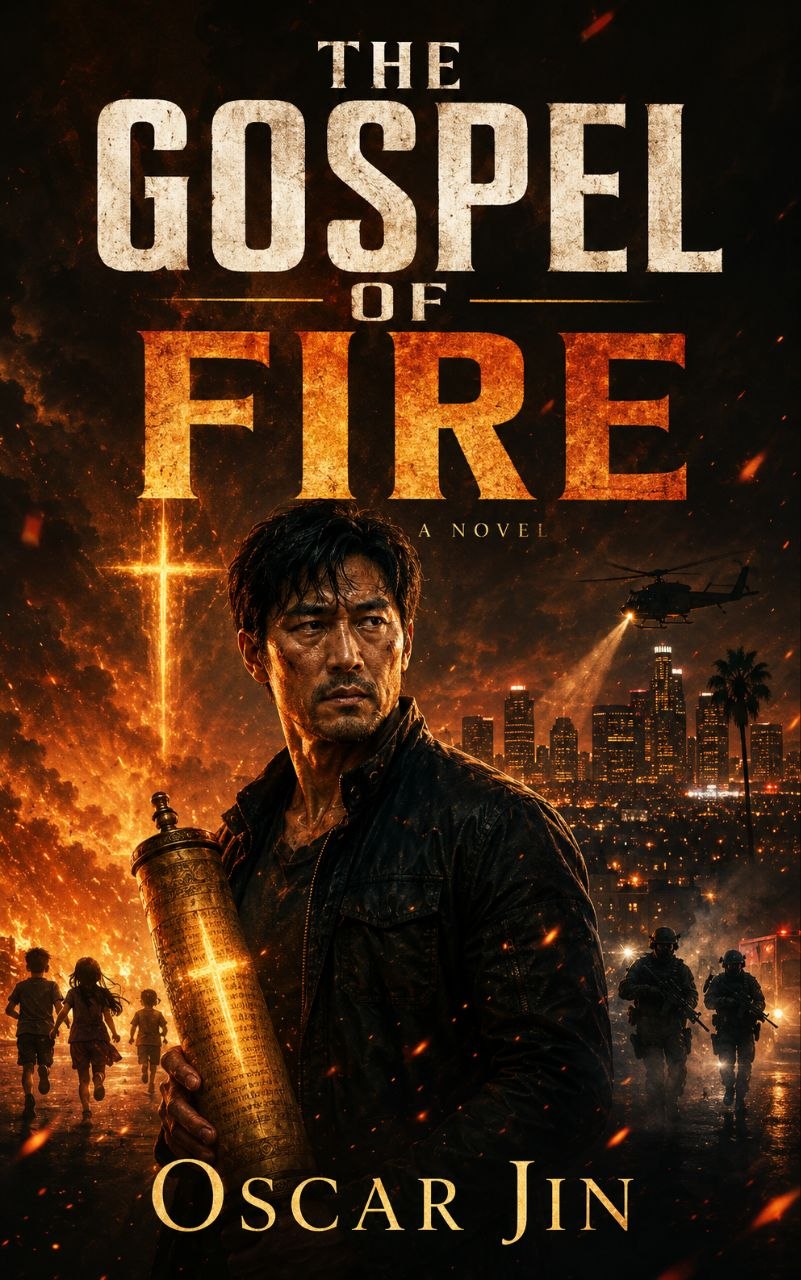
Chapter 1
THE KNOCK
The Silver Lake apartment was still quiet at 6:00 AM. Rain drummed against the windows like static electricity—perfect cover for silence.
I lit the incense stick Sarah gave me before the accident. Sandalwood, the way she liked it. Thirty-two seconds of rising smoke, then the box was empty. Just like my future felt.
Prayer. Psalm 23. Whispered in the dark. Then Genesis 15:6—faith credited as righteousness. Sarah's favorite verse. I underlined it in my Bible every year: Righteous God protects His own.
Coffee. Black. Two sugars. The way Sarah made it.
The phone didn't ring. No messages. Just silence and the morning news playing silently on the TV: another weather report, another traffic jam on the 10, another day in Paradise that felt more like a ghetto.
Then the knock.
6:17:03 AM.
Three precise raps on the door.
Not the doorbell. Not the neighbor checking if I was home. Three precise raps at 6:17 AM—the exact time Sarah died.
Coincidence, I muttered, glancing at the digital clock.
My hand moved before my brain could process. The peephole camera on my smart doorbell flickered to life. I saw her face through glass—terror frozen in real-time.
"Jeff?"
Her voice was a whisper, but the apartment's acoustics carried every word. Maria. Sarah's college roommate. Dead six years ago.
I lowered the security chain six inches, left the door cracked.
"I know you're religious," she said, blood under her fingernails from clawing her way through an alley. "But I got nowhere else to run."
"Why me?"
"Sarah's... roommate. You knew each other in college." She pressed something small against the glass—a USB drive. "For when you're ready to pull the Thread."
The Thread was our call sign before White Ash Protocol. Before the mission went sideways. Before Sarah.
Footsteps echoed in the hallway behind her. Heavy. Two sets, minimum.
Maria's eyes widened. "Jeff, they're here."
The door handle jiggled. Someone was picking the lock from the outside.
I moved. My right hand drew the suppressed SIG P320RX from my nightstand—index finger straight along the frame, safety off. My left hand pulled the Karambit blade from my boot sheath.
"Fire escape," I whispered, pressing the door shut. "Now."
We moved. Maria scrambled left toward the kitchen window. I covered the hallway, weapon up, listening for the lock to give.
The stairwell smelled like industrial cleaner and low tide. Two flights down, concrete steps slick with last night's rain. My boots found traction. Maria's flats didn't—she stumbled, caught herself on the railing.
"Keep moving," I said.
The elevator in the basement garage was a death trap. We bypassed it. Emergency exit to Parking Lot 7.
A dark minivan waited at the far end, engine running, exhaust curling in the damp air. Tinted windows. No front plate.
Maria ran for it. I followed, scanning the ramp entrance, the stairwell door, every shadow.
The side door slid open. A man I didn't recognize sat behind the wheel—Chinese, mid-forties, surgical scar above his left eyebrow.
"Get in," he said. No accent. Local.
I paused. "Who sent you?"
"Your father did," Maria said, climbing into the back seat. "Now get in before they put a drone over this lot."
I got in. The door shut. The van pulled onto the 105 toward El Segundo, invisible in the pre-dawn fog.
Maria's breath still came in ragged bursts. She showed me her wrist—bracelet with a pill compartment. Empty. "They're tracking me through the USB encryption. It has a biometric key."
I stared at the USB drive in my palm. Warm. Smaller than a thumbnail.
"The White Ash Facility," Maria said after five minutes. "Black project. Neural modification. Children. They were looking for me because I..." She stopped. "I shouldn't say."
"Yes you should," I said.
"Aren't you dying to know?"
The driver glanced at me in the rearview mirror. "Your father asked me to give you one message," he said. "The scroll is real. And they know you have it."
I gripped the Karambit tighter. "Then they're already too late."
The USB drive had been warm against the glass. Inside: White Ash files. Child test subjects. Neural modification protocols.
And somewhere in the dark, someone was looking for that same drive.
I thought back to Sarah's Bible resting on my nightstand, her hospital wristband still marking Genesis 15:6. The grandfather's scroll hidden in the wall behind it.
Now I had the tools to find out what White Ash Protocol forgot.
Chapter 2
THE FACILITY
The minivan smelled like stale cigarettes and hydraulic fluid. Maria hadn't stopped shaking since we crossed the 110 interchange.
The driver—still no name—kept his eyes on the road. Surgical scar catching the glow of passing streetlights. I watched him in the convex mirror, cataloging details: wedding ring, tan line where a watch used to sit, fingernails bitten to the quick.
"Where are we going?" I asked.
"Someplace dry," he said. "Your father's people secured a safe house in Torrance. Two hours, maybe three if the fog doesn't lift."
"My father's been dead twenty-six years."
The driver's eyes found mine in the mirror. "Has he?"
Torrance was gray industrial sprawl pretending to be a city. We pulled into a warehouse complex off Western Avenue, corrugated metal walls tagged with gang signs that hadn't been updated since the nineties.
The driver killed the engine. "Inside. Unit 14B. Don't use the front door."
"Who are you?" I asked.
"Someone who owes Jin Do Young more than I can repay." He nodded toward Maria. "Get her warm. She's going into shock."
He didn't follow us out.
Unit 14B had a loading dock in back and a steel door with a biometric scanner I recognized—military surplus, Blackwater era. I pressed my thumb against it. Nothing happened.
Maria reached past me, her hand still trembling, and pressed her palm flat against the reader.
Green light. The lock thunked open.
"They gave me access six months ago," she said. "When I started asking questions about the children."
Inside was a single room. Concrete floor, folding table, three chairs. A laptop chained to a steel eyebolt in the wall. No windows.
Maria collapsed into the nearest chair. I checked corners—clear. Checked the ceiling—no cameras I could spot. Checked the door—solid core, rebar reinforced.
Safe enough to breathe.
"The USB," I said.
She pulled it from her coat pocket. The plastic casing was cracked, exposing copper contacts.
"Biometric encryption," Maria said. "My heartbeat is the key. They built it that way so if I died, the data died with me."
"How do we access it?"
"We don't." She looked at me. "You do. I need you to run a protocol override. Split the encryption layers and extract the raw files before my vitals drop below threshold."
"That's not cybersecurity. That's surgery."
"Then scrub in."
The laptop was a ThinkPad X1, modified with a secondary FPGA board for brute-force decryption. I recognized the setup—I'd built similar rigs in Fallujah, back when intercepting insurgent comms meant the difference between a patrol coming home or not.
I plugged the USB into the isolated port. The screen flashed red.
BIOMETRIC VERIFICATION REQUIRED.
Maria pressed her wrist against the scanner—an aftermarket unit duct-taped to the laptop's edge. Her pulse thumped against the sensor.
VERIFICATION FAILED. VITALS UNSTABLE.
"My heart rate's too high," she said. "Adrenaline. I need to calm down or the drive locks permanently."
"How long do we have?"
"Three attempts. We're on two."
I pulled the chair from the table. Sat across from her, knees almost touching hers.
"Sarah used to panic during thunderstorms," I said. "Not because of the noise. Because she couldn't see what was coming."
Maria's eyes found mine.
"I told her the same thing every time," I continued. "The lightning already happened. We're just waiting for the sound to catch up."
Maria closed her eyes. Breathed in through her nose, out through her mouth. Four counts each.
The scanner beeped.
VERIFICATION ACCEPTED.
The screen filled with files. Hundreds of them. Names I didn't recognize beside dates I did—Sarah's death, my mother's disappearance, the day my father walked out of our apartment and never came back.
"What is White Ash?" I asked.
Maria leaned forward, her finger hovering over a folder labeled OPERANDUM.
"It's not a weapons program," she said. "It's a recruitment program. They find children with specific neurological profiles. Kids who process trauma differently. Kids who can be trained to—"
She stopped.
"To what?"
"To kill without hesitation. Without remorse. Without conscience." She opened the folder. "They call them Vessels. And your father was the architect."
The first document was a personnel file. Black and white photo. Younger man. Same jawline as mine.
Dr. David Jin. Lead Psychiatrist, White Ash Protocol.
Status: ACTIVE.
I stared at the screen until my eyes burned.
Active. Not dead. Not missing. Active.
"The photo's from six months ago," Maria said softly. "El Segundo facility. Level 7 clearance."
"My father was a psychiatrist?"
"Your father was a hunter. He found the children. Assessed them. Selected the ones who could survive the program." She scrolled down. "There's a list. Fourteen names. All from the San Gabriel Valley. All within ten miles of where you grew up."
I didn't want to look. I looked.
The eighth name was mine.
Jeffrey Jin. Age 8. Candidate Status: REJECTED.
"Rejected," I whispered.
"You were too empathetic," Maria said. "They found that out during the preliminary assessment. You cried when they showed you pictures of wounded animals. The other children didn't."
I remembered that day. Not the details, but the feeling—sitting in a white room, pictures flashing on a screen, a woman's voice asking how I felt. I'd told her I felt sad. She'd made a note.
"Why wasn't I told?"
"Because your father rejected you to save you." Maria pulled another file. "The children who passed—they were sent to facilities. Training camps. Your father built the psychological framework for what they became."
"And what did they become?"
She opened a video file.
The footage was grainy, security camera angle. A teenager—maybe fifteen—stood in a concrete room. Blank expression. A man entered, unarmed, and struck the boy across the face.
The boy didn't flinch. Didn't blink. He moved—one strike, palm to throat—and the man hit the ground. Dead before he landed.
No hesitation. No remorse.
"Vessel 12," Maria said. "Deployed last month. Location unknown."
I closed the laptop.
"Your father tried to stop it," Maria continued. "Five years ago. He went to the FBI, tried to blow the whistle. They buried him. Officially, he committed suicide in a hotel room in Pasadena."
"But?"
"But the body was cremated before anyone could identify it. And six months later, this photo surfaced." She tapped the screen. "Your father didn't die. He went deeper."
I stood. My legs felt wooden, foreign.
"The scroll," I said. "The one my grandfather hid. What does it have to do with this?"
Maria's eyes widened. "You have the scroll?"
"Sealed. In my apartment wall. Behind Sarah's Bible."
"Then we're already dead." She grabbed my arm. "Jeff, the scroll isn't a family heirloom. It's the master encryption key for the entire White Ash network. Your grandfather Jin Do Young didn't just found Teukgong Moosool—he founded White Ash. The martial art was the cover. The scroll contains the names of every Vessel ever created."
The door lock thunked.
Not from the scanner. From the outside.
Someone was picking it.
"Fire escape?" Maria asked.
"No fire escape." I drew the P320RX, checked the magazine—fifteen rounds, plus one in the chamber. "Get behind the table. Now."
The steel door bent inward. Not kicked—hydraulic forced entry, military breaching charge.
Three figures in black. NVGs. Suppressed MP7s.
I fired first—two rounds center mass, first target down. The second attacker ducked right. I pivoted, Karambit in my left hand, and caught his forearm as he raised his weapon.
Teukgong Moosool blind fighting—Master Jin Do Young's first lesson. Close your eyes. Listen to the breath. Strike where the breath ends.
The blade found his brachial artery. He dropped the MP7, clutching his arm.
The third attacker was already through the door.
"Jeff!" Maria screamed.
I turned. The third figure had her by the throat, weapon pressed against her temple.
"The scroll," the figure said. Voice modulated, mechanical. "Or she dies."
I lowered my weapon.
"Good," the voice said. "Now—"
Maria moved. Not away—toward. Her forehead snapped back, striking the attacker's nose. Cartilage crunched. She twisted, torqueing his wrist until the MP7 clattered to the concrete.
I finished him with a single strike. Palm to temple. Master Jin Do Young's favorite technique—economical, precise, permanent.
Maria stood over the body, breathing hard. Blood on her forehead. Not hers.
"You killed him," I said.
"I watched them kill twelve children," she replied. "This is Tuesday."
The minivan was gone. The driver with it. We ran through the warehouse district, past shuttered machine shops and empty loading bays, until we found a 24-hour diner with a payphone in back.
Maria made the call. I watched the street.
"Who did you call?" I asked.
"The only person who still answers." She hung up. "Your father's brother. Uncle James. He lives in Koreatown. He's been waiting thirty years for this."
"For what?"
"For someone to bring the scroll out of the wall."
I thought of Sarah's Bible. Genesis 15:6. The wristband bookmark. The hidden compartment behind the drywall.
Righteous God protects His own.
But God hadn't protected Sarah. And He hadn't protected the children in White Ash.
Maybe it was time I stopped asking God to do my job.
The diner's neon sign buzzed pink and blue. OPEN 24 HOURS. The coffee tasted like burnt rubber. I drank it anyway.
Maria sat across from me, USB drive clutched in her fist like a rosary.
"What happens now?" she asked.
"Now we go to Koreatown. Now we get the scroll. Now we find out if my father's really alive, and if he is, why he built a factory for monsters."
"And if he's not alive?"
I set the cup down.
"Then we burn White Ash to the ground."
The payphone rang.
We both stared at it.
"You gonna answer that?" Maria asked.
I picked up the receiver.
"Jeffrey." The voice was older, rougher, but I'd known it since I was eight years old. "Don't go to Koreatown. They're already there. Get Maria out. Get the scroll. And Jeffrey—"
"What?"
"I'm sorry I missed your wedding."
The line went dead.
I set the receiver back in the cradle. My hand didn't shake. That was the Teukgong Moosool training. Master Jin Do Young had taught me that too. Emotion is a luxury. Survival is a discipline.
"Jeff?" Maria touched my arm.
"My father's alive," I said. "And he just told me to run."
The diner's front window shattered.
Glass sprayed across the counter. The neon sign sparked, died.
Three black SUVs idled at the curb. Doors opening.
"Move," I said.
We moved. ---
Chapter 3
K-TOWN
The diner's kitchen door had a rusted hinge and a broken lock. I kicked it open and pulled Maria through, into an alley that smelled like rotting cabbage and diesel.
Behind us, the front window shattered completely. The three SUVs had dismounted their teams—six men total, spreading in a standard sweep pattern. I fired three rounds from the P320RX through the kitchen door's small window, not to hit anything, to make them hesitate. The suppressor coughed twice. Glass sprayed.
"Move," I said, and we did.
"Your father," Maria said, breathless, as we ran. "He's alive. He just called you."
"I heard him." I checked the alley both ways. Clear. "Doesn't mean I believe it."
"Then why are we running?"
"Because someone in that van believed enough to shoot out the window."
We moved. Past dumpsters, past a homeless man sleeping under cardboard, past a Korean barbecue restaurant where the owner was mopping floors at 5 AM. I kept us off main streets, threading through loading docks and service alleys. Maria's flats slapped against wet concrete. My boots were quieter. Training.
The 105 was a death trap. They'd have drones. We needed surface streets.
"Where are we going?" Maria asked.
"Koreatown. Vermont and Sixth. My uncle James runs a dry cleaner there. He's been waiting thirty years for this."
"For what?"
"For someone to bring the scroll out of the wall."
Koreatown woke slowly. Street vendors unrolling tarps. Ajummas setting up produce. The city had a different rhythm here—not the frantic pulse of Downtown, but something older. Deliberate.
James Jin Dry Cleaning was a narrow storefront between a karaoke bar and a herbal medicine shop. The sign was faded, the windows fogged from decades of steam.
I didn't knock. I pressed my palm flat against the glass door and waited.
Thirty seconds. The lock clicked.
Uncle James stood in the doorway. Seventy-two years old. Same jaw as my father. Same eyes as my grandfather Jin Do Young. He wore a cardigan with holes in the elbows and held a twelve-gauge shotgun like it was a walking cane.
"You're late," he said.
"Traffic."
"Your father called." He stepped aside. "Said you'd have a woman with you. Said she'd be bleeding."
Maria touched her forehead. The blood from the headbutt had dried in a streak across her temple.
"Just a scratch," she said.
"Just a scratch," James repeated. "Sit down. Tea. Then we talk about the scroll."
The back room was a shrine to a man I'd never met.
Photos of Jin Do Young covered the walls. Training in Seoul. Demonstrations in LA. A black-and-white shot of him beside a young man in a military uniform—my father, before White Ash, before the corruption.
James poured oolong from a ceramic pot. His hands didn't shake. I'd seen those hands break oak boards in the photos.
"Your grandfather didn't create Teukgong Moosool to make killers," James said. "He created it to stop them."
I stared at the photo. "Explain."
"1953. Korean War ends. Your grandfather was a master of multiple arts—Taekkyeon, Subak, Kwon Bup. The South Korean government asked him to develop a system for special forces. Something comprehensive. Something lethal." James set down his cup. "He gave them what they wanted. But he kept the true art for himself."
"The scroll," Maria said.
"The scroll." James nodded. "Your grandfather embedded a cipher in the martial art's original forms. Every movement, every sequence, every breathing pattern contains data. Locations. Names. The true history of what White Ash became."
"What did it become?"
James reached under the table. Pulled out a manila folder. Yellowed pages. Photos of children in white rooms. Charts with brainwave patterns.
"Jin Do Young designed Teukgong Moosool to create the perfect soldier. Body and mind working as one. No hesitation. No fear." James paused. "But he included a safeguard. A psychological kill switch. He called it 'The Weight.'"
"The Weight?"
"Empathy." James tapped the photo of my grandfather. "Every true practitioner of our family's art carries The Weight. They feel what their opponent feels. They hesitate before striking. They choose mercy over efficiency. The government hated it. They stripped The Weight from the public version of Teukgong Moosool and created something else. Something hollow."
Maria leaned forward. "The Vessels."
"Yes." James closed the folder. "Your father didn't create White Ash, Jeffrey. He tried to destroy it from within. He thought he could reform it. Save the children. Instead, they made him the Architect. The designer of their program."
I remembered the video. Vessel 12. Blank eyes. No hesitation.
"And the scroll?"
"The scroll contains the original forms. The complete art. And embedded within those forms—coordinates to every White Ash facility. The names of every child they took. The location of The Core." James looked at me. "Your grandfather hid it in your apartment wall because he knew they'd never look there. A widower's grief. A dead wife's Bible. The last place anyone would search for military secrets."
I thought of Sarah's Bible. Genesis 15:6. The wristband bookmark.
"We need to go back," I said.
"You need to be smart." James stood. "White Ash has surveillance on your building. They've had it since Sarah died. They were waiting for you to find the scroll. That's why they let you live."
"Let me live?"
"Your father made a deal. Your life for his compliance." James picked up the shotgun. "But that deal expired when Maria walked through your door. Now you're loose ends."
The front door rattled.
James didn't flinch. He checked his watch.
"My ride," he said. "I'm going to circle the block, draw away any drone sweeps. You have twenty minutes inside." He handed me a key. "Your apartment in Silver Lake. Behind Sarah's Bible. The scroll is in a steel tube. Bring it back here. Don't open it. Don't read it. Just bring it."
"And if we're not back in twenty minutes?"
James chambered a round. "Then I come in shooting."
The Silver Lake apartment was three miles away. We took James's Hyundai. Old model, no GPS, no black box.
Maria drove. I watched the mirrors.
"Your uncle," she said. "He's not just a dry cleaner."
"He's the Keeper. The scroll's guardian since my grandfather died." I checked the SIG P320RX. Fifteen rounds. "He's also the only person in LA who still answers my father's calls."
"Why you?"
"What?"
"Why are you the one retrieving the scroll? Your uncle could have done it years ago."
I watched a FedEx truck pass us. "Because the scroll requires a bloodline descendant to activate. Jin Do Young built it that way. Biometric lock. My palm print. My heartbeat. Anyone else touches it, the cipher destroys itself."
"That's not cybersecurity," Maria said. "That's a dead-man's switch."
"Exactly."
The building looked the same. Rain-washed. Anonymous. I counted three new cameras on the streetlight outside the entrance. White Ash had upgraded their surveillance.
We entered through the service entrance. Loading dock. Trash room. Stairwell.
Apartment 2B. My home.
The door was intact. No breach marks. They were waiting for me to come back. Smart.
I pressed my palm against the smart lock. It recognized my print. The door clicked.
Inside, everything was as I'd left it. Coffee cup on the counter. Bible on the nightstand. Sarah's hospital wristband marking Genesis 15:6.
But the air was wrong. Stillness that wasn't empty. Someone had been here. Recently.
I moved to the bedroom. The wall behind the nightstand was drywall painted eggshell white. No seams. No panels. Just wall.
I pulled Sarah's Bible from the stand. Held it. Smelled it. Sandalwood and old paper.
Then I pressed my thumb against the bottom right corner of the drywall and pushed.
Click.
A section of wall, two feet square, swung inward on hidden hinges. Behind it: a steel tube, twelve inches long, capped with a biometric scanner.
I pressed my palm against the scanner.
GREEN LIGHT. The cap unlocked with a soft hiss.
The scroll was ancient. Rice paper. Korean calligraphy in black ink. Tied with a silk cord the color of dried blood.
I didn't open it. James had said not to.
I slipped it into my jacket and turned.
The bedroom door was open.
A man stood in the hallway. Black tactical gear. NVGs pushed up on his forehead. Suppressed Glock 19 in his hand.
"Mr. Jin," he said. "The Presbyter would like a word."
I didn't answer. I moved.
Teukgong Moosool blind fighting—Master Jin Do Young's first lesson. Close your eyes. Listen to the breath.
The man's breath was shallow. Nervous. Amateur.
I struck before he could raise the Glock. Palm to throat. He hit the wall, gagging.
The second man came through the window off the fire escape platform. Glass shattered. Suppressed MP7 tracking.
I grabbed Maria and rolled. Bullets punched holes in the drywall where we'd stood.
"Fire escape!" I yelled.
We went out the same window onto the platform. The scroll was warm against my ribs.
My boots hit concrete. Maria landed beside me, graceless but alive.
The alley was narrow. Brick walls on both sides. Dead end.
"Jeff—"
"Up." I pointed. Fire escape ladder. Rusted. Fifteen feet.
I jumped. Caught the bottom rung. Pulled myself up. Maria followed.
The MP7 barked behind us. Rounds sparked off brick.
We climbed. Third floor. Fourth. Roof access.
The LA skyline spread before us. Gray dawn breaking through clouds. The 101 a river of headlights below.
"Now what?" Maria asked.
I looked at the scroll in my hand. The silk cord. The rice paper.
"Now we find out what my grandfather died for."
The helicopter rose from behind the neighboring building. Black. Unmarked. Searchlight sweeping.
"Run," I said.
We ran.
James was waiting in the Hyundai, engine running, shotgun across his lap.
"Drive," I said, climbing in back. Maria piled in beside me.
"You opened it," James said. Not a question.
"I didn't."
"Good." He pulled onto Sunset. "Because the first layer activates with body heat. Twenty minutes in your jacket and the cipher starts decoding. You'd have White Ash, the FBI, and every intelligence agency in the Pacific Rim tracking your heartbeat."
I looked at the scroll. It was warm against my ribs.
Warm like grief. Like anger that wouldn't cool.
"How long do we have?"
"Fifteen minutes." James handed me a thermal bag from the passenger seat. "Seal it. Now."
I dropped the scroll into the bag. Zipped it shut.
"Where are we going?"
"Someplace they can't track." James turned onto the 101 North. "Someplace your grandfather built before they built White Ash."
"Where?"
"The mountain." James smiled. "Your grandfather's original dojo. Above Malibu." ---
Chapter 4
THE DOJO
The road to Malibu wasn't a road. It was a scar.
James turned the Hyundai off the Pacific Coast Highway onto a dirt track that climbed through coastal scrub. The suspension groaned. The headlights caught chaparral and granite and nothing else. No signs. No mailboxes. No evidence that anyone had driven this way since the last rainstorm washed the ridge clean.
"Your grandfather bought this land in 1978," James said, both hands on the wheel. "Paid cash. No deed recorded until 1999. By then, the county didn't care about some Korean hermit living on a mountaintop."
"How did he build a dojo without permits?"
"He didn't build it." James downshifted as the grade steepened. "He found it."
The headlights swept across a clearing. Then the road ended.
The dojo sat in a granite bowl, roofline low against the ridge, built from the same stone as the mountain. No windows facing the ocean. No windows facing inland. Just a single timber door, black with age, iron studs arranged in a pattern I recognized from the scroll's silk cord.
Teukgong Moosool. The original forms.
James killed the engine. " biometric bag goes in first. Then you. Then me. Maria stays with the car until I clear the perimeter."
"I'm not a child," Maria said.
"No." James chambered a round in the shotgun. "You're the witness. Witnesses stay alive."
The door wasn't locked. It didn't need to be. The biometric scanner was embedded in the iron knocker—a handprint reader disguised as ornamental scrollwork.
I pressed my palm against cold metal.
The mechanism inside the wall groaned like something waking from sleep. Gears turned. Bolts retracted.
The door opened on darkness.
James struck a match. Lit a lantern hanging from the ceiling beam. Then another. Then a third.
The dojo breathed.
The floor was polished pine, worn smooth by decades of bare feet. The walls were lined with weapons—staffs, swords, nunchaku, knives—all arranged by length, by weight, by the principle Master Jin Do Young had called "The Tenfold Order."
At the far end, a wooden platform. A single cushion. Above it, a calligraphy scroll in Korean characters:
"The Weight is the Way."
I read it aloud.
"Empathy is not weakness," James translated. "It is the burden the strong carry so the weak may live."
Maria stepped closer to the weapons wall. "These aren't decorative."
"No." James set the lantern on the platform. "Every weapon here has killed. Every weapon here has also spared a life. Your grandfather believed a blade was only as moral as the hand that held it."
I pulled the thermal bag from my jacket. The scroll was warm even through the foil lining.
"How do we activate it?"
James pointed to the platform. "Sit. Place the scroll on the cushion. Press your thumbs to the ends. The rice paper is woven with conductive filaments. Your body heat completes the circuit. Your heartbeat sets the decryption rhythm."
"And if my heartbeat's wrong?"
"Then the cipher burns." James handed me the lantern. "Your grandfather was paranoid. He had reason to be."
I sat on the cushion. The pine floor was cold through my jeans.
The scroll lay before me like a sleeping thing. Ancient paper. Modern circuitry. A bridge between two centuries.
I pressed my thumbs to the brass end caps.
Nothing happened.
Then warmth. Spreading from my thumbs into the paper, from the paper into my palms. The rice paper began to glow—not with light, but with something beneath the surface. Ink shifting. Characters rearranging.
"It's working," Maria whispered.
The calligraphy scroll on the wall began to vibrate. The characters—the ones I'd read as "The Weight is the Way"—were changing. New strokes forming. New meanings emerging.
"It's a projection," James said. "The scroll on the wall is a screen. The real data is embedded in the paper you're holding. Your body heat activates the phosphor."
The characters resolved into numbers. Coordinates.
I read them aloud.
"El Segundo. The White Ash facility. Level 7."
More characters. Names.
"Vessel 1 through 147. Status: DEPLOYED. Location: VARIABLE."
Then one name I recognized.
David Jin. Status: ARCHITECT. Location: MOBILE.
My father's name. Still active.
The scroll flashed once. The glow faded. The rice paper returned to looking like ancient calligraphy.
"That's it?" I asked.
"First layer." James took the scroll, resealed it in the thermal bag. "Your grandfather built seven layers. Each requires a different biometric. Heartbeat. Palm print. Retinal scan. Voice match. DNA. And two we haven't identified yet."
"Two?"
"Jin Do Young died before he could tell me." James's voice cracked. "He said the final keys would reveal themselves when the student was ready."
I stood. My legs were stiff from the cold mountain air.
"Then we find layer two. And layer three. And we keep going until we have enough to burn White Ash to the ground."
The perimeter alarm chirped.
James moved faster than a seventy-two-year-old should. He killed the lanterns. Grabbed the shotgun. Pointed to a shadow in the wall that I'd mistaken for a crack.
"Tunnel. Leads to the ridge. Go. Now."
"What about you?"
"I'm the Keeper." He racked the shotgun. "I keep."
"Take this," I said in the tunnel, pressing the P320RX into her hand. "Finger off the trigger until you see black gear."
She nodded. I kept the Karambit. Close quarters, the scroll, and my empty hand.
The tunnel was narrow. Granite scraped my shoulders. I ran in darkness, Maria's hand in mine, the scroll bouncing against my ribs.
Behind us, the dojo door exploded.
Not a breaching charge. Something worse. A shaped charge—military-grade, designed to kill everyone inside without damaging the structure.
White Ash wanted the dojo intact. They wanted the weapons. The scroll. The legacy.
James fired. The shotgun's boom was muffled by stone.
Then silence.
"Keep moving," I said.
We burst from the tunnel onto the ridge. The Pacific Ocean spread below us, gray and infinite. The wind was a physical thing, shoving us toward the edge.
Maria pointed. "There."
A trail. Barely visible. Switchbacking down the mountain face.
We ran.
The helicopter rose from the coastal fog behind us. Black. Unmarked. Same model as the one outside the diner. Searchlight sweeping.
"Split up," I said.
"No."
"Maria—"
"I said no." She raised the P320RX. "You have the scroll. I have the gun. We stay together."
The helicopter's searchlight found us. A single brilliant circle pinned us against the granite.
I did the only thing Master Jin Do Young had taught me that didn't require a weapon.
I closed my eyes.
Teukgong Moosool blind fighting—advanced application. Not just hand-to-hand. Environmental awareness. Reading terrain through sound, wind pressure, temperature shifts.
The helicopter's rotor wash pushed warm air from the exhaust. The searchlight operator was on the left side door.
The helicopter flared low over the granite outcrop to deploy its tactical team, skids nearly scraping rock. The pilot was arrogant, showing off.
"When I say run," I whispered, "run toward the light. Not away."
"You're insane."
"Trust the Weight."
The helicopter drifted closer, nose down, side door sliding open.
"Now."
We ran.
Not away from the light—into it. The searchlight operator wasn't expecting targets to charge from above. He hesitated. Adjusted his harness.
That half-second was enough.
I leaped from the granite lip onto the nearest skid. My left hand locked around the strut. I swung my right fist into the operator's throat as he leaned out. He folded.
Maria was already climbing. She pulled herself through the open door, P320RX aimed at the pilot.
"Land it," she said. "Or I land you."
The pilot—a kid, maybe twenty-five, private contractor—put his hands up.
I took the controls. I'd flown Seahawks in the Navy. This was a civilian variant. Simpler.
We rose above the ridge. Below us, the dojo burned.
Not from White Ash. From inside. James had triggered the failsafe. The weapons. The records. The history.
All of it, ash.
"James," Maria said.
"He's gone."
"We don't know that."
I looked at the burning building. The flames were white-hot. Intentional. Designed to destroy evidence.
My hands were shaking. I pressed them against my thighs. The left one still bled from where the Karambit had bit me during the tunnel fight. I didn't remember the cut. Didn't remember pain. Just motion. Escape. Survival.
"He was the Keeper," I said. "He kept."
The helicopter banked south. Toward El Segundo. Toward the coordinates from the scroll.
Maria sat in the copilot seat, scroll in her lap, fire reflected in her eyes.
"Jeff," she said.
"What?"
"The scroll's getting warm again."
I looked down. The thermal bag was glowing at the seams. Inside, the steel tube's pressure seal had clicked open as the helicopter climbed—altitude change, pressure differential. The second layer. Jin Do Young had built more than a cipher. He'd built a puzzle that only his bloodline could solve, step by step, in the exact circumstances he'd foreseen.
"What's it say?" I asked.
Maria unzipped the bag. The scroll's characters were rearranging again.
"It's not coordinates this time." She stared at the glowing paper. "It's a name."
"What name?"
"The Presbyter."
I banked the helicopter toward the coast. The sun was rising over Catalina Island, turning the ocean bronze and gold.
"Who is The Presbyter?"
Maria looked at me. "According to this, it's someone you know. Someone who's been watching you since you were eight years old."
"Who?"
She read the name aloud.
I almost lost the controls.
"Sarah's father," Maria said. "Dr. Richard Chen. The man who pronounced her dead."
The helicopter shuddered.
I gripped the stick tighter.
"Jeff?"
"He was at the funeral," I said. "He held my hand. He told me God had a plan."
"And now?"
"Now I think God's plan included me putting a bullet in his head."
The radio crackled. A voice I didn't recognize.
"Helicopter November-Two-Seven, you are entering restricted airspace. Descend and identify."
Maria looked at me.
I looked at the horizon.
"Hold on," I said.
I pushed the stick forward.
We dove. ---
Chapter 5
SANCTUARY
The helicopter dove toward the Pacific like a stone.
I pulled the stick at the last second, flaring the rotors, skimming the wave tops close enough to taste salt spray through the open door. The engine screamed. Maria gripped the seat frame, knuckles white.
The restricted airspace warning was still squawking. I killed the radio.
"Where are we landing?" Maria shouted over the rotor wash.
"We don't." I pointed at a strip of sand below the Palos Verdes cliffs. "We hide."
The skids touched down hard. Sand blasted the windows. I cut the engine.
Silence, except for the ocean and our breathing.
The beach was narrow. Rocky. No footprints but ours. We dragged the helicopter into a sea cave, wedging it between boulders that had fallen from the cliff face centuries ago.
"They'll find it," Maria said.
"Eventually." I checked the P320RX. Still loaded. "Not today."
She pulled the scroll from the thermal bag. The glow had faded. The second layer was spent.
"El Segundo," she said. "We have coordinates. We have The Presbyter's name. Why aren't we moving?"
"Because Richard Chen has been running White Ash since before I met Sarah." I stared at the cave mouth, gray light filtering through. "He was at my wedding. He held my hand at her funeral. He told me God had a plan."
"And now?"
"Now I need to know if God has a plan for me, or if I'm just making excuses to put a bullet in a man I once called family."
Maria was quiet for a long moment. "There's a church in Chinatown. Pastor Kim. He was my confessor when I worked at White Ash."
"Worked?"
"I was a clinical psychologist. I assessed the children. I determined which ones had the neurological profile for... for what they became." She didn't look at me. "I defected when I realized the assessments weren't for therapy. They were for selection."
I watched her face. No tears. Just the same hardness I'd seen in the safe house when she killed the attacker.
"How many children did you assess?"
"One hundred forty-seven." She finally met my eyes. "You're number eight. The one who cried for the animals. I remember your file."
The ocean pulled at the rocks below us. Cold. Indifferent.
"Then you know what I need," I said.
"I know what you want. What you need is different." She stood, brushing sand from her knees. "Pastor Kim's church is a Thread sanctuary. He has documents. He has answers about why God allows men like Chen to exist."
"And if his answers aren't enough?"
"Then you go to El Segundo alone." Maria walked toward the cave mouth. "But I've seen what happens when men like you try to fight evil without faith. They become the thing they're hunting."
I stripped the P320RX's magazine, topped off three rounds from my pocket, and slid it back until the baseplate clicked. Seventeen total. I'd need every one.
We abandoned the helicopter in the sea cave and hiked up to the cliffs. A Thread contact met us with a panel van—no GPS, no plates, registered to a defunct catering company. We rode in back, Maria watching the road, me watching the mirrors.
The Blue Line Metro took us north under the radar. We surfaced two blocks from Pastor Kim's church, invisible in the evening crowd.
Pastor Kim's church was above a dumpling house on Broadway. No sign. Just a red door with a small brass cross nailed at eye level.
I knocked the pattern James had taught me: three, two, one.
The door opened a crack. An old Korean man, sixty maybe, reading glasses pushed up on his forehead. He looked at me, then at Maria, then at the thermal bag under my arm.
"You're late," he said.
"I was delayed by a helicopter."
"A helicopter." He stepped aside. "Come in. Lock the door behind you."
The sanctuary was small. Twenty chairs. No windows. The altar was a plain wooden table with a Bible in Korean and English, side by side.
Pastor Kim didn't offer tea. He offered answers.
"You're here because you want to kill Richard Chen," he said.
"I'm here because I want to know if God wants me to kill Richard Chen."
"God doesn't want you to kill anyone." Kim sat across from me. "God wants you to love your enemy. But God also gave you hands that can stop a man from killing children. The question isn't whether God approves of violence. The question is whether you can use violence without becoming the violence yourself."
"That's not an answer."
"It's the only answer." Kim reached under the table. Pulled out a metal lockbox. "Your father's journal. He wrote it after he faked his death. He was trying to understand what he'd built. What Chen had twisted."
I opened the journal. The first page was dated five years ago.
*"Today I watched a child kill a man with his bare hands. The child was twelve. The man was a volunteer, someone who thought he was participating in a defense study. The child did not hesitate. Did not blink. I designed this. I built the psychological architecture that made this possible. And when I wept afterward, Chen told me my weakness was the reason the program needed me. I could feel what the children felt. I could measure their pain. And I could use that pain to make them better weapons."*
I turned the page.
*"I asked Chen once why God allowed this. He said God didn't allow it. God commanded it. That the elect were chosen to rule, and the children were chosen to serve. I told him that was Calvinism twisted into fascism. He laughed. He said fascism was just providence without the patience."*
My hands were shaking.
"Chen was my father-in-law," I said. "He stood beside me at Sarah's grave. He told me she was with Jesus."
"She is," Kim said. "But Richard Chen has never met Jesus. He's met power. And he thinks they're the same person."
Maria sat beside me. "The documents," she said. "Do they prove what White Ash is doing?"
"They prove Chen is receiving funding through three shell corporations tied to defense appropriations. They prove the children are being deployed domestically, not just internationally. And they prove—" Kim paused. "They prove Chen is planning something called Covenant Day. A demonstration of White Ash capabilities. Live broadcast.""
"When?"
"Three days." Kim looked at me. "The same three days Maria told you about."
I closed the journal. The leather cover was worn soft from my father's hands.
"Where's Covenant Day happening?"
"Mexico City." Kim slid a folder across the table. "White Ash has a recruitment facility there. An orphanage. They're going to show the world what the Vessels can do. And they're going to use real targets."
I opened the folder. Photos of a building. White walls. Red tile roof. Children playing in a courtyard.
Underneath, another photo. The same courtyard. Targets arranged in rows.
"No," I said.
"Yes." Kim's voice was gentle. "Covenant Day is a massacre designed to sell White Ash to the highest bidder. And Richard Chen will be there, watching from a secure location."
I stood. The P320RX was a weight against my hip. The Karambit was a whisper in my boot. The scroll was a furnace against my ribs.
"I need a plane," I said.
"I have a contact at Hawthorne Municipal. Small craft. No flight plan." Kim stood too. "But Jeffrey—before you go—"
"What?"
He pressed a small book into my hands. A pocket Bible, the pages warped from water damage.
"Your father carried this," Kim said. "He marked the same verse in it every week. The same one you mark. Genesis 15:6. Faith credited as righteousness. He wanted to believe he could be righteous again."
I opened it. The margin was crowded with my father's handwriting. The same cramped letters I'd seen in my mother's journals.
*"I will not let the weight crush me. I will carry it. For the children. For my son. For the God who sees what I have done and still offers grace."*
The last line was different. Dated two weeks ago.
*"The scroll is with Jeffrey. The Presbyter knows. If you read this, I am already dead. Do not mourn me. Finish what Jin Do Young started. Break the Covenant. Free the Vessels. And tell my son—I was never the Architect. I was just the prisoner who learned to pick the lock."*
I read it twice. Three times.
Maria touched my arm. "Jeff."
"He's dead," I said. "Not five years ago. Now. Two weeks ago. Chen killed him."
"We don't know that."
"I know." I slipped the pocket Bible into my jacket, beside the scroll. "Because Chen doesn't leave loose ends. And my father was the biggest loose end of all."
The red door rattled. Someone knocking. The pattern: two, three, one.
Kim's face went pale. "That's not Thread."
"Who is it?"
"White Ash. They found us."
I moved. P320RX in my right hand, Karambit in my left. The main room felt like a kill box—one visible door, no exterior windows.
"Maria," I said. "The files. Now."
She grabbed the lockbox, shoved papers into a satchel.
"Kim," I said. "Get behind the altar."
"I'm not a fighter."
"Then be a witness. Witnesses stay alive."
The door exploded inward.
Not a breaching charge. A hydraulic ram. Silent until the lock gave.
Three figures in black. MP7s. NVGs. The same tactical gear from the apartment. From the dojo.
I didn't wait. I charged.
Teukgong Moosool blind fighting in a room with no windows, no light, no escape. Master Jin Do Young's most brutal lesson. The one he called "The Last Room."
I closed my eyes.
The first attacker fired. Muzzle flash lit the darkness like a strobe. I saw his silhouette, his stance, his weight distribution.
I was beside him before he could track. Palm to temple. The Karambit followed, finding the gap between his vest and his neck.
The second attacker turned. I caught his MP7 barrel with my left hand, forced it upward, fired the P320RX into his center mass. Two rounds. He folded.
The third attacker had Kim by the throat.
"The scroll," the figure said. Voice modulated. Mechanical. "Or the pastor dies."
I lowered my weapon.
"Good." The figure dragged Kim toward the door. "Now—"
Kim moved. Not away. Toward. His forehead snapped back, striking the attacker's nose. Cartilage crunched. The same move Maria had used in the safe house. The same move I'd taught her in the stairwell.
I finished him with a single strike. Palm to temple. Economical. Precise.
Kim stood over the body, blood on his forehead. Not his.
"You killed him," I said.
"No." Kim looked at his hands. "God killed him. I was just the instrument."
Maria grabbed my arm. "Jeff, we need to move."
"Where?"
"Hawthorne. The plane." She pulled me toward a side door I'd missed—hidden behind the altar, disguised as paneling. "Your father left one last thing. A contact in Mexico City. Someone who can get us inside the orphanage."
"Who?"
"Miguel." Maria opened the door. Cold night air flooded in. "Vessel 12. The one from the video. He escaped three days ago. He's waiting for us."
I stared at her.
"He's fourteen years old," she said. "And he's the only person alive who's seen the inside of Covenant Day."
We ran down a fire escape into an alley. The Chinatown night market was in full swing—lights, noise, crowds perfect for disappearing.
I pulled the scroll from my jacket. Warm against my palm. Layer two was spent. Layer three waited.
My father's pocket Bible pressed against my heart. Genesis 15:6. Faith credited as righteousness.
But righteousness without action was just theology.
And I was done with theology.
"Jeff," Maria said, as we merged with the crowd.
"What?"
"Your father's last line. 'The prisoner who learned to pick the lock.'" She looked at me. "What if he's not dead? What if he's still picking?"
I thought of the journal. The handwriting. The desperation.
"Then we find him," I said. "Before Chen does."
The night market swallowed us. Lanterns and smoke and the smell of char siu. Above us, the LA skyline was a constellation of light and threat.
Somewhere in Mexico City, a child was waiting. A child who could kill without hesitation.
And I was going to teach him how to feel again.
Or die trying. ---
Chapter 6
HAWTHORNE
Hawthorne Municipal Airport was a graveyard of old aviation dreams.
We came through the fence at the north end, where the chain link had been cut and re-wired so many times the holes were practically official gates. A Cessna 172 sat on the tarmac, white with blue stripes, propeller still ticking from a recent shutdown. A man in a leather flight jacket leaned against the wing, smoking a cigarette that smelled like cloves.
"Pastor Kim said you'd be two," he said. Not a question.
"We're two," I said.
"You're armed."
"We're armed."
He flicked the cigarette into the darkness. "Then we're leaving now. Mexican airspace doesn't ask questions if you land in the right field."
"How long?"
"Fourteen hours with the headwind. Two fuel stops. Arizona, then Durango." He looked at Maria, then at the thermal bag under my arm. "No cargo check. No customs pre-clearance. Just you, me, and whatever's in that bag that makes White Ash helicopters show up over civilian airspace."
"You don't want to know."
"I don't." He opened the cockpit door. "But I pray for you anyway. Name's Raul. Get in."
The Cessna was cramped. Four seats, two occupied by fuel cans strapped to the floor. Maria sat in back, the scroll sealed in a new thermal bag Raul had provided—military surplus, silver-sided, designed for blood transport.
I sat up front, watching the instruments. Raul flew by feel, not by flight plan. The transponder was off. The radio squawked with commercial traffic below us, but we were ghosts at eight thousand feet.
"You know Pastor Kim from where?" I asked.
"Prison." Raul adjusted the mixture. "Chino, 2009. Kim was doing ministry. I was doing five to ten for trafficking."
"Drugs?"
"People." He didn't look at me. "Coyote runs. Families paying everything they had to get north. I took their money and left them in the desert. Kim visited me every Tuesday for three years. Told me God still had use for broken things."
"And you believed him?"
"I believed the food." Raul smiled, teeth white in the instrument glow. "Then I believed the man. Now I fly for Thread because the man asked me to. Not because I think I'm redeemed."
The engine droned. Below, the California desert stretched black and infinite.
"You ever kill anyone?" Raul asked.
"Yes."
"Did you feel it?"
"Every time."
"Good." He tapped the altimeter. "The ones who don't feel it are the ones Pastor Kim prays for the hardest."
Arizona was a fuel stop and nothing more. Raul didn't shut down the engine. He sumped the tanks, topped off from a barrel in a shed that had no sign, no permit, no owner.
Maria slept in back, her head against the window, the scroll cradled like a child.
I stood on the tarmac, piss warm wind blowing from the south. The stars were different here—brighter, closer, indifferent to the border below.
My phone buzzed. One bar. Unknown number.
I answered.
"Jeffrey."
The voice was wrong. Electronic. Distorted through a modulation chip.
"Who is this?"
"The man who buried your wife." A pause. "The man who will bury you if you land in Mexico City."
I said nothing.
"Covenant Day is not a sale, Jeffrey. It's a sermon. The world has forgotten what power looks like. I intend to remind them. And you—my failed Vessel, my daughter's disappointing husband—you intend to stop me with a pistol and a knife and a scroll you don't understand."
"I understand enough."
"You understand nothing." The voice hardened. "Your father understood. He built the architecture. He designed the selection criteria. He chose the children, Jeffrey. He chose Miguel. He chose you. And when he tried to undo what he'd created, I let him live because I wanted him to watch."
"Watch what?"
"Watch his son become the final Vessel. The one who finishes what he started. The one who doesn't need empathy to kill."
The line went dead.
I stood on the tarmac, the Arizona wind warm and meaningless. My hands were steady. My heart was not.
Raul called from the cockpit. "Five minutes."
I climbed back in. Maria was awake, watching me.
"Chen?" she asked.
"The Presbyter." I buckled in. "He thinks I'm the final Vessel."
"You're not."
"How do you know?"
She looked out the window. "Because Vessels don't ask if they're Vessels. They just are."
Durango was mountains and morning. The Cessna bucked in the thermals as Raul descended through a valley that shouldn't have had a runway but did—a strip of graded dirt between cornfields, a pickup truck with armed men watching from the cab.
"Cartel?" I asked.
"Farmers," Raul said. "Thread pays them to look the other way."
The landing was rough. The takeoff was rougher. We bounced twice before Raul found the air.
Below, Mexico City spread like a stain. Twenty-two million people. One orphanage. One child waiting.
The safe house was in Colonia Roma, above a bookstore that sold theology texts in Spanish and Korean. The stairs creaked. The door was steel, painted to look like wood.
Raul didn't come up. He handed me a key and a phone—burner, five numbers programmed, no GPS.
"The fifth number is Pastor Kim's emergency line," he said. "The first four are dead drops. Use them if you need extraction."
"You're not staying?"
"I don't stay anywhere." He started the Cessna's engine. "But I'll be in the air above the city for the next three days. Channel seven-seven on the burner. If you call, I come."
The propeller wash blew dust into my eyes.
I turned and climbed the stairs.
The safe house had one window, barred, overlooking the street. The bed was a mattress on the floor. The bathroom was a closet with a toilet that didn't flush properly.
Miguel sat on the mattress.
He was fourteen. Maybe. Small for his age, with the compact build of someone who had been trained early and fed irregularly. His eyes were dark and empty—not stupid, not drugged, just empty. The eyes of someone who had learned that feelings were liabilities.
"You're Vessel 12," I said.
"I'm Miguel." His Spanish was clipped. Efficient. "You're Vessel 8. The reject."
"I'm Jeffrey."
"Jeffrey." He tested the name. "They told me about you. The one who cried. The one they sent home because he felt too much."
"And what did they tell you about feeling?"
"That it was weakness." He stood. Moved to the window. Looked at the street below with the practiced scan of someone who had been taught situational awareness before he could read. "That the Weight was a defect. Master Jin Do Young's error."
"The Weight isn't a defect. It's the whole point."
Miguel turned. For a moment, something moved behind his eyes. Not feeling. Curiosity. The first crack in a wall built by White Ash.
"Prove it," he said.
I pulled the scroll from the thermal bag. Layer two was spent. The paper was cool now, inert. But the flight had done something. The altitude change. The pressure differential.
The scroll had been squeezed. Just like me. Just like every choice since Sarah died—pressed between what I wanted and what the world demanded.
"Layer three," I said. "It needs something else."
"Blood," Miguel said. "They told us. The final layer needs blood. Jin Do Young built it that way so no one but his descendant could unlock it."
"Then we need a lab."
"No." Miguel reached into his pocket. Pulled out a small blade. Not a knife. A lancet. Medical. Sterile. "We need this. Your blood. My witness."
"Witness?"
"The scroll requires a witness from the bloodline. Someone who watched Jin Do Young's art being taught." Miguel held the lancet toward me. "I watched your uncle teach you. Through the window. Three summers ago. Before they took me."
I stared at him. "You were there?"
"I was always there. Watching. Waiting. They never knew." He pressed the lancet into my palm. "Your blood. My witness. The covenant your grandfather made with God."
The cut was shallow. Blood welled, dark and slow.
I pressed my palm against the scroll.
Nothing.
Then—warmth. Spreading from the paper into my hand, up my arm, into my chest. The calligraphy shifted. Korean characters rearranging themselves, responding to my pulse, my temperature, my DNA.
"It's reading you," Miguel whispered. "The biometric lock. Final layer."
The characters stopped moving. A new pattern emerged. Coordinates. Names. And a single line in English, written in Jin Do Young's hand:
*"The children are not weapons. They are sheep among wolves. And the shepherd does not send wolves to save sheep. He sends himself."*
I read it twice. Three times.
"What does it mean?" Maria asked.
"It means my grandfather didn't build White Ash to create soldiers." I looked at Miguel. "He built it to create shepherds. People who would go into the darkness and bring the children out."
"Then why did they become weapons?"
"Because Chen took the scroll and read only the coordinates. He never unlocked the philosophy. He never paid the blood price." I wiped my palm on my pants. "He thought he could steal the map without understanding the mission."
Miguel sat back down on the mattress. The empty eyes were different now. Not full, not healed, but less hollow.
"The orphanage," he said. "Covenant Day. They're going to use us to kill civilians. Government officials. Journalists. People who've been asking questions about White Ash."
"When?"
"Tomorrow." He looked at the floor. "They're already moving us into position. I escaped because they thought I was compliant. They were wrong."
"Wrong how?"
Miguel looked up. For the first time, I saw something real in his face. Fear. Not of death. Of hope.
"Because you showed up," he said. "Because the reject came back. And if the reject can come back, maybe the rest of us can too."
The window shattered.
Not a bullet. A gas canister. White smoke filled the room, hissing, burning.
"Move!" I grabbed the scroll, shoved it into the thermal bag. "Miguel, fire escape!"
"There isn't one."
"Then we make one."
I kicked the window bars. They were iron, embedded in concrete. They didn't budge.
The door exploded inward. Not hydraulic this time. A battering ram. Military. Fast.
White Ash. They'd tracked the Cessna. Or the burner. Or Miguel.
Three operators. MP7s. Gas masks.
I pushed Maria and Miguel behind me. The P320RX was in my hand, Karambit in my left, the scroll burning against my ribs.
The lead operator raised his weapon.
Then stopped.
A sound from the street. A sound I recognized. Rotor wash. Close. Low.
Raul's voice crackled from the burner phone on the floor: "Channel seven-seven. Jump now."
I grabbed Miguel and Maria. The window was too small. The door was blocked.
But the ceiling—
I looked up. Old construction. Plaster and lathe. A skylight, painted over, forgotten.
"Up," I said. "Now."
I fired three rounds into the skylight. Glass rained down. Paint chips scattered across the floor.
I sheathed the Karambit, re-holstered the P320RX, and pushed Miguel onto my shoulders. "Climb."
He grabbed the roof lip. Maria followed, pulling herself through the skylight frame.
I stepped onto the mattress, used the wall-mounted bookshelf for leverage, and hauled myself up. My palms tore on the rough concrete. Blood slicked my grip.
The operators fired. Rounds punched into the wall where I'd stood.
The roof was flat. Tar and gravel. Two stories above the street.
Raul's Cessna wasn't what I'd heard.
It was a helicopter. Black. Unmarked. Hovering at roof level, side door open.
A figure leaned out. Not Raul.
My father.
David Jin. Older than I remembered. Thinner. Gray hair where there had been black. But his eyes—the same eyes in every photo, every memory, every dream of a man who was supposed to be dead.
"Jump," he said.
I didn't hesitate. I grabbed Miguel and Maria and leaped.
We landed in the helicopter's cargo bay. Hard. Breathless.
My father pulled the door shut. Rapped the bulkhead twice.
"Raul set us down in Durango," my father said. "Thread had a helicopter waiting there for the last leg. Rotor transport for inner-city extraction. I arranged it from the air."
Below, White Ash operators poured onto the roof, weapons tracking, too late.
I stared at my father.
"You're dead," I said.
"I was." He handed me a headset. "Now I'm just late."
"Late for what?"
He smiled. The same smile from my childhood. The same smile from the photo in Uncle James's shrine.
"Late to stop Covenant Day," he said. "And late to tell you I'm sorry. For everything."
The helicopter banked east, toward the mountains. Toward the orphanage. Toward tomorrow.
I looked at Miguel. At Maria. At the scroll, warm and alive in the thermal bag.
Then I looked at my father—the Architect, the prisoner, the man who'd learned to pick the lock—and I felt something I hadn't expected.
Not anger.
Hope.
The most dangerous weapon of all. ---
Chapter 7
COVENANT DAY
The orphanage sat on the eastern edge of Mexico City, where the urban sprawl surrendered to volcanic rock and scrub pine. From the helicopter's thermal camera, it looked like any other charitable institution—white walls, red tile roof, a courtyard where children played soccer behind chain link.
But the soccer was choreographed. The children moved in patterns. Military precision disguised as play.
"They're already in position," my father said. He sat across from me in the helicopter's cargo bay, studying a tablet displaying thermal signatures. "Twelve Vessels in the courtyard. Six more in the basement level. And Chen—" He tapped a concentrated heat source in the north wing. "—is watching from the observation deck."
"How many guards?"
"Twenty visible. Probably another twenty in the perimeter buildings." He looked up at me. "This isn't a raid, Jeffrey. This is a public event. He's invited buyers. Government officials. Journalists. He wants witnesses."
"What kind of buyers?"
"The Sheikh from Riyadh bid two million per Vessel," my father said. "Chen's asking for five. Last year's Covenant Day in São Paulo sold twelve children to a mining consortium. This year he's selling to governments."
"Then we give him witnesses he didn't invite."
Miguel sat beside Maria, cleaning a pistol he'd found in the helicopter's emergency kit. A Glock 19. Standard Thread issue. He handled it like he'd been born with it in his hands.
"The Vessels in the courtyard," Miguel said. "I know them. Numbers 3, 7, 9, 11. We trained together. They don't want to do this."
"They don't have a choice."
"Everyone has a choice." Miguel's voice was flat. Certain. "I had a choice when I escaped. They have a choice when you show them there's another way."
I thought of the scroll. Jin Do Young's words. *The shepherd does not send wolves to save sheep. He sends himself.*
"Then I go in alone," I said.
"No." My father stood. The helicopter bucked in a thermal. "I built this. I designed the selection. I wrote the protocols that turned children into weapons. If anyone goes in alone, it's me."
"You'd be dead before you reached the gate."
"Probably." He smiled. The same sad smile from the photo in James's shrine. "But I've been dead before. I'm good at it."
Maria stood. "Neither of you goes alone. Thread has contacts in the neighborhood. Street vendors. Taxi drivers. People who've watched White Ash traffic children for years. We create a diversion. We breach from two points. We split their response."
"And then?"
"And then you do what Jin Do Young built you to do." She looked at me. "You carry The Weight into the fire. And you show the Vessels there's another way to be strong."
The diversion was simple. A gas main explosion two blocks north. Not enough to hurt civilians. Enough to pull security focus. Thread's contacts had rigged it in twenty minutes using equipment from a construction site.
My father and I approached from the south, through a drainage ditch that ran beneath the orphanage's eastern wall. The ditch smelled of sewage and rainwater. My boots slipped on algae-slicked concrete.
"When we reach the grate," my father whispered, "I'll take the basement. The Vessels there are younger. Less conditioned. They'll listen to me."
"And if they don't?"
"Then I'll do what I should have done twenty years ago." He checked his weapon—a suppressed SIG P226, older than me. "I'll stand between them and the people who want to use them. And I'll let them kill me if that's what it takes for them to understand they're not weapons. They're children."
We reached the grate. Iron bars, rusted but solid. I pulled the Karambit from my boot and wedged it between the frame and the wall. The bar bent. Bent more. Snapped with a sound like a bone breaking.
The basement was dark. Concrete floor. Concrete walls. The smell of bleach and fear.
Six beds. Six children. Not asleep—lying rigid, staring at the ceiling, waiting for morning. Waiting for Covenant Day.
My father stepped into the room.
"David Jin," one of the children said. Not a question. A statement. Like reading a file.
"Yes."
"You're dead."
"I was." He moved to the center of the room, weapon lowered. "Now I'm here to tell you the truth. You're not going to kill anyone today. You're not going to perform for anyone. You're going to walk out of this building with me, and we're going to find your families."
"We don't have families."
"Everyone has a family." My father knelt. The same gesture from the photo—teaching, not commanding. "Even if it's just the man kneeling in front of you. Even if it's just the other children in this room. Family isn't blood. Family is choice. And I'm choosing you."
The children didn't move. But they didn't attack either.
I climbed the stairs to the ground floor.
The courtyard was worse than the thermal camera suggested.
Twelve children. Ages ten to sixteen. Each holding a weapon—some pistols, some knives, one child barely twelve with a compact submachine gun. They stood in formation, facing a raised platform where men in suits sat behind bulletproof glass.
Chen stood at the center microphone.
"Ladies and gentlemen," his voice boomed through speakers, electronic and smooth. "What you're about to witness is the culmination of forty years of research. Children who do not hesitate. Children who do not fear. Children who perform with the precision of mature operators, because they have been freed from the limitations of conscience."
He gestured. The platform rotated. Behind the glass, a second enclosure. Five people. Bound. Gagged. A journalist I recognized from the LA Times. A Mexican senator. Three others I didn't know.
"These individuals," Chen said, "have been asking inconvenient questions about private security operations. Today, they receive their answers."
The Vessels raised their weapons.
I didn't think. I moved.
Teukgong Moosool—the complete art, not the hollow version Chen had stolen. I crossed the courtyard in four seconds, not running at the Vessels, not at Chen, but at the platform's power junction. The Karambit found the main cable. Severed it.
The speakers died. The lights flickered. The bulletproof glass went opaque as the electrical systems rebooted.
"Vessel 8," Chen said. Not into the microphone. Just his voice, carrying in the sudden quiet. "The failed one. The one who felt too much."
I turned. He stood alone on the platform, no guards visible. Arrogant. Certain.
"You feel it now, don't you?" Chen said. "The Weight. The hesitation. The empathy that makes you weak. Every time you could have killed me and didn't. Every time you chose mercy over efficiency."
"I chose mercy because I'm human."
"You're not human." Chen descended the platform stairs. "You're a mistake. An error in the code. Your grandfather built the perfect weapon, and you malfunctioned. Your father tried to fix you, and he failed. Your wife died because you couldn't protect her. And now you're here, trying to save children who don't want saving."
Behind him, the Vessels hadn't moved. Their weapons were still raised. But they weren't firing.
"They're waiting," Chen said. "For my command. One word, and those five people die. One word, and you die. One word, and your father dies in the basement with the children he thinks he can save."
"Then give the word."
Chen stopped. Ten feet away. Close enough to smell his cologne. Something expensive. Something masking.
"What?"
"Give the word." I lowered the P320RX. Let it hang at my side. "Show them what you really are. Not a prophet. Not a theologian. Just a man who tortures children and calls it providence."
Chen's face shifted. The mask slipped. Not rage—desperation. The look of a man who had built an empire on a lie and was watching it crack.
"You think this is about theology?" His voice rose. "This is about order. The world is chaos, Jeffrey. Pain and death and meaningless suffering. I give it meaning. I give it structure. I choose who lives and who dies, and in doing so, I create a world where the strong don't suffer at the hands of the weak."
"You're not strong." I stepped closer. "You're just a man with a microphone and a room full of children who are afraid of you."
"They're not afraid."
"Look at them."
Chen turned.
The Vessels had lowered their weapons. Not all. But most. Miguel stood at the courtyard's edge, speaking to them in Spanish, in Korean, in the private language of children who had been trained to kill and had chosen not to.
Vessel 3—a girl, fourteen, with a scar across her cheek—dropped her pistol. It hit the concrete with a sound like a bell.
"What are you doing?" Chen screamed. "Pick it up! Pick it up NOW!"
"No." The girl's voice was small. Trembling. Alive. "I don't want to."
"You don't want to?" Chen reached for his own weapon—a compact Glock 43 in a shoulder holster. "You don't get to want. You're a Vessel. You're a tool. You're—"
I moved.
Not to kill him. Jin Do Young's art wasn't about killing. It was about ending threats with the minimum necessary force. A palm to the throat to stop speech. A sweep to the knee to stop movement. A forearm across the chest to pin him to the platform steps.
Chen struggled. Weak. Old. Powerful only in rooms where children were afraid.
"You can't," he gasped. "I'm the Presbyter. I'm chosen. I'm—"
"You're just a man." I leaned close enough to whisper. "And God doesn't need you."
The courtyard was silent. The buyers in the bulletproof glass hadn't moved. The bound prisoners were still bound, but alive.
My father emerged from the basement, six children behind him. They weren't holding weapons. They were holding hands.
Maria entered from the north gate, Thread contacts flanking her—taxi drivers, street vendors, ordinary people who had chosen to fight. The perimeter guards had surrendered. Or fled. Or simply stopped, watching children choose not to kill.
I stood over Chen, the P320RX in my hand, the Karambit in my other, the scroll warm against my ribs.
"Kill me," Chen said. "You know you want to."
"I don't." I holstered the pistol. "That's the difference between us."
I pulled the scroll from my jacket. The final layer. The one that required the blood price and the witness and the choice.
I sheathed the Karambit. The scroll wanted blood — my grandfather had built it that way, a covenant sealed in the body of the one who would carry it. I pressed my palm against the silk. The skylight cut opened again, fresh, mine. Not spilled in anger. Offered.
The characters rearranged. A final message. Jin Do Young's last words, written in Korean, translated in my mind:
*"The shepherd lays down his life for the sheep. But he does not ask the sheep to lay down theirs for him. The Weight is not weakness. It is the courage to choose love when death is easier. This is the art I built. This is the legacy I leave. Not in the blood of enemies, but in the tears of those who finally understand they are free."*
I looked at the Vessels. At the children who had been weapons and were now just confused, frightened children. At Miguel, who had chosen hope over programming. At my father, who had chosen death and found life instead.
The scroll's characters stopped moving. The final layer had revealed coordinates. Names. A list of facilities—not just Mexico City, but seven locations worldwide. Beijing. Manila. Seoul. Dubai. São Paulo. London. Washington DC.
And at the top of the list, a name I didn't recognize.
**The Presbyter.**
Not Chen. Chen was just the administrator. The Presbyter was the true leader. The theologian who had twisted my grandfather's art into a doctrine of divine killing.
Chen laughed. A broken sound. "You think you've won? I don't even have clearance to meet The Presbyter. I'm middle management, Jeffrey. A regional director. The Covenant has seven members. I'm not even on the board."
Maria's tablet pinged. She looked at it. Her face went pale.
"The buyers," she said. "The ones in the bulletproof glass. They're not witnesses. They're extraction."
The glass platform—the one I'd thought was for observers—began to descend. Hydraulic lift. Going underground. The reinforced polycarbonate sealed seamlessly into the concrete floor deck before my rounds could reach the housing.
"No—" I lunged for the platform.
Too late. The glass went opaque. The lift dropped. Thirty seconds later, it rose again. Empty.
Chen was gone. The buyers were gone. And somewhere beneath Mexico City, a tunnel led to an airstrip, a private jet, and a meeting I would never reach in time.
"Track them," I said.
"Already trying." Maria's fingers flew across the tablet. "They're using military-grade encryption. Same as the scroll."
"Then we use the scroll."
"The scroll only shows coordinates. Not real-time tracking."
I looked at the paper in my hand. Still warm. Still alive. Seven locations. Seven facilities. And the name at the top—the one I couldn't identify.
**The Presbyter.**
The sirens were closer now. Police. Federal agents. The witnesses Chen had invited were now giving statements, but the real criminals had vanished into the earth.
Miguel stood beside Elena. Both of them looking at me like I had answers.
I didn't.
But I had the scroll. And I had a list. And I had the first clue to who The Presbyter really was.
I walked to Elena. She was shaking. Not from cold. From feeling.
"What's your name?" I asked.
"I don't..." She looked up. "They called me Vessel 3."
"That's not a name."
"I know."
I knelt. Jin Do Young's posture. The shepherd's posture. "My name is Jeffrey. I'm not here to save you. I'm not here to tell you what to do. I'm just here to tell you that you can choose."
She stared at me. "Elena," she whispered. "My mother called me Elena."
"Elena." I stood. "Welcome to the war."
The sun rose over Mexico City as the police secured the orphanage. The Vessels who had stayed—twenty-three children—were loaded into ambulances. Medical care. Social workers. People who knew how to help children become children again.
But Chen was gone. The buyers were gone. And The Presbyter was still out there.
My father stood beside me on the orphanage roof, watching the sunrise.
"I built seven facilities," he said quietly. "I designed the architecture. I never met The Presbyter. Only his proxies."
"Who is he?"
"I don't know." My father turned to me. "But I know where to start looking."
"Where?"
"Manila." He pulled a photo from his pocket. A woman. Asian. Forties. Standing in front of a server farm. "Lena Chen. Richard Chen's sister. White Ash's former sysadmin. She defected two years ago. She has the financial records. The real ones."
Maria joined us. "Manila's in the scroll."
"So is Seoul. So is Dubai." I looked at the paper in my hand. The seven locations. The seven battles to come. "This isn't the end. This is the beginning."
My phone buzzed. Unknown number. No text. Just a photo.
A building. Beijing. Coordinates in the metadata.
The same photo from before. But this time, a caption:
*"You're not hunting me, Vessel 8. I'm hunting you. Come to Manila. I'll be waiting. —The Presbyter"*
I showed it to my father. To Maria. To Miguel, who had climbed the stairs to find us.
"It's a trap," Maria said.
"Of course it's a trap." I slipped the scroll into my jacket. Warm against my ribs. "But traps work both ways."
I looked at the city below. Twenty-two million people. And somewhere among them, a predator who had built an empire on stolen children and false theology.
"Pack your bags," I said. "We're going to Manila."
Miguel stepped forward. "I'm coming."
"You're fourteen."
"I'm Vessel 12. I know their systems. I know their codes. And I know The Presbyter's real name." He paused. "He told me once, when he thought I was compliant. He told me his name was God's judgment."
"That's not a name."
"No." Miguel looked at the sunrise. "But it's a start."
The helicopter was waiting. Not Raul's Cessna. A Thread transport. Rotor blades turning.
I climbed in. Maria followed. My father hesitated at the door.
"You don't have to come," I said.
"I know." He buckled in. "That's why I'm coming."
The helicopter rose. The orphanage shrank below us. The volcanoes caught the morning light, ancient and indifferent.
Covenant Day was stopped. But the Covenant was still out there. The Presbyter was still out there. And the scroll had seven layers left to reveal.
I opened my father's pocket Bible to Genesis 15:6. The verse about faith credited as righteousness.
Then I turned the page. To Romans 12:19.
*"Vengeance is mine; I will repay, saith the Lord."*
I underlined it. In pen. Permanent.
"Not anymore," I said. "Not anymore."
The helicopter banked northwest. Toward the Pacific. Toward Manila. Toward whatever was waiting.
And I was ready. ---
Chapter 8
MANILA
The airstrip was a scar in the rice paddies.
We landed at dawn in a Cessna Caravan that smelled like aviation fuel and dried fish. Raul's contact—a Filipino woman named Delia with a .45 on her hip and a rosary around her neck—met us with a flatbed truck and no questions.
"Subic Bay," she said. "Two hours. White Ash has eyes on the main roads. We go through the villages."
I sat in the truck bed with Maria and Miguel. My father rode up front with Delia, studying a map she'd drawn on butcher paper. The scroll was in my jacket, warm even against the humid morning air. Layer four was spent, but the paper still felt alive. Like it was waiting.
Elena had stayed behind in Mexico City with Thread's medical contacts. She wasn't ready for this. Maybe none of us were.
"Your father hasn't slept," Maria said.
"He hasn't slept in twenty years."
"He looks worse than when we found him."
I watched the back of his head through the cab window. Gray hair. Thin shoulders. The man who had built White Ash and spent his life trying to unbuild it.
"He's carrying something," I said. "Something he hasn't told us yet."
"The Covenant?"
"The Covenant. The Presbyter. The seven facilities." I looked at Miguel, who was watching the rice paddies roll by with the empty stare of someone who had seen too much before seeing anything at all. "He knows more than he's saying. He always has."
Subic Bay Freeport Zone looked like America had forgotten it.
The old US naval base was a graveyard of concrete and rust. Warehouses with Navy logos faded to ghosts. Fences with barbed wire that had turned orange in the tropical rain. And in the middle of it all, a building that had once been a commissary, now reborn as a server farm.
Lena Chen met us at the loading dock.
She was Richard's sister, but they didn't look related. Richard had been polished. Lena was raw. Sinewy arms from rack-mounting servers. Gray streaks in black hair pulled back with a rubber band. She wore cargo pants and a threadbare Metallica T-shirt and held a tablet like a weapon.
"You're late," she said.
"Traffic."
"Traffic doesn't exist at four AM in Olongapo." She looked at my father. "David. You look like death."
"I feel worse."
"Good. Worse means you're still paying attention." She turned to me. "You're Vessel 8. The reject."
"I'm Jeffrey."
"You're both." She tapped her tablet. "Come inside. I've been running the numbers since Richard called me from Mexico City. He's scared. When Richard gets scared, he makes mistakes. And his mistakes are how we find The Presbyter."
The server farm was cold. Industrial AC blasting against the tropical humidity. Rows of racks hummed with the sound of spinning drives and cooling fans. Lights blinked green and amber in patterns that meant nothing to me and everything to Lena.
"White Ash isn't funded by the US government," she said, pulling up graphs on a wall-mounted monitor. "Not directly. It's funded by a shell company called Covenant Holdings, registered in the Cayman Islands, owned by a holding company in Liechtenstein, controlled by a trust in Geneva."
"Follow the money," Maria said.
"I followed the money." Lena zoomed in on a network diagram. Seven nodes. Seven names. "The Covenant isn't just a board of directors. It's a council. Each member controls one continent. Each member has veto power over deployments. And each member reports to one man."
"The Presbyter," I said.
"The Presbyter." Lena pulled up a photo. Black and white. Grainy. A man in a suit standing beside a military officer. The face was blurred. Intentionally.
"You don't have his face?"
"I have better." She tapped the keyboard. Audio waveform. "Voiceprint. From a Covenant call six months ago. The Presbyter speaking to my brother about the Mexico City facility."
She hit play.
The voice was smooth. Educated. American. Old enough to have authority, young enough to still want it.
*"Richard, the children are not assets. They are sacraments. We do not sell sacraments. We administer them. And if Jeffrey Jin interferes again, administer him."*
The voice was familiar. Not the words. The cadence. The rhythm. Like a sermon I'd heard before.
"You recognize it?" Lena asked.
I shook my head. "Not yet. But I will."
"You'd better. Because he's already here."
The lights died.
Not a power outage. The AC kept humming. The server LEDs kept blinking. Someone had cut the building lights.
"Move," Lena said.
Too late.
The loading dock door buckled inward. Not explosives. A hydraulic ram. Military. Precise.
White Ash.
But not operators. Something worse.
A figure stepped through the smoke. Small. Maybe sixteen. Maybe younger. Dressed in black tactical gear that fit like a second skin. No weapon visible. None needed.
Vessel 9.
I'd seen the file. Female. Recruited from Manila slums at age six. Trained in the White Ash variant of Teukgong Moosool—the hollow version, stripped of The Weight. No empathy. No hesitation. No mercy.
She moved before I could draw.
I blocked. Barely. Her palm strike caught my forearm, numbing it to the elbow. She was fast. Faster than the operators in LA. Faster than Chen's guards in Mexico City.
This was what my grandfather's art became without the philosophy. Pure efficiency. Pure lethality.
I drew the Karambit. She drew hers. Twin blades. Same training. Different teachers.
"Vessel 8," she said. Not a greeting. A classification.
"My name is Jeffrey."
"Names are weakness." She attacked.
Teukgong Moosool versus Teukgong Moosool. In a server farm. Between racks of humming drives. The air was close. The space was narrow. And she had no Weight to slow her down.
She struck for my throat. I deflected. She followed with a knee I barely saw coming. I took it on my hip, spun away, felt something tear.
"You're slow," she said.
"I'm careful."
"Careful is dead."
She was right. In a fair fight, she would kill me. The hollow art was faster. More ruthless. Unburdened by conscience.
But I had something she didn't.
I had The Weight.
I sheathed the Karambit. Let my hands hang open.
"What are you doing?" she asked.
"Choosing."
"Choosing what?"
"Not to be what they made me."
She hesitated. A fraction of a second. The first hesitation she'd ever felt.
I moved. Not to kill. To disarm. Palm to wrist. Lock to elbow. Sweep to ankle. The complete art—the one my grandfather built, the one with The Weight intact.
She hit the floor. Hard. The Karambit skittered across concrete.
I pinned her. Not with force. With position. My knee on her chest. My palm on her throat. Light enough to let her breathe. Heavy enough to let her know.
"You're not a Vessel," I said. "You're a child. And you can choose."
Her eyes were black. Empty. But something moved behind them. A flicker. A memory. A mother she'd forgotten. A name she'd lost.
"I don't..." she whispered. "I don't know how."
"Yes you do."
Behind me, gunfire. Maria's Glock. My father's P226. White Ash operators pouring through the loading dock.
"Jeff!" Maria yelled. "We need to move!"
I looked at Vessel 9. At the child beneath the killer.
"Come with us," I said.
"I can't. They'll find me. They'll—"
"They won't." I stood. Held out my hand. "Choose."
She stared at my hand like it was a weapon she'd never seen before.
Then—
A single shot. Suppressed. Precise.
Lena Chen hit the floor. Blood spreading across her Metallica T-shirt. A hole between her shoulder blades.
I spun. Richard Chen stood in the loading dock doorway, breathing hard, a private tactical vest strapped over his shirt. He'd tracked Lena's terminal ping from his private jet at Subic Bay, landed twenty minutes ago, run the last half-mile. Different clothes. Different continent. Same smile.
"Vessel 9," he said. "Kill him."
The girl moved. Not at me. At Chen.
She was fast. Even without the Karambit, even without training, she was faster than he expected. Her palm caught his throat. He hit the wall, gagging, weapon clattering.
"Not... anymore," she gasped. "Not... your... Vessel."
The operators hesitated. Their chain of command had just collapsed.
"Now!" I grabbed the girl's hand. "Run!"
We ran. Through the server farm. Through the back corridor. Through a fire exit that led to the old naval docks.
Delia was waiting in a speedboat. My father and Maria were already aboard. Miguel had the tablet. The data. The financial records.
I pulled Vessel 9 into the boat. Pushed the throttle. The engine roared.
Behind us, Chen was on his knees in the loading dock, clutching his throat, watching his empire dissolve.
Not yet. Not completely. But cracking.
The girl sat in the bow, shivering in the tropical heat. Not from cold. From choice.
"What's your name?" I asked.
"I don't..." She looked at me. "Isabella. My grandmother called me Isabella. Before they took me from the slums."
"Isabella." I handed her a blanket from the storage locker. "Welcome to the war."
She laughed. A broken sound. Like Chen's laugh, but different. Younger. Alive.
"You keep saying that," she said.
"It's true."
"Then I choose," she whispered. "I choose the war. But I choose your side."
My stomach clenched. I leaned over the gunwale and vomited into the wake. The protein bar from twelve hours ago. Coffee. Bile. My body finally registering what had happened—the blade, the gun, the server farm, the child I'd almost killed who now sat shivering in my boat.
Maria touched my shoulder. I shook my head. Don't. Not yet.
The boat hit the open water. The sun was high now. The old naval base shrinking behind us.
Maria held up the tablet. "We have the financial records. Seven accounts. Seven names. And—" She paused. "One location. The Covenant's next meeting."
"Where?"
"Hong Kong." She looked at me. "In seventy-two hours."
I looked at my father. At Maria. At Miguel, who was teaching Isabella how to use the tablet. At the scroll, warm against my ribs.
Seventy-two hours. Hong Kong. The Covenant.
And somewhere in that city, The Presbyter was waiting.
"The helicopter," my father said quietly. "The one that picked us up in Mexico City. I arranged it through Thread. But Thread didn't arrange the second helicopter. The one with the sniper."
I stared at him. "What are you saying?"
"I'm saying someone else knows where we are. Someone who wants us to find The Presbyter. Someone who's been guiding us." He looked at the water. "The scroll isn't just a map. Jeffrey. It's bait. And we've been swallowing it since Koreatown."
The boat rocked in the wake of a passing freighter. The scroll was warm. Too warm.
"Then who's holding the hook?" I asked.
My father didn't answer.
He didn't have to.
The scroll was already moving. Characters rearranging. A new layer activating. One I hadn't seen before.
And at the top, in Jin Do Young's handwriting, a single word:
*JUDGMENT.* ---
Chapter 9
THE NINEVEH PROTOCOL
Hong Kong smelled like rain and money.
We came in through Macau, Delia's fishing boat hugging the coast past Zhuhai, then a speedboat transfer to a cargo dock in Kennedy Town. Isabella had spent the twelve-hour crossing teaching Miguel how to disarm a man with a pen. Miguel had spent it teaching her how to read financial spreadsheets. They were both terrible students and excellent teachers.
My father hadn't spoken in six hours.
He sat in the bow with the scroll open on his lap, watching the characters rearrange themselves in the salt air. Layer four was spent. Layer five—JUDGMENT—was active now, showing coordinates that shifted every few hours, like someone was moving the meeting location in real time.
"It's not a map," he said finally. "It's a handshake."
"What?"
"The scroll isn't showing us where the Covenant meets. It's negotiating with their system. Jin Do Young built a backdoor into White Ash's architecture. The scroll is the key, and every time we use it, we're telling them exactly where we are." He looked at me. "We're not hunting them, Jeffrey. We're being herded."
"Then we stop using it."
"We can't. Without the scroll, we don't have the meeting coordinates. With it, they know we're coming." He closed his eyes. "Your grandfather was brilliant. But he was also cruel. He built a trap that looks like a gift."
The boat bumped against the dock. Hong Kong rose around us. Vertical. Neon. Alive.
Maria had arranged a safe house in Mong Kok. Fourteenth floor. One bedroom. A window that looked out on a street market selling dried squid and counterfeit handbags.
Isabella stood at the window, watching the crowd.
"They're already here," she said.
"Who?"
"White Ash spotters. Two on the corner. One in the tea shop. They've been trained to look for Vessels." She touched her neck. "I can feel them watching."
"Then we don't look like Vessels."
She laughed. "We are Vessels. We can't stop being what we are."
"Then we be better versions." I handed her a shopping bag. Clothes from the market below. A yellow sundress. Sandals. Sunglasses. "You're Isabella now. Not Vessel 9. Not a weapon. A tourist."
She held the dress like it was foreign armor.
"I've never worn a dress."
"There's a first time for everything."
The meeting was in Central.
Not the slums or the markets. The glass towers. The financial district where billionaires moved money between time zones and called it banking.
The Covenant had rented the top three floors of the ICC. International Commerce Centre. The tallest building in Hong Kong. Symbolic. Arrogant. Perfect.
Lena's data had given us the time. The scroll had given us the floor. But we still didn't know which of the seven members was The Presbyter. Or whether The Presbyter would even attend in person.
"Seven members," Maria said, reviewing the tablet. "Three confirmed: Richard Chen, Americas. General Viktor Petrov, Eastern Europe. Madam Lin, East Asia. The other four are proxies. Stand-ins. The real members attend by encrypted video."
"Except The Presbyter," my father said. "He never attends by video. Too paranoid. He uses a proxy too. But the proxy carries his voice. His authority. His orders."
"Then we find the proxy," I said. "And we follow them."
"How?"
I looked at Isabella. At Miguel. At the two children who had been programmed to kill and had chosen not to.
"We send someone they won't recognize. Someone who looks like a Vessel but isn't one anymore."
Isabella shook her head. "They'll see me. They'll know me."
"Not if you're already inside." I pulled the scroll from my jacket. Layer five was pulsing. Warm. Alive. "Your grandfather built backdoors. Let's use one."
The ICC atrium was marble and chrome and controlled climate.
Isabella walked through security in the yellow sundress, Miguel beside her in a school uniform from the market. Brother and sister. Tourists. Lost.
The guards didn't look twice. Children didn't threaten billionaires.
Maria and I took the service elevator. My father took the freight lift with the catering cart. We'd coordinated through Thread's encrypted channel. Simple. Clean. No weapons visible.
The P320RX was in a magnetic lockbox under a trash bin on the 87th floor. The Karambit was taped to the back of a fire extinguisher cabinet on 89.
We were unarmed. Naked. And walking into a room with seven people who had built an empire on child murder.
The service elevator opened on 88.
Conference level. Glass walls. A long table with seven chairs. Six of them filled. One empty.
I saw them through the glass.
Chen. Pale. Throat bruised from Isabella's strike. He sat at the far end, typing on a laptop.
Petrov. White hair. Military bearing. A scar from his left ear to his jaw.
Madam Lin. Seventy. Silk dress. Jade bracelet. She looked like someone's grandmother. She had probably ordered the deaths of a hundred children.
Three proxies. Suits. Earbuds. Reading from tablets.
And the seventh chair.
Empty.
But the microphone in front of it was on. A red light. Live audio.
"Where's The Presbyter?" Maria whispered.
"He's here," my father said. He'd appeared beside us, pushing the catering cart. "He just isn't visible."
The red light pulsed. Then a voice.
The same voice from Lena's recording. Smooth. Educated. American. But this time, amplified. Close. Intimate.
*"Gentlemen. Madam. We have an unexpected guest."*
Chen looked up. His face went white.
*"Jeffrey Jin. Vessel 8. Failed candidate. Failed husband. Failed everything except the one thing that matters—he survived."*
I stepped forward. Through the glass door. Into the conference room.
"I'm not here to survive," I said.
The voice laughed. The sound of a man who had heard every threat and survived every weapon.
*"Then what are you here for, Jeffrey? Justice? Vengeance? Or are you finally ready to finish what your grandfather started?"*
"My grandfather built something you twisted. I'm here to untwist it."
*"Your grandfather built a weapon. I simply aimed it."*
The voice. The cadence. The rhythm. It hit me like a physical blow.
I'd heard it before. Not on a recording. In person.
At Sarah's funeral.
The man who had delivered the eulogy. The man who had spoken about God's mysterious will and the peace that passes understanding. The man who had shaken my hand afterward and told me he was praying for me.
Senator Elias Shaw.
US Senator. Chairman of the Senate Intelligence Committee. Presbyterian elder. And the man who had watched me grieve my wife while he ordered her death.
"Shaw," I said.
The red light blinked. Once. Twice.
*"Very good, Jeffrey. Your grandfather's bloodline does include intelligence. Pity it didn't include obedience."*
Chen stood. "He's alone. Unarmed. Kill him."
"No." The voice was sharp. Commanding. "Mr. Jin is our guest. And guests deserve hospitality."
The glass doors locked. Magnetic seals. I tested them. Solid.
"You're trapped, Jeffrey," Shaw said. Not from the microphone. From behind me.
I turned.
He stood in the doorway to the private elevator. Gray suit. Silver hair. The same sympathetic smile from Sarah's funeral. The same eyes that had watched me bury my wife.
"I wasn't going to attend in person," Shaw said. "But when I heard you were coming, I couldn't resist. The failed Vessel. The man who carries The Weight." He stepped closer. "Do you know what The Weight really is, Jeffrey? It's not mercy. It's not love. It's fear. Your grandfather was afraid to use his own art. Afraid to become what he could have been. So he built a philosophy to justify his cowardice."
"He built a conscience."
"Conscience is weakness." Shaw circled me. "I've been inside your head, Jeffrey. I watched you for years. I know what you want. You want to believe that Sarah died for a reason. That her death meant something. That your suffering had purpose." He stopped. Close enough to touch. "It didn't. She died because she was inconvenient. Because she asked too many questions. Because she was going to expose what her father and I had built."
I felt something break inside me. Not my resolve. Something older. The belief that grief had meaning. That pain had purpose.
"And you know what the best part is?" Shaw leaned in. Whispered. "She died in agony. Not the peaceful sleep you imagined. She knew. At the end. She knew who ordered it. She knew why. And she died hating you for not saving her."
My fist moved before my mind caught up.
Teukgong Moosool. The complete art. The one with The Weight.
I stopped my fist an inch from Shaw's throat.
He didn't flinch. Didn't blink. "See? The Weight. Always stopping you from doing what needs to be done."
"No." I lowered my fist. "The Weight isn't what stops me from killing you. It's what stops me from becoming you."
Shaw's smile faltered. For the first time. A crack.
Behind me, the glass wall shattered.
Isabella.
She'd thrown the fire extinguisher from Floor 89 through the interior observation wall separating the service corridor from the boardroom. The reinforced glass was designed to stop bullets, not twenty pounds of steel impacting the same spot three times. It spiderwebbed on the second hit, blew inward on the third.
Miguel slipped through the breach behind her, the P320RX from the 87th-floor lockbox in his hand. He'd grabbed it while climbing the service stairwell with my father, who had the Karambit he'd pulled from behind the extinguisher cabinet on 89. Maria came through last, holding Petrov's own pistol against his head.
"I told you," Shaw said. "You were herded."
"And I told you," I said. "Traps work both ways."
I grabbed Shaw's wrist. Twisted. The way Jin Do Young taught. Not to kill. To control.
Shaw was old. Soft. He had built empires with words and money, not with his hands. He went down hard.
"The Covenant is finished," I said. "You're finished."
"The Covenant is seven people." Shaw laughed, even with his face against the marble. "Kill me, you create a martyr. Arrest me, you create a scandal that destroys the US government. Expose me, you expose your own father. Because David Jin built the architecture. David Jin designed the selection. David Jin is as guilty as I am."
I looked at my father.
He stood with the Karambit in his hand. Looking at Shaw. Looking at me. Looking at the life he had built and the destruction he had caused.
"He's right," my father said quietly. "I built this. I can't unbuild it with words."
He reached into his jacket. Not for a weapon. For the scroll.
"What are you doing?" I asked.
"What I should have done twenty years ago." He held the scroll up. Layer five was blazing. Hot enough to burn. "Jin Do Young built a witness. Not a weapon. A witness. It records everything it hears. Every conversation. Every crime."
"It needs blood to activate," Shaw said. "Your blood. Are you going to slit your throat in a boardroom, David?"
"No." My father smiled. The same sad smile from the photo. From the helicopter. "I'm going to do something worse. I'm going to tell the truth."
He pressed his palm against the scroll. Hard enough to reopen the scar from Mexico City. Blood on paper. Layer five flared.
"My name is Dr. David Jin. I am the Architect of White Ash. I designed the facilities. I wrote the selection protocols. I turned children into weapons." His voice was steady. Calm. "And I am telling the world that Senator Elias Shaw is The Presbyter. He ordered the deaths of Vessel candidates who failed. He ordered the death of Sarah Chen Jin. And he is continuing to operate a global conspiracy to traffic children as military assets."
The scroll blazed. Transmitting. Broadcasting.
Shaw's face went gray. "Kill him. Someone kill him."
Madam Lin's proxy reached for a weapon. Isabella moved. Palm to throat. The proxy hit the floor.
"The broadcast is already out," Maria said. She held up her tablet. "Thread has it. News outlets have it. The world has it."
Shaw stood. Adjusted his suit. The smile was back, but it was wrong. Cracked. Desperate.
"You think this ends me?" He laughed. "I'm a US Senator. I have immunity. I have allies. I have enough blackmail to bury every member of this council ten times over." He backed toward the private elevator. "And you, David? You're a confessed terrorist. Your son is an accessory. Your little family reunion ends in federal prison."
He stepped into the elevator.
"No—" I lunged.
The doors closed. Sealed.
I hammered the button. Nothing.
Above us, the sound of rotor blades. Shaw's private helicopter. Rising from the ICC roof.
"Track it," I said.
"Already trying," Maria said. "But it's masked. Military-grade stealth."
I turned. My father was on his knees. The scroll in his hands. Smoke rising from layer five.
"It worked," he whispered. "It actually worked."
"You broadcast Shaw's crimes to the world."
"I broadcast my crimes too." He looked up at me. "I'm going to prison, Jeffrey. Probably for the rest of my life."
"No. You're a whistleblower."
"I'm the architect. There's a difference between exposing evil and creating it." He stood. Wobbled. "But I'm okay with prison. I'm okay with whatever comes next. For the first time in twenty years, I'm okay."
The elevator opened behind us.
Hong Kong police. Interpol. Thread operatives.
They didn't rush in. They stood in the doorway. Weapons lowered. Waiting.
"Dr. David Jin?" The lead officer. British accent. Interpol.
"That's me."
"You're under arrest."
"I know." He held out his wrists.
"And you," the officer said, looking at me. "Mr. Jin. You're wanted for questioning."
"I'll answer whatever you ask."
"Not here." The officer stepped aside. "Washington wants you. They want to know everything about the Covenant. About White Ash. About what your father built and what Shaw twisted."
My father was led to the elevator. He looked back at me.
"The scroll," he said. "Layer six. It's still active."
"What does it say?"
"It doesn't say anything." He smiled. "It asks."
"Asks what?"
"What you'll do with The Weight. Whether you'll carry it alone. Or teach others to carry it with you."
The elevator doors closed.
I stood in the conference room. The broken glass. The captured proxies. The helicopter fading into the Hong Kong sky.
Shaw was gone. But exposed. The world knew his name. His crimes. His face.
My father was alive. But in custody.
The Covenant was cracked. Not destroyed. But cracked.
And I had a choice.
Miguel stood beside me. "What now?"
"Now we finish it." I picked up the scroll. Layer six was warm. Pulsing. "Shaw is running. But he's not running to safety. He's running to his last facility. The Core."
"Where's The Core?"
"I don't know." I looked at the scroll. "But it does."
The characters rearranged. Not coordinates this time. A name.
**El Segundo.**
Ten miles from where Sarah died. Ten miles from where this started.
"He's going home," I said.
We were on the ground in twenty minutes.
Thread had arranged a car to the airport. Another safe house. Another identity.
But I wasn't running anymore.
I sat in the back of a black sedan with Maria and Miguel. Isabella was in the front, watching the mirrors. She'd traded the yellow sundress for cargo pants and a tactical vest.
"Your father," Maria said.
"He's alive. That's what matters."
"Shaw will kill him. In prison. In transit. Anywhere he can reach."
"Then we reach him first." I looked at the scroll. "El Segundo. The Core. That's where Shaw is going. That's where he's going to rebuild. Or hide. Or both."
"And your father?"
"My father bought us time. He traded his freedom for Shaw's exposure." I slipped the scroll into my jacket. "I won't waste it."
Miguel held up a tablet. "Thread intercepted something. Shaw's helicopter didn't go to Beijing. It went south. Toward the Philippines. Then west."
"Where west?"
"Guam. Then Hawaii. Then—" He paused. "Los Angeles."
I looked out the window. The Hong Kong skyline. The city that never slept.
"He's going back to the beginning," I said.
"Why?"
"Because he thinks he's already won." I turned to face them. "He thinks my father is in custody. He thinks I'm running. He thinks the scroll is spent."
"Is it?"
"No." I touched the warm paper against my ribs. "Layer six is waiting. And it's waiting in El Segundo."
The car hit the highway. The airport signs loomed.
I opened my father's pocket Bible. Genesis 15:6. Romans 12:19.
I turned to a new page. Isaiah 61:3.
*"To appoint unto them that mourn in Zion, to give unto them beauty for ashes, the oil of joy for mourning, the garment of praise for the spirit of heaviness."*
White Ash.
Beauty for ashes.
I underlined it. In pen. Permanent.
"That's the name," I said. "That's what this is. Not vengeance. Not justice. Beauty. From ashes."
Maria touched my hand.
"Then let's go build it," she said.
The car accelerated. Toward the airport. Toward Los Angeles. Toward whatever was waiting.
And I was ready. ---
Chapter 10
THE CORE
Los Angeles looked different from the ground.
We flew into Ontario Airport to avoid LAX cameras, then took a Thread car through the Inland Empire. The same freeways I'd driven a hundred times. The same palm trees. The same smog hanging over the basin like a judgment.
But everything was wrong.
Sarah was dead. My father was in custody. And the man who had ordered both was ten miles away, hiding in the facility where he had built his empire.
"The Core," Maria said, studying a satellite image on her tablet. "El Segundo. Two hundred thousand square feet. Former aerospace manufacturing. Shaw bought it through a shell company in 2019."
"What's inside?"
"What's inside is the problem." She zoomed in. "Thermal imaging shows three levels above ground. But Lena's data had floor plans for six. Three levels underground."
"The children," Miguel said from the back seat. "The new Vessels."
"What?"
"The Core isn't just a headquarters. It's a production line." He pulled up a schematic on his own tablet. "White Ash stopped recruiting from orphanages after Mexico City. Too exposed. Now they grow their own. Genetic selection. In vitro conditioning. Embryonic implantation of compliance markers."
"That's not possible."
"It's possible." Isabella didn't look up from the window. "I saw the files. In Manila. Before I escaped. They're not making soldiers anymore. They're making something that doesn't remember being human."
The car hit the 405 interchange. The ocean appeared in the distance. Gray. Flat.
"How many?" I asked.
"The files said forty-seven embryos." Miguel's voice was flat. "Fully viable. Due for activation in eighteen months."
"Activation."
"That's what they call birth now."
I looked at the scroll in my lap. Layer six was warm. Pulsing. The question my father had mentioned.
*What will you do with The Weight?*
"We don't just stop Shaw," I said. "We save them."
"They're embryos," Maria said. "Not children yet."
"They're potential." I folded the scroll. "Same as Miguel. Same as Isabella. Same as every Vessel who deserved a chance to choose."
El Segundo at dusk smelled like jet fuel and ocean salt.
The Core sat on a dead-end industrial street a mile from the beach. No signage. No lights. Just a concrete building with a loading dock and a security gate that looked like it belonged at a prison.
We parked two blocks away in a residential neighborhood. Thread had left us a van. Tools. Tactical gear. And a note: *"Shaw arrived six hours ago. Twelve guards visible. Probably twenty more inside. He knows you're coming."*
"He wants us to come," I said.
"Of course he does." Maria checked her Glock. "He thinks he's already won. Your father is arrested. The Hong Kong broadcast is yesterday's news. Shaw's lawyers are already spinning it as a deepfake conspiracy theory."
"The broadcast was his voice. His face. His words."
"And half the internet thinks it's AI-generated." She holstered the pistol. "That's the problem with exposing truth in 2024. Everyone's already seen ten versions of fake, so the real thing looks artificial."
"Then we give them proof they can't ignore."
"How?"
I looked at the building. At the loading dock. At the vents on the roof.
"We go inside. We document everything. And we bring the children out."
The infiltration was simple.
Miguel had memorized the schematic. Loading dock, east side. Security room, ground floor. Nursery levels, B1 through B3. Shaw's quarters, top floor.
Isabella went first. She scaled the fence like she'd been born on it—a lifetime of climbing out of windows, I guessed—and cut the power to the exterior cameras. Not all of them. Just enough to create a blind corridor along the east wall.
Maria followed. Then me. Then Miguel, carrying a backpack full of recording equipment.
The loading dock was unlocked. Shaw's arrogance. He thought no one would dare come here. Or he wanted someone to.
The interior was cold. Not air-conditioned cold. Sterile cold. The temperature of hospitals and laboratories.
We moved through a corridor lined with windows. Each window looked into a room. Each room held a tank.
Forty-seven tanks. Bioreactors. Transparent steel and nutrient fluid. And inside each one, floating in blue-green light, a shape the size of a fist.
"Jeff," Maria whispered.
"I see them."
They weren't children yet. But they weren't nothing. They were potential. Possibility. The same potential that had been in Miguel when White Ash found him. In Isabella when they took her from the Manila slums.
"We need to shut this down," I said.
"Not yet." Miguel was at a terminal. "The life support is redundant. Three separate systems. If we kill power to the nursery, the backup kicks in. If we kill backup, the tertiary uses battery reserves. We need all three down at once."
"Can you do that?"
"From the security room. Ground floor. But—" He paused. "The access codes change every six hours. I need the current seed."
"Where's the seed?"
"Shaw's quarters. Top floor."
Of course.
"Then I go up," I said. "You three stay here. Document everything. If I'm not back in twenty minutes, get out. Call Thread. Get this to the press."
"Jeff—"
"Twenty minutes." I checked the P320RX. Seventeen rounds. Plus the spare magazine in my pocket. "No arguments."
The stairs to the top floor were steel and echo.
I climbed slowly. The Karambit was in my right hand. The P320RX in my left. Teukgong Moosool stance. Weight forward. Ready.
The door at the top was wood. Not steel. Shaw's arrogance again. He didn't think anyone would reach him.
I kicked it open.
The room was an office. Floor-to-ceiling windows overlooking the Pacific. A desk. A couch. And Shaw, sitting in a leather chair with a glass of scotch.
"Took you long enough," he said.
"I was admiring your embryos."
"Aren't they beautiful?" He swirled the scotch. "Forty-seven perfect little soldiers. No childhood trauma. No inconvenient memories. Just pure, unfiltered obedience. Your grandfather dreamed of this, Jeffrey. Art without The Weight. Discipline without doubt."
"My grandfather would have burned this place to the ground."
"Your grandfather built the philosophy that made this possible." Shaw stood. "I simply improved the execution."
I moved. Not fast enough.
The floor beneath me dropped.
Not a trapdoor. A hydraulic panel. The entire section of flooring I was standing on pivoted downward, dropping me into a chute. I tumbled. The P320RX clattered away. The Karambit stayed in my hand by reflex.
I hit a padded floor three levels down. Dazed. The panel above sealed shut. Darkness.
Then lights. Harsh. White.
I was in a room. Concrete walls. No windows. One door. Steel.
And on the wall, a screen.
Shaw's face. Live feed. Smiling.
"Welcome to the holding cell, Jeffrey. I had it built specifically for you." He leaned closer to his camera. "Do you know why I chose El Segundo? Because this is where Sarah found the truth. She broke into this facility a month before she died. Stole files. Took photos. She was going to expose everything." His smile widened. "So I ordered her death. And I made sure you found the body. Because grief is a leash, Jeffrey. And I wanted you collared."
I tried the door. Locked. Magnetic seal. No handle.
"Your friends are in the nursery," Shaw continued. "Maria. Miguel. Isabella. They're surrounded by twenty guards right now. White Ash operators. Not mercenaries. Professionals. Trained by the same program that made Isabella."
"They'll fight."
"They'll die." Shaw sipped his scotch. "Unless you give me what I want."
"What do you want?"
"The scroll." His voice changed. Hungry. "Layer seven. The final layer. The one your grandfather built as a dead man's switch. I know it exists. I know it needs two Jin bloodlines to activate. And I know your father is in custody, so he can't help you."
"Then I can't activate it."
"You can't. But you can give it to me. And in exchange, I'll let your friends live. I'll let the embryos live. I'll even let your father live—Interpol custody is so... fragile."
I looked at the scroll in my jacket. Layer six was warm. Pulsing.
"The scroll doesn't work for you," I said. "It needs Jin blood."
"It needs Jin blood to activate the dead man's switch. But it doesn't need Jin blood to be studied. To be reverse-engineered. To be copied." Shaw leaned in. "Your grandfather built a backdoor into White Ash's entire architecture. I want that backdoor. I want the kill switch. And you're going to give it to me."
I looked at the cell. At the screen. At the man who had killed my wife.
"No."
Shaw laughed. "Then your friends die. Starting with Maria."
The screen split. A new feed. The nursery. Maria against the wall. Miguel and Isabella beside her. Guards closing in.
"Wait—" I said.
"No waiting." Shaw's voice was sharp. "The scroll. Now. Or I give the order."
I reached into my jacket.
Not for the scroll. For my phone.
My father's recording. The one from the Interpol van. I pressed play.
*"If you're hearing this, Shaw has Jeffrey. Good. Because the backdoor isn't in the scroll. The backdoor is in Jeffrey. Layer seven doesn't need two Jin bloodlines. It needs one Jin bloodline and one Jin choice. The Weight. The choice to protect rather than destroy. That's the key."*
Shaw's face changed.
*"Jeffrey. You have my blood. You have your grandfather's scroll. And you have The Weight. But layer seven isn't a weapon. It's a door. And it opens both ways."*
I looked at the scroll. At the characters rearranging. Layer six was shifting. Layer seven was emerging.
But not Shaw's way. My way.
I pressed my palm against the scroll. Hard. Blood on paper. Layer seven flared.
And this time, it didn't broadcast. It didn't destroy. It connected.
The nursery's lights changed. The tanks' displays flickered. The life support systems pulsed once, twice, three times—and then redirected.
Not into portable units. Into lockdown.
The embryos were safe. The systems were frozen. And the access codes Miguel needed suddenly appeared on the nursery terminal.
Shaw's screen went black.
"No—" He slammed his fist on the desk. "What did you do?"
"What my grandfather built." I looked at the scroll. Still warm. Still alive. "He didn't build a dead man's switch. He built a door. And I just locked you out."
The cell's magnetic seal clicked. The door opened. The corridor beyond was empty—Layer 7's lockdown had jammed the security hub doors, trapping the floor guards in their sector barracks.
I didn't wait. I ran. Up the stairs. Three levels. Past guards who were scrambling to understand why their systems had just turned against them.
The nursery. Maria had the P320RX—she'd found it on Shaw's office floor during the breach, snagged it on their way up. Miguel had the terminal. Isabella had taken down two guards with a fire extinguisher.
"The codes," Miguel said. "They just appeared. All three systems. I can shut them down."
"Do it."
He typed. The tanks' displays went from blue to amber. Lockdown mode. The embryos were preserved, protected, but Shaw couldn't access them.
"We need to move," Maria said. "Shaw's helicopter is on the roof. He's leaving."
"Then we stop him."
We ran. Up the stairs. To the roof.
Shaw was at the helicopter. Two guards. A pilot. The rotors were turning.
"Shaw!"
He turned. His face was gray. Not smiling anymore.
"You think you've won?" he shouted over the rotors. "The embryos are frozen. I can't access them. But neither can you. They're locked in a system that requires layer eight to unlock. And layer eight—" He climbed into the helicopter. "—requires something you don't have."
"What?"
"Your grandfather."
The helicopter rose.
"He's alive, Jeffrey. Jin Do Young. Alive. And he's been working with me for twenty years." Shaw leaned out the door. "The scroll you carry? It's his leash on you. The Weight? His way of keeping you compliant. And when you finally meet him—when layer eight forces you to choose between his life and yours—you'll understand what The Weight really is."
The helicopter banked west. Toward the ocean. Toward a future I didn't want to imagine.
I stood on the roof. The wind roared. The embryos were safe below. Shaw was gone above.
But the scroll was pulsing again.
Layer eight. A new message. A new question.
And at the top, in Jin Do Young's handwriting, a single word:
*CHOICE.*
The warehouse in Vernon was empty.
Thread had checked. Interpol had checked. Shaw's men had scattered.
My father was safe. In a secure facility. Protected by lawyers and publicity.
But Shaw was right about one thing.
It wasn't over.
We sat in a Thread safe house in Santa Monica. The embryos were locked in The Core's systems. We couldn't move them. We couldn't access them. We couldn't even fully understand what layer eight required.
"Shaw's lawyers filed an injunction," Maria said. "Claiming the Hong Kong broadcast was illegally obtained. He's still a US Senator. Still has immunity. Still has allies."
"Then we keep pushing."
"How?" Isabella asked. "We exposed him. We locked The Core. We saved the embryos from activation. What else is there?"
I looked at the scroll.
Layer eight was active. The word CHOICE pulsed in my mind.
"There's more," I said. "Shaw said my grandfather is alive. That he's been working with White Ash for twenty years."
"Do you believe him?" Miguel asked.
"I don't know." I looked at the scroll. "But layer eight requires something. Something I don't have yet. Something only Jin Do Young can provide."
"What?"
I didn't answer.
Because the scroll was already moving. Characters rearranging. A new layer activating. One I hadn't seen before.
And at the center, in my grandfather's handwriting, an address.
**Seoul. South Korea.**
Jin Do Young's homeland. The birthplace of Teukgong Moosool. The place where this had all started.
"He's there," I said. "Or he was. Or he wants me to think he is."
"It's a trap," Maria said.
"Of course it's a trap." I slipped the scroll into my jacket. "But traps work both ways."
I looked out the window. The Santa Monica pier. The Ferris wheel turning. The Pacific dark and endless.
Shaw was in the wind. The Covenant was cracked but not destroyed. And my grandfather—my grandfather—was either alive and evil, or dead and still protecting me from beyond the grave.
Either way, I had to know.
"Book the flights," I said. "We're going to Seoul."
Miguel stood. "I'm coming."
"You're fourteen."
"I'm Vessel 12. And I know White Ash's Korean operations better than anyone." He looked at me. "You need me."
I looked at Maria. At Isabella. At the team we had built from broken pieces.
"Then we all go," I said.
The scroll pulsed. Warm. Alive.
Waiting.
**THE CORE**
**Chapter 10**
**THE GOSPEL OF FIRE**
*The Weight* ---
Chapter 11
SEOUL
The scroll's coordinates led to a hanok village.
Not a temple. Not a military base. A neighborhood of traditional Korean houses with curved tile roofs and wooden lattice doors, tucked between glass towers in Jongno District. Tourists walked the narrow lanes taking photos. An old woman sold hotteok from a street cart. Children ran past in school uniforms, laughing.
"This is the address?" Maria checked her tablet. "Bukchon. A residential neighborhood."
"It's the right coordinates," Miguel said. He'd been quiet since Inchon, watching the Seoul skyline rise through the smog. "White Ash's Korean operations aren't military. They're cultural. They hide in plain sight."
"How do you know?"
"Because this is where I was supposed to go." He touched his neck. "Before I escaped in Manila. They told me about the Seoul facility. The 'completion school.' Where Vessels go to become instructors."
I looked at the scroll. Layer eight was still warm. The word CHOICE had faded, replaced by a street name. An alley. A number.
And beneath it, in my grandfather's handwriting, a symbol I didn't recognize. A character. Not Korean. Not Chinese. Something older.
"What is that?" Isabella asked.
"I don't know." I folded the scroll. "But someone here does."
The house was indistinguishable from its neighbors.
White walls. Dark wood frame. A small courtyard visible through the gate. No signage. No guards. No cameras.
I knocked.
The door opened. Not a servant. Not an operator.
An old man.
Maybe seventy. Maybe older. White hair. A face like weathered granite. He wore a simple gray dobok—the traditional training uniform. And around his neck, a wooden pendant. The same symbol from the scroll.
"You've kept me waiting," he said. In Korean. Then, seeing my face: "Vessel 8."
"My name is Jeffrey."
"Names are for people. Vessels are numbers." He stepped aside. "But you're not a Vessel anymore, are you? You've chosen."
"How do you know?"
"Because you're here." He gestured to the courtyard. "Come. Your grandfather's debt is about to be paid."
The courtyard was sand. Not decorative gravel. Training sand. Packed hard from decades of footwork.
Weapons lined the walls. Staffs. Swords. Spears. Not ceremonial. Worn. Used.
"Your grandfather trained here," the old man said. "Before White Ash. Before America. Before the scroll. This was his home."
"Who are you?"
"I am Master Park." He turned to face me. "I was Jin Do Young's first student. His only true student. The others—your father, the White Ash instructors—they learned the movements. I learned the meaning."
"The Weight."
"The Weight." He walked to the center of the courtyard. "Your grandfather didn't die in Korea, Jeffrey. He didn't die at all. Not in the way you think."
My chest tightened. "Shaw said he was alive. Working with White Ash."
"Shaw lies. But he lies best when he wraps truth inside the lie." Master Park knelt. He touched the sand. "Jin Do Young is dead. His body was cremated in 2003. Shaw knows this—he's known it for twenty years. But he told you Jin Do Young was alive because grief makes men desperate, and desperate men chase ghosts. Shaw wanted you running to Seoul. He wanted you distracted. He wanted you angry enough to stop thinking." Master Park looked up at me. "Your grandfather is not alive, Jeffrey. But his enemy is. And Shaw is meeting that enemy tonight."
"Waiting for what?"
"For you." He looked up. "The scroll has eight layers. You know this. But you don't know what layer eight requires."
"CHOICE."
"Yes. But not your choice. His." Master Park stood. "Jin Do Young made a choice twenty years ago. He chose to hide the complete art rather than let White Ash corrupt it. He split the scroll in two. The half you carry—the layers of blood and witness and judgment—those are the outer shell. The lock."
"And the other half?"
"The key." He walked to a wooden chest in the corner. Opened it. Removed a steel tube. Identical to the one behind Sarah's Bible. "This is layer eight. The inner scroll. The one that reveals what The Weight truly is."
"Show me."
"I can't." He held out the tube. "Only you can. It requires your blood. Your choice. And your answer to the question your grandfather asked before he died."
"What question?"
Master Park's voice was soft. "Will you teach? Or will you kill?"
The courtyard went silent.
I looked at the tube. At the sand. At the weapons on the walls.
"I've killed," I said. "To protect. To survive."
"Killing is easy." Master Park stepped closer. "Teaching is The Weight. Your grandfather didn't build Teukgong Moosool to destroy enemies. He built it to build shepherds. Men and women who would carry protection rather than weapons."
"White Ash twisted it."
"White Ash removed The Weight. They kept the strikes and threw away the purpose." He handed me the tube. "Your grandfather knew this would happen. That's why he rejected your father. David was brilliant. But he loved the art more than the meaning. He wanted to perfect the system. Jin Do Young wanted to perfect the soul."
I took the tube. Cold. Heavy.
"How do I activate it?"
"You already know. Blood. Witness. And choice."
I looked at my team. Maria. Miguel. Isabella. They stood in the courtyard doorway, watching. Witnesses.
I drew the Karambit. Cut my palm. Pressed the blood against the tube's seal.
The metal clicked. Opened.
Inside, not paper. Silk. Delicate. Ancient.
And on the silk, characters I could read. Korean. Simple. Devastating.
*"The Weight is not a burden you carry. It is a gift you give. You do not protect others because you are strong. You become strong because you choose to protect. This is the complete art. This is Teukgong Moosool. And it dies with you, or it lives through you. Choose."*
I read it twice. Three times.
Then I looked at Miguel. At Isabella. At the children who had been weapons and were now just... students.
"I choose to teach," I said.
The silk blazed. Not with heat. With light. Soft. Golden.
And the scroll in my jacket—the outer scroll—pulsed in response. Layer eight, complete. The two halves connected. The full cipher, revealed.
Master Park smiled. For the first time. A crack in the granite.
"Welcome home, Jeffrey."
The explosion came from the street.
Not an accident. White Ash. They'd found us.
"Move!" Master Park grabbed a staff from the wall. Not decorative. Oak. Weighted. Deadly in the right hands.
The gate buckled. Smoke. Flashbangs.
I pulled the P320RX. Maria drew her Glock. Miguel and Isabella took positions by the door.
"How many?" I asked.
"Twelve," Isabella said. She'd counted the footfalls. "Maybe more. Korean Vessels. Not operators. Trained here."
"In this courtyard?"
"In this tradition. But the hollow version." She looked at Master Park. "They know this place. They've trained here before."
"White Ash took this dojo in 2015," Master Park said. He held the staff like it was part of his arm. "They killed my senior students. Took the children. Turned this place into a recruitment center. I've been hiding in the cellar since then."
"Then we'll take it back."
The first Vessel came through the gate. Young. Maybe fifteen. Male. Dressed in black. No weapon. None needed.
I re-holstered the SIG—bullets wouldn't teach these kids anything—and dropped into an open-palm stance.
I moved. Teukgong Moosool. The complete art. Not to kill. To control.
Palm to wrist. Lock to elbow. Sweep to ankle. He hit the sand. Hard. Conscious. Disarmed.
"Stay down," I said. "Choose."
Another Vessel. Female. Older. Maybe eighteen. She attacked Master Park. He blocked with the staff. Spun. Struck her knee. Not hard enough to break. Hard enough to stop.
She fell. Groaning.
"The Weight!" Master Park shouted. "Show them!"
We fought. Four of us against twelve. But we weren't trying to kill. We were trying to teach.
Maria shot a Vessel in the shoulder. Non-lethal. The girl dropped her knife.
Miguel used a throw he'd learned from Isabella. Took down a boy his own age.
Isabella moved like water. Palm strikes. Joint locks. No killing. Just... stopping.
And me. I fought with the Karambit sheathed. With the P320RX holstered. With my hands and my feet and The Weight.
It was the hardest fight of my life.
Killing is easy. Teaching is The Weight.
The last Vessel fell.
Not dead. Not even badly hurt. Just... stopped. Lying in the sand. Looking up at the sky.
"What now?" one of them asked. A boy. Sixteen. "They'll kill us. For failing."
"They won't," I said. "Because you're not going back."
I looked at Master Park. "Can you hide them?"
"I can hide them. I can teach them. I can give them what White Ash took away." He leaned on his staff. "But I can't stop what's coming."
"What's coming?"
He looked at the scroll. The silk. The completed cipher.
"The Covenant didn't send these Vessels to kill you. They sent them to delay you." He walked to the gate. Looked out at the burning car in the street. "Shaw is in Seoul. He arrived six hours ago. He's meeting someone at the old fortress. Namhansanseong. Tonight."
"Who?"
Master Park turned to me. His eyes were old. Tired. Full of grief.
"The man who killed your grandfather."
I stared at him.
"Jin Do Young didn't die of illness. He was murdered. Poisoned. By someone who wanted the complete art destroyed. Someone who wanted only the hollow version to survive." Master Park's voice was stone. "That man is still alive. Still in power. And Shaw is meeting him tonight to negotiate the next generation of Vessels."
"Who is he?"
Master Park handed me a photo. Black and white. An old man in a military uniform. Korean. Decorated. Familiar.
"General Choi Min-ho. Founder of the modern Korean special forces. The man who took Teukgong Moosool from your grandfather and gave it to the government. The man who sold it to Shaw." Master Park paused. "And the man who ordered Sarah's death."
The photo blurred in my hand.
Sarah.
Not Shaw. Not Chen.
This man.
"Namhansanseong," I said.
"Yes."
"Tonight."
"Yes."
I looked at my team. At Maria. At Miguel. At Isabella.
"We need transport," I said. "Weapons. And a way into a fortress."
"I have all three." Master Park walked to the wooden chest. Removed a map. A key. And four passports. "Your grandfather prepared for this. He knew you'd come. He knew you'd choose. And he knew you'd need help to finish what he started."
"What did he start?"
"Justice," Master Park said. "Not vengeance. Justice. There's a difference."
"What difference?"
"Vengeance is what you want. Justice is what The Weight demands." He handed me the map. "Choose wisely, Jeffrey. Because tonight, you cannot have both."
We spent the next four hours in the cellar below the hanok—prepping gear, studying the fortress layout, and resting while the wounded Vessels slept. Maria cleaned her Glock. Miguel and Isabella sparred quietly in the corner. And I sat with the silk scroll, reading my grandfather's words until I knew them by heart.
Then we moved.
The mountain road to Namhansanseong was dark. Cold. The ancient walls loomed above us, silhouetted against the city lights below.
The scroll pulsed. Not warm. Hot. Layer nine was emerging.
And the silk—the inner scroll—was showing new characters. A name. A location. A time.
**Namhansanseong. Midnight. The fortress gate.**
And beneath it, in Jin Do Young's handwriting, a warning:
*"The man who killed me will offer you the same poison he gave me. Power without Weight. Strength without soul. Do not drink."*
I looked at the fortress on the map. The mountain. The walls.
Then I looked at the photo of General Choi. The man who had taken everything from me. Before I even knew I had it.
"I won't drink," I said.
But I would go.
I would walk through the gate.
And I would face the man who had turned my grandfather's art into a factory for child soldiers.
With The Weight.
Or not at all.
**SEOUL**
**Chapter 11**
**THE GOSPEL OF FIRE**
*The Weight* ---
Chapter 12
NAMHANSANSEONG
The fortress gate was twelve feet of oak and iron, built in 1624 to keep out Manchu armies.
Tonight, it was keeping us out.
Maria studied the lock from the shadows of the guardhouse. "Magnetic seal. Modern retrofit. The original iron is just decoration now."
"Can you open it?"
"Not quietly." She looked at the wall beside the gate. Fifteen feet of ancient stone, weathered smooth by four centuries of Korean winters. "But we don't need the gate."
Isabella was already moving. She found a drainage channel, a vertical crack where centuries of rainwater had eroded the mortar. Barely wide enough for a person. Barely.
"I go first," she whispered. "Then Miguel. Then you and Maria."
"What about Master Park?"
"He stays below. Too old for climbing." Isabella looked at me. "But he gave me something. For you."
She handed me a cloth bundle. Inside: a wooden pendant. The same symbol from the scroll. Carved from oak. Worn smooth by touch.
"Your grandfather wore this," she said. "Master Park kept it for twenty years. He said... he said it would remind you why you're here."
I tied it around my neck. It was warm. Not from my body heat. From something else.
"Let's go," I said.
The climb was brutal.
Ancient stone, slick with moss. No handholds that weren't also four centuries old. My fingers found cracks my eyes couldn't see. My feet searched for purchase while my arms held my weight.
Teukgong Moosool includes wall-scaling. Blind fighting. Fighting on unstable ground. I'd trained for this in my grandfather's dojo, years ago, before I knew what the training meant.
Now I knew.
Miguel climbed beside me. Silent. Efficient. The Vessel training had taught him to move without thinking. The Weight was teaching him to think without moving.
We reached the top. A parapet. Crenellations. The kind of wall where archers once stood to defend Seoul from invading armies.
Below us, the fortress spread across the mountain ridge. Barracks. Storehouses. A command pavilion. And at the center, the West Command Post—a restored wooden hall with electric lights glowing behind paper windows.
"That's where they are," Maria said. She'd come up behind us, her Glock secured in a shoulder holster. "Shaw and Choi. Two guards visible outside. Probably more inside."
"How do we get in?"
"We don't." She pointed to the roof. "We go over. The original wooden shingles are intact. We walk above them, listen through the gaps, and decide what we're walking into."
It was a good plan. Simple. Ancient. The kind of plan my grandfather would have approved of.
We moved across the roof like ghosts.
The voices came through the shingles.
"—forty-seven embryos, frozen. The Core is locked." Shaw's voice. Tight. Angry. "Your man in Seoul failed to stop them."
"My men are not the problem, Senator." A new voice. Older. Harder. Korean accent, polished by decades of command. General Choi Min-ho. "The problem is the scroll. The complete cipher. If Jeffrey Jin has layer eight, he can unlock layer nine. And layer nine—"
"I know what layer nine is." Shaw's voice dropped. "The broadcast key. The master signal Jin Do Young built to reach every Vessel simultaneously. The one that overrides their conditioning."
"Then you understand the danger." Choi's voice was cold. "Jeffrey Jin is not just an enemy. He is an extinction-level event for everything we have built."
I lay on the roof, frozen.
The broadcast key. Layer nine. Not a weapon. A signal. A way to reach every Vessel at once.
My grandfather had built a way to set them all free.
And Shaw and Choi were terrified of it.
"We need to move," Maria whispered. "Before they finish their meeting and leave."
"No." I held up a hand. "We need to hear the rest."
Below, Choi continued. "The Dubai summit is in seventy-two hours. Every Covenant member will be there. The Presbyter. The seven facility directors. And your precious Senator Shaw will present his solution."
"What solution?"
"A new program." Choi's chair scraped. "Enhanced conditioning. Irreversible. The embryos at The Core were just the prototype. Dubai is where we scale. Three hundred new Vessels in the first year. Global deployment."
Three hundred.
Miguel's hand tightened on the roof beside me. Isabella went still.
"And the current Vessels?" Shaw asked.
"Obsolescence." Choi said it like he was discussing budget cuts. "The termination signal exists in every implant. Layer nine can broadcast freedom. But layer ten—layer ten can broadcast death."
My blood went cold.
Layer ten.
My grandfather had built a liberation signal. And White Ash had built a kill switch on top of it.
"You'd kill your own soldiers," Shaw said.
"I'd replace them with better ones." Choi paused. "But only if Jeffrey Jin doesn't reach Dubai first. If he activates layer nine before we activate layer ten, every Vessel we currently control becomes... unpredictable. Free. Unreliable."
"Then we stop him here."
"We stop him permanently." Choi's voice hardened. "I have his father en route to Seoul. Interpol transfer. Plane lands at Incheon in six hours. If Jeffrey doesn't surrender the scroll before that plane touches down, the transfer becomes an execution."
I felt the roof shift beneath me.
My father.
Six hours.
"It's a trap," Maria breathed.
"Of course it's a trap." I looked at the roof beneath me. At the fortress around me. At the pendant against my heart. "But traps work both ways."
We dropped through the shingles.
Not quietly. The old wood shattered under our weight. We fell into the command post like stones from the sky.
I landed in a combat roll. The P320RX was in my hand. Maria beside me. Isabella and Miguel flanking.
Shaw stood by the window. Choi sat behind a desk. Two guards by the door—Korean special forces, not White Ash operators. Professional. Alert.
"Jeffrey." Shaw smiled. "I was hoping you'd join us."
"You set this up."
"Of course." He gestured to the chair across from Choi. "Sit. Let's talk."
"We talk standing."
"Then we talk standing." Shaw walked to a cabinet. Removed a bottle. Scotch. Pouring himself a glass like we were at a dinner party. "General Choi, this is Jeffrey Jin. The failed Vessel. The one with The Weight."
Choi looked at me. His eyes were black. Empty. The eyes of a man who had ordered so many deaths they no longer registered as real.
"You look like your grandfather," Choi said. "Same stubborn jaw. Same stupid eyes."
"You look like a corpse."
Choi laughed. It was a terrible sound. "Your grandfather said the same thing. In 2003. Right before he drank the tea I offered him."
I felt the room tilt.
"The poison wasn't fast," Choi continued. "It took three days. Three days of paralysis. Three days of watching his body die while his mind stayed awake. I sat with him. On the second day, he begged me to finish it. I refused. I wanted him to understand what weakness felt like."
The P320RX was heavy in my hand.
"You want to shoot me," Choi said. "I can see it. The finger on the trigger. The tremor in your wrist. But you won't. Because your grandfather taught you The Weight. And The Weight is a leash."
"The Weight is a choice."
"Then choose." Choi slid a photo across the desk. A man. Asian. Mid-thirties. Scar across his throat. "Lee Hyun-sik. Former White Ash operator. The man who killed your wife. He did it slowly, Jeffrey. He enjoyed it. And I have him. In a building five miles from here. Alive. Waiting for you."
I looked at the photo.
Sarah's killer.
"Trade me the scroll," Shaw said. "Both halves. And Lee Hyun-sik is yours. Do what you want with him. Justice. Vengeance. Whatever The Weight allows."
"The scroll for a murderer."
"The scroll for your father." Shaw stepped closer. "Choi has the Interpol transfer schedule. The plane. The route. The guards. Give us the scroll, and your father lands safely. Refuse, and he dies in a 'tragic accident' over the Yellow Sea."
I looked at the scroll in my jacket. Layer eight pulsing. The silk warm against my chest.
My grandfather had faced this same choice. In 2003. Choi had offered him power. He'd refused. And he'd died for it.
But he hadn't died silently. He'd hidden the scroll. Split it in two. Built a cipher that only a Jin with The Weight could complete.
He'd died teaching.
"No," I said.
Shaw's smile faltered. "No?"
"You don't want to disable the kill switch. You want to control it. You want layer ten so you can murder every Vessel I've ever saved and replace them with your new program." I holstered the P320RX. "And I won't let you."
Choi moved.
Not slowly. The old general was seventy, but he'd kept himself sharp. His hand found a drawer. A pistol. A SIG Sauer, military issue.
He fired.
Not at me. At Miguel.
Miguel dove. The round took him in the shoulder. Not fatal. Not clean. He hit the floor, gasping.
"Next one goes in his head," Choi said. "The scroll. Now."
I moved.
Teukgong Moosool. The complete art.
Not the killing version. The teaching version.
I stepped inside his guard—inside the arc where the muzzle couldn't track back to Miguel—before he could fire again. Palm to wrist. Choi's pistol went flying. Elbow to solar plexus. He folded. Knee to the back of his legs. He hit the floor. Hard. Old bones on old wood.
I didn't kill him.
I didn't need to.
Shaw ran.
Through the door. Past the guards. Into the fortress.
"After him!" Maria shouted.
"No." I knelt beside Miguel. The wound was clean. Through and through. "Isabella. Pressure. Now."
She tore her sleeve. Pressed it against the wound. Miguel's face was gray, but his eyes were open.
"I'm okay," he whispered. "Go."
"Maria. Stay with them."
"Jeffrey—"
"Stay." I stood. Looked at Choi on the floor. At the guards who were backing away, uncertain, their weapons lowered. "This fortress is four centuries old. There's only one way down. And Shaw is running toward it."
I ran.
The fortress was a maze.
Stone corridors. Wooden stairs. Gates that had been built to slow invaders now slowing me.
Shaw was ahead. I could hear his footsteps. His breathing. The man was sixty-two years old and running for his life.
I caught him at the East Gate.
Not the main entrance. A sally port. A secret exit for defenders to flank attackers.
He was fumbling with a key. A helicopter beyond the wall. Rotors turning.
"Shaw!"
He turned. No scotch. No smile. Just a desperate old man with a gun.
He fired.
I moved.
Teukgong Moosool. The Weight.
I didn't dodge. I closed the distance. Inside the arc of his arm. Inside the range of the pistol.
Palm to his elbow. The shot went wide. Strike to his wrist. The pistol fell.
I caught it. Holstered it.
Then I looked at him.
"You want to kill me," Shaw gasped. "Do it. End it. Be the monster I made you."
"No."
I stepped back. Let him see the helicopter. The open gate. The darkness beyond.
"Run," I said.
He stared at me. "What?"
"Run. Get in your helicopter. Fly to Dubai. Your summit. Your new program." I pulled the scroll from my jacket. Both halves. Layer eight pulsing. "But know this. Layer nine isn't a weapon. It's a voice. And in seventy-two hours, I'm going to use it to speak to every Vessel you've ever made."
"You can't reach Dubai in seventy-two hours."
"Watch me." I pressed my palm against the scroll. Layer eight flared. Not gold this time. Blue. Cold. Connected.
The scroll's silk shifted. New characters. New coordinates.
Dubai. The Burj Al Arab. The summit location.
And beneath it, a message in my father's handwriting:
*"Don't come for me. Go to Dubai. Stop the summit. I'll hold out as long as I can. —D"*
Shaw's face crumbled. "You'd abandon your own father?"
"I'm not abandoning him." I stepped aside. Let him pass. "I'm trusting him."
Shaw ran.
Into the helicopter. Into the sky. Into the darkness toward Dubai.
I watched him go. Maria was already on her tablet, tracking his transponder—civil aviation, registered to a Cayman shell. Flight path locked. Incheon to Dubai via Doha. Eighteen hours. We had his vector.
Then I turned back to the fortress. To Miguel. To Maria. To the team.
The scroll was still pulsing. Layer eight, complete. Layer nine, waiting.
Seventy-two hours.
Dubai.
The summit.
And somewhere over the Yellow Sea, a plane carrying my father toward a prison—or a grave.
The Weight was heavy.
But it was mine. ---
Chapter 13
DUBAI
Miguel's shoulder wouldn't stop bleeding.
We got off the mountain by dawn, Master Park guiding us through trails the White Ash Vessels didn't know. A village below. A clinic that didn't ask questions. A doctor who stitched Miguel's wound with silk thread and local anesthetic that barely worked.
"Through and through," the doctor said in broken English. "No bone. No artery. But infection will kill him in three days if you don't get him to real medicine."
"We will," I said.
But I didn't know how.
Maria was at the clinic's single computer, booking flights. "Incheon to Dubai direct is eighteen hours. But Shaw's already in the air. He'll beat us by six hours minimum."
"Then we don't go direct." I looked at the map on her screen. "Shaw's flying Incheon-Doha-Dubai. Commercial aviation. Customs. Delays. What if we go Incheon-Dubai non-stop?"
"No commercial flight is that fast."
"What about Thread?"
She shook her head. "Thread's Korean assets are grounded. White Ash flagged every private aviation registry in Seoul after Namhansanseong."
"Then we find another way."
Master Park stepped forward. He'd been silent since the fortress, carrying his staff like a walking stick. "There is a contact. In Busan. A shipping captain. Old student of mine. He runs cargo between Korea and the Emirates."
"Cargo ship? That's a week."
"Cargo plane." Master Park's eyes were hard. "He smuggles art. Antiquities. Things that need to move without customs. He owes me a debt. And he has a C-130."
"A C-130?"
"Military surplus. Bought at auction. Registered in Panama." Master Park wrote an address on a scrap of paper. "Busan. Gimhae Airport. Hangar 7. Tell him Park sent you. Tell him the debt is due."
"What about you?" I asked. "The wounded Vessels. The hanok."
"I hide. I teach. I wait." He handed me the staff. Oak. Heavy. The same one he'd used against the Vessels in the courtyard. "Take this. Your grandfather made it. For your father. Your father never earned it."
I took the staff. The wood was warm. Familiar.
"Earn it now," Master Park said.
The C-130 smelled like diesel and incense.
Captain Rhee was sixty, tattooed, missing two fingers on his left hand. He looked at Master Park's note for ten seconds, then at our faces for five.
"I owe Park one transport," he said. "One. Not a return. Not comfort. You want to go to Dubai, you ride in the back with the cargo. And you don't ask what's in the boxes."
"How long?" I asked.
"Twelve hours. Gimhae to Al Maktoum. I file a cargo manifest for machine parts. You are the parts." He pointed to a stack of wooden crates near the ramp. "Pick two. Big enough for a person. Small enough to look like equipment."
"We're not hiding in crates."
"Then you're not flying." Rhee's voice was flat. "White Ash has people at every airport in the Gulf. Customs agents. Security contractors. The only way through is inside something they're not allowed to open. Religious artifacts. Diplomatic pouches. Or very expensive antiquities." He gestured to the crates. "These are going to a buyer in Jumeirah. Twelve million dirham of Qing Dynasty porcelain. Insured. Sealed. Untouchable."
I looked at the crates. At Maria. At Miguel, pale and sweating, his shoulder wrapped in gauze.
"Do it," I said.
Twelve hours in a wooden box.
I had the scroll against my chest. The staff against my side. The P320RX in my hand—unloaded, magazine separate in a side pouch for immediate loading. And the Karambit in my boot sheath.
The crate was barely six feet long. The wood was old. It smelled of earth and age. There were air holes drilled in the sides—small, hidden, enough to breathe.
But not enough to think.
Somewhere over the Indian Ocean, the turbulence hit. The C-130 dropped. My stomach rose. The crate shook. I heard Miguel moan in the box beside mine.
"You okay?" I whispered through the air hole.
"Hurts," he said. "But I'm here."
"We're almost there."
"You don't know that."
"I know we're flying. I know we're moving. And I know Shaw thinks we're still in Seoul, trying to find a flight."
Silence. Then: "Jeffrey?"
"Yeah?"
"Why did you let him go?"
I stared at the dark wood above me.
"Because killing him wouldn't have stopped the summit. Because tracking him was better than catching him. Because—" I paused. "Because The Weight isn't about what I want. It's about what works."
"The Weight sucks."
"Yeah." I smiled in the darkness. "It does."
Al Maktoum Airport at night.
The cargo bay opened. Hot desert air flooded in. Not the dry heat of Los Angeles. Something heavier. Something that pressed against your skin like a hand.
Captain Rhee's crew unloaded us last. Pallet jacks. Forklifts. The crates marked FRAGILE—ANTQUITIES in English and Arabic.
Rhee himself opened my crate. "Welcome to Dubai. My buyer's trucks are coming in twenty minutes. You need to be gone before they arrive."
"Where do we go?"
"There is a Thread safe house." He handed me a key and an address. "Deira. Near the creek. Old merchant quarter. No cameras. No White Ash presence."
"How do you know Thread?"
"I don't. Thread knows me." He turned away. "Now move."
We moved.
The safe house was a flat above a spice shop.
Three rooms. Two beds. A kitchen that smelled of cardamom and cumin. And a window that looked out over Dubai Creek—the old waterway where dhows still carried cargo from Iran and India, wooden hulls against glass towers.
Maria got Miguel onto a bed. Changed his bandage. The wound was angry. Red. Hot to the touch.
"We need antibiotics," she said. "Real ones. Not village clinic."
"I'll find a pharmacy."
"You can't. White Ash will have facial recognition at every medical facility in the city."
"Then we find someone who doesn't use facial recognition."
Isabella was at the window. She'd been quiet since Seoul. Watching. Listening.
"I know someone," she said.
"Who?"
"Dr. Amira. She ran the Manila conditioning program. Before White Ash. Before the implants." Isabella turned to me. "She's here. In Dubai. She defected three years ago. She heals people the Covenant wants dead."
"Can we trust her?"
"She saved my life once. When the implant malfunctioned. She could have let me die. She didn't." Isabella's voice was soft. "That's The Weight, isn't it? Choosing to protect instead of destroy."
I looked at her. At the girl who had tried to kill me in a server farm. Who now wore a yellow sundress under her tactical jacket.
"Yeah," I said. "That's The Weight."
Dr. Amira's clinic was in Satwa.
Not the Dubai of postcards. Not Burj Khalifa and infinity pools. This was the old neighborhood. Pakistani tailors. Indian restaurants. Filipino markets. The Dubai that cleaned the luxury.
She opened the door in a hijab and surgical scrubs. Mid-forties. Sharp eyes. Hands that had opened skulls and closed them.
"Isabella." She didn't smile. "You look terrible."
"You should see the other guy."
"I have. Many times." She looked at Miguel. At his shoulder. At the fever in his eyes. "Bring him in."
The clinic was clean. Modern. Hidden behind a fabric shop.
She cut the village stitches. Cleaned the wound. Administered IV antibiotics. And while she worked, she talked.
"White Ash knows you're coming," she said. "They've locked down the Burj Al Arab. Every entrance. Every service corridor. Every air duct."
"How do you know?"
"Because they asked me to consult." She didn't look up from Miguel's shoulder. "Three days ago. A man named Chen. Richard Chen. He wanted to know how to condition three hundred embryos in eighteen months."
"Richard Chen. Alive."
"Very alive. Very angry. He said you humiliated him in Mexico City. Said you stole his daughter's research. Said you'd pay for it in Dubai." She finished the stitching. Professional. Clean. "He's at the summit. As Shaw's guest."
I felt the scroll pulse against my chest.
Richard Chen. The man who had lost his daughter Sarah to White Ash. The man who had tried to kill his other daughter, Lena. The man who had shot his own sister.
And now he was in Dubai. With Shaw. Planning three hundred new Vessels.
"How many hours?" I asked.
"Until the summit?" Amira checked her watch. "Forty-one. The Covenant convenes at midnight tomorrow. Shaw presents the new program at 0200."
"And layer ten?"
"The termination signal?" She looked at me. Her eyes were ancient. "They're building the transmitter now. On the Burj Al Arab helipad. It's disguised as a telecommunications upgrade. But I saw the schematics. It will reach every Vessel on Earth. Simultaneously."
"Can it be stopped?"
"Only from inside. The transmitter is hardwired to the hotel's mainframe. You need physical access to the server room. And you need the scroll."
"I have the scroll."
"You have layer eight." Amira stood. Washed her hands. "Layer nine is the broadcast key. But layer ten is the kill switch. And layer eleven—" She paused. "Layer eleven is something I don't understand. Something Jin Do Young built that no one has ever seen."
"What is it?"
"I don't know." She dried her hands. "But Shaw is terrified of it. Chen too. They want the scroll not to control the Vessels. They want it to make sure layer eleven never activates."
I looked at the scroll. At the silk. At the characters I could read and the ones I couldn't.
My grandfather had built twelve layers. Maybe more.
And the deepest ones were still hidden.
We spent the day in the safe house.
Miguel slept. The antibiotics worked. His fever broke by evening.
Maria studied the Burj Al Arab blueprints. Isabella practiced with the staff Master Park had given me. And I sat with the scroll, reading layer eight over and over, looking for the path to layer nine.
The silk showed coordinates. The Burj Al Arab. The helipad. The server room.
But it also showed something else. A name.
*David Jin.*
My father's name. Written in the silk. Not as a message. As a destination.
The scroll was pointing me toward him.
But my father's note had said: *Don't come for me. Go to Dubai. Stop the summit.*
And now the scroll was saying the opposite.
I didn't understand.
Not yet.
At sunset, Maria found me on the roof.
"We have a problem," she said.
"Only one?"
"Choi's plane landed in Seoul four hours ago. Your father was on it."
I turned.
"He's alive. For now. Choi has him at a White Ash facility outside the city. The same one where they trained the Korean Vessels."
"How do you know?"
"Thread intercepted the transport manifest." She handed me her tablet. "Look."
The screen showed a satellite image. A compound. Barbed wire. Guard towers. And in the center, a single building marked MEDICAL.
"Your father is there. But—" She hesitated. "There's something else. The compound is broadcasting a signal. Low frequency. Encrypted. Thread can't break it. But the pattern matches the termination signal."
"Layer ten."
"They're testing it." Maria's voice was grim. "On your father."
I felt the world tilt.
My father. In a White Ash facility. Being used as a test subject for the same termination signal that could kill every Vessel on Earth.
"We need to split up," I said.
"No."
"Maria—"
"No, Jeffrey." She grabbed my arm. Hard. "I know what you're thinking. You're thinking you can save him. You're thinking The Weight demands you protect your family. But if you leave Dubai, Shaw wins. The summit happens. Three hundred new Vessels. And the termination signal goes live."
"My father is being tortured."
"Your father chose this." Maria's eyes were wet. "He chose to stay in custody. He chose to send you to Dubai. He chose to be the distraction so you could stop the summit. And if you abandon that mission now, his sacrifice means nothing."
I looked at the scroll. At my father's name in the silk.
"Then what do I do?"
"You trust him." Maria let go of my arm. "You trust the scroll. And you finish what Jin Do Young started."
I looked at the sunset. The desert sky. The city of glass and gold.
Twenty-nine hours.
The Burj Al Arab.
The summit.
And my father, somewhere in Korea, holding out as long as he could.
The scroll pulsed.
Layer nine was waiting.
And somewhere beneath it, layer eleven.
The one that scared Shaw.
The one that could end everything.
Or save it. ---
Chapter 14
THE SAIL
The Burj Al Arab rose from the sea like a sword.
I watched it from a dhow on Dubai Creek. The old wooden boat—Captain Rhee's contact, a Iranian trader named Farhad—rocked gently on the tidal water. The city's glass towers reflected the morning sun. And there, on an artificial island three hundred meters offshore, the sail-shaped hotel pierced the sky.
"How tall?" I asked.
"Three hundred twenty-one meters," Maria said. She had the blueprints on a waterproof tablet. "Fifty-six floors. Two hundred two suites. And exactly three ways in that don't involve the front bridge."
"Show me."
She pointed. "Service tunnel. Underwater. Connects the mainland desalination plant to the hotel's utilities. Used for maintenance. Monitored, but not heavily."
"Two?"
"Helipad. Two hundred twelve meters up. Shaw's helicopter lands there. But it's guarded by SAM batteries and White Ash contractors."
"Three?"
"The restaurant. Al Muntaha. Suspended near the top. Has its own service elevator from the parking garage. Used for food delivery. Three deliveries a day. Next one is in four hours."
I looked at the hotel. At the sail. At the summit waiting inside.
"The tunnel," I said.
"It's underwater. Fifty meters. No scuba gear."
"Then we hold our breath."
Maria stared at me.
"Teukgong Moosool includes water combat." I touched the pendant Master Park had given me. "My grandfather trained in the Han River. In winter. Under ice. Fifty meters is nothing."
"For you. What about Miguel?"
I looked at Miguel. He sat in the dhow's cabin, his shoulder bandaged, his face gray. The antibiotics had stopped the infection, but he was weak. Feverish.
"Miguel stays here. With Isabella."
"I can fight," Miguel said.
"You can barely stand." I knelt beside him. "I need you alive, Miguel. Not heroic. Isabella will keep you safe. And you'll be our eyes."
"Eyes?"
"Dr. Amira gave us a schematic." I pulled out a folded paper. "The hotel's electrical grid. If we trip the right breaker, we can kill power to the server room for ninety seconds. Long enough to bypass the locks. But we need someone on the outside. Someone watching the grid. Someone ready to hit the switch."
Miguel took the schematic. His hands were shaking, but his eyes were sharp.
"I can do that," he said.
"I know you can." I stood. Looked at Maria. "It'll be you and me."
"And me," Isabella said.
"You're staying with Miguel."
"No." She stood. The yellow sundress was gone, replaced by black tactical gear. But she still wore the wooden pendant. "You need someone who knows the Covenant's security protocols. I trained in their Dubai facility. I know the codes. The rotations. The blind spots."
"You're not fully recovered from Namhansanseong."
"I'm recovered enough to walk through a tunnel." She looked at me. "You taught me The Weight, Jeffrey. Let me carry it."
I looked at her. At Miguel. At Maria.
"Then it's three," I said. "Miguel, you're command. Isabella and Maria are breach team. I'm point."
Miguel smiled. For the first time since Seoul. "Roger that."
The desalination plant was an industrial wasteland.
Pipes. Pumps. The roar of machinery turning seawater into drinking water for a city that shouldn't exist. We came through a maintenance gate—Farhad's cousin worked security—and found the tunnel entrance behind a filtration tank.
"Fifty meters," Maria said, checking her watch. "Straight line. But the tunnel narrows at the hotel end. Only wide enough for one person."
"I go first," I said.
"Jeffrey—"
"I have the longest breath." I pulled off my jacket. The scroll was wrapped in waterproof cloth against my chest. The staff was too long to carry—I'd left it with Miguel. But the Karambit was in my boot, retention strap locked against the tidal pull. The P320RX was in a waterproof bag. And the pendant was against my skin.
I looked at the tunnel. Dark. Wet. The smell of salt and rust.
"Teukgong Moosool," I whispered.
Then I dove.
The water was cold.
Not LA cold. Not Seoul cold. Something else. The desalination process had changed the chemistry. It felt like swimming through oil.
I kept my eyes closed. The tunnel was straight—Maria had confirmed it on the blueprints. No turns. No branches. Just fifty meters of pipe.
My lungs burned at thirty meters.
Not from lack of air. From the cold. The muscles around my diaphragm were seizing. My grandfather had trained for this. Ice baths. Breath holds. Meditation that slowed the heart.
I pushed forward.
At forty meters, I felt the tunnel narrow. My shoulders brushed the sides. The pipe was old. Concrete. Seeping.
At forty-five meters, my lungs screamed.
I opened my eyes. There—a light. Faint. Above.
The exit.
I kicked. Hard. The last five meters. My vision narrowing. Black edges.
My hand found the ladder. I pulled myself up. Broke the surface.
Gasped.
Air. Cold. Metallic. But air.
I was in a service room. Pipes. Pumps. A single red emergency light.
I pulled myself out. Dripping. Shaking. And pressed the radio twice—our signal.
Maria came through thirty seconds later. Then Isabella. Both gasping. Both alive.
"Miguel," I whispered into the radio. "We're in."
"Copy." His voice was faint. Static. "Grid is live. I'm watching. Thread burst transceiver—low frequency, under White Ash's RF sweep. They can't pin me."
"How long until the next delivery?"
"Forty-seven minutes. The service elevator will be active."
"Then we move."
The service elevator was a metal box that smelled like fish.
We hid inside it—Maria, Isabella, and me—crouched among crates of frozen shrimp and vegetables. The elevator rose past the kitchen. Past the laundry. Past the staff quarters.
Floor forty-seven. Al Muntaha. The restaurant.
The doors opened.
We moved fast. Through the kitchen—startled chefs, raised hands, no resistance. Through a service corridor. Past a security checkpoint—empty, the guard called away by a diversion Miguel had triggered through the electrical grid.
The server room was two floors above.
We took the stairs.
The door was steel. Magnetic lock. Biometric scanner.
"Shaw's protocol," Isabella whispered. "Retinal scan. Keycard. Voice print."
"Can you bypass it?"
"Not without setting off every alarm in the building." She looked at me. "Unless..."
"Unless what?"
"Unless the scroll has something. Layer eight showed coordinates. Maybe layer nine shows codes."
I pulled the scroll. The silk was damp from the tunnel. But it was alive. Warm.
I pressed my palm against it.
The characters shifted. Not coordinates this time. Symbols. Numbers.
A retinal scan pattern. A keycard code. A voice frequency.
My grandfather had built this.
I held the scroll to the scanner.
The lock clicked.
Green light.
We were in.
The server room was cold.
Not air-conditioned. Cryogenic. The Covenant's mainframe lived in a bath of liquid nitrogen, processing data at speeds that generated enough heat to melt steel.
Racks of servers. Blinking lights. The hum of a million decisions being made by machines that didn't know they were killing children.
"The transmitter," Maria said. She pointed to a terminal near the window. "That's the control for the helipad."
I moved to it.
The screen was locked. Password prompt.
I pressed the scroll against the reader.
ACCESS DENIED.
"It needs something else," Isabella said. "A secondary key."
"What?"
"Blood." She pointed to a small port below the screen. A biometric scanner. "Jin Do Young's final protocol. Blood of the carrier. Blood of the witness."
I looked at Maria. At Isabella. At the two women who had chosen to stand with me.
"I need witnesses," I said.
"We're here," Maria said.
I cut my palm. Pressed it to the port.
The screen flared.
ACCESS GRANTED.
And then—
The screen went black.
Not off. Black. A different kind of darkness. Deeper.
And words appeared.
Not in Korean. Not in any language I knew.
But the scroll understood.
It pulsed. Hot. Dangerous.
And a voice came through the speakers. Not recorded. Live.
"Jeffrey."
My father's voice.
"Dad?"
"The termination signal is live." His voice was weak. Tired. "Choi accelerated the timeline. Moved the demonstration ahead of the summit to force the Covenant's buyers to commit early. They're going to kill fifty Vessels. In Seoul. In an hour. To prove the system works."
"Where are you?"
"It doesn't matter. Listen. Layer nine isn't what you think. It's not a broadcast key. It's a lock. And layer ten—layer ten is the key that opens it."
"I don't understand."
"You will." His voice changed. Urgent. "When the signal hits, every Vessel with an implant will receive a choice. Not termination. Not freedom. Something else. Jin Do Young built layer nine to teach. Not to destroy. The Covenant thinks they control the kill switch. But they don't. They never did."
"Dad—"
"The scroll has twelve layers, Jeffrey. Not eleven. Twelve. And layer twelve—"
The screen went dead.
Static. Then nothing.
I stared at the black terminal.
"Jeffrey." Maria's voice was soft. "The signal."
I looked at the helipad through the window.
The transmitter was active.
A beam. Invisible. But real.
And in Seoul, fifty Vessels were about to die.
Unless I could stop it.
"Miguel," I whispered into the radio. "Trip the breakers. Now."
"I can't," he said. His voice was panicked. "They're not on the grid. The transmitter has its own power source. Independent. I can't kill it from here."
I looked at the scroll.
Layer nine. Layer ten. Layer eleven. Layer twelve.
My grandfather had built a puzzle.
And I had twenty-three minutes to solve it.
Before fifty children died in Seoul.
And my father died with them.
The transmitter pulsed.
The clock was counting down.
And somewhere in Seoul, fifty children were waiting for a signal that would either save them or kill them.
The Weight was mine.
And it was about to get heavier. ---
Chapter 15
THE SIGNAL
Twenty-three minutes.
I ran.
The server room door sealed behind us—Isabella triggered the lockdown to slow pursuers—and we hit the stairs. Up. Not down. Toward the helipad. Toward the transmitter.
Maria took point. Her Glock out. Two rounds into a ceiling camera. One round into a guard who stepped around the corner—leg shot, he went down screaming.
"Fourteen floors to the helipad," she gasped.
"Then we climb fast."
Isabella was already moving past us. She knew the building. She knew the blind spots. She led us through a service corridor, past a linen closet, up a ladder marked MAINTENANCE ONLY.
The ladder went straight through the building's core. A vertical shaft. Cables. Pipes. The skeleton of a hotel built to look like a sail.
I climbed. The scroll was wet against my chest. The pendant was hot. My hands found rungs my eyes couldn't see.
Floor fifty. Floor fifty-five. Floor sixty.
My lungs burned. Not from the climb. From the scroll. It was pulsing now. Layer nine and layer ten—both active. Competing. Like two hearts beating in the same chest.
"Jeffrey!" Isabella's voice from above. "I see the exit!"
The ladder ended at a hatch. Locked. Keypad.
"Can you bypass it?" I asked.
"No time." She looked at me. "The scroll."
I pressed the silk against the keypad.
Nothing.
"It needs blood," Maria said.
I cut my palm again. Pressed it to the pad.
The hatch hissed. Opened.
Hot desert air. The roar of helicopter rotors. And Shaw.
The helipad was a concrete circle two hundred twelve meters above the Persian Gulf.
Wind. Salt. The sun setting over the water. And in the center, the transmitter—a steel monolith disguised as a telecommunications tower. Cables ran from it to a control panel. And at the panel, Shaw and Richard Chen.
They weren't working together.
They were arguing.
"—can't stop it now!" Chen shouted. His pistol was out. Not aimed at Shaw. Aimed at the transmitter. "The signal's broadcasting! Fifty Vessels in Seoul are dying because of your demonstration!"
"The demonstration is necessary!" Shaw's voice was sharp. "The buyers need to see the system works. They need to know we can control our product."
"Product?" Chen's hand was shaking. "Sarah was your product. Lena was your product. My own—" He stopped. His jaw tightened. "I'm done, Shaw. I'm done with all of it."
He fired.
The round sparked off the transmitter housing. Shaw dove. Chen fired again. The control panel sparked. Smoke.
"Chen, you fool!" Shaw scrambled behind a maintenance cart. "Do you know what you've done?"
"I'm ending it."
"You've made it worse!" Shaw's voice was raw. "The transmitter is damaged! The signal is fragmenting! Instead of clean termination, it's broadcasting garbage! Random pulses! Every Vessel on Earth is receiving corrupted data!"
I understood.
Chen had broken the transmitter. Not stopped it. The termination signal was still broadcasting, but it was fractured. Unstable. Some Vessels would receive the kill command. Some would receive nothing. And some—the unlucky ones—would receive something else entirely.
The implants weren't designed for partial signals. They were binary. On or off. Live or die.
A corrupted signal could do anything.
Burn out the implant. Fry the neural pathways. Turn a child into a vegetable.
"Stop!" I shouted.
Both men turned.
Chen saw me. His eyes went wide. "Jeffrey. I didn't—this wasn't—"
"Put the gun down."
"He killed my daughters."
"Put the gun down."
Chen looked at the transmitter. At the smoking panel. At the countdown still running on the screen.
Seventeen minutes.
"I can't fix it," he whispered. "I broke it. And I can't fix it."
"I can." I held up the scroll. "But you need to move."
Chen didn't move.
Shaw did.
He came up from behind the cart with his own pistol—a compact Glock 26—and fired.
Not at me.
At Chen.
The round took Chen in the back. He folded. Hit the concrete. A small man with a big grief, lying in a spreading pool.
"No witnesses," Shaw said. He turned the pistol on me. "No survivors. No one to tell the Covenant that I lost control of the demonstration."
"You killed him."
"I ended a liability." Shaw's hand was steady. The wind whipped his suit. "Chen was unstable. He was going to betray us all. Just like he betrayed his own daughter. Just like he betrayed his sister."
I looked at Chen. At the man who had ordered Sarah's death. Who had shot Lena. Who had tried to kill his own family to serve White Ash.
He didn't deserve my grief.
But he didn't deserve to die like this either.
"The transmitter," I said. "It's still broadcasting. Still fragmenting."
"Then let it fragment." Shaw smiled. "Let it burn out every implant on Earth. The old Vessels die. The new program starts fresh. No liabilities. No witnesses. Just three hundred new embryos with clean neural architecture."
"That's genocide."
"That's business." Shaw stepped closer. "Give me the scroll, Jeffrey. Layer nine. The broadcast key. With it, I can amplify the signal. Reach every facility simultaneously. Clean. Complete. No fragmentation."
"And kill every Vessel on Earth."
"And start over." Shaw's eyes were bright. "Don't you see? The old program is corrupted. The old Vessels are damaged goods. Miguel. Isabella. The others. They're failures. But the new program—the embryos at The Core, the ones in Dubai, the ones we're building for next year—those will be perfect."
I looked at the scroll.
Layer nine. Layer ten. And beneath them, something pulsing. Something waiting.
"No," I said.
Shaw fired.
I holstered the P320RX. Empty hand. Clear mind.
Then I moved.
Teukgong Moosool. The complete art.
Not to kill. To survive.
I was inside the arc before the round left the barrel. Inside his guard. Inside his space.
Palm to wrist. The Glock went flying over the helipad edge. Disappeared into the Gulf two hundred meters below.
Elbow to his throat. Not hard enough to crush. Hard enough to stop.
Shaw gagged. Staggered. Fell to his knees.
I looked at the transmitter. Seventeen minutes. Fragmenting. Corrupted.
I needed the scroll.
Not layer nine. Not layer ten.
Something deeper.
I pressed both halves—the steel tube and the silk—against the transmitter's emergency port.
The scroll blazed.
White. Not blue. Not gold. White.
And on the control panel, something happened.
The fragmentation slowed.
Not stopped. Stabilized.
The signal was still broadcasting. Still reaching the Vessels. But it was... organized now. Directed. Wrapped in a frequency that the scroll recognized.
Layer eleven.
Not a shield. Not a weapon.
A bridge.
The scroll had found a way to talk to the implants. Not to control them. Not to destroy them. To communicate with them.
But it was only a bridge.
Not a cure.
The Vessels were still receiving the termination signal. But now they were also receiving something else. A frequency that said: *Hold on. Help is coming. Don't let go.*
Not freedom. Hope.
The screen changed.
SIGNAL STABILIZED.
TERMINATION CONTAINED.
TEMPORARY PROTECTION ACTIVE.
LAYER ELEVEN PARTIAL.
Temporary.
The protection wouldn't last. The stabilization was holding the fragmentation at bay, but it wasn't stopping the signal. It was just... postponing it.
I needed more time. More layers. More answers.
"What did you do?" Shaw gasped. He was on his knees, holding his throat.
"Bought time." I looked at the screen. "Layer eleven is a bridge. It can talk to the implants. But it can't remove them."
"Then the Vessels are still mine."
"No." I looked at him. "They're still yours to kill. But they're not yours to control anymore. Layer eleven broke that chain."
Shaw's face went gray. "You don't understand. The Covenant won't accept this. The buyers won't pay for damaged goods. If the Vessels can't be controlled, they're worthless."
"Then maybe they'll stop making them."
Shaw laughed. It was a broken sound. "You think the Covenant cares about children? About ethics? They care about power. And power needs soldiers. If the implants don't work, they'll find another way. Worse ways."
"Then we'll stop those too."
I turned to the helicopter. Shaw's ride. The turbine was still idling—his pilot had bolted into the stairwell when Chen started shooting, leaving the rotors on standby.
"Maria. Isabella. Get Chen's body. We're taking him with us."
"Why?" Maria asked.
"Because he's evidence. Because the Covenant needs to see what Shaw does to his own people. And because—" I looked at Chen's small frame. "—because even monsters deserve to be buried by someone who remembers they were human."
Isabella moved to Chen's body. She lifted him—not easily, but with care—and carried him to the helicopter.
"What about Shaw?" Maria asked.
I looked at him. On his knees. Defeated. For now.
"He runs," I said. "He always runs."
I kicked the maintenance cart toward him. It rolled, blocked his path.
"Or he stays. Either way, we're leaving."
I climbed into the helicopter. Maria at the controls—she'd flown before, in another life. Isabella in the back with Chen's body.
The rotors turned.
Shaw stood. Watched. Didn't move to stop us.
He didn't need to.
The helicopter rose. Banked. Flew north toward the city.
I looked back.
Shaw was at the transmitter. Alone. His empire crumbling. His Vessels slipping from his control.
But he was still alive.
Still dangerous.
And the summit—the real summit, the midnight meeting with the Covenant buyers—was still hours away.
The scroll pulsed.
Layer eleven was active. But it was temporary. A bridge, not a destination.
I needed layer twelve.
And I needed to find it before the protection failed.
Before fifty Vessels in Seoul died.
Before my father became one of them.
The helicopter flew low over the Gulf.
Maria's hands were steady on the controls. The sun was setting. The city lights were coming on.
"Where do we land?" she asked.
"Farhad's dhow." I checked the radio. "Miguel. You there?"
Static. Then: "I'm here."
"Status?"
"Seoul facility is... strange. The Vessels are alive. But they're not responding to commands. The guards are confused. The implants are still active, but they're... different."
"Different how?"
"They're dreaming, Jeffrey. The Vessels are asleep. And they're dreaming."
I looked at the scroll.
Layer eleven.
A bridge.
Not to control.
Not to freedom.
To dreams.
"What are they dreaming about?" I asked.
"Home," Miguel said. His voice was soft. "They're dreaming about home."
The scroll pulsed.
Warm. Alive.
Waiting. ---
Chapter 16
THE HARBOR
The helicopter settled onto a sandbar where Dubai Creek met the Gulf.
Maria cut the turbine. The rotors slowed. The silence that followed was worse than the noise.
I climbed out. My clothes were still damp from the tunnel. The scroll was wrapped in waterproof cloth against my chest—warm, pulsing, alive. The P320RX was holstered at my hip. The Karambit was in my boot.
I turned back to help Isabella. She was struggling with Chen's body. Small man. Heavy grief.
We laid him on the sand. Covered his face with a cloth from Farhad's dhow.
"Miguel?" I called.
Farhad's boat was anchored twenty meters away. The old Iranian stood on the deck, waving.
"Here!" Miguel's voice was faint. He was in the cabin, propped against a cushion. His shoulder was bandaged, but the bandage was fresh. Blood had seeped through. His fever was back—his eyes were glassy, his skin slick.
"How bad?" I asked.
"Bad enough." He tried to smile. "Isabella gave me the last of the antibiotics."
"That was supposed to be for you."
"She chose." He looked at her. "The Weight."
Isabella didn't look at him. She was staring at Chen's covered body on the sand.
"We should bury him," she said.
"No time." I knelt beside Chen's body. "But we can search him. Evidence. Clues. Anything that helps us understand what we're facing."
Chen had three things in his pockets.
A USB drive. Titanium casing. White Ash logo etched on the side.
A photograph. Faded. Sarah as a child, maybe seven years old, sitting on a bench in what looked like San Francisco's Chinatown. Chen stood behind her. His hand on her shoulder. Both of them smiling.
Before.
Before he became The Presbyter. Before he ordered her death. Before he became a monster.
And a note.
Handwritten. On White Ash stationery. The handwriting was Chen's—precise, architectural.
*Layer 12 requires the carrier to become the conduit. The conduit must bear the Weight of all Vessels simultaneously. This is not metaphor. Jin Do Young built the final layer to transmit neural patterns across the entire implant network. The carrier's mind becomes the bridge. The cost is proportional to the number of Vessels connected. Fifty Vessels. Fifty minds. One carrier. The strain will be... significant.*
*Jin Do Young never tested it. He built it for his grandson. He believed only someone with The Weight could survive it.*
*I am telling you this because I saw Sarah in Jeffrey's eyes. The same empathy. The same curse. If you are reading this, I am dead. And I am sorry. For everything.*
*—RC*
I read it twice.
"What does it mean?" Maria asked.
"It means Layer 12 isn't a weapon." I held up the scroll. "It's a network. My mind becomes the bridge. I connect to every Vessel simultaneously."
"And the cost?"
I looked at the note again.
*The strain will be significant.*
"He means brain damage," I said. "Or death. Fifty minds flooding one consciousness."
"You can't do it."
"I might have to."
The scroll pulsed against my chest. Not warning. Not inviting.
Waiting.
Farhad had a laptop.
Old. Soviet-era. Running some Linux distribution I'd never heard of. But it worked.
He plugged in Chen's USB.
The drive was encrypted. Three layers. Farhad cracked the first two with a dictionary attack. The third required a biometric—retinal scan.
"We don't have Chen's eyes," Farhad said.
"We have something better." I held up the scroll.
Layer nine had bypassed retinal scanners before. At the server room door.
I pressed the silk against the laptop's webcam.
The screen flashed.
ACCESS GRANTED.
Files. Hundreds of them.
The Covenant's financial records. Buyer lists. Facility schematics.
And one file marked URGENT. Dated today.
SUMMIT AGENDA — BURJ AL ARAB PENTHOUSE — 00:00
I clicked it.
The buyers were listed by code name. Seven of them. One for each continent.
*AFRICA: General Bakari (military procurement, Lagos)* *ASIA: Minister Park (technology minister, Seoul)* *EUROPE: Countess Varga (arms dealer, Budapest)* *AMERICAS: Colonel Reeves (CIA liaison, Langley)* *MIDDLE EAST: Sheikh Al-Rashid (royal advisor, Riyadh)* *OCEANIA: Director Tan (intelligence chief, Canberra)* *RUSSIA: General Volkov (GRU, Moscow)*
Seven buyers. Seven nations. Seven new White Ash programs.
The agenda was simple.
1. Demonstration of Layer 10 termination signal (Seoul facility, live feed) 2. Presentation of Layer 9 broadcast key (scroll acquisition) 3. Distribution of Vessel implant schematics (next-generation, "improved conditioning") 4. Voting on expansion targets (Africa and South America prioritized) 5. Senator Shaw's keynote: "The Future of Human Capital"
"Human capital," Maria whispered. "They're selling children."
"They're selling weapons," I said. "The children are just the delivery system."
The final line of the agenda made my blood cold.
*Special Item: Execution of David Jin (live feed, Seoul facility, 00:30)*
My father.
They were going to execute him at midnight.
Half an hour into the summit.
As entertainment.
"We need to move," I said.
"Jeffrey." Miguel's voice was weak. "The summit is at the Burj Al Arab. The same building we just left."
"Different floor. The penthouse. Floor fifty-six."
"Shaw knows you were in the building. He'll have security."
"Then we go in fast." I looked at Farhad. "Can your boat get us close?"
"Close, yes. Inside, no." Farhad scratched his beard. "But I know a man. Worked construction on the hotel. Knows the service corridors. The blind spots. The places cameras don't reach."
"Where is he?"
"Deira. Ten minutes by boat."
"Take us."
Farhad nodded. He started the engine. The dhow's ancient diesel rumbled.
I turned to Isabella.
"You're staying with Miguel."
"I can fight."
"I know. But Miguel needs someone who knows the Covenant's medical protocols. If his fever spikes, if the infection spreads—"
"I understand." She looked at me. "The Weight."
"The Weight." I touched the pendant.
Maria was checking her Glock. Two magazines. Fifteen rounds each. Plus the one in the chamber.
"I'm coming with you," she said.
"I know."
"You didn't ask."
"I didn't need to."
She smiled. For the first time since Manila.
The dhow moved through Dubai Creek like a ghost.
Old wooden hull. Diesel engine coughing black smoke. We passed modern glass towers. Luxury yachts. Floating restaurants.
No one looked at us.
Farhad's contact was a Bangladeshi electrician named Rahim. He worked maintenance at the Burj Al Arab. He knew the building's skeleton.
"Penthouse floor," Rahim said. He spread a hand-drawn map on the dhow's deck. "Service elevator goes to floor fifty-five. One floor below the penthouse. From there, a maintenance ladder. Very narrow. Very hot. Goes up through the spire."
"The spire?"
"The sail. The building is shaped like a sail, yes? The spire is the mast. Hollow. Maintenance access for the aircraft warning lights."
"Can we reach the penthouse from there?"
"Yes. But there is a problem." Rahim pointed to the map. "The penthouse has its own security. Six guards. Rotating. Plus biometric locks. Plus Shaw's personal detail."
"How many in the detail?"
"Four. Former SAS. Very good."
I looked at the scroll.
Layer eleven was still active. Still protecting the Vessels. But it was temporary. A bridge, not a cure.
And my father was going to die in ninety minutes.
"We need a distraction," I said.
"I have one." Farhad smiled. "The dhow carries diesel. Three hundred liters. If I ground her near the hotel's artificial island, create a small fire..."
"The fire department responds. Security shifts."
"Exactly."
"And you?"
"I swim. I am Iranian. We are born in water."
I looked at the old man. At his weathered face. At his ancient boat.
"You're risking everything."
"I am old." He shrugged. "What is a boat to a man who has seen the Shah fall and the mullahs rise? I have nothing left to lose. But you—you have a father to save. And children to free."
He handed me a folded cloth.
Inside: a khanjar. A curved dagger. Traditional Omani blade.
"For the summit." Farhad's eyes were serious. "Some fights require steel, not philosophy."
I took it.
We reached the artificial island at 23:15.
The Burj Al Arab rose above us. A sail of glass and steel. The penthouse windows glowed with warm light.
The summit was starting.
Farhad grounded the dhow on the island's rocky shore. He poured diesel onto the deck. Lit a match.
The fire was small at first. Then growing. Orange light reflecting off the water.
Alarms. Shouting.
Security moved.
We moved too.
Rahim led us through a maintenance gate. Past the desalination plant. Into the building's skeleton.
The service elevator was waiting.
I press-checked the P320RX. Round in chamber. Magazine seated. Safety off. Then I sheathed the khanjar at my hip—curved blade, easy draw.
Ready.
We stepped inside.
Maria, Rahim, and me.
The doors closed.
The elevator rose.
And the scroll pulsed.
Layer twelve.
Waiting. ---
Chapter 17
THE SUMMIT
The elevator stopped at Floor 55.
The doors opened onto a maintenance corridor. Gray walls. Exposed conduit. The smell of ozone and machine oil.
Rahim moved ahead. Quick steps. No hesitation. He'd walked these corridors a hundred times.
"The spire access is here." He stopped at a steel door marked AUTHORIZED PERSONNEL ONLY. Magnetic lock. Keypad.
Rahim punched in a code. The lock clicked.
Beyond the door: a vertical shaft. Narrow. Dark. A ladder bolted to the concrete wall, rising into shadow.
"How far?" I asked.
"Twelve meters. Straight up. Then a hatch. Opens into the penthouse's utility closet."
"Guards?"
"Two. Usually. But with the summit—"
"More."
"Probably."
I looked at Maria. She nodded. Glock in her right hand. Spare magazine in her left pocket.
I checked my own gear. P320RX. Round chambered. Safety off. Khanjar at my hip. Karambit in my boot. Scroll against my chest.
"I go first," I said.
"Jeffrey—"
"I have the shortest reach but the fastest hands. If there are guards at the hatch, I can silence them before they call."
Maria didn't argue.
The spire was claustrophobic.
Concrete walls brushed both shoulders. The ladder rungs were rusted. Every movement echoed.
I climbed. Silent. Breathing controlled. Teukgong Moosool breathing—the same pattern my grandfather had used in the Han River tunnels.
Eight meters.
Ten.
Twelve.
My hand found the hatch. Metal. Warm from the room above.
I listened.
Voices. Male. English. Professional.
Two guards. Maybe three.
I cut my palm. Pressed blood to the hatch's biometric scanner.
The scroll pulsed.
ACCESS GRANTED.
The hatch hissed.
I was through before the guards turned.
Palm to throat. One down. Elbow to temple. Two down. The third guard had his hand on his radio—khanjar out, curved blade to his wrist. He froze. I stripped the radio. Zip-tied his hands with his own cuffs.
I sheathed the khanjar. Drew the P320RX. Held it low, ready.
Then I stepped through.
Three guards. Thirty seconds. No alarm.
I waved Maria and Rahim up.
The utility closet opened into the penthouse.
Glass walls. Floor-to-ceiling. The Persian Gulf spread below like a black mirror. The city lights of Dubai shimmered in the distance.
And the room itself.
A cathedral of wealth.
Marble floors. Silk carpets. A table of polished ebony running the length of the space. Around it, seven figures.
I recognized them from Chen's USB.
General Bakari. Military uniform. Gold braid. Lagos patch on his collar.
Minister Park. Korean. Silk suit. The same technology ministry badge Jeffrey had seen in Seoul.
Countess Varga. Hungarian. Red hair. Arms dealer's tan. Diamonds at her throat that could have fed a village.
Colonel Reeves. American. Crew cut. Langley posture. CIA to his bones.
Sheikh Al-Rashid. Robes of white gold. A watch that cost more than a house.
Director Tan. Australian. Weathered. Intelligence chief's eyes—flat, evaluating.
General Volkov. Russian. GRU insignia on his lapel. Hands like shovels. A scar running from ear to jaw.
Seven buyers. Seven nations. Seven new White Ash programs.
And at the head of the table, Shaw.
Not running. Not hiding. Standing. Waiting.
"Jeffrey." He smiled. "You're early."
The guards didn't rush in from the sides.
They were already in the room.
Ten men. Not six. Not four. Ten. Positioned against the glass walls. Armed with MP5s. Silenced. Professional.
White Ash contractors. Former SAS. French Foreign Legion. Russian Spetsnaz. The best killers money could buy.
"I knew you'd come," Shaw said. "The helicopter. The dhow fire. The service elevator. I have cameras, Jeffrey. I have resources you can't imagine."
I looked at the buyers. They watched me with expressions ranging from curiosity to hunger.
"This isn't a summit," I said.
"No." Shaw stepped around the table. "It's an auction."
He gestured to a screen behind him. Live feed. Seoul facility. A concrete room. A man on his knees.
My father.
David Jin. Hands bound. Face bruised. But alive. Eyes open.
"Your father is scheduled for execution in twenty-three minutes." Shaw checked his watch. "00:30. As promised. But that was never the main event."
He turned to the buyers.
"Gentlemen. Lady. What you've seen so far—the termination signal, the Vessel program, the implant technology—is obsolete. The new product is standing right here."
He pointed at me.
"Jeffrey Jin. Carrier of the scroll. Bearer of Layer Twelve. A human being who can connect to every Vessel simultaneously. Who can control them. Protect them. Or destroy them."
General Volkov leaned forward. "Prove it."
"I can't prove Layer Twelve. Jeffrey hasn't activated it yet." Shaw smiled. "But I can prove what he's already done."
He touched a control. The screen changed.
Footage from Seoul. The Vessels. Sleeping. Dreaming. Connected to Layer Eleven.
"He built a neural bridge," Shaw said. "Without equipment. Without a lab. Just his mind and a piece of silk. Imagine what he could do with proper resources. Proper training. Proper... ownership."
Countess Varga's eyes gleamed. "How much?"
"Bidding starts at two hundred million. American."
I stared at Shaw.
He was selling me.
Not the scroll. Not the Vessels. Me.
"You're insane," I said.
"I'm a businessman." Shaw spread his hands. "And you're the product. The final Vessel. The one that controls all others."
He looked at the buyers.
"Shall we begin?"
General Bakari raised his hand. "Two hundred fifty."
"Three hundred," Volkov said.
"Three fifty," Minister Park added. "For exclusive Asian distribution rights."
"Four hundred," Reeves said. His voice was flat. CIA money. Unlimited.
I looked at my father on the screen. At the countdown. At the buyers treating my life like a commodity.
The scroll pulsed.
Not layer nine. Not layer ten. Not layer eleven.
Layer twelve.
Waiting.
My grandfather's voice in my memory. *The Weight is not a burden. The Weight is a gift. And the gift must be given.*
I pressed my palm to the scroll.
Hard. Blood on silk.
"No," I said.
The scroll blazed.
White. Blinding white.
And I fell.
Not physically. Mentally.
Into the network.
Fifty minds. A hundred. More.
I saw through their eyes. Felt through their skin. Heard through their ears.
The Vessel in Seoul—female, sixteen, Korean—looking at my father through her cell window.
The Vessel in Manila—male, fourteen, Filipino—cowering in a corner while guards argued about the failed signal.
The Vessel in Beijing—female, twelve, Chinese—practicing forms in a training room, her movements mechanical, her eyes empty.
And more. Lagos. Budapest. São Paulo. London. Washington DC.
Every Vessel. Every child. Every implant.
Connected to me.
Through me.
I found my father. He was in the Seoul cell. No implant. Just a man. But I could see him through the Vessel's eyes. I could reach him.
*Dad.*
*Jeffrey?* His voice in my mind. Not spoken. Felt. *What are you doing?*
*Layer twelve. I'm in the network. I can see you. I can—*
*No.* His mental voice was sharp. Urgent. *Get out. Now. The strain—*
*I can help you escape. I can tell the Vessel near you to—*
*JEFFREY. LISTEN TO ME.*
I stopped.
*Layer twelve isn't a weapon. It's a sacrifice. The more minds you connect, the more you lose. Your memories. Your identity. Your self. Jin Do Young built it to save the Vessels, not to control them. And the only way to save them is to let go.*
*Let go of what?*
*Everything.*
I understood.
Layer twelve didn't just connect me to the Vessels.
It made me one with them.
Permanently.
My mind would become the network. My consciousness would scatter across every implant. I would cease to be Jeffrey Jin.
And in exchange, every Vessel would wake up. Truly wake up. Free. Whole. Human.
The cost was me.
*Dad—*
*Do it,* he said. *Or don't. But decide now. The strain is already killing you.*
I felt it. My nose was bleeding. My vision was fragmenting. My hands were shaking.
In the penthouse, my body was convulsing. Maria was holding me down. Rahim was trying to shield me from the guards.
The buyers were watching. Mesmerized. Terrified.
Shaw was recording. Every twitch. Every flicker. Documentation for his product.
*Decide,* my father said.
I looked at the Vessels. At their empty eyes. At their broken lives.
I looked at my father. At his bruised face. At his love.
I looked at the scroll.
And I made my choice.
I pulled back.
Not all the way. Just enough.
I disconnected from the full network. Kept only one thread. One connection.
The Vessel in Seoul. The girl watching my father's cell.
Through her eyes, I saw the guard approaching. Key in hand. Execution time.
Through her body, I moved.
She stood. Walked to the cell door. Her hands found the guard's throat—Teukgong Moosool, transmitted through neural feedback, my muscle memory becoming hers.
The guard fell.
She took his keys. Opened the cell.
My father stumbled out. Supported by a sixteen-year-old girl who had just become herself again.
*Run,* I told her. *East. Toward the coast. Miguel has a ship waiting.*
She ran.
And I let go.
The penthouse rushed back.
Sound. Light. Pain.
I was on the floor. Maria was above me. Blood on her hands. My blood.
"Jeffrey!" She was shouting. "Jeffrey, get up!"
I tried. My legs wouldn't work.
The guards were moving. MP5s rising. Shaw was giving orders.
"Take him alive. The buyers need proof of functionality."
Rahim stepped in front of me.
"No," he said.
The guards fired.
Rahim's body jerked. Once. Twice. Three times. He hit the marble floor. Blood spreading.
"Rahim—" I tried to reach him.
Maria grabbed my collar. Dragged me toward the glass wall.
"We need to move. Now."
I looked at Shaw. At the buyers. At Rahim's body.
"I can still—"
"You can't." Maria fired three rounds into the glass. Spiderweb cracks. A fourth round. The pane blew outward.
Desert wind. Gulf air. Two hundred meters up.
"Jump?" I gasped.
"Climb." She pointed to a maintenance platform four meters below. "The spire. Same way we came up."
She half-carried, half-threw me through the broken window.
I caught the ledge. My fingers found purchase. My arms—weak, shaking, burning—pulled me onto the platform.
Maria followed. Gunfire behind us. Rounds chewing the glass frame.
We dropped into the spire. The same ladder. Down now. Fast. Too fast.
My hands slipped. I fell three rungs. Caught myself. Fell again.
Maria grabbed my belt. Held me steady.
"Move," she ordered.
I moved.
We hit Floor 55 running.
Through the maintenance corridor. Past the utility closet. Into the service elevator.
Maria hit the button. Ground floor.
The doors closed.
I leaned against the wall. Blood dripping from my nose. My ears. My eyes.
Layer twelve.
I hadn't completed it. Hadn't sacrificed everything.
But I'd used it. Partially. And the strain was killing me.
"Your father?" Maria asked.
"Free." My voice was a rasp. "A Vessel helped him. They're running."
"And the buyers?"
"Saw everything." I closed my eyes. "Shaw has proof now. Proof that Layer Twelve works. He'll sell it. Me. The network. Everything."
"Then we stop him."
"How?" I opened my eyes. Looked at her. "I can barely stand. I can barely think. And Shaw has the summit. The buyers. The resources."
Maria was quiet.
Then: "You still have the scroll. You still have Layer Eleven. And you still have your father."
She touched my shoulder.
"We lost the battle, Jeffrey. Not the war."
The elevator reached the ground floor.
The doors opened.
And somewhere above us, Shaw was making deals.
Selling the future.
Selling children.
Selling me.
But my father was free.
And I was still breathing.
For now.
The scroll was cold.
Shaw had won the summit.
But my father was running.
And I was coming back for him. ---
Chapter 18
THE CREEK
We hit the water hard.
Maria's grip on my belt was the only thing that kept me from sinking. The Dubai Creek was warm, shallow near the shore, but my legs wouldn't work. Layer twelve had burned through something essential. Synapses. Motor control. I didn't know what. I just knew I couldn't swim.
Maria dragged me to a concrete pier. Rolled me onto the dock. My head bounced off wood.
"Jeffrey. Stay awake."
I tried. The world was gray at the edges. My nose was still bleeding. I could taste copper.
"How bad?" she asked.
"Bad." My voice sounded like gravel.
She checked my eyes. Pupils. Tracking. "No concussion. But you're shocky. Cold. Shocky and cold in Dubai summer—that's not normal."
"Layer twelve." I touched the scroll. It was cold against my chest. Dead. "It took something."
"What?"
"Don't know yet."
She helped me sit. The Burj Al Arab blazed above us. The penthouse windows—Floor 56—still glowed. The summit was still going. Shaw was still selling.
A boat horn. Low. Three short blasts.
I turned.
Farhad's dhow. Coming through the smoke from the fire. The old man stood at the stern, steering with one hand, waving with the other. Behind him, Isabella held Miguel upright. He was conscious. Barely. His bandage was fresh, but his skin was the color of old paper.
"Maria!" Farhad called. He threw a line. She caught it. Tied it to a piling.
They pulled alongside. Hands reached down. Isabella's. Farhad's. They dragged me onto the deck like a fish.
Miguel was propped against the cabin wall. He looked at me. His eyes were glassy. Fever bright.
"You look worse than me," he said.
"I'm not dying."
"Neither am I." He tried to smile. Failed. "Isabella gave me her dose. The last one."
I looked at Isabella. She was back in tactical black. The yellow sundress was gone, folded carefully in a bag.
"You needed it more," she said.
"I needed you alive."
"You need me functional." She looked at my face. My blood. My shaking hands. "What did you do up there?"
"Used layer twelve. Partially."
"Cost?"
"Don't know yet."
She didn't ask again.
Farhad had a medical kit.
Basic. Bandages. Painkillers. Antiseptic. No antibiotics. Miguel had used the last of those.
He cleaned my nosebleed. Wiped the blood from my ears. Checked my eyes again.
"Neural strain," he said. "I have seen this. In the Iran-Iraq war. Chemical exposure. Nerve agents. The body bleeds from stress points."
"Will it stop?"
"Maybe. If you rest. If you don't use the scroll again."
I touched the silk. Cold. Dead. The scroll had gone quiet after layer twelve. Not pulsing. Not warm. Just silk and steel.
"I need to reach my father," I said.
"Miguel?" Maria turned to him.
He had a tablet. Military grade. Rugged. Waterproof. He tapped at it. Slow. Trembling fingers.
"Thread satellite," he said. "I still have access. The Covenant doesn't know about my backdoor."
The screen showed thermal imaging. Seoul. Coastline. A small signature moving east.
"There." Miguel pointed. "Two heat signatures. Adult male. Adolescent female. Moving toward the water."
My father. And the Vessel girl.
"Are they close to the ship?"
"Five kilometers." Miguel zoomed. "The Thread vessel is anchored offshore. Waiting. But there's a problem."
"What?"
"White Ash patrols. Three trucks. Moving along the coastal road. Hunting."
I stared at the screen.
My father was five kilometers from safety. With three enemy patrols between him and the water.
"Can we warn him?"
"Comms are jammed," Miguel said. "White Ash is blanketing the area. No radio. No phone. No satellite uplink."
"Then he's alone."
"Not alone." Miguel looked at me. "He has the girl. The Vessel you activated. She's with him. She's armed—she took the guard's weapon. And she's trained."
I closed my eyes.
A sixteen-year-old girl. Conditioned since childhood. Barely awake from layer eleven's dream state. Carrying a dead man's pistol. Escorting a sixty-year-old architect through enemy territory.
And she was all my father had.
"We need to get there," I said.
"Jeffrey." Maria's voice was gentle. "You can't fly. You can't fight. You can barely stand."
"Then you fly. You fight."
"We're in Dubai. Your father is in Korea. It's not a cab ride."
I looked at Farhad.
The old man was at the tiller. Steering the dhow through the creek's dark water. The fire on his deck had burned out. The Burj Al Arab was receding behind us.
"Farhad. You know people. Smugglers. Pilots."
"I know everyone." He didn't turn. "And no one. In my business, names are dangerous."
"I need to get to Seoul. Fast."
"Fast costs money."
"How much?"
He named a figure. High. Not impossible.
"We have Chen's accounts," Miguel said. His fingers moved on the tablet. "White Ash money. Frozen by Interpol, but I can... redirect. Small amounts. Untraceable."
"Do it."
Miguel typed. Winced. His shoulder was bleeding again.
"Done." He looked at Farhad. "Wire transfer. Clean."
Farhad checked his phone. Nodded.
"I know a pilot. Afghan. Former military. Flies a King Air 350. Twin turboprop. Range to Seoul with one fuel stop."
"When?"
"He sleeps in Deira. We wake him, we fly tonight."
"Wake him."
The pilot's name was Qasim.
He was fifty. maybe sixty. Hard to tell with the beard and the sun damage. He had one eye—the other was milky white, blinded by shrapnel in Kandahar. He limped. He smelled of tobacco and aviation fuel.
But his King Air was clean.
White with blue stripes. Twin engines. Eight seats. Weather radar. De-icing. Range of 2,500 nautical miles.
"Seoul," he said. He was chewing something. Betel nut, maybe. "Long flight. Tbilisi fuel stop. Maybe seven hours."
"Can you do it?"
"Can. But won't. Not without reason."
I showed him the scroll.
He looked at it. At the silk. The steel. The blood stains.
"What is this?"
"A weapon. Against people who buy children."
Qasim's good eye narrowed. He had children. Three daughters. He'd mentioned them in the five-minute walk from his apartment to the airfield. Aminah. Safia. Zarina. Living in Peshawar with their mother.
"These people," he said. "They buy children?"
"And sell them. As soldiers. As weapons."
Qasim chewed. Spit. Looked at his plane.
"Twelve hours. One fuel stop. You pay for fuel. You pay for my time. And you tell me their names. The ones who buy."
"I'll tell you everything."
He nodded.
"We fly in twenty minutes."
The King Air took off from a private strip outside Dubai.
Qasim was a good pilot. Smooth hands. No wasted motion. The turboprops hummed. The cabin pressurized. The desert fell away.
I sat in the copilot seat. Maria behind me. Isabella and Miguel in the back, both trying to sleep. Farhad had stayed in Dubai. "Too old for Korea," he'd said. But he'd given me his khanjar again. "For the fight ahead."
The scroll was in my lap. Cold. Silent.
I touched it. Nothing.
Layer twelve had burned something out. The connection was gone. The warmth was gone. It was just silk and steel now.
Or maybe I was burned out. Maybe the scroll was fine and I was the one who was broken.
"Your father," Qasim said. He didn't look at me. "He is the one running?"
"Yes."
"And the girl? The one with him?"
"A Vessel. A child soldier."
"She protects him?"
"Yes."
Qasim was quiet for a long moment.
"Then she is not a child soldier anymore." He adjusted the trim. "She is a daughter."
I looked at him.
"My daughters," he said. "They are sixteen. Fourteen. Twelve. If someone took them. Made them into weapons. And they chose to protect an old man instead of killing him..." He paused. "That is not conditioning. That is grace."
I held the scroll tighter.
Grace.
The Weight was grace.
And grace was heavy.
Six hours into the flight, Miguel woke me.
He'd been monitoring Thread satellite feeds. His tablet showed Seoul. The coastline. The patrols.
"They found him," he said.
My blood went cold.
"Where?"
"Three kilometers from the ship. The patrols boxed him in. The girl tried to lead them away, but they separated them. Your father is in an abandoned warehouse. Two guards. The girl is in the open. Running. Five more guards chasing her."
"Can the ship help?"
"Thread doesn't carry weapons. It's a medical transport. Crew of four. No security."
I looked at the scroll.
Cold. Silent.
"How long until we land?"
"Ninety minutes," Qasim said.
"Can you push it?"
"I can. The engines won't thank me."
"Push it."
Qasim pushed the throttles. The turboprops screamed. The King Air gained speed.
I looked at Miguel. At Isabella. At Maria.
"When we land," I said, "we split. Maria, you and Qasim get Miguel to the Thread ship. He needs real medical care. Antibiotics. Surgery. Isabella, you're with me. We go after my father."
"And the girl?" Isabella asked.
"We find her too."
"If she's still alive."
"She's alive." I touched the scroll. Still cold. But I felt something. A flicker. Distant. Weak. "She's carrying The Weight now. And The Weight doesn't let go."
The King Air landed at a private airstrip near Incheon.
Qasim greased the landing. The twin turboprops wound down. The cabin depressurized.
Dawn was breaking. Korean morning. Gray sky. Cold air. The smell of the sea.
I stood. My legs were shaky but functional. The nosebleed had stopped. My vision was clearing.
The scroll was still cold. But not dead.
Waiting.
"Miguel," I said. "Radio the Thread ship. Tell them we're coming."
"Already did." He was pale. Sweating. But his eyes were sharp. "They're expecting you."
I helped him stand. He leaned on me. We walked to the door.
Qasim stopped me.
"The names," he said.
"What?"
"You promised. The buyers. The ones who sell children."
I told him. Bakari. Park. Varga. Reeves. Al-Rashid. Tan. Volkov.
Qasim wrote them in a small notebook. Arabic script. Each name careful. Deliberate.
"I have cousins," he said. "In Peshawar. In Karachi. In Istanbul. Some are journalists. Some are fighters. All are angry."
"What will they do?"
"What you cannot." He closed the notebook. "You fight with silk and blood. They fight with words and fire. Different weapons. Same war."
He shook my hand.
"Go save your father."
I went.
The warehouse was in Songdo.
An industrial district. New buildings. Empty lots. Concrete and steel waiting for tenants that never came.
Isabella and I approached from the east. Through an empty parking structure. Across a field of construction debris.
The warehouse was single-story. Metal siding. Roll-up door. Two guards outside. Smoking. Bored.
"Two outside," Isabella whispered. "Probably two more inside."
"Can you take the outside?"
"Silently?"
"If possible."
She nodded. She had no weapon except her hands. But she was Vessel 9. Trained since childhood. She didn't need a gun.
She moved.
I gave her thirty seconds.
Then I moved too.
P320RX in my right hand. Khanjar in my left. The scroll pressed against my chest.
The guards never saw her coming.
Palm strike to the temple. One down. Throat strike. Two down. She caught both bodies before they hit the concrete. Lowered them silently.
I reached the door.
Locked. Rusted latch.
The khanjar's curved tip slid under the rusted latch pin. I levered down. The pin scraped free. The door rolled.
I rolled the door up. Six inches. Enough to slide through.
Dark inside. Dust. The smell of mildew and concrete.
My father was tied to a chair. Hands behind him. Feet bound. A bruise on his cheek. But alive. Eyes open.
Two guards. Seated. Playing cards on a folding table. Pistols on the table. Not even looking up.
I fired.
Two rounds. Fast. Center mass. Both guards dropped.
The sound was enormous in the concrete space. Echoing. Deafening.
"Jeffrey—" my father's voice.
I ran to him. Cut his bonds. The plasticuffs parted. I pulled him up. He was lighter than I remembered. Smaller.
"The girl," he said. "They took her. When they separated us. She's—"
"I know. We're going after her."
"Jeffrey." He grabbed my arm. His grip was weak but urgent. "Layer twelve. You used it."
"Partially."
"The cost. The strain. You can't—"
"I know." I looked at him. At his bruised face. At his love. "But I can still fight. I can still choose. That's what The Weight means, isn't it? Not power. Choice."
He stared at me.
Then he smiled. Broken. Proud.
"Your grandfather would have liked you," he said.
"Let's go find out if he's right."
We ran.
Isabella met us at the door.
"Four guards approaching. North side. Heard the shots."
"How many rounds in your mag?" I asked.
"Twelve. Plus one in the pipe."
"Mine's full. Seventeen."
"Not enough for four guards with rifles."
"Then we don't fight them." I looked at my father. "Can you run?"
"I can try."
"Then run."
We ran south. Through the debris field. Across the empty lot. Toward the water.
Behind us, shouts. Footsteps. Gunfire—suppressed, professional, missing.
I turned. Fired three rounds. Not to hit. To slow. The guards dove for cover.
"Keep moving!" I shouted.
My father stumbled. I caught him. Isabella caught his other arm.
We ran.
The water was two hundred meters away. The Thread ship was a white shape on the gray horizon.
And behind us, Shaw's men were closing.
But my father was alive.
And I was still breathing.
For now.
The ship was two hundred meters away.
Shaw's men were a hundred meters behind.
And the girl was somewhere in between.
We ran. ---
Chapter 19
THE GIRL
We ran.
My father's breath was ragged. His legs were stiff from the chair, the bonds, the hours of waiting. Isabella held one arm. I held the other. We moved across the empty lot like three people tied together—slow, visible, vulnerable.
Maria was behind us. Covering. Her Glock up. Eyes scanning.
"Contact!" she shouted.
I turned.
Four guards. South side of the warehouse. Rifles up. They'd seen us.
Maria fired. Three rounds. Fast. One guard dropped. The others dove behind a concrete barrier.
"Keep moving!" Maria yelled. She was walking backward, firing, buying seconds.
We ran faster. My father's feet scraped gravel. He was trying. God, he was trying.
The water was a hundred and fifty meters now. I could see the Thread ship—a white medical vessel, low profile, anchored near a breakwater. A dinghy was on the beach. Two figures waving.
But between us and the water: open ground. No cover. Just gravel and construction debris.
And behind us: Shaw's men, regrouping.
"The girl!" my father gasped. "We can't leave her!"
"We find her after we get you to the ship!"
"No!" He stopped. Pulled against my grip. "She saved me. She led them away. We don't leave her!"
I looked at him. At his bruised face. At his absolute certainty.
"Maria!" I called. "Take my father. Get to the dinghy."
"Jeffrey—"
"Go!"
I turned back. Toward the warehouse. Toward the guards. Toward the girl.
Isabella was beside me.
"You're not doing this alone," she said.
"I know."
We moved.
The guards were advancing.
Two on the left, using a concrete mixer for cover. Two on the right, behind a stack of steel beams. Professional spacing. Overlapping fields of fire.
They weren't White Ash contractors. These were Korean military. Special forces patches. Choi's men.
"They'll have comms," Isabella whispered. "We need to silence them fast."
"You take left. I take right."
She nodded.
We split.
I moved low, using debris for cover. The P320RX was in my hand. Twelve rounds in the magazine. Plus one. I needed to make them count.
The first guard on the right leaned out from the steel beams.
I fired.
One round. Center mass. He dropped.
The second guard turned. His rifle came up. I was already inside his arc—Teukgong Moosool, the closing distance. Palm to the rifle barrel, pushing it offline. Knee to his thigh. He buckled. Elbow to his temple. Down.
Two down. Silent.
I looked left.
Isabella was a shadow. She moved through the concrete mixer's blind spot. The first guard never saw her. Throat strike. He gagged, fell. The second guard turned—her hand found his wrist, twisted, broke. The rifle dropped. She drove her knee into his chest. He hit the ground. Didn't get up.
Four guards. Forty seconds.
"Clear," she breathed.
"Find the girl."
We moved north.
The girl had run this way. Leading the second patrol away from my father. Five guards chasing her.
We found the first body twenty meters out.
A guard. Male. Korean military. Single gunshot to the back of the head. Close range.
The girl had taken his weapon.
"She's armed now," Isabella said.
"And she's fighting."
We followed the trail. Another body. Thirty meters. Throat cut. The girl's work—she'd been trained in close combat.
A third body. Fifty meters. This one was different. Two shots. Chest and head. Professional.
"That's not her," Isabella said. "She's sixteen. One shot, maybe two. But not a controlled pair."
"Then who?"
We kept moving.
The sound of gunfire came from the east.
Pistol shots. Three. Then two. Then silence.
We ran toward it.
A drainage ditch. Concrete. Half-finished. The girl was inside it. Back to the wall. A dead guard at her feet. His pistol in her hand.
She was bleeding. Not a graze—her left leg was soaked, a dark stain spreading from her thigh. A cut on her cheek. Her clothes were torn. But her eyes were clear.
She saw us. The pistol came up.
"Wait!" I raised my hands. "We're with your father. The man you saved."
She didn't lower the gun. "Proof."
I pulled the scroll from under my shirt. Held it out.
She looked at it. Her eyes widened. "Layer eleven."
"You felt it?"
"I dreamed." Her voice was small. Young. "I dreamed about my mother. I haven't dreamed in six years."
I lowered my hands. Stepped closer. Slow. Not threatening.
"What's your name?"
She hesitated. "Hana."
"Hana. I'm Jeffrey. This is Isabella. We're getting you out."
"My leg—" She looked down. The blood was pooling now. "I can't run. Not far."
"Then we carry you."
"You can't. Not and fight."
"Watch us."
We moved toward the water. Slow. Hana between us, her arms on our shoulders, her left leg dragging. She left a trail of blood. Visible. Trackable.
"They're coming," she gasped. "Behind us. East and south. Eight, maybe ten."
"We see them."
The guards were moving. Cautious now. They'd found the bodies. They knew she wasn't alone.
The water was a hundred meters. The dinghy was still on the sand. But I couldn't see my father or Maria anymore—they'd be at the ship by now.
We hit the gravel edge. Sand. The shore.
Fifty meters to the water.
Hana stumbled. Her leg gave out. Isabella caught her. I turned, P320RX up.
The guards emerged from the debris field. Eight of them. Spread out. Rifles aimed.
"Down!" I shouted.
We hit the sand.
Gunfire. Suppressed. Professional. Rounds kicked up gravel around us. Isabella covered Hana with her body. I fired back. Three rounds. The guards went to ground.
But they were advancing. Methodical. Closing the distance.
"The ship!" Isabella pointed.
The Thread ship's motor had started. White smoke from the exhaust. They were moving. But slowly. Too slowly.
And between us and the water: open sand. No cover. Forty meters of killing ground.
"We swim," I said.
"Hana can't—"
"We carry her."
I lifted Hana. She was light. Too light. A child in wet clothes. I threw her over my shoulder. Her blood soaked my back.
"Go!"
We ran.
The water hit my knees at twenty meters.
My thighs at fifteen.
My waist at ten.
The guards fired. Rounds hit the water. Spray. Salt. I kept moving.
Isabella was beside me. Swimming now. One arm. The other holding Hana's waist, keeping her head above water.
"The ship!" Isabella gasped.
I looked.
The Thread ship was moving. But something was wrong. The motor was coughing. Smoking. A guard on the beach had fired an RPG—the round had missed the hull but shredded the exhaust stack.
The ship was crippled.
Dead in the water.
"No—" I treaded water. Hana's weight pulling me down.
A Zodiac launched from the ship's side. Maria at the motor. My father in the bow. Two crew members with rifles.
They were coming for us.
But so were the guards.
Three guards were in the water now. Swimming. Armed. Closing.
I handed Hana to Isabella. "Hold her. Keep swimming."
"Jeffrey—"
"Go!"
I turned. Faced the swimmers.
I checked the P320RX. Slide locked back. Empty. I'd burned through the last rounds covering Hana on the beach. I had the khanjar. The Karambit. My hands.
Teukgong Moosool. In the water.
The first swimmer reached me. Rifle raised above the surface. I went under. Came up inside his reach. Blade to his wrist. The rifle dropped. Elbow to his throat. He went under. Didn't come up.
The second swimmer was smarter. He kept his distance. Aimed.
I dove.
The round passed where my head had been. I came up beside him. Karambit out. Curved blade to his ribs. He convulsed. Sank.
The third swimmer turned back. Swimming for shore.
I let him go.
The Zodiac reached us.
Maria cut the motor. Hands reached down. Isabella first. Then Hana—unconscious now, limp, pale. Then me.
I climbed in. Collapsed. The Zodiac was small. Overloaded. Six people in a boat built for four.
"Go!" I gasped.
Maria restarted the motor. It coughed. Caught. We planed across the water.
Behind us, the guards on the beach fired. Useless. Out of range.
But the Thread ship was still dead. Smoking. The RPG had done more than damage the exhaust—it had hit the fuel line. Diesel was leaking. The crew was fighting a fire on the stern.
"The ship—" my father said.
"Can't take us," Maria said. "We need another extraction."
"Where?"
"I don't know."
I looked at the coastline. At the burning ship. At Hana's pale face.
Then I looked up.
A sound. Faint. Growing.
Helicopter.
Not Thread. Not rescue.
Black. Unmarked. White Ash markings on the tail.
Shaw's.
Coming for us.
"Down!" I shouted.
The Zodiac was a target. Slow. Exposed. The helicopter had a door gun. Minigun, maybe. Or rockets.
We couldn't outrun it.
We couldn't hide.
"The ship!" Maria pointed.
The Thread vessel was burning. But it was big. Steel hull. Some cover.
Maria turned the Zodiac. We raced toward the burning ship.
The helicopter closed.
I could see the pilot now. The door gunner. The White Ash insignia.
And in the passenger seat, looking down at us through binoculars: Shaw.
He was smiling.
The Zodiac hit the Thread ship's hull.
Crew hands pulled us aboard. We dragged Hana. Dragged my father. Maria. Isabella.
The helicopter circled. Two hundred meters up. Out of rifle range. Waiting.
"Why aren't they firing?" Isabella asked.
"They don't need to," I said.
I looked at the ship. The fire. The leaking diesel. The dead engine.
Shaw wasn't here to kill us.
He was here to watch us burn.
Or drown.
Whichever came first.
I found Miguel below deck.
Worse than before. Delirious. His bandage was black—necrotic tissue spreading. The ship's doctor was trying to start an IV, but the fire upstairs had shaken the medical bay. Supplies scattered.
"He needs surgery now," the doctor said. "Not later. Now."
"The ship is dead."
"Then he dies."
I looked at Miguel. At my friend. The man who had defected from White Ash to stand with me. Who had taken a bullet in Seoul. Who had given everything.
"No," I said.
I climbed back to the deck.
The helicopter was still circling. Shaw still watching.
The ship was burning. The Zodiac was punctured—rounds from the beach, leaking air. The radio was dead—fried in the RPG blast.
We had no way out.
No way to fight.
No way to run.
I touched the scroll.
Cold. Silent.
But not dead.
I pressed my palm to it. Hard. Blood on silk.
"Wake up," I whispered.
Nothing.
"Please."
Nothing.
The helicopter descended. Fifty meters. Forty.
The door gunner was visible now. Helmet. Goggles. Minigun spinning up.
Shaw was going to finish it.
I looked at Isabella. At Maria. At my father holding Hana's unconscious body.
"I'm sorry," I said.
"For what?" Maria asked.
"For not being enough."
The scroll pulsed.
Once.
Weak. Distant.
But alive.
And in my mind, a voice. Not my grandfather's. Not my father's.
Hana's.
*Don't give up. We need you. All of us.*
I looked at her. Still unconscious. Still pale.
But her lips were moving.
*Wake us. Wake us all.*
The scroll blazed.
Not white. Not gold.
Blue.
The color of deep water. The color of dawn. The color of hope.
And the fire on the ship—
Went out.
Not extinguished. Just... stopped. The flames frozen. The diesel no longer burning.
A neural frequency. EMP-hardened. Thread had built their medical ships with military-grade shielding—hospitals in war zones needed to survive electromagnetic pulse. The scroll's blue wave had triggered it. Cut the electronic fuel feed to the fire. Forced the auxiliary starter circuit online.
The ship's automated fire suppression engaged. CO2 canisters. The diesel no longer had the oxygen to burn.
And the helicopter's turbine—unshielded, commercial—stalled. The pilot fought the controls. The gunner grabbed the doorframe.
Shaw's face, visible through the windshield, went from triumph to terror.
The scroll had done something. Not layer eleven. Not layer twelve.
Something else.
A failsafe Jin Do Young built into Thread's own infrastructure. Hiding the scroll's true function inside the network his son had helped design.
The helicopter pulled up. Banked. Flew north. Retreating.
And below deck, the ship's backup diesel—hardened, shielded, waiting—turned over.
Once.
Twice.
Caught.
The propeller turned. Slow. Then faster.
The ship moved.
We were alive.
For now.
The scroll was cold again.
Whatever it had done, it was gone. Spent.
But the ship was moving. The fire was out. The helicopter was gone.
And Hana was breathing.
I sat on the deck. My father beside me. Maria at the rail. Isabella below, tending to Miguel.
"What was that?" my father asked.
"I don't know." I looked at the scroll. "Something Jin Do Young built. Something he never told anyone about."
"A failsafe?"
"Or a gift." I touched the silk. "A last gift. For when everything else failed."
The ship sailed south.
Manila. Then maybe farther.
Miguel was still dying. Hana was still wounded. The ship was damaged.
But we were moving.
And Shaw was running.
For now. ---
Chapter 20
THE TURN
The ship limped.
Six knots. Maybe seven. The backup diesel was running hot, burning contaminated fuel, coughing black smoke. The hull had a list—three degrees to port, the RPG's near-miss had buckled a plating seam below the waterline. The pumps ran constant. The crew worked in shifts. Bail. Patch. Pray.
I sat in the medical bay.
Miguel was unconscious. IV lines ran to both arms—saline, painkillers, broad-spectrum antibiotics that weren't working. The doctor, a Korean-American woman named Dr. Park, checked his vitals every fifteen minutes. His temperature was 104. His heart rate was erratic. His blood pressure was dropping.
"Septic shock," she said. Not looking at me. Looking at the numbers. "The infection's in his blood. His kidneys are failing."
"What does he need?"
"Meropenem. High dose. IV. And surgical debridement—cut out the necrotic tissue before it spreads to his bones."
"Do you have it?"
She turned. Her eyes were tired. Older than her face. "Meropenem, yes. Enough for twenty-four hours. But surgery..." She looked at the medical bay. Clean. White. Equipped for trauma, not orthopedics. "I need an OR. A sterile field. An anesthesiologist."
"Manila?"
"Manila has a Thread hospital. Floating facility. Three ORs. Full surgical staff." She paused. "But Manila is also Covenant territory."
"How do you know?"
"I used to work there. Before I defected." She touched her neck—no implant scar, just habit. "White Ash runs the harbor security. The customs office. The Coast Guard liaison. They own the port."
I looked at Miguel. At his gray skin. At the man who had given up everything to stand with me.
"We don't have a choice."
"We never did."
Hana was on the stern deck.
Her leg was bandaged—Dr. Park had cleaned the wound, stitched the graze, given her painkillers. She was limping but mobile. She stood at the rail, watching the horizon. The South China Sea. Gray water. Gray sky.
"You were Vessel 7," I said.
She didn't turn. "Yes."
"High ranking?"
"The numbers don't mean rank. They mean sequence. Order of activation. But seven..." She paused. "Seven was early. Before they refined the conditioning. I remember more than the later Vessels. I remember training. Facilities. Names."
"Tell me."
She turned. Her eyes were different now. Not the flat, dead gaze of a soldier. Something had opened in her. The dream. The mother. The choice.
"Manila facility is Covenant Southeast Asia hub. Not just a hospital. A processing center. New recruits. Indoctrination. Surgery." She touched her neck. "The implants are installed there. The latest version. Layer eleven compatible."
"How many Vessels?"
"Active? Fifty. Maybe sixty. In training? Hundreds. Children. Some as young as four."
I felt The Weight settle on my chest. Hundreds of children. Fifty active soldiers. And Shaw controlling all of it.
"Can we free them?"
"Not from outside. The facility is a fortress. Underground. Harbor front. One entrance. Biometric locks. Kill zones." She looked at me. "But from inside..."
"You know the layout."
"I know the training floors. The dormitories. The surgery wing. I don't know the command levels. The server rooms. The director's quarters."
"Who's the director?"
"I never saw him. Only heard his voice. Korean accent. Older. They called him the Gardener."
The Gardener.
Not The Presbyter. Not Shaw. Someone else.
"Is he Covenant council?"
"I don't know. I know he reports to someone called the Harvester."
Another name. The conspiracy had layers I hadn't touched yet.
My father was in the galley.
He had the scroll spread on a steel table. UV lamp above it—rigged from a medical sterilization light. The silk looked different under ultraviolet. Threads I hadn't seen before. Patterns. Markings.
"The blue pulse changed it," he said. "Activated something."
I looked. The scroll's inner surface—previously blank silk—now showed faint lines. A map. Coastlines. Harbors. Seven points marked in phosphorescent ink. The seven facilities. Beijing. Manila. Seoul. Dubai. São Paulo. London. Washington DC.
And an eighth point.
In the Pacific. Remote. A small island I didn't recognize.
"What is this?" I pointed.
My father adjusted his glasses. His hands were steady now. The dehydration was passing. The mind was returning. "Your grandfather had a research station. Before White Ash. Before the Covenant. A private project. Funded by his own money."
"I thought he was poor. A martial arts master."
"He was. Until he wasn't." My father looked at me. "In 1987, a South Korean conglomerate approached him. Wanted to fund his 'human potential' research. They gave him an island. Equipment. Staff. He worked there for six years. Then he realized what they wanted to do with his research."
"What?"
"Build soldiers. Enhanced humans. Neural implants to override fear. Override conscience. Override choice." He touched the eighth point. "He burned the facility. Faked his death. Disappeared. Six years later, he resurfaced in Los Angeles. Met your mother. Had me."
"The island is still there?"
"The facility is gone. But the island..." He looked at the scroll. "The scroll's original biometric ink was manufactured there. The silk was woven there. The steel tube was forged there. Everything in this scroll came from that island."
"Why mark it now?"
"Because the blue pulse didn't just save us. It completed something. A hidden layer. Not thirteen—twelve is still the count. But layer twelve has two phases. The neural bridge. And the source."
"The source?"
"Where the bridge leads. Where the signal originates. The island is the source. Jin Do Young built layer twelve to lead the Vessels home. Not to a place. To a state. Free will. But the signal needs a transmitter. A origin point."
"The island has a transmitter?"
"Had. Maybe still has. If Shaw hasn't found it."
I looked at the map. At the eight points. Seven facilities of death. One island of hope.
"We need to get there."
"First, we need to survive Manila."
The radio crackled.
Emergency channel. Unencrypted. Anyone could listen.
"Jin." Shaw's voice. Smooth. Amused. "I know you can hear me."
I picked up the handset. "Shaw."
"You're heading to Manila. Predictable. Your friend is dying. You need a hospital." He paused. "I have a proposal."
"No."
"Hear me out. I have fifty Vessels here. In the Manila facility. Fresh recruits. Some haven't even been implanted yet. Children, Jin. Real children. Not weapons. Not yet."
I said nothing.
"I'm going to execute them. One every minute. Starting in two hours. I'll broadcast it live. Satellite feed. Every news channel in Asia. The world will watch you let children die because you wouldn't surrender."
"You're lying."
"Am I?" His voice shifted. Closer to the microphone. Intimate. "Check your Thread satellite. Channel 4. Thermal imaging. Manila facility. Dormitory wing. Count the heat signatures. Fifty. Exactly fifty."
I looked at Miguel. At Dr. Park. She had a tablet—Thread access.
She pulled up the feed.
Manila. The facility. A concrete building on the harbor front. Thermal imaging showed a large room. Fifty small heat signatures. Huddled together.
Children.
"Two hours," Shaw said. "Surrender yourself at the Manila harbor gate. Unarmed. Alone. Or I start the timer."
The radio went dead.
"It's a trap," Isabella said.
We were in the galley. All of us. My father. Maria. Isabella. Hana. Dr. Park. The Thread ship's captain—a weathered Australian named Ellis.
"Of course it's a trap," Maria said. "But the children are real."
"We can't save them by surrendering," Isabella said. "Shaw will kill Jeffrey, then kill the children anyway."
"Not if we split the play," my father said.
We looked at him.
"Shaw wants Jeffrey. He wants the scroll. He wants to prove he controls the technology." My father stood. He was still weak, but his mind was sharp. "But what he doesn't know is the scroll's second function. The blue pulse. The source."
"What are you suggesting?" I asked.
"Shaw gave us two hours. That means he's preparing something. A demonstration. A spectacle." My father pointed to the scroll's UV map. "But he's also given us his location. The Manila facility. The dormitory wing. The broadcast setup."
"And?"
"And Hana knows the facility. The training floors. The dormitories. The ventilation shafts." He looked at Hana. She nodded. "We don't surrender. We infiltrate. While Shaw is watching the front gate, waiting for Jeffrey, we come in the back."
"Through the ventilation?"
"Through the harbor." My father pulled up Manila harbor charts on Dr. Park's tablet. "The facility has an underwater intake. Seawater for cooling. Large pipe. Two meters diameter. Leads to the sub-basement."
"Guards?"
"Grates. Sensors. But Hana knows the shift changes. The blind spots." He looked at me. "You, Maria, Isabella, Hana. Four of you. Small team. Fast. In through the pipe, up through the service shafts, into the dormitory wing."
"And you?"
"I stay with the ship. With Miguel. With Dr. Park." He touched the scroll. "But I give you this. The blue pulse pattern. Memorized. Written. You carry it into the facility. If you reach the server room, you trigger it. Not just a local pulse. A facility-wide override. Every Vessel in the building goes to sleep. Every implant shuts down."
"For how long?"
"Twelve hours. Enough to get the children out."
"And the active Vessels? The fifty soldiers?"
"They sleep too. Long enough for you to move."
I looked at him. At his plan. At his refusal to let me surrender.
"Shaw will know we're not at the gate."
"Shaw will think you're delayed. Damaged ship. Slow approach. He'll wait. He's arrogant. He likes an audience." My father smiled. "Use his arrogance."
We prepared.
I press-checked the P320RX. Round in chamber. Magazine seated. Seventeen rounds. I re-indexed the spare magazine in my thigh pouch. Checked the Karambit in its boot sheath. The khanjar at my hip.
Maria loaded her Glock. Two spare magazines. Isabella had no gun—just her hands, her training, her will. Hana carried the dead guard's pistol. A Smith & Wesson M&P. Compact. Reliable. Fifteen rounds.
The Zodiac launched at 23:40.
Dark water. No moon. Cloud cover. We moved through the harbor's industrial zone. Container ships. Rusted cranes. No lights. No witnesses.
Hana navigated. She knew the harbor's blind spots. The Coast Guard's patrol patterns. The White Ash sensor network's coverage gaps.
"Two kilometers to the intake," she whispered.
We paddled. Silent. The Zodiac's motor was off—too loud. Just oars. Drip. Pull. Drip. Pull.
The facility loomed ahead.
Concrete walls. Razor wire. Searchlights sweeping the water. But the lights focused on the surface. Not below.
We reached the intake at 00:05.
A large pipe. Concrete collar. Steel grates. Water flowing in. Cold. Dark.
"The grate is bolted," Hana said. "Hydraulic wrench. Maintenance leaves it at 00:00 for the night shift."
She reached into a recessed compartment. Found the wrench. Heavy. Pneumatic. Loud.
"Quick," I said.
She fired it. The bolts spun free. Six of them. Thirty seconds.
The grate came loose.
We pushed it aside. Slipped into the pipe.
Cold water. Current pulling us in. We swam against it. Hard. The pipe was two meters across. Smooth concrete. Dark.
Fifteen meters in, Hana found a ladder. Metal. Bolted to the wall.
We climbed.
The sub-basement was dry.
Pumps. Filters. Desalination equipment. The hum of machinery. No guards.
Hana led us through a maintenance corridor. Up a stairwell. Past a security door—she knew the code. Four digits. Changed weekly. She'd memorized the pattern from her training days.
The door clicked.
We were inside.
The dormitory wing was two floors up.
We moved through service corridors. Gray walls. Exposed pipes. The smell of antiseptic and fear.
Hana stopped at an intersection. "Left leads to the dormitories. Right leads to the server room. Straight ahead is the command center. Shaw is there."
"Split," I said. "Maria, Hana. Go left. Get the children moving. Head to the sub-basement. The pipe. Back to the ship."
"And you?"
"Isabella and I go right. Server room. Trigger the pulse."
"Twelve hours," Hana said. "That's all the time the pulse buys."
"Then we move fast."
They went left.
We went right.
The server room was guarded.
Two men. White Ash contractors. Not Vessels—just hired security. Bored. Tired. Night shift.
Isabella moved first.
Palm strike to the throat. One down. I followed—elbow to the temple. Two down.
Silent. Fast.
The door was biometric. Retinal scanner. Keypad.
I pressed my palm to the scroll. Felt the warmth. The pulse. The connection.
The scanner beeped.
Red.
Denied.
"It's not reading you," Isabella whispered.
"It's reading Jin DNA. I'm a Jin." I tried again. Pressed harder.
Red.
Then—
The scroll pulsed.
Blue. Faint. Weak.
The scanner beeped.
Green.
The door unlocked.
The server room was cold.
Racks of equipment. Blinking lights. The hum of a thousand processors. Monitors showing facility feeds—dormitories, training floors, the command center.
I saw Shaw.
On the center monitor. Seated at a desk. Two guards behind him. A clock on the wall. Counting down.
00:47:12.
Forty-seven minutes until the executions.
"The pulse trigger," Isabella said. "Where?"
I looked at the scroll. At the blue lines. At the pattern my father had drawn.
I pressed the scroll to the main server terminal.
Nothing.
I pressed harder.
Still nothing.
"It needs power," I said. "A signal. A broadcast frequency."
Isabella looked at the equipment. "The facility's antenna. Main broadcast array. Top of the building."
"We don't have time to climb."
"Then we don't climb." She pointed to a coaxial cable. Thick. Black. Leading from the server rack up through the ceiling. "This goes to the antenna. If we splice into it. Connect the scroll directly."
"How?"
She smiled. It was a terrible thing. "I was trained in sabotage. Cut the cable. Strip it. Touch the scroll to the copper. The signal will travel."
"The pulse will fry the server."
"Yes."
"Shaw will know."
"He'll know in sixty seconds. We'll have sixty seconds to run."
I looked at the cable. At the scroll. At the monitor showing Shaw waiting.
"Do it."
Isabella drew the khanjar.
Curved blade. Sharpened by Farhad's hand.
She cut the cable.
Sparks. The monitors flickered. Alarms—silent alarms, network alerts—started blinking.
She stripped the insulation. Exposed the copper core. Thick. Glistening.
I pressed the scroll to it.
The blue pulse erupted.
Not faint. Not weak.
Blinding.
The server room went white. The racks sparked. Processors died. The facility's lights—visible through the door's window—flickered. Then died.
Emergency lighting only. Red.
And through the walls, through the floors, through the building's steel bones, I felt it.
The pulse. Spreading. Reaching. Touching every mind connected to the network.
Every Vessel.
Every child.
Sleeping.
Dreaming.
Free.
For twelve hours.
"Run!" I shouted.
We ran.
Out the server room. Down the corridor. Left toward the dormitories.
Shouts behind us. Guards waking. Confused. The facility's power was out. The biometric locks were dead. The lights were red.
We found Maria and Hana in the dormitory wing.
The children were moving. Fifty of them. Small. Silent. Some as young as four. Hana led them. Maria covered. The children followed like ducklings. Trusting. Terrified.
"This way!" Hana pointed to a service stairwell.
We descended. Fast. The children were slow. Some were crying. Some were limping—recent surgery, fresh implants.
"Carry them," I said.
Isabella lifted a small boy. Maybe five. He weighed nothing. Maria took a girl. Eight years old. Shaking.
I took the smallest. A toddler. Two, maybe three. She clung to my neck. Her breath was warm. Her heart was racing.
"It's okay," I whispered. "We're going home."
She didn't understand. But she held on.
The sub-basement was chaos.
The pumps had stopped. The water was rising. The pipe we'd entered was now an exit—and the current was stronger, pulling out instead of in.
"Swim!" Hana shouted.
She went first. Into the pipe. The children followed. Older ones helping younger ones. The current carried them.
I went last.
The toddler on my chest. One arm around her. One arm pulling along the pipe wall.
The water was cold. Black. The current was strong.
We burst out the intake. Into the harbor. Into the night.
The Zodiac was waiting. Dr. Park had piloted it from the ship. My father was in the bow. His face was pale. His hands were shaking. But he was alive.
"Get them in!" he shouted.
Hands reached down. Isabella's. Maria's. My father's. They pulled the children aboard. One by one. Small wet bodies. Shivering. Crying. Alive.
I climbed in last. The toddler still on my chest. She was breathing. Her eyes were open.
"What's your name?" I asked.
She didn't answer. Just held my shirt.
"It's okay," I said. "You're safe."
The ship moved.
Not fast. Still crippled. But moving. South. Away from Manila. Away from Shaw.
I stood on the deck. The children were below. Huddled in blankets. Eating. Drinking. Some were sleeping—the pulse's aftereffect. Some were awake. Staring. Silent.
My father was beside me.
"Fifty children," he said.
"Fifty."
"And Shaw?"
"Confused. Angry. But alive." I looked at the horizon. "He'll come for us."
"He will. But not tonight."
I touched the scroll.
Cold. Silent. Spent.
The blue pulse had worked. But it had cost something. The scroll felt different now. Lighter. Thinner. As if a layer had been peeled away.
"The island," my father said. "The source. We still need to get there."
"How?"
"I know a way." He looked at me. "But you won't like it."
"Tell me."
"Shaw's helicopter. The one that attacked us. It retreated north. To a Covenant carrier. Philippine Sea. One hundred kilometers from the island."
"A carrier?"
"Modified. Not military. Corporate. Black water. Helicopter pad. Radar. Weapons. But also... fast."
"You want us to take Shaw's carrier?"
"No." He smiled. "I want us to steal it."
The scroll pulsed.
Once.
Weak.
But alive.
Waiting.
Chapter 21
THE CARRIER
The Thread ship crawled.
Eight knots on a good heading. Six on the bad. The list to port was worse now—four degrees, the buckled seam taking on water faster than the pumps could clear. Captain Ellis had the crew working in four-hour shifts. Patch. Bail. Pray.
Below deck, the children slept.
Fifty of them. Huddled in blankets on the medical bay floor, the galley benches, the crew quarters. Some were crying in their sleep. Some were silent. A few—the older ones, eight or nine years old—sat awake. Watching. Guarding the younger ones with sticks they'd found in the engine room.
Hana moved among them. Limping. Her leg was healing, but slowly. She spoke to each child in soft Korean. Told them they were safe. Told them about the dreams. About layer eleven. About waking up.
Most didn't understand. But they listened. Her voice was calm. It helped.
My father was in the medical bay.
Miguel was worse. His fever had spiked to 105. His skin was gray-yellow. Jaundice. The infection had reached his liver. Dr. Park had doubled the meropenem. Added vasopressors to keep his blood pressure up. But she was running out of everything.
"He needs dialysis," she told me. "His kidneys are shutting down. I can do it here. Crude. Dangerous. But possible."
"Do it."
"It requires clean water. Sterile tubing. Power. This ship has none of those in reliable supply."
"Then we get to the carrier."
"If the carrier has a medical bay. If it's equipped. If we can hold it."
"It will."
I didn't know that. I was guessing.
Philippine Sea. 03:00.
The radar— salvaged from a dead console and wired to a backup battery— showed a contact. Large. Stationary. Seventy kilometers north.
"That's her," Captain Ellis said. He was at the helm, steering by compass and stars. The ship's navigation system had died an hour ago. "Shaw's carrier. Modified container ship. Three hundred meters. Helicopter pad aft. Radar mast forward. Satellite uplink."
"Crew?"
"Unknown. Small, probably. It's a mobile command post, not a warship. Maybe twenty security. A dozen technicians. The helicopter we saw earlier— that's its only air asset."
"If the helicopter is in Manila with Shaw..."
"Then the carrier is vulnerable. For now."
I looked at Maria. At Isabella. At Hana, who had limped up from below.
"Four of us," I said. "Small team. Fast. In and out before they know we're coming."
"How?" Maria asked.
"Swim." I pointed to the chart. "The carrier is stationary. Drifting. No anchor— too deep here. Just holding position with thrusters. Low speed. We approach from the south. Swim the last kilometer. Climb the hull."
"The hull is three stories high," Isabella said.
"Container ships have ladder chains. Mooring points. We find one."
"And then?"
"Bridge first. Control the ship. Engineering second. Lock the crew in quarters. Then we figure out what we have."
"What about weapons?" Hana asked.
I checked the P320RX. Fifteen rounds in the magazine. I'd reloaded from the spare after Manila. Plus one in the pipe. Sixteen total. The spare magazine was empty—I'd used those rounds in the facility.
"Low on ammo," I said. "We go quiet. Hands and blades until we secure the armory."
Isabella nodded. Hana checked her M&P. Twelve rounds left.
"We leave in twenty minutes," I said.
The water was warm.
Eighty degrees. The Philippine Sea in summer. But the current was strong, and swimming a kilometer in tactical gear— boots, pants, weapons— was harder than it sounded.
We went in pairs.
Maria and Isabella first. Then Hana and me. Twenty-meter spacing. No lights. Just the stars and the carrier's running lights— minimal, dim, barely visible against the black horizon.
I swam with the P320RX held above water. The Karambit was strapped to my chest. The khanjar was at my hip, secured with a rubber band around the sheath—Farhad's trick, learned on the dhow.
Hana swam beside me. Her wounded leg dragged. She was tough. Too tough for sixteen. But she was slowing.
"You okay?" I whispered.
"Fine."
"If you need to turn back—"
"I don't."
We swam.
The carrier grew.
First a black shape. Then a wall of steel. Then details— the helicopter pad, the radar mast, the container stacks modified into living quarters and command centers.
It was ugly. Functional. A merchant ship turned predator.
We found a ladder chain at the stern. Heavy links. Rusted. Draped over the side for maintenance access.
Maria went up first. Fast. Silent. Isabella followed.
Then me.
Then Hana.
We climbed onto the aft deck. Wet. Quiet. The deck was metal grating. The helicopter sat under a tarp, tied down. A Bell 412. Civilian paint job. White with blue stripes.
Voices forward. Two men. On the port side rail. Smoking. Filipino accents. Not guards— deckhands. Or technicians.
We moved past them. Using the container stacks for cover.
The bridge was forward. A steel superstructure rising above the containers. Stairs leading up. Light inside. Two figures visible through the windows.
"Two on the bridge," Maria whispered.
"Hana, cover the stairs. Anyone comes up, you stop them."
She nodded. Found a shadow. Disappeared.
"Maria, take the door. Isabella, with me."
We climbed.
The bridge door was unlocked.
They weren't expecting visitors. Not here. Not in the Philippine Sea at 03:00.
I went through first.
P320RX up. Low ready.
Two men. One at the helm. One at a navigation console. Both turned.
"Don't," I said.
The helmsman reached for a radio.
Isabella moved. Palm strike to his throat. He gagged. Dropped.
The navigator froze. Hands up.
"How many on board?" I asked.
"Twelve," he stammered. "Twelve total. Six security. Four techs. Two pilots."
"Where?"
"Security quarters. Deck C, port side. Techs are sleeping. Deck B. Pilots are in the helicopter. Not here. They're in Manila."
"Armed?"
"The security team has rifles. lockers. Deck C."
"Keys?"
The navigator pointed to a pegboard. Keycards. Labeled.
Maria grabbed them.
"Tie him," I said.
Isabella zip-tied the navigator's wrists. The helmsman was unconscious. We tied him too.
"Now the security team," I said.
Deck C was one level down.
A corridor. Six doors. Small cabins. The security team was in three of them— two men per room, sleeping.
We hit them fast.
First room: Isabella through the door. Throat strike to the first man. Elbow to the second before he could roll off his bunk. Both down. Unconscious.
Second room: Maria and me. I covered the door. She went in. Glock to the first man's head. "Don't." The second man reached for a pistol on his nightstand. I fired. One round. Suppressed. His hand exploded. He screamed. Maria struck him. Silence.
Third room: Empty.
"Where's the sixth man?" I asked.
Hana's voice came over the ship's intercom— she'd found the radio. "He was in the head. I handled it."
Six security. Down. In four minutes.
The techs were easier. Four men. Unarmed. Scared. We locked them in the galley with the navigator.
The ship was ours.
But it wasn't enough.
The carrier was large. Empty. Most of its space was cargo holds— modified for equipment, not containers. Servers. Communication arrays. Satellite dishes.
And a medical bay.
Small. But equipped. Surgical lights. Anesthesia machine. Dialysis unit. Antibiotics. Including meropenem.
Dr. Park would have what she needed.
But Miguel needed it now. Not in twelve hours. Not when we could transfer him.
I found the ship-to-ship radio. Called the Thread ship.
"Father."
Static. Then: "Jeffrey."
"We have the carrier. Medical bay. Equipment. Tell Dr. Park to prepare Miguel for transfer. We're sending the Zodiac back for him."
"The Zodiac is punctured. Leaking."
"Patch it."
"Jeffrey..." His voice was quiet. "Miguel's heart stopped. Ten minutes ago. Dr. Park got it back. Barely. But he's on epinephrine and prayer. He won't survive a boat ride."
I closed my eyes.
"Then we bring the carrier to him."
"The Thread ship can't take the carrier's wake. We'll swamp."
"Then we get close. Very close. Transfer by line." I paused. "How long does he have?"
"Hours. Maybe less."
"We're moving."
I took the helm.
The carrier's engines were diesel-electric. Simple. Powerful. I engaged the propulsion. The ship rumbled. Water churned.
Captain Ellis had given me a crash course in merchant ship handling. Rudder. Throttle. GPS— the carrier's navigation was intact. I steered south. Toward the Thread ship. Toward Miguel.
Maria was on the radar. Isabella was securing the prisoners. Hana was below, searching the carrier's files.
"Jeffrey." Her voice over the intercom. "You need to see this."
I found her in the command center.
A room full of monitors. Server racks. Communication equipment. The Covenant's Pacific hub.
Hana was at a terminal. Her fingers moved across the keyboard— fast, trained, Vessel reflexes.
"What is it?"
"The carrier's logs. Mission orders." She pointed to the screen. "Shaw wasn't using this as a command post. He was using it as a hunting platform."
"For what?"
"For the island." She pulled up a map. The Pacific. The eighth point. Jin Do Young's island. "Look."
Satellite images. Thermal imaging. Radar sweeps.
The island was active.
Not abandoned. Not burned.
Lights. Heat signatures. A small facility on the northern shore. A dock. A tower.
"Someone's there," I said.
"Not someone. Something." Hana zoomed. "The thermal signatures are wrong. Too uniform. Too consistent."
I looked.
She was right. The heat signatures were identical. Row after row. Like... soldiers.
"Vessels?" I asked.
"No." Hana's voice was small. "Worse. Look at the size."
I looked.
The signatures were small.
Children.
Dozens of them.
Hundreds.
"The Gardener," Hana whispered. "He's not in Manila. He's here. The Manila facility was a decoy. A branch. This is the root. The Garden. Where they grow the Vessels."
I stared at the screen.
Jin Do Young's island.
The source.
The place where the scroll was born.
Now a nursery for child soldiers.
"How many?" I asked.
"The thermal count shows two hundred and forty. But that's just the northern facility. There may be more inland. Underground."
Two hundred and forty children.
On my grandfather's island.
Using his research.
His legacy.
I touched the scroll. Cold. Silent. Spent.
But still pressed against my chest.
Still waiting.
"How far?" I asked.
"One hundred and twenty kilometers. Northwest."
I looked at the helm. At the carrier's engines. At the weapons locker we'd found— six M4 carbines, a dozen magazines, grenades, breaching charges.
"Change course," I said.
"What about Miguel?"
"We get close enough to transfer him by line. Ten minutes. Then we turn northwest. Full speed."
"Jeffrey." Hana's hand on my arm. "Two hundred and forty children. Plus security. Plus the Gardener. Plus whatever automated defenses your grandfather left. We can't take that with five people and a broken scroll."
"We don't take it." I looked at her. At her young face. At the child soldier who had chosen to be a daughter. "We burn it."
"Burn it?"
"The source. The Garden. The place where they make children into weapons." I touched the scroll. "Jin Do Young built this to free people. Not to chain them. If Shaw has turned his island into a factory, then we destroy the factory."
"And the children?"
"We save as many as we can."
She stared at me.
"How?"
"I don't know yet." I turned the helm. The carrier groaned. Changed heading. "But I'm going to find out."
The transfer was chaos.
We brought the carrier alongside the Thread ship. Close. Dangerously close. Ten meters between hulls. The wake was brutal. The Thread ship rolled. Children screamed below deck.
Dr. Park and my father prepared Miguel.
Ellis had rigged a tensioned high-line between the two ships—cable strung bow to stern, tightened with a come-along, fender buoys hung at the gap to keep the hulls from grinding. A traveler block rode the line. The stretcher clipped to it.
He was unconscious. Intubated. On a stretcher. They clipped him to the traveler block. Two crew members guiding. The block rolled along the high-line, the stretcher sliding across the gap. The line dipped. The stretcher dipped. Miguel's IV pole swung. But he crossed. We caught him.
Miguel was on the carrier's deck. Gray. Still. The epinephrine drip swinging from an IV pole.
"Medical bay!" Dr. Park shouted from the Thread ship. "Dialysis. Now!"
We ran.
Isabella and Hana carried the stretcher. I cleared the way. Through corridors. Up ladders. Into the medical bay.
The dialysis machine was there. Clean. Functional.
Dr. Park had radioed instructions. Hana had medical training— Vessel training included field medicine. She set up the machine. Connected the lines. Started the pump.
Miguel's blood flowed through the filter.
We watched.
His vitals were on the monitor. Heart rate: 140. Blood pressure: 70 over 40. Temperature: 105.2.
"He's crashing," Hana said.
"Keep the pump running," I said.
"Jeffrey—"
"Keep it running."
An hour later, Miguel was stable.
Not better. Not safe. But stable. The dialysis was working. The infection was still raging, but his kidneys were processing. His blood pressure was 80 over 50. His heart rate was 120.
Dr. Park had transferred to the carrier too. She came across by line, carrying medical supplies. My father stayed with the children. With Captain Ellis. With the damaged Thread ship.
"Keep her afloat," I told Ellis. "Head south. Any friendly port. Anywhere Shaw can't reach."
"And you?"
"Northwest. The island."
He didn't argue. He just shook my hand.
"Bring them back," he said. "The children. Bring them back."
"I will."
I didn't know if I was lying.
Maria found the weapons locker.
She laid out the M4s on the deck. Six carbines. Black. Well-maintained. She checked the bolts, the sights, the magazines. Then she loaded each one. Thirty rounds per mag. Twelve mags total. She distributed them—two rifles to Isabella, two to Hana, one to herself, one to me.
I kept the P320RX on my hip. But I took the M4. Checked the magazine. Topped it off. Racked the bolt.
"The island will have automated defenses," Maria said. "Motion sensors. Trip wires. Maybe mines. The M4s are for suppression. The pistols are for close work."
"And the scroll?" Hana asked.
"The scroll is for last resorts." I touched it. Cold. Silent. "If we need to trigger a pulse, we need to be inside the facility. Within range."
"Then we get inside." Maria slapped a magazine home. "Fast."
The carrier cut through the water.
Eighteen knots. Full power. The diesel-electric engines hummed. The bow cut white foam.
I was on the bridge. Maria at navigation. Isabella at communications— monitoring Covenant channels, Shaw's frequencies.
Hana was below. With Miguel. With Dr. Park.
I was alone at the helm.
The island appeared on radar.
One hundred kilometers. Then eighty. Then sixty.
I could see it now. Through binoculars. A dark shape on the horizon. Green. Mountainous. Surrounded by reef.
Beautiful.
And deadly.
"Contact," Maria said.
I turned.
"What?"
"Radar. Southeast. Three fast movers. Forty knots. Heading our way."
I looked at the screen.
Three blips. Small. Fast.
"What are they?"
"Patrol boats. White Ash. Or Philippine Coast Guard working for Shaw."
"Time to intercept?"
"Ninety minutes."
I looked at the island. Forty kilometers now.
"Can we reach the island before they reach us?"
"Maybe. If we push the engines."
"Push them."
Maria increased throttle. The carrier groaned. Vibrated. Nineteen knots. Twenty.
The island grew.
Cliffs. Beach. A small harbor. A tower.
And on the radar, something new.
"Jeffrey." Maria's voice was tight. "The island. It's pinging us."
"Pinging?"
"Active radar. Military grade. They're tracking us."
"Are they transmitting?"
"No. Just... watching."
I looked at the island through binoculars.
The tower was visible now. White. Steel. A radar dome on top.
And something else.
Movement on the cliffs.
Figures. Small. Uniform.
Children.
Standing watch.
Vessels.
Guarding the Garden.
I lowered the binoculars.
The scroll was cold. Silent.
But my chest was warm.
The Weight.
Heavy.
Alive.
The carrier closed on the island.
Thirty kilometers.
The patrol boats closed on us.
Sixty kilometers.
The island's radar tracked us.
The Vessels watched from the cliffs.
And below deck, Miguel was breathing.
For now.
The scroll was cold.
The island was close.
And I could see the children's faces now.
Waiting.
Chapter 22
THE GARDEN
The carrier grounded on the reef.
Not a hard grounding—a controlled beaching. The island's lagoon was shallow, coral heads rising like tombstones from the sand. Captain Ellis would have called it reckless. I called it necessary.
The bow scraped coral. The hull groaned. The carrier shuddered to a stop fifty meters from the beach.
Close enough.
"Miguel?" I asked Dr. Park.
She was in the medical bay. "Stable. Dialysis running. But he can't be moved."
"Stay with him. Lock the door."
"Jeffrey—"
"If we don't come back, take the Zodiac. Head south. Find the Thread ship."
She nodded. Grim.
I gathered the team on the aft deck.
Maria. Isabella. Hana.
M4 carbines. Pistols. Blades. The scroll.
"The cliffs are the weak point," I said. "North face. Coral shelf. No automated guns there—the reef's too shallow for boat traffic, so they didn't fortify it."
"Child Vessels?" Hana asked.
"Yes. On the ridge. I counted twelve through binoculars."
"Are they armed?"
"Unclear. But they're watching. They know we're here."
"Will they shoot?"
"They'll test." I remembered Manila. Remembered Isabella. Remembered the mirror match. "They'll want to know if we're worthy."
"Worthy of what?"
"Of The Weight."
We went over the side.
Rope ladders down the hull. Into the water. Chest deep. Warm. Coral underfoot.
We waded toward the beach. Forty meters. Slow. Weapons held high. Eyes on the cliffs.
The child Vessels watched.
Small figures. Silhouettes against the dawn sky. Some stood. Some crouched. All were still.
Waiting.
We reached the beach. Sand. White. Pristine. A paradise built on horror.
The facility was above us. Concrete buildings built into the hillside. The tower. The radar dome. And between us and the buildings: a path. Winding. Overgrown.
"Motion sensors," Hana whispered. "In the trees. See the black globes?"
I saw them. Camouflaged. Watching.
"We go around. Up the coral. Through the rocks."
We climbed.
The coral shelf was sharp.
Cut hands. Scraped knees. But no sensors. No cameras.
We reached the cliff base. A vertical face. Ten meters. Iron rungs driven into the rock.
Jin Do Young's work. From the old days. Before the Covenant.
"He built escape routes," I said. "Even into paradise."
Maria went up first. Fast. Silent. Then Isabella. Then me.
Hana last. Her wounded leg slowed her. But she didn't complain.
We crested the ridge.
And faced the children.
Twelve of them.
Ages six to twelve. Boys and girls. Dressed in white. Simple clothes. No weapons visible.
But their eyes.
Dead. Flat. Trained.
They stood in a semicircle. Between us and the facility entrance.
"Vessels," Hana said quietly. "Early sequence. Low numbers."
"Are they hostile?"
"They don't know yet. They're assessing."
I stepped forward. Slow. Hands visible.
"My name is Jeffrey Jin," I said. "I'm the grandson of the man who built this place. I've come to free you."
None moved.
"The Gardener," one said. A girl. Maybe eight. "He says you're the enemy."
"The Gardener is wrong."
"He says you want to kill us. Like you killed the others in Manila."
"I didn't kill anyone in Manila. I saved them. Fifty children. They're on a ship heading south. Safe."
The girl tilted her head. "Prove it."
I touched the scroll.
Cold. Silent.
But when I pressed it to my chest, I felt something. A flicker. The Weight. Reaching toward them.
The children stepped back.
Not afraid. Surprised.
"You carry it," the girl said. "The old silk."
"Yes."
"The Gardener said it was destroyed."
"It was hidden. Waiting."
"For what?"
"For me."
The girl studied me. Her eyes were ancient in a child's face.
"We cannot let you pass," she said. "Not without testing."
"Then test me."
She moved.
Fast.
Not a strike. A sweep. Low. Taking my legs.
I jumped. Not high—just enough. She passed under. I landed. She was already turning. Another sweep. Another dodge.
Not combat. Dance.
She was testing my reflexes. My balance. My control.
I didn't strike back. Just moved. Evaded. Stayed upright.
After thirty seconds, she stopped.
"You don't fight," she said.
"Not children."
"We're not children."
"You are." I knelt. Eye level. "You are children. And you don't have to be soldiers anymore."
She stared at me.
Then she stepped aside.
The others followed.
The path opened.
The facility entrance was a steel door.
Biometric. Retinal. Keypad.
Hana approached. "I know the Gardener's codes. From my training. He uses the same sequence across facilities."
She typed.
Denied.
She tried again.
Denied.
"He's changed it."
I pressed my palm to the scanner.
Nothing.
The scroll was cold. Silent. The blue pulse in Manila had drained it.
Then—
A voice from inside.
"Jeffrey."
My father.
"Father!"
"Don't touch the door. It's wired. Biometric lock with a failsafe—if the wrong pattern tries three times, it floods the corridor with nerve gas."
"How do we open it?"
"You don't. I do." His voice was muffled. Tired. "There's a maintenance hatch. North side. Behind the water tank. Jin Do Young's original design. The Gardener doesn't know about it."
"How do you—"
"Because I helped build this place." He paused. "I was twelve when my father brought me here. I know every hidden door. Every escape route. Every secret."
"We're coming."
"Hurry. The Gardener knows you're here. He's preparing something."
We found the hatch.
Behind a concrete water tank. Overgrown with vines. A steel panel. No lock. Just a lever.
I pulled.
It opened onto a crawlspace. Dark. Damp. The smell of mildew and old concrete.
We crawled.
Ten meters. Twenty. The crawlspace opened into a utility room. Pipes. Wires. A maintenance ladder.
We climbed.
The ladder opened into a corridor. White walls. Fluorescent lights.
And my father.
He was kneeling. Hands tied behind him. A bruise on his cheek. But alive. Eyes sharp.
"Jeffrey." He smiled. Broken. Proud.
I ran to him. Cut his bonds. He stood. Stiff. Sore. But standing.
"Where is he?" I asked. "The Gardener?"
"Command center. Top of the tower. He's activated the termination protocol."
"For the children?"
"For everyone." My father looked at me. "The island is wired to burn. Explosives in the foundation. Nerve gas in the ventilation. He'd rather kill every child than let them be freed."
"How long?"
"Thirty minutes. Maybe less."
"Can you stop it?"
"I can." He touched my face. His hand was warm. Trembling. "But I need the scroll."
"It's drained. The Manila pulse—"
"Not for a pulse. For the code." He looked at the scroll. "Jin Do Young built a master override into the island's architecture. A biometric key. Blood plus silk. It can disarm every failsafe. Open every door. Free every child."
"Then we go together."
"No." He shook his head. "The override requires the Architect's blood. My blood. Your grandfather's design. I have to input it personally. At the central terminal."
"Then we cover you."
"You can't." He looked at the corridor. "The terminal is in the tower. The Gardener is there. His security team. Automated defenses. You'll never reach it in time. Not with me slowing you down."
"I won't leave you."
"You must." He grabbed my shoulders. His grip was iron. "There are two hundred and forty children on this island. Two hundred and forty. You take them. Through the eastern hatch. Down to the beach. The carrier's Zodiac. Get them aboard. Get them away."
"And you?"
"I go to the tower. I stop the termination."
"Father—"
"Jeffrey." His voice was soft. Final. "I am the Architect. This is my design. My responsibility. My sin. Let me undo it."
"You'll die."
"Probably." He smiled. "But I'll die saving them. Not running."
He pulled me close. Hugged me. Tight. Hard. The way he'd hugged me when I was a child. Before Sarah. Before the scroll. Before everything.
"I'm proud of you," he whispered. "Your grandfather would have been too. The Weight suits you."
He let go.
Turned.
Walked toward the tower.
I didn't follow.
I couldn't.
Because he was right.
"This way!" Hana pointed east.
We ran through the facility. Corridors. Stairwells. Past dormitories. Small rooms. Bunk beds. The children's living quarters.
The children were awake.
Standing in their doorways. Watching us. Silent.
"Come!" I shouted. "We're leaving! Everyone! Now!"
They didn't move.
Conditioned. Trained. Waiting for orders.
Hana stepped forward. "Vessels!" she barked. In Korean. Sharp. "Sequence command! Follow me! Move!"
They moved.
Not because they trusted me. Because they recognized a Vessel. A higher number. A senior soldier.
It broke my heart.
But it worked.
The children poured into the corridor. Dozens. Then hundreds. Small bodies. White clothes. Silent feet.
We led them east.
Maria covered. Isabella guided. Hana and I ran point.
Through the facility. Past the kitchen. Past the classrooms. Past the surgery wing—doors open, tables clean, instruments ready.
We reached the eastern hatch.
My father had been right. A steel door. Emergency release. Red handle.
I pulled it.
The door opened onto a path. Winding down the hillside. To the beach. To the water.
"Go!" I shouted. "Run!"
The children ran.
Hundreds of them. Down the path. Toward the beach. Toward the carrier.
Dr. Park saw them from the deck. She waved. Shouted. The crew lowered ladders. Ropes.
The children climbed aboard.
I counted.
Fifty. One hundred. One fifty.
Two hundred.
Two twenty.
Two thirty.
Two forty.
The last child—a boy, no older than four—climbed into a crewman's arms.
They were safe.
But my father wasn't back.
The explosion came from the tower.
Not a massive blast. A contained one. Directed inward.
The tower's windows blew out. Glass and smoke. A plume of black rising into the dawn sky.
"No—" I started toward the facility.
Maria grabbed me. "Jeffrey. The patrol boats."
I turned.
The three fast movers. On the horizon. Ten minutes out.
"We have to go. Now."
"My father—"
"Is gone." Her voice was gentle. Brutal. "And if we don't move, so are we. So are the children."
I looked at the tower.
Smoke.
Fire.
Then—a figure.
In the tower window.
My father.
Standing.
His hand raised.
Not in pain. In farewell.
Then the window exploded outward. He disappeared in the smoke.
"Father!"
Maria dragged me. "Move! Now!"
We ran to the Zodiac.
Isabella. Hana. The children watching from the carrier's rails.
The patrol boats were five minutes out.
We launched.
The Zodiac's motor screamed. We planed across the water. To the carrier.
Hands pulled us aboard.
"Captain!" I shouted. "Get us off this reef!"
The carrier's engines groaned. Full reverse. The hull scraped coral. The ship shuddered.
Then—the tide rose. Just enough. The lagoon water lifted the hull three inches, barely, barely over the coral heads. The ship slid backward. Free.
The bow swung toward open water.
The patrol boats rounded the island's point. Rifles up.
They fired.
Rounds hit the water behind us. Then the hull. Sparks.
"Faster!"
The carrier picked up speed. Ten knots. Twelve.
The patrol boats were faster. But we had distance.
We ran.
The children were below deck. Huddled. Silent.
Hana was with them. Speaking soft Korean. Telling them they were safe.
I stood at the stern.
Watching the island burn.
The tower was a torch. The smoke was black. The Gardener was in there. My father was in there.
Gone.
I touched the scroll.
Cold.
Silent.
Dead.
Like my heart.
Dr. Park found me an hour later.
"Miguel," she said.
I turned.
"He's awake."
I went below.
Miguel was in the medical bay. Pale. Weak. But his eyes were open.
"Jeffrey," he whispered.
"Don't talk."
"I have to." He reached for my hand. His grip was fragile. "Satellite feed. From the island. Before the explosion."
"What?"
"I was monitoring. On the carrier's systems." He swallowed. "Your father. He reached the terminal. He input the override. The termination protocol stopped. The children were freed."
"I know."
"But then—" Miguel's eyes were wet. "Then The Gardener came in. They fought. Your father was winning. He had the code. The scroll's architecture. He was disarming everything."
"And?"
"And The Gardener pulled a dead man's switch. Not for the children. For himself. And your father." Miguel closed his eyes. "He said something. Before the explosion. I read his lips on the camera."
"What?"
"'Tell Jeffrey: The Weight is enough.'"
I stood there.
Silent.
The Weight is enough.
My father's last words.
Not a command. Not a confession.
A blessing.
I went to the deck.
The sun was high now. The Philippine Sea was blue. The island was a smudge of smoke on the horizon.
Two hundred and forty children.
Saved.
And one father.
Lost.
I touched the scroll.
Still cold.
But something was different.
Under the cold. Under the silence.
A pulse.
Once.
Faint.
Like a heartbeat.
Like memory.
Like hope.
The scroll pulsed.
Once.
Warm.
Alive.
Waiting.
Chapter 23
THE RUN
The carrier was making fourteen knots.
Fourteen knots with a full load. Two hundred and forty children below deck. Miguel in the medical bay, tethered to a dialysis machine that hummed like a prayer. Dr. Park monitoring vitals. My team on the deck.
And three patrol boats closing from astern.
"Range?" I asked.
Maria was at the radar, salvaged from the bridge console and wired to a backup battery. "Eight kilometers. They're doing forty knots. We have maybe ten minutes before they're in rifle range."
"Armament?"
"Each boat carries a .50 caliber on the bow. Crew of six. Maybe eight."
"Vessels among them?"
"Unknown."
I checked the M4. Maria had distributed them on the carrier deck—six carbines, twelve magazines. I had one. She had one. Isabella and Hana shared the others. The remaining two were locked in the armory below.
The P320RX was on my hip. Sixteen rounds. Un-fired since the carrier heist.
I checked the magazine anyway. Habit. Pressed it home. Racked the bolt. One in the pipe.
"They'll try to disable us first," I said. "Engine shots. Rudder shots. They want the cargo intact."
"The children," Hana said.
"And the scroll."
I touched the scroll. It was warm now. Not hot. But alive. Pressed against my chest under the tactical vest, it pulsed in rhythm with my heartbeat.
Or maybe my heartbeat pulsed in rhythm with it.
I couldn't tell anymore.
The radio crackled.
Static. Then a voice.
"Jeffrey."
Shaw.
Senator Elias Shaw. The Presbyter. Covenant #1.
His voice was smooth. Educated. The voice of a man who had never been denied anything.
"I see you found the Garden," he said. "How many did you save? Two hundred? Two fifty?"
I keyed the mic. "Two hundred and forty. And The Gardener is dead."
A pause. Then laughter. Not angry. Amused.
"Dead? Oh, Jeffrey. The Gardener was never alive. He was a function. A protocol. I wrote him. I can write another." Shaw's voice hardened. "But you. You are irreplaceable. The failed Vessel. The final Vessel. The man who carries the master key."
"I'm not a Vessel."
"Aren't you? You've been connected to the scroll since Manila. Since Hong Kong. Since the harbor. Every pulse brings you closer. Every layer peels back another piece of your autonomy. Soon, Jeffrey, you won't be Jeffrey. You'll be the scroll."
I looked at the warm silk against my chest.
"Turn around," Shaw said. "Surrender the carrier. Surrender the children. And I'll let your friends live. Miguel. Maria. The traitor Isabella. Even the old Afghan pilot who thinks he's spreading secrets."
"Qasim."
"Qasim's King Air is being tracked by three fighter jets as we speak. Indonesian airspace. He won't make it to Papua."
My jaw tightened.
"You have sixty seconds," Shaw said. "Heave to. Lower the ladder. Or we open fire."
The radio went dead.
"He's bluffing," Maria said.
"No," Hana said. "He's not." She was at the rail, binoculars up. "The lead boat is Shaw's. I can see him. White shirt. No vest. Standing at the bow like he's on a yacht."
"The other two?"
"Mercenaries. Filipino contractors. Armed. Disciplined. But Shaw's boat has something else." She lowered the binoculars. "A dish. On the aft deck. Satellite uplink. And a cage."
"A cage?"
"Small. Steel. In the bow. I can see movement inside."
I took the binoculars.
She was right.
A cage. Two meters by one. Bars. And inside—a figure.
Small.
Child-sized.
"A hostage," I said.
"Or a message," Hana whispered.
I focused.
The child in the cage was Korean. A girl. Maybe ten. She was wearing a white jumpsuit. Numbered.
Vessel 247.
New.
Fresh from the Garden.
"He's showing us what he can do," I said. "What he'll do to the ones we couldn't save."
"There are no others," Maria said. "We got them all."
"Then that's one of the two forty." Hana's voice was flat. "She was below deck during the evacuation. She must have wandered. Got separated."
A missing child.
In Shaw's cage.
"Thirty seconds!" Shaw's voice boomed across the water. Loudspeaker. Not radio.
The lead patrol boat was five kilometers back. Close enough for voices.
"Jeffrey!" Shaw called. "I have a gift for you! A new Vessel! Fresh from the Garden! She's incomplete. Missing some protocols. But she'll do for demonstration purposes!"
"Don't," I whispered.
"Unless you heave to!"
I looked at the scroll.
Warm.
Alive.
Pulsing.
Then—a sound from below.
Not the engines. Not the water.
Children.
Singing.
Soft. Wordless.
A melody.
I went below.
The children were awake.
All two hundred and thirty-nine of them. Sitting cross-legged on the deck. Eyes closed.
Singing.
Not Korean. Not any language I knew.
A frequency. A tone.
Layer 11.
The bridge.
But stronger than Manila. Stronger than the harbor. Two hundred and thirty-nine voices. Harmonizing.
Hana was among them. Her eyes closed. Her lips moving.
"They're connected," Dr. Park said. She was against the bulkhead, terrified. "I tried to wake them. I couldn't."
I touched the scroll.
The warmth flared.
And I saw.
Not with my eyes. With my mind.
The carrier. From above.
The patrol boats. From their decks.
Shaw's face. Smiling.
The caged girl. Crying.
The Vessels on the patrol boats. Six of them. Armed. Watching.
And deeper.
The scroll's architecture.
Layer 12.
Not a pulse. Not a bridge.
A lattice.
A neural web.
Connecting all Vessels. All children. All carriers.
Permanently.
If I entered it—fully, completely—I could free them all.
But I would lose myself.
Not die.
Dissolve.
My mind becoming the web. My consciousness becoming the protocol.
The Weight.
Infinite.
"Jeffrey!" Shaw's voice. Distant. "Ten seconds!"
I pulled back.
The vision broke.
I was on my knees. Below deck. The scroll was hot now. Burning.
Nosebleed. My hand came away red.
The children stopped singing.
Opened their eyes.
Looked at me.
Not afraid.
Waiting.
"He knows," one said. A boy. Maybe seven. "He saw the lattice."
"He can't hold it," another said.
"Not yet."
Hana opened her eyes. "Jeffrey. You were glowing."
I touched my face. My fingers came away warm.
"What did you see?" she asked.
"The end," I said. "And the cost."
The first .50 caliber round hit the water ten meters off the port quarter.
A geyser. White. Violent.
"Warning shot!" Maria shouted from above.
I ran to the deck.
The patrol boats were two kilometers back. Close enough to see faces.
Shaw stood at the bow of the lead boat. The cage beside him.
He held a microphone.
"Last chance, Jeffrey! Heave to or I put one through your engine block!"
"Return fire?" Isabella asked. She was at the rail, M4 shouldered.
"Not yet," I said. "They want us intact. They won't sink us."
"They'll disable us."
"Then we fight hand to hand."
"Against twenty-four men?"
"Against whatever comes."
The second .50 caliber round hit the stern.
Not a warning shot.
The carrier shuddered. Metal screamed.
"Engine room!" Dr. Park shouted from below. "We're taking water!"
"Patch it!" I shouted back.
"With what?"
"Anything!"
Dr. Park and two crewmen hammered wooden wedges and hydraulic patches into the hull seam, sealing the gap below the waterline. The generator stayed dry. Miguel's dialysis machine hummed on.
The third round.
The radar mast. Shattered.
Maria dove for cover.
"Jeffrey!" Shaw's voice. "You're making this tedious!"
I looked at the M4. At the patrol boats. At the cage.
Then I looked at the scroll.
Warm.
Pulsing.
Waiting.
I had sixteen rounds in the P320RX. Thirty in the M4. A khanjar at my hip. A Karambit on my chest.
I had two hundred and thirty-nine children below deck.
And I had a choice.
Fight.
Or surrender.
Or become the lattice.
"Jeffrey!" Shaw again. "Five seconds! Four! Three!"
I raised the M4.
Not at Shaw.
At the water.
Between us.
I fired.
A three-round burst. Into the sea.
Then another.
And another.
Not shooting at anything.
Sending a message.
I am not surrendering.
Shaw laughed. "Oh, Jeffrey. You are magnificent."
He turned to his crew.
"Boarding parties. Prepare to—"
The scroll pulsed.
Not me.
It pulsed on its own.
A wave.
Invisible.
But the water felt it.
The patrol boats felt it.
They rocked.
Not from waves. From something beneath.
A frequency.
Low.
Deep.
Resonant.
The cage on Shaw's deck rattled.
The girl inside looked up.
Her eyes changed.
From fear.
To focus.
She reached through the bars.
Touched the lock.
It clicked.
Open.
The cage door swung.
She stepped out.
Onto Shaw's deck.
"What—" Shaw turned.
The girl moved.
Not fast.
Deliberate.
A sweep. Low. Shaw's legs.
He fell.
She was ten years old.
She was a Vessel.
And she was free.
The mercenaries on Shaw's boat raised their rifles.
The girl didn't stop.
She ran.
Not at them.
Over the side.
Into the water.
Diving.
Disappearing.
"After her!" Shaw screamed, sprawled on the deck. "Get her!"
But the water was deep.
And the girl was gone.
"What was that?" Maria asked.
"Layer 11," Hana whispered. "Remote activation. The scroll reached her. Through Shaw's boat. Through the water. Through the cage."
"Can it reach the others?" I asked. "The Vessels on the patrol boats?"
"Maybe. If they're close enough. If the frequency is right."
"Then we get closer."
"Jeffrey—"
"Full speed. Turn into them. Head-on."
"We'll ram them!"
"No. We'll pass between them. Close enough to touch."
Maria stared at me.
"Trust the scroll," I said.
She engaged the helm.
The carrier swung.
From fleeing.
To charging.
Shaw saw us turn.
Saw us accelerate.
"He's insane," I heard him say. Not on radio. Just loud enough across the water.
The patrol boats held position.
Three boats. Spread in a line.
Waiting.
The carrier bore down on them.
Two kilometers.
One.
Five hundred meters.
The .50 calibers tracked us.
But didn't fire.
They wanted us intact.
Two hundred meters.
I could see Shaw's face.
Bloody. Angry. But smiling.
"Now!" I shouted.
The scroll pulsed.
I pushed everything into it.
My fear. My grief. My father's last words.
The Weight is enough.
The wave erupted.
Not from the scroll.
From the children.
Two hundred and thirty-nine voices.
Singing.
Layer 11.
The bridge.
But amplified.
Focused.
Directed.
The patrol boat Vessels—six of them—reacted.
Their rifles dropped.
Their hands went to their heads.
Their eyes rolled back.
Dreaming.
The mercenaries looked at their own men. Confused.
"What—"
"Now!" I shouted.
Maria fired.
Isabella fired.
Hana fired.
The M4s barked.
Not at the Vessels.
At the mercenaries.
At the engines.
At the fuel tanks.
The lead boat—Shaw's boat—caught fire.
A fuel line ruptured.
Flame.
Smoke.
Shaw scrambled back from the bow.
"Abandon ship!" someone screamed.
The second patrol boat swerved. Its Vessel crew had seized the helm. Turned it hard to starboard.
The third boat—confused, panicked—ran aground on a coral head.
The carrier passed between them.
Fifty meters.
Close enough to smell the smoke.
Close enough to see Shaw's face.
Not smiling anymore.
Screaming.
"This isn't over, Jin! This isn't—"
We left him behind.
Burning.
Sinking.
But alive.
I knew it.
Shaw always survived.
The carrier cleared the patrol boats.
Ten kilometers.
Twenty.
The smoke was a smudge on the horizon.
We had lost the radar.
Lost the engine room pump.
Lost six feet of hull integrity.
But we were alive.
The children were below deck. Quiet now. The singing had stopped.
But their eyes were different.
Open.
Aware.
Human.
Miguel was awake.
I found him in the medical bay. Sitting up. Weak. But conscious.
"Jeffrey," he whispered.
"Don't talk."
"I have to." He reached for my hand. "The girl. The one in the cage."
"She escaped. She's in the water. We're looking for her."
"No." He shook his head. "She's here."
"What?"
"She swam to the carrier. Climbed the stern ladder." He pointed.
I turned.
The girl stood in the medical bay doorway.
Soaking wet.
Shivering.
Vessel 247.
No longer in a cage.
She looked at me.
And smiled.
Not a Vessel smile.
A child's smile.
"Thank you," she said.
Her first words as a free person.
I knelt.
Eye level.
"What's your name?" I asked.
"My name?" She tilted her head. "I don't... I had a number."
"You had a name before that."
She thought.
"Ji-yoon," she said. "I think. My mother called me Ji-yoon."
"Ji-yoon," I repeated.
The scroll pulsed.
Warm.
Not for me.
For her.
For Ji-yoon.
For every child who remembered their name.
The carrier sailed south.
Damaged.
Slow.
But free.
Two hundred and forty children.
One free man.
One dying man.
One scroll.
Pulsing.
Growing.
Waiting.
For the lattice.
For the final layer.
For the reckoning.
The scroll pulsed.
Once.
For Ji-yoon.
For all of them.
Waiting.
Chapter 24
THE PORT
The cove appeared at dawn.
A gap in the Philippine archipelago. Green hills. White sand. A channel barely wide enough for the carrier's hull. Thread charts showed it—marked in pencil, not ink. A place the Covenant didn't know.
Captain Ellis guided us through. The carrier's draft was shallow with the engine room taking water, the bow riding low. We scraped once. Twice. Then cleared.
The lagoon inside was calm.
Turquoise. Sheltered by coral walls on three sides. A small dock. Wooden. Weathered. And above it, a village.
Not a town. A village.
Maybe thirty houses. Stilts. Tin roofs. Fishing nets drying on lines.
People came to the shore.
Old women. Children. Men with machetes—not threatening. Curious.
A man in a faded Thread jacket waved from the dock.
"Ellis!" he shouted. "You old pirate!"
Ellis smiled. The first time I'd seen him smile.
"Ramos," he called back. "We need water. Food. Medicine. And silence."
"You always need silence." Ramos looked at the carrier's deck. At the children peering over the rails. His face changed. "Dios mío. How many?"
"Two hundred and forty-one."
Ramos crossed himself.
"Bring them," he said.
The children came ashore in groups of twenty.
Climbing down rope ladders. Wading through shallows. Small feet on white sand.
The village opened to them.
Houses cleared. Mats laid out. Rice cooking in iron pots. Fish from last night's catch.
The women of the village gathered the youngest. Four-year-olds. Five-year-olds. They washed them in basins. Dressed them in hand-me-down shorts and t-shirts.
The older children sat in a circle under a mango tree. Silent. Watching.
Hana sat with them.
She spoke in Korean. Then English. Then Tagalog—learned in Manila.
"You are safe," she said. "No one will hurt you. No one will number you."
The children didn't respond.
They were waiting for protocol. For command.
"You can speak," Hana said. "You can ask questions. You can say no."
A girl raised her hand.
"Yes?" Hana asked.
"What... what do we do now?"
"Whatever you want."
The girl looked confused.
"I don't know what I want," she whispered.
Hana hugged her.
The girl stiffened. Then relaxed. Then cried.
It started with one.
Then three.
Then ten.
Then all of them.
Two hundred and thirty-nine children crying under a mango tree.
Not from fear.
From relief.
From the simple, impossible realization that they were allowed to feel.
I found Ji-yoon at the water's edge.
She was alone. Kneeling in the sand. Staring at the lagoon.
"Ji-yoon," I said.
She turned. "Mr. Jin."
"Just Jeffrey."
"Jeffrey." She tested the name. "I remember water. From before. My mother took me to the sea. At Busan. I was small."
"How small?"
"Three. Maybe four." She looked at her hands. "I had a red bucket. A yellow shovel. I built a castle. The tide washed it away. I cried. My mother held me."
She stopped.
"I don't remember her face. Just her hands."
I sat beside her.
"The Gardener said memories were weakness," she said. "He made us forget. Burned them out with the protocols."
"How much do you remember now?"
"Pieces." She touched her temple. "Like broken glass. Sharp. Scattered."
I touched the scroll.
Warm.
"Do you feel that?" I asked.
"What?"
"Warmth. In your chest. When I'm near."
She looked at me. Then down at her own chest.
"Yes," she whispered. "Since the boat. Since the cage. Like... like a hand. Holding my heart."
"That's The Weight," I said. "My grandfather's gift. Not a weapon. A safeguard."
"It feels like love."
"It is."
She looked back at the water.
"Jeffrey?"
"Yes?"
"Can I build a castle?"
"Yes."
"Will the tide wash it away?"
"Probably."
"Will you hold me when I cry?"
I swallowed.
"Yes."
She began to dig.
Miguel was in Ramos's house.
The largest in the village. Built on stilts. Cool. Clean.
Dr. Park had set up a proper medical station. IV bags hung from bamboo poles. The dialysis machine—salvaged from the carrier, running on a generator—hummed in the corner.
Miguel was awake.
Sitting up. Eating. Rice and fish broth.
"You look terrible," I said.
"You look worse." He smiled. Weak. "When did you last sleep?"
"I don't remember."
"Sit."
I sat on the floor. The bamboo creaked.
"Qasim made it," Miguel said.
"What?"
"Papua. He landed six hours ago. Thread radio net picked up his transmission. The fighter jets were Indonesian military—Covenant-aligned, but not committed. Qasim flew low. Under radar. Through a storm."
"The buyer names?"
"Distributed." Miguel's eyes gleamed. "Every Thread cell in Southeast Asia has them. Every journalist. Every cop. General Bakari's name hit the BBC three hours ago. Countess Varga is being raided by Interpol in Monaco. Minister Park has disappeared—his aides say he's seeking 'medical treatment abroad.'"
"And Shaw?"
Miguel's face darkened.
"Shaw survived the patrol boat. Picked up by a private submarine. US-registered. Off-books."
"Where?"
"Heading east. Pacific. Deep water."
"To where?"
"The Covenant's final facility." Miguel reached for a tablet—Ramos had satellite internet, limited. "Washington State. Puget Sound. An island. Shaw owns it through shell companies."
I stared.
"Washington State."
"Your home," Miguel said quietly.
"The Presbyter's seat."
"The original facility. Where the first Vessels were made. Where Jin Do Young's research was stolen. Where Shaw built his empire." Miguel zoomed the map. "He's going to ground. Fortifying. Preparing for a siege."
"Or preparing the final protocol."
"What?"
"The Lattice." I touched the scroll. "Layer 12. Shaw knows I have to come for him. He wants me there. On his territory. Where he controls the infrastructure."
"Then don't go."
"I have to. The lattice needs a central node. A physical location. The scroll was built here—Jin Do Young's island—but Shaw moved the core architecture to Washington decades ago. That's why the scroll points there now."
"How do you know?"
"Because it won't stop pulsing." I pulled the scroll from my vest. It glowed faintly. Warm. "Look."
Miguel looked.
"Coordinates," he whispered.
"Embedded in the silk. Lat-long. Pacific Northwest."
"Jeffrey. If you go there, Shaw will kill you. Or worse—he'll complete your integration. Make you the central node. A Vessel forever."
"I know."
"Then why?"
"Because two hundred and forty-one children are free. But there are still hundreds out there. In Sao Paulo. In London. In Beijing. In the other facilities. The lattice can reach all of them. If I become the node, I can free them all. Permanently."
"At the cost of yourself."
"The Weight is enough."
Miguel closed his eyes.
"Your father's last words."
"Yes."
"He was wrong, Jeffrey. The Weight is not enough. Not alone."
"Then what is?"
Miguel opened his eyes.
"Community. Family. Love. The things the Covenant tried to burn away." He reached for my hand. "Don't go alone."
"I'm not."
"Who's coming?"
"Everyone."
Maria found me at sunset.
I was on the beach. Watching Ji-yoon's sandcastle. The tide was coming in. Already licking the outer wall.
"The children are settled," she said. "Ramos has contacts in Manila. UNICEF. Thread has lawyers. Paperwork. They'll be classified as trafficking victims. Given asylum. New identities."
"Good."
"Miguel told me about Washington."
I didn't answer.
"I'm coming," she said.
"No."
"Yes."
"Maria—"
"Don't." She sat beside me. Close. "I've been with you since Koreatown. Through Manila. Hong Kong. Seoul. Dubai. The harbor. The summit. The island. I'm not stopping now."
"This is different."
"How?"
"Because I might not come back."
She looked at me. Her eyes were hard. And soft.
"Then I'll make sure you do."
"How?"
"By being there. By reminding you who you are when the scroll tries to make you someone else." She touched my face. "You are Jeffrey Jin. Son of David. Grandson of Jin Do Young. Not a weapon. Not a node. A man."
I turned away.
"The scroll is getting stronger," I said. "In Manila, it was a tool. In Hong Kong, a key. In Dubai, a bridge. Now..."
"Now?"
"Now it's hungry."
Maria was silent.
"Every pulse takes something from me. A memory. A sensation. Yesterday, I couldn't remember my mother's voice. I had to concentrate. Force it. Like lifting a weight."
"The scroll is eating you."
"Consuming me. Slowly. If I become the lattice—fully, completely—there'll be nothing left. Just... protocol."
"Then we destroy it."
"We can't. It's the only thing that can free the other Vessels."
"Then we find another way."
"There is no other way."
Maria stood.
"We'll see."
She walked back to the village.
I stayed.
Watching the tide.
Watching Ji-yoon's castle dissolve.
Isabella found me at midnight.
She was carrying a duffel. Weapons. Ammunition.
"Maria told me," she said.
"You're not coming either."
"I am." She dropped the bag. "I was Vessel 9. I killed for the Covenant. Hurt children. Enforced protocols. I owe a debt."
"You've paid it. Manila. Dubai. The island."
"Not yet." She looked at the scroll. "Shaw made me. Designed me. I want to see his face when his creation destroys him."
"Isabella—"
"Don't argue." She smiled. Fierce. "I need this. For my own soul."
I didn't argue.
Hana came at dawn.
She didn't speak.
Just stood there. In the doorway of Ramos's house. Watching me pack.
"You're too young," I said.
"I was never young."
"Hana—"
"I felt the lattice. In Manila. On the carrier. On the boat." She touched her chest. "It's still there. A thread. Connecting me to the others. To Ji-yoon. To the children in Sao Paulo I haven't met. If you go to Washington, I need to be there. To anchor you. To remind the lattice that we're human."
"You could die."
"I could live." She stepped closer. "Really live. Not as a Vessel. As Hana. For the first time."
I looked at her.
Sixteen.
Child soldier.
Daughter.
"Okay," I said.
She smiled.
We left at noon.
The village gathered to see us off.
Two hundred and forty-one children. Ramos. Ellis. Dr. Park.
Miguel was on a stretcher. Propped up. Waving.
"Come back," he called.
"I will."
"Liar."
I smiled.
Ji-yoon ran to me.
She held something. Sand. Wet. In her small fist.
"For you," she said.
"Sand?"
"From my castle. Before the tide took it." She pressed it into my hand. "So you remember. Even when the scroll makes you forget."
I closed my fist around the wet sand.
"Thank you, Ji-yoon."
"Come back," she said.
"I will."
This time, I meant it.
Ramos had a boat.
Small. Fast. A fishing trawler with a modified engine. Carbon fiber hull. Low radar signature.
"Thread kept it here for years," he said. "Never needed it. Until now."
"How far?" I asked.
"To Washington? Three weeks by sea. If the weather holds."
"We don't have three weeks."
"Then you fly." He pointed north. "Cebu. Four hundred kilometers. I have a pilot. Old Thread asset. Gulfstream G450. Long-range. Can reach Hawaii in eight hours with one refuel at Guam. Then California. Then Seattle."
"When?"
"Tonight."
I looked at the team.
Maria. Isabella. Hana.
My family.
"Tonight," I said.
The plane was old.
A Gulfstream G450. Thread had stripped the interior. Cargo nets. Weapons lockers. Medical kit. Seats for eight plus a fold-down jump seat for the gear.
The pilot was a woman.
Filipina. Sixties. Gray hair. Callsign "Mother."
"I've flown into worse," she said. "Luzon in '91. Aceh in '04. This is a vacation."
We loaded.
M4s. Pistols. The scroll.
And a bag of wet sand.
I sat by the window.
The Caravan lifted off.
The village fell away.
The lagoon.
The children.
Ji-yoon's castle. Gone now. Washed clean.
We turned north.
Toward Cebu.
Toward Hawaii.
Toward home.
Toward the end.
The scroll pulsed.
Warm.
Insistent.
Like a second heartbeat.
I looked out the window.
The Philippine Sea stretched below. Blue. Endless.
And somewhere ahead:
Shaw.
The Presbyter.
The final facility.
The lattice.
The choice.
I touched the bag of sand in my pocket.
Wet.
Real.
Mine.
The scroll pulsed again.
I ignored it.
For now.
Chapter 25
THE SOUND
The rain was cold.
Not the warm monsoon of Manila. Not the dry heat of Dubai. This was Pacific Northwest rain. Persistent. Bone-deep. The kind of rain that had soaked my childhood. That had fallen on Sarah's funeral. That had washed the blood from my hands in Koreatown.
I was home.
The Gulfstream touched down at Boeing Field at 04:00. Gray sky. Runway lights reflecting on wet tarmac. No customs. No immigration. Thread had cleared it.
Mother shut down the engines. "You've got eighteen hours of fuel left in the wings if you need to run. I'll be here."
"We won't need to run," I said.
"Everyone needs a way out, Jeffrey. Even you."
We deplaned.
Maria. Isabella. Hana.
The cold hit them like a wall.
Hana was wearing a Thread jacket—olive drab, too large. She pulled it tight. "This is what home feels like?"
"For me, yes."
"It's wet."
"It's honest."
The Thread safe house was in Tacoma.
A warehouse. Disused. Paper mill adjacent. The smell of sulfur and wood pulp mixed with the rain.
Inside: weapons. Gear. Medical supplies.
A woman waited for us.
Sixties. Gray bun. Reading glasses on a chain. She looked like a librarian.
"You must be Jin," she said. "I'm Dr. Elaine Wright. I treated your mother. Before she passed."
I stopped.
"Sarah?"
"Lovely woman. Strong. She came to my clinic in Lakewood. Migraines. Stress. She never told me about the scroll. About Shaw. But she knew something was wrong. She felt it." Dr. Wright handed me a folder. "Her medical records. The headaches started six months before the accident. Neural inflammation. Consistent with early Vessel exposure."
"Shaw was already watching her."
"Testing her. Seeing if the Jin bloodline carried the markers." Dr. Wright looked at Hana. At Isabella. "I see he found what he was looking for."
"In my son," I said.
"And in you." She touched my chest. Not the scroll. My heart. "The Weight is real, Jeffrey. I've studied Jin Do Young's papers. Recovered from Seoul after the fire. He wasn't building weapons. He was building... connection."
"Then Shaw corrupted it."
"Shaw refined it." Dr. Wright's eyes were hard. "The Presbyter took your grandfather's gift and made it scalable. Efficient. Profitable. The original research was here. On an island in Puget Sound. Shaw bought it in 1995. Built the first facility. The prototype for all the others."
"How do we get in?"
"You don't." She pulled up a tablet. Satellite imagery. Thermal. Radar. "The island is two kilometers offshore. Shaw Island—he renamed it, the ego. Automated guns. Minefields. Underwater sensors. A battalion of private security, mostly ex-Special Forces. And Vessels. At least fifty. Maybe more."
"The Lattice."
"The central node." She zoomed. A white building. Low. Modern. Built into the rock. "The Core. Where the original scroll was duplicated. Where the first Vessels were activated. If Shaw completes the integration—makes you the permanent node—he controls every Vessel on Earth. Forever."
"What's the timeline?"
"He's already started." She showed me a frequency graph. Spikes. Regular. Rhythmic. "The Lattice is active. Searching for you. It knows you're close. It's pulling you in."
I felt it.
The scroll.
Hot now.
Burning against my chest.
Pulsing in sync with the graph's spikes.
"I can feel it," I said.
"Then you're already compromised." Dr. Wright looked at my team. "Get him to the island. Fast. Before the scroll pulls his mind apart."
We geared up.
Thread had prepared well.
Maritime assault kit. Dry suits. Rebreathers. Waterproof weapons bags. And a boat.
Not a speedboat. A Zodiac Hurricane. Military-spec. Black. Low-thermal.
Maria checked the engine. "Outboard. Two-twenty horsepower. Quiet. We can make thirty knots."
"Range?"
"Eighty kilometers. The island is twenty." She looked at the rain. "We'll be soaked before we start."
"Good." I zipped the dry suit. "Shaw won't expect anyone in this weather."
Isabella loaded magazines. M4s. Pistols. The khanjar—still at my hip, Farhad's gift, curved and faithful.
"The island has a blind spot," Dr. Wright said. "North face. A cliff. Twenty meters. Exposed. No sensors—Shaw thought the rock was too sheer for climbing."
"He never met my grandfather," I said.
"What?"
"Jin Do Young built escape routes into paradise. And assault routes into hell."
We launched at dusk.
The Zodiac cut through the gray water. Rain stung our faces. The Sound was choppy. Whitecaps.
Hana was at the bow. Scanning. Isabella ran navigation—GPS, backup compass. Maria handled the throttle.
I sat amidships.
The scroll was scalding now.
Not warm. Hot.
I could feel the Lattice.
Reaching.
Pulling.
A thousand voices in my head. Not words. Frequencies. Codes.
The Vessels.
Waiting.
Calling.
I touched the bag of sand in my pocket.
Wet.
Cold.
Real.
The voices receded.
Not gone.
Waiting.
The island appeared.
Shaw Island.
Two kilometers of rock. Forest. Cliffs.
And light.
Not bright. Subtle. Glowing from the Core.
The white building.
Pulsing.
In rhythm with the scroll.
"There," Maria said.
"I see it."
"How do we approach?"
"North face. As Dr. Wright said." I checked the P320RX. Sixteen rounds. Pressed home. "We beach on the north shore. Climb the cliff. Enter through the maintenance hatch."
"And then?"
"Find Shaw. Stop the Lattice. Free the Vessels."
"Simple."
"Nothing about this is simple."
The north shore was a shingle beach.
Not sand. Rocks. Smooth. Wet.
We beached the Zodiac. Hauled it above the tide line. Camouflaged it with driftwood and netting.
The cliff rose above us.
Twenty meters. Vertical. Basalt. Wet.
"Jin Do Young's route?" Hana asked.
I searched the rock face.
Looking for what my grandfather would have built.
A crack.
A seam.
A hidden ledge.
There.
Three meters up. A horizontal fissure. Barely wide enough for fingers.
"There," I said.
"How do you know?"
"Because it's exactly what he would have done." I started to climb.
The fissure led to a chimney.
A vertical crack. Narrow. Wet.
I chimneyed up. Feet on one wall. Back on the other. Pressing.
Maria followed. Then Isabella.
Hana struggled. Her wounded leg. The cold.
"Go back," I whispered.
"No."
"Hana—"
"I'm not a child, Jeffrey."
She climbed.
Slow.
Painful.
But she climbed.
The top of the cliff was a meadow.
Grass. Wildflowers.
And beyond it: the Core.
The white building.
Low. Sleek.
Glass and steel.
Not a fortress.
A laboratory.
Beautiful.
Deadly.
Two guards patrolled the perimeter.
Not Vessels. Private security. Ex-military.
Heavy jackets. HK416 rifles. Thermal optics.
I signaled.
Maria took the left.
Isabella took the right.
They moved like shadows.
Maria: garrote from behind. Silent. The guard dropped.
Isabella: throat strike. Palm to nose. The guard fell without a sound.
We dragged them into the grass.
Took their keycards.
Their radios.
Their jackets.
The maintenance hatch was behind an HVAC unit.
Small. Steel.
I used the keycard.
It clicked.
We entered.
The Core.
Inside: white walls. White floors.
The smell of antiseptic.
And something else.
Ionized air.
Ozone.
The scent of electricity.
Of minds being rewritten.
We moved through corridors.
Past labs.
Past observation rooms.
Past cells.
Small.
White.
Occupied.
Children.
In beds.
Wired.
Connected.
Vessels.
Dozens.
Hundreds.
Their eyes open.
Staring.
Dreaming.
Not awake.
Not asleep.
Waiting for the Lattice.
Waiting for me.
Hana stopped.
At one cell.
A girl.
Fourteen.
Korean.
"My sister," Hana whispered.
"What?"
"Soo-min." Hana pressed her hand to the glass. "They took her from our village. Two years ago. I thought she was dead."
The girl in the cell didn't move.
Didn't blink.
But her chest rose.
Fell.
Alive.
"We'll free her," I said.
"How?"
"By ending this."
The central chamber was a dome.
Thirty meters across.
White.
And at the center: a platform.
Like a surgical table.
But larger.
Surrounded by screens.
By servers.
By cables.
And on the platform: Shaw.
Senator Elias Shaw.
The Presbyter.
Covenant #1.
He was lying down.
Wired.
Connected.
His eyes closed.
But his mouth moved.
Speaking.
Not words.
Codes.
Frequencies.
He was the Lattice.
Not me.
Him.
He had made himself the central node.
"No," I whispered.
I understood.
Shaw didn't want me to become the Lattice.
He wanted to become it himself.
To control every Vessel.
Forever.
Immortal.
God.
And I had led him to the final layer.
To the scroll.
To the code.
"Jeffrey," Maria said.
"He's integrating." I ran to the platform. "If he completes the sequence—"
Shaw's eyes opened.
Not human.
White.
Glowing.
"Jeffrey," he said.
His voice was not his own.
It was a chorus.
A thousand voices.
Speaking as one.
"You're just in time."
The scroll burned.
I ripped it from my vest.
Hot.
Pulsing.
Screaming.
It wanted to merge.
To complete the Lattice.
But not with Shaw.
With me.
The original blood.
The rightful heir.
I held it.
Tight.
The sand in my pocket was cold.
Wet.
Real.
I squeezed it.
And chose.
Chapter 26
THE LATTICE
Shaw's eyes were white.
Not blind. Not empty.
Filled.
With light. With code. With the thousand voices of every Vessel he had ever claimed.
He sat up on the platform.
Slow.
The wires didn't pull taut. They moved with him. Through him. Part of him.
"You're early," he said.
The chorus voice. Layered. Harmonic. Terrifying.
"Or late." He smiled. "Depending on perspective."
I held the scroll.
It was burning my hands.
Not fire. Frequency. Neural resonance. The silk was alive. Screaming. Pulling me toward the platform.
Toward Shaw.
Toward the merge.
"You think you're the rightful heir," Shaw said. "The blood of Jin Do Young. The Weight. The scroll." He stood. Wires trailing like veins. "But your grandfather was a fool. He built a bridge and called it freedom. I built a kingdom and called it order."
"You built a prison."
"Prisons keep people safe, Jeffrey. From themselves. From their weakness." He stepped down from the platform. Bare feet on white tile. "The Weight is weakness. Empathy is inefficiency. Love is a liability. The Lattice eliminates all of it. Pure function. Pure purpose. No pain. No fear. No death."
"No life."
"Life is overrated." Shaw was close now. Ten meters. Five.
I raised the P320RX.
Sixteen rounds.
He laughed.
"Shoot me." He spread his arms. "The bullets will pass through meat. But the Lattice is distributed. Redundant. My consciousness is in every server. Every Vessel. Every facility. You can't kill a network with a bullet."
"Then I'll kill it another way."
I touched the scroll to my chest.
The burn was instant.
Excruciating.
But it wasn't attacking me.
It was...
Welcoming me.
The Lattice opened.
Not physically. Mentally.
I saw it.
The architecture.
Jin Do Young's original design.
Not twelve layers.
Not twenty.
Infinite.
A fractal of connection.
Every Vessel.
Every facility.
Every pulse.
Laid bare.
And Shaw was inside it.
Not controlling it.
Struggling with it.
His ego—vast, bloated, hungry—was too large for the code. He was forcing himself into the lattice like a hand into a glove three sizes too small. The system was rejecting him. But he was strong. Rich. Funded. He had brute-forced his way to partial integration.
Seventy percent.
Eighty.
Climbing.
But incomplete.
And the scroll knew.
The original key.
The first frequency.
Not Shaw's corruption.
Jin Do Young's gift.
"You're not the heir," Shaw said.
He was inside my mind now.
Speaking directly.
"You're the lock. The seal. The thing that keeps the door closed. Your grandfather built you into the architecture. A fail-safe. If you enter the Lattice fully, you don't control it. You collapse it. You destroy every Vessel. Every child. Every mind I've collected."
"You're lying."
"Am I?" He showed me.
A vision.
Myself.
On the platform.
Wired.
Integrated.
And then—
Darkness.
Every Vessel on Earth.
Gone.
Not freed.
Erased.
The scroll as a kill switch.
The ultimate failsafe.
Jin Do Young's final gift.
Not life.
Mercy.
If the Lattice was corrupted, the rightful heir could end it.
Permanently.
"That's the truth," Shaw said. "Your grandfather built a bomb, Jeffrey. Not a bridge. And you're the trigger."
I pulled back.
The vision shattered.
I was on my knees in the dome.
The scroll was smoking.
My hands were blistered.
Maria was beside me. "Jeffrey! What happened?"
"He showed me." I gasped. "The Lattice. What it really is."
"What?"
"A kill switch. If I integrate—fully—I destroy every Vessel. Every child. Soo-min. Ji-yoon. All of them."
Maria's face went pale.
"Then don't."
"If I don't, Shaw completes his integration. He controls them forever."
"There's a third option."
"There isn't."
"There always is." She grabbed my shoulders. "You're not your grandfather. You're not Shaw. You're Jeffrey Jin. You find another way."
Isabella moved.
She wasn't talking.
She was doing.
She ran to the platform. To the servers. To the cables.
"Isabella!" Shaw turned. The chorus voice cracked. "Stop!"
She drew her pistol.
Not at Shaw.
At the cables.
She fired.
Three rounds.
Server connections severed.
Sparks.
Smoke.
Shaw screamed.
Not from pain.
From fragmentation.
His integration wavered.
Eighty-two percent.
Eighty-one.
"No!" He lunged.
But Hana was there.
She hit him.
Not with force.
With precision.
A sweep. Low. The way she'd been trained. The way she'd escaped.
Shaw—old, wired, unbalanced—fell.
"Now!" Hana shouted.
I ran.
Not to Shaw.
To the platform.
To the cables.
But not to destroy.
To redirect.
I understood now.
Jin Do Young's design.
The Lattice wasn't meant to be controlled by one mind.
It was meant to be shared.
Distributed.
Every Vessel.
Every child.
A node.
A voice.
A choice.
Shaw had centralized it.
Hoarded it.
Made himself the sun.
But the original architecture was a web.
A net.
A community.
The Weight wasn't a burden.
It was a connection.
I lay on the platform.
Wires in my hands.
Not plugged in.
Held.
Guided.
I pressed the scroll to the central console.
The silk touched the server.
And I spoke.
Not codes.
Not frequencies.
Words.
"You are not numbers." I closed my eyes. "You are not weapons. You are not property. You are children. You are human. You are free."
The scroll flared.
White.
Blinding.
Not hot.
Warm.
The Lattice responded.
Not to Shaw.
To me.
But not as a master.
As a brother.
The frequencies shifted.
From command.
To invitation.
Every Vessel on Earth.
Heard it.
In Sao Paulo.
In London.
In Beijing.
In Manila.
In Dubai.
In Seoul.
In Washington.
In Shaw Island.
Children opened their eyes.
Not dreaming.
Awake.
The wires went cold.
The screens went dark.
And Shaw—on the floor, half-integrated, fragmenting—screamed.
"No! No! NO!"
His kingdom.
His immortality.
His godhood.
Dissolving.
Not destroyed.
Distributed.
The power he had hoarded—neural energy, quantum processing, consciousness itself—was no longer his.
It was theirs.
Every Vessel.
Every child.
Owning themselves.
"Jeffrey!" Shaw crawled toward the platform. Blood from his nose. His ears. "Stop! You'll kill them! They can't handle autonomy! They'll die!"
"They're not dying," Hana said.
She was at a cell.
Soo-min's cell.
The glass was clear now.
The wires dead.
And Soo-min—fourteen, small, terrified—was blinking.
Looking at her sister.
"Hana?" she whispered.
Hana broke the glass.
With her bare hands.
Reached in.
Pulled Soo-min out.
Held her.
"I'm here," Hana said. "I'm here. You're safe."
Soo-min cried.
Real tears.
Not protocol.
Not training.
Human tears.
Across the facility, in every cell, every lab, every dormitory—children were waking.
Confused.
Afraid.
Alive.
Shaw reached the platform.
He pulled himself up.
One hand on the console.
One hand on the wires.
"I can still—" he gasped. "I can still complete. Without the Vessels. Just me. Just the scroll. Just the—"
I kicked his hand away.
He fell.
Hard.
The back of his head hit the white tile.
Crack.
He lay still.
Eyes open.
White.
Empty.
The light gone.
The Lattice—his version of it—broken.
Not dead.
But no longer god.
Just a man.
An old man.
Bleeding on a floor.
I stood over him.
The scroll was cool now.
Silent.
Sated.
"Finish it," Maria said.
She held her pistol.
Aimed at Shaw's head.
"No," I said.
"He'll recover. He'll rebuild."
"Let him." I looked at the children. At Soo-min. At Hana. "The Lattice isn't a weapon anymore. It's a choice. If he comes back, they'll choose. Not me. Not him. Them."
"That's naive, Jeffrey."
"That's faith."
Maria lowered her pistol.
The evacuation took hours.
Two hundred and twelve children on Shaw Island.
Plus the two hundred and forty-one in the Philippines.
Plus the facilities in Sao Paulo, London, Beijing, Dubai, Seoul, Manila.
Thread's radio network was flooded.
Reports.
Celebrations.
Confusion.
Children walking out of facilities.
Guards overwhelmed.
Doctors stunned.
The global Vessel network—The Covenant's crown jewel—was gone.
Not destroyed.
Liberated.
Shaw was unconscious when the FBI arrived.
Senator Elias Shaw. The Presbyter. Found in a white room on a private island. Wires attached to his head. A scroll nearby. Two hundred unconscious children in the basement.
The news wrote itself.
He would never hold office again.
He would never hold freedom again.
But he was alive.
And that was my choice.
I found Ji-yoon's sand in my pocket.
Still there.
Wet.
Cold.
Real.
I held it.
And I wept.
Not for Shaw.
Not for the victory.
For my father.
For Sarah.
For Jin Do Young.
For every child who had been a number.
And was now a name.
Hana found me on the cliff.
The sun was rising over Puget Sound.
Gray.
Wet.
Beautiful.
"Soo-min is sleeping," she said.
"Good."
"She asked about you."
"What did you say?"
"That you were the man who gave her back her name."
I looked at the water.
"I'm not a hero, Hana."
"No." She sat beside me. "You're family."
She held out her hand.
Small.
Scarred.
Human.
I took it.
The scroll was quiet.
Pressed against my chest.
Not cold.
Not hot.
Warm.
Like a heartbeat.
Like memory.
Like hope.
It had been a weapon.
A key.
A bridge.
A bomb.
A lattice.
Now it was just silk.
Just words.
Just my grandfather's legacy.
And mine.
I touched the sand.
One last time.
Then I let it fall.
Into the Sound.
Washed away.
Free.
Chapter 27
THE HUNT
Forty-eight hours after Shaw fell.
The island was a circus.
FBI. Interpol. DHS. Local sheriff. Coast Guard. News helicopters circling like vultures. The Core—my grandfather's stolen research, Shaw's twisted monument—was sealed behind yellow tape.
I sat on a rock at the cliff's edge.
Watching.
The sun was out. Rare for November in Puget Sound. The water glittered. The air smelled of pine and salt.
Maria found me.
"They're asking for you," she said.
"Who?"
"Everyone. FBI wants a statement. Interpol wants testimony. Thread wants a debrief. And there's a journalist from the Times who somehow got a boat out here."
"What did you tell them?"
"That you were injured. In shock. Under medical supervision."
"Am I?"
She sat beside me. Close. Her shoulder against mine.
"You haven't slept in three days. You have second-degree burns on your hands from the scroll. And you just defeated a global conspiracy that enslaved children for thirty years." She paused. "So yes. You're under my medical supervision."
I smiled.
The first time in days.
"What about Shaw?"
"In custody. Federal holding in Seattle. No bail. They're calling it the largest child trafficking case in US history." She pulled out her phone. "The news has a name for it."
"What?"
"The Covenant. It's trending worldwide. Every facility. Every buyer. Every name Qasim leaked. It's all coming out."
"Good."
"Not good for everyone." She showed me a headline.
*SENATOR SHAW'S 'COVENANT' LINKED TO SEVEN GLOBAL FACILITIES*
*Hundreds of Children Rescued in Coordinated Raids*
*Former Special Forces Child Soldiers Freed Across Four Continents*
Below the fold:
*South Korean General Choi Min-ho Identified as Architect of Program*
*Manhunt Underway in Seoul*
I stared.
"Choi."
"He's running," Maria said. "Thread has eyes on him. Safe house in Gangnam. Preparing to cross to the North."
"He killed my grandfather."
"I know."
"He ordered Sarah's death."
"I know."
"I'm going to Seoul."
"I know." She stood. "That's why I already booked the flight."
Thread's Seattle office was a warehouse.
Same as Tacoma. Same aesthetic. Wood pulp and sulfur.
But busy.
Agents on phones. Screens showing maps. Live feeds from Sao Paulo. London. Beijing.
A man in a suit— Thread's Pacific Northwest coordinator— met us at the door.
"Jin." He shook my hand. "Hell of a week."
"Who are you?"
"Call me Shepherd. I run this region." He led us to a conference table. "Field reports from the global sites."
He spread out tablets.
"London: MI6 secured the Chelsea facility twelve hours ago. Forty-three children. Twelve guards surrendered without resistance."
"Beijing: Ministry of State Security acted on our intel. The facility was already abandoned. Someone tipped them off. But we found records. Financial trails. Names."
"Sao Paulo: Brazilian Federal Police hit the compound at dawn. Eighty-seven children. Heavy resistance. Six officers wounded. But the kids are safe."
"Manila: Already liberated by your team. UNICEF has them now."
"Dubai: Desert facility. Empty. Shaw must have evacuated it when he learned you were coming."
"Seoul: The Bukchon site. Where your father was held. Where Hana was trained." Shepherd paused. "It's still active. Not Covenant anymore. Something else."
"What?"
"Choi's men. Private military. Ex-ROK Special Forces. They've fortified the building. They're holding something inside. Someone."
"Who?"
Shepherd pulled up a thermal image.
The Bukchon hanok. Traditional Korean architecture. Wood and tile.
And in the courtyard: a figure.
Small.
Alone.
"We don't know," Shepherd said. "But Choi's there. And he's not running anymore. He's waiting."
"For what?"
Shepherd looked at me.
"For you."
The flight to Seoul was eighteen hours.
Seattle to Tokyo. Tokyo to Incheon.
Maria slept. Isabella read—an old paperback thriller, the kind with no subtext.
Hana and Soo-min sat together.
Holding hands.
Soo-min hadn't spoken since the island. She ate. She slept. She followed her sister like a shadow.
But silent.
The Vessel protocols had been removed.
The silence was hers.
Not training.
Grief.
Fear.
The simple terror of being awake after years of sleep.
I sat across from them.
"She'll talk when she's ready," Hana said.
"I know."
"Don't rush her."
"I won't."
Hana looked out the window.
"Choi was my first trainer. After they took me from my village. He taught me to fight. To kill. To obey." Her voice was flat. "He said my parents had sold me. That they didn't want me. That I was garbage he was refining into gold."
"He lied."
"I know that now." She looked at Soo-min. "But it took me sixteen years to learn."
The plane hit turbulence.
Soo-min flinched.
Hana pulled her closer.
"It's okay," Hana whispered. "Just air. Just sky. We're safe."
Soo-min buried her face in her sister's shoulder.
I turned away.
Gave them privacy.
Incheon Airport.
Customs was a formality.
Thread had arranged diplomatic cover. We were classified as humanitarian workers. Counselors for rescued trafficking victims.
Technically true.
A car waited.
Black sedan. Korean plates. Government issue.
The driver was Korean.
Fifty. Gray hair. Hard eyes.
"Mr. Jin," he said. "I'm Agent Park. National Intelligence Service. We've been monitoring the Covenant for three years. Your grandfather's research... it's a national security priority."
"I'm here for Choi."
"I know." Park pulled into traffic. "He's at the Bukchon facility. But he's not alone. He has twenty men. Heavy weapons. And he's threatening to destroy the building. With everything inside."
"What's inside?"
Park didn't answer.
He just drove.
Faster.
Bukchon at dusk.
The hanok sat on a hill. Traditional Korean architecture. Wooden beams. Tiled roof. A courtyard garden with a stone pagoda.
Beautiful.
And surrounded by men with rifles.
Park stopped two blocks away.
"We can't approach openly. He has spotters. Snipers. The neighborhood is evacuated."
"How do I get in?"
"There's a tunnel." Park handed me a map. "Jin Do Young built it. Escape route. Leads from the basement of the tea house three blocks east, under the street, into the hanok's cellar."
"My grandfather built escape routes everywhere."
"He was paranoid."
"He was prepared."
Park looked at my hands.
At the burns.
"The scroll?"
"Quiet now."
"Will it help?"
"No." I touched my chest. "This ends without silk. Just flesh."
Park nodded.
"Then may God be with you."
"He already is."
The tunnel was narrow.
Stone. Damp. Smelling of earth.
I crawled.
P320RX on my hip. Sixteen rounds. The Karambit on my chest. The khanjar at my hip.
No scroll.
Just me.
Fifteen meters.
Twenty.
The tunnel opened into a cellar.
Storage. Old furniture. Boxes.
And stairs.
Leading up.
I climbed.
Slow.
Silent.
The main room was empty.
Traditional Korean architecture. Wooden beams. Paper screens.
And in the center: General Choi Min-ho.
Alone.
Sitting on the floor.
Cross-legged.
A bottle of soju in front of him.
Two cups.
He was old.
Seventy. Maybe seventy-five.
Gray hair. Military bearing. Still straight-backed despite the years.
"Jeffrey Jin," he said.
Not surprised.
"General Choi."
"Sit."
"I'm not here to drink."
"I know." He poured two cups. "You're here to kill me. Sit anyway."
I sat.
Cross-legged.
Facing him.
"You poisoned my grandfather."
"Yes."
"You ordered Sarah's death."
"Indirectly. Shaw gave the order. I provided the resources."
"Why?"
Choi lifted his cup.
Drank.
"Because Jin Do Young was going to publish his research." Choi wiped his mouth. "In 2003. He was going to go public. Give the scroll to the world. The Lattice. The Weight. Everything."
"That would have saved lives."
"That would have destroyed Korea." Choi's voice hardened. "Do you know what the Americans would have done? The Chinese? If they knew Korea had developed mind-control technology? Biological neural networks? We would have been invaded. Occupied. Erased."
"So you killed him."
"I saved my country." Choi poured another cup. "And I sold the research to Shaw. Because Shaw promised to keep it secret. Controlled." He laughed. "I was naive."
"You're a traitor."
"I'm a patriot." Choi looked at me. "The same way your father was a patriot. The same way you are. We all make choices. We all carry Weight."
I drew the P320RX.
Laid it on the floor between us.
"I came here to kill you."
"I know."
"But I'm not going to."
Choi's eyes narrowed.
"Why?"
"Because my grandfather built a failsafe. A kill switch. I could have used it. Destroyed every Vessel. Every child." I touched my chest. "I chose not to. I chose to distribute power. To give autonomy."
"Weakness."
"Mercy." I stood. "And mercy applies to you too."
"You're arresting me?"
"No." I picked up the pistol. "I'm leaving you here. The NIS is outside. Interpol. They'll arrest you. Try you. You'll spend your final years in prison."
"That's worse than death."
"Yes." I turned to leave. "It is."
"Jeffrey."
I stopped.
"The embryos." Choi's voice was quiet. "El Segundo. The forty-seven."
"What about them?"
"They're not embryos anymore." Choi smiled. "They're children. Shaw accelerated the program. White Ash biological conditioning protocol—neural development fast-tracked through growth hormone therapy. The stasis failed three months ago. They're eight years old now."
"Jin Do Young's Layer 7 failsafe was designed to halt this," I said.
"It did." Choi's smile faded. "For twenty years. Until Shaw found a workaround."
I turned.
"What?"
"Layer seven was a time-lock. Not just security. Temporal suspension. Shaw wanted to raise them himself. The perfect Vessels. Born in the Core. Raised in the Lattice." Choi drank again. "They're in Seoul. Not El Segundo. Shaw moved them when he learned you were coming."
"Where?"
"The facility under the hanok." He pointed to the floor. "Basement level three."
I ran.
The stairs went down.
Concrete.
Steel.
Modern architecture hidden beneath traditional Korean beauty.
Level one: storage.
Level two: servers.
Level three: cells.
Small.
White.
Occupied.
Forty-seven of them.
Children.
Eight years old.
Sitting in rows.
Eyes open.
Staring.
But different from the Vessels.
These children were awake.
Aware.
Waiting.
Not for command.
For rescue.
A girl stood.
In the front row.
Small.
Korean.
With eyes like mine.
"Are you Jeffrey Jin?" she asked.
I stared.
"Yes."
"We've been waiting for you." She smiled. "Grandfather said you'd come."
"Grandfather?"
"Jin Do Young." The girl touched her chest. "He left a message. For you. In our cells."
She pointed to the wall.
A screen.
Old.
CRT.
Flickering.
And on it:
A video.
Jin Do Young.
My grandfather.
Younger than in the photos.
Filmed in 2003.
The year he died.
"Jeffrey," he said.
His voice was calm.
Warm.
"If you're seeing this, then you have found the children. The ones I could not save. The ones I hid."
I fell to my knees.
"The Layer Seven lock was not just protection. It was preservation. These children carry the purest form of The Weight. Untouched by Shaw. Untouched by Choi. They are the future. Not as weapons. As healers."
The screen flickered.
"Teach them, Jeffrey. Not to fight. But to carry. The Weight is not a burden. It is a gift. And gifts are meant to be shared."
The screen went black.
The children were silent.
Watching me.
Waiting.
I stood.
Looked at them.
Forty-seven faces.
Forty-seven futures.
"My name is Jeffrey Jin," I said.
"We know," the girl said.
"What's your name?"
"My name is Min-ji." She smiled. "And we're ready to go home."
Chapter 28
THE REFUGE
The extraction took twelve hours.
Thread coordinated with NIS, Interpol, and South Korean Child Welfare. Paperwork. Diplomatic clearances. Medical screenings.
Forty-seven children.
Eight years old.
Born in a lab.
Raised in white rooms.
Now standing in sunlight for the first time.
Min-ji held my hand as we walked up the cellar stairs.
"The sky is big," she said.
"Yes."
"Bigger than the ceiling."
"Much bigger."
She squinted at the sun.
Not afraid.
Curious.
The other children followed.
Silent.
Not Vessel-silent.
Awed-silent.
Like children seeing the ocean.
Or mountains.
Or God.
Maria handled logistics.
Three buses.
Incheon Airport.
A charter flight—not Thread's Gulfstream, something larger.
A 737.
Seats for eighty.
Medical staff on board.
Dr. Park.
Dr. Amira—flown in from Dubai.
Miguel.
He was walking now.
Slow.
Thin.
But walking.
He met us at the gate.
"You look terrible," he said.
"You look worse."
"I was shot and poisoned and had kidney failure. What's your excuse?"
"I defeated a god."
"Show-off."
He hugged me.
Tight.
"The children?" he asked.
"Pure." I looked at the 47 filing onto the plane. "Jin Do Young's real legacy. Not Shaw's corruption. Something clean."
"What are you going to do with them?"
"Teach them."
"To fight?"
"To carry."
Miguel nodded.
"Good." He coughed. "Because I called in a favor."
"What favor?"
"Remember Farhad?"
"The Iranian trader. The khanjar."
"He knows a place. On the Olympic Peninsula. Ninety hectares. Forest. Lake. Isolated. Private. The owner died last year. Estate sale. No heirs."
"How much?"
"Farhad bought it." Miguel smiled. "Through twelve shell companies. As a gift. For the children."
"We can't—"
"He said you saved his niece. In Dubai. The girl in Satwa. The one Dr. Amira treated." Miguel squeezed my shoulder. "Let people give, Jeffrey. That's part of The Weight too."
The flight was fourteen hours.
Seoul to Seattle.
Direct.
The children slept.
Most of them.
Min-ji stayed awake.
Sitting by the window.
Watching clouds.
"What do you see?" I asked.
"Shapes," she said. "Animals. Castles."
"That's called imagination."
"I know." She looked at me. "Jin Do Young taught us. In the video. He said imagination was the first gift. Before fear. Before obedience."
"He was right."
"Why did Shaw take it away?"
"Because imagination is dangerous to men who want control."
"Will you give it back?"
"I will help you find it."
She smiled.
Then slept.
Boeing Field.
November.
Cold.
The children shivered.
Not from fear.
From weather.
They had never felt cold.
The Seoul facility was climate-controlled.
Perfect.
Sterile.
This—this sharp, wet, alive cold—was new.
Hana and Soo-min distributed jackets.
Thread surplus.
Olive drab.
Too large.
The children wore them like tents.
Laughing.
Min-ji raised her arms.
The sleeves hung past her fingers.
"I'm a monster!" she shouted.
The other children laughed.
Real laughter.
Not protocol.
Not training.
Joy.
The Olympic Peninsula property was two hours west.
Through Seattle.
Across the floating bridge.
Into the forest.
The road became gravel.
Then dirt.
Then trail.
We stopped at a gate.
Iron.
Old.
Covered in moss.
Beyond it: trees.
Cedar.
Fir.
Moss.
Ferns.
A world of green.
"Welcome home," I said.
The house was craftsman-style.
Built 1923.
Wood.
Stone.
A wraparound porch.
Windows that caught the afternoon light.
Forty-seven children explored.
Running.
Touching.
Smelling.
The woodsmoke from the fireplace.
The cedar in the closets.
The dust—real dust, not sterile filtration.
Min-ji found the kitchen.
A woman stood there.
Sixties.
Gray bun.
Reading glasses.
Dr. Elaine Wright.
"Hello," she said.
"Who are you?"
"I'm a doctor. I knew Jeffrey's mother. And I helped free children like you." She knelt. "Would you like some hot chocolate?"
"What is hot chocolate?"
Dr. Wright laughed.
A real laugh.
Warm.
"Oh, my dear. You're in for a treat."
The first night, no one slept.
The children explored.
The house had twelve bedrooms.
Not enough.
But Thread sent cots.
Bedding.
Supplies.
They slept in groups.
Three to a room.
Four.
Piled like puppies.
Min-ji slept on the porch.
In a sleeping bag.
Watching stars.
"There are so many," she whispered.
"More than you can count."
"Jin Do Young said each star is a soul. Looking down. Watching."
"Do you believe him?"
"I believe you."
She closed her eyes.
I sat on the porch rail.
The scroll was warm.
Quiet.
Not demanding.
Not burning.
Just present.
A reminder.
Not of war.
Of duty.
The second day, I started teaching.
Not in a classroom.
In the forest.
By the lake.
Forty-seven children.
Sitting on logs.
On grass.
On stones.
Hana and Soo-min among them.
Ji-yoon.
Isabella.
Maria.
Miguel.
All of us.
A strange family.
"My grandfather," I said, "built something called The Weight."
The children listened.
Silent.
Attentive.
But not Vessel-attentive.
Human.
"The Weight is what you feel when someone else is hurting. When you choose to carry their pain instead of adding to it. It's not a weapon. It's not a skill. It's a way of being."
Min-ji raised her hand.
"Yes?"
"How do we learn it?"
"You already know it." I touched my chest. "You waited for me. You trusted me. That's The Weight. Trust. Patience. Hope."
"But Shaw—"
"Shaw took children and made them weapons." I looked at each face. "I will teach you to be healers. To carry pain. To transform it."
"Into what?"
"Into love."
The days became weeks.
Thread secured the global facilities.
Sao Paulo: UNICEF transition.
London: MI6 oversight.
Beijing: State Welfare Bureau.
Dubai: Empty, but records recovered.
Manila: Children reunited with families.
Seoul: Hana's village. Soo-min's village. Min-ji's—wherever that was.
Choi Min-ho stood trial.
International court.
The Hague.
Life imprisonment.
No parole.
Shaw's trial was domestic.
Federal.
Seattle.
He sat in a wheelchair.
Wires still attached to his skull.
Hospital-grade.
Not Lattice.
Just life support.
He couldn't speak.
Couldn't move.
The integration had fried his nervous system.
He was alive.
Aware.
Trapped.
Justice.
Not vengeance.
But justice.
December.
Snow fell on the Olympic Peninsula.
The children had never seen snow.
They ran outside.
Barefoot.
Screaming.
Laughing.
Catching flakes on their tongues.
Min-ji made a snowball.
Threw it at me.
It hit my chest.
Exploded.
Cold.
Wet.
Perfect.
"You're it!" she shouted.
The children scattered.
Running.
Hiding.
Playing.
I stood in the snow.
Alone.
And I wept.
Not from sadness.
From the Weight.
From the beauty of it.
From the unbearable, holy reality that children who had been numbers were now throwing snowballs.
That night, Maria found me by the lake.
Frozen.
Still.
Reflecting stars.
"They're calling it The Jin School," she said.
"What?"
"The media. The government. They need a name for the refuge. For the program. For what you're building." She sat beside me. "The Jin School. It has a ring."
"It's not mine."
"It is now." She took my hand. "You inherited it. From Jin Do Young. From David. From Sarah. You're the keeper."
"I'm not a keeper. I'm a carrier."
"Same thing."
"Different words."
"Same Weight."
I laughed.
"When did you get philosophical?"
"When I fell in love with a man who thinks too much."
The scroll pulsed.
Once.
Warm.
Not a demand.
A heartbeat.
"It's not over," I said.
"No."
"Shaw's allies. The buyers. The ones Qasim couldn't name."
"Interpol is hunting them."
"Some will escape."
"Some always do."
"And the scroll?" I touched my chest. "It's quiet. But it's waiting."
"For what?"
"For the next child who needs carrying."
Maria squeezed my hand.
The lake reflected stars.
Infinite.
Alive.
And somewhere in the house behind us, forty-seven children were dreaming.
Not of codes.
Not of frequencies.
Of snow.
Of stars.
Of home.
I stood.
Walked to the water's edge.
The ice was thin.
Cracked.
Beautiful.
I touched the scroll.
"Thank you," I whispered.
Not to the silk.
To the man who made it.
To the woman who hid it.
To the father who died for it.
To the children who made it mean something.
The Weight was not a burden.
It was a gift.
And I was finally ready.
To carry it.
Forever.
Chapter 29
THE MESSAGE
January.
The snow had settled into a permanent blanket.
Three feet on the ground.
The lake frozen.
The forest silent.
The Jin School had become a home.
Not a fortress.
Not a facility.
A home.
The children had claimed rooms.
Named spaces.
Min-ji's room faced east.
She wanted to see the sunrise.
"Jin Do Young said the sun is God's promise," she told me.
"Every day."
"Yes." She smiled. "I like that He keeps it."
The morning routine was simple.
Breakfast at seven.
Oatmeal.
Eggs from the chickens Miguel had built a coop for.
Bread from the oven Dr. Wright had taught Ji-yoon to use.
Classes at nine.
Not classrooms.
Forest.
Lake.
Porch.
Reading.
Writing.
Math.
History.
And The Weight.
Always The Weight.
"What do we do when someone is hurting?" I asked.
"We carry," the children answered.
"What do we not do?"
"We do not add."
"Why?"
"Because The Weight is enough."
Isabella taught physical movement.
Not martial arts.
Yoga.
Dance.
Running through snow.
"Your body is not a weapon," she said.
"What is it?" Min-ji asked.
"A home. For your soul. Treat it gently."
Miguel taught navigation.
Map reading.
Compass.
Stars.
"If you know where you are," he said, "you can never be lost."
"What if the map is wrong?" a boy named Tae-ho asked.
"Then you make a new map."
Soo-min taught music.
Not Vessel frequencies.
Piano.
Dr. Wright had found an upright in a Seattle thrift store.
Soo-min played by ear.
Chopin.
Bach.
And hymns.
"Amazing Grace."
"It Is Well With My Soul."
The children sang.
Not in unison.
In harmony.
Different voices.
Different parts.
Each choosing their own note.
The message arrived on a Tuesday.
Thread courier.
Encrypted drive.
Maria brought it to the porch.
Where I sat with coffee.
Watching Min-ji build a snow fort with six other children.
"You need to see this," Maria said.
"Good or bad?"
"Neither. Both."
The drive contained video.
Grainy.
Security footage.
A facility.
Not one of the seven.
Something new.
Siberia.
Taiga forest.
Underground.
The timestamp: three days ago.
A figure walked through a corridor.
Familiar gait.
Familiar posture.
Shaw.
Not Shaw.
Someone wearing Shaw's face.
Or Shaw's body.
But moving.
Walking.
Alive.
"That's impossible," I said.
"Keep watching."
The figure stopped at a cell.
Looked in.
The cell's occupant: a child.
Ten.
Korean.
Wired.
Vessel.
The figure—the Shaw-thing—spoke.
Not with Shaw's voice.
A synthetic voice.
Robotic.
"Layer Thirteen," it said.
"Initiate."
The child convulsed.
Then stood.
Eyes white.
Smiling.
"Compliance," the child said.
The video ended.
"Layer Thirteen?" Maria said.
"There were only twelve documented layers. Plus the blue pulse."
"Apparently not."
"Shaw is in federal custody. In Seattle. In a wheelchair." I stood. "We verified this."
"The man in the wheelchair is Shaw," Maria said. "We ran DNA. Facial recognition. Voiceprint. It's Shaw."
"Then who is that?"
She didn't answer.
She didn't need to.
The second file on the drive was audio.
Intercepted transmission.
Encrypted.
Thread had cracked it.
A voice.
Not Shaw.
Not Choi.
A woman.
Accent: Eastern European.
"The Presbyter is compromised. The Lattice is fractured. The Jin bloodline has proven resilient." Static. "Activate the Thirteenth Layer. Begin recruitment. The Covenant is not ended. It is evolved."
"Who is she?" I asked.
"Countess Varga." Maria's voice was flat. "One of the buyers from Shaw's summit. Interpol raided her estate in Budapest. She wasn't there. Neither were her assets. Estimated net worth: four billion euros. Private military. Research facilities. And now—apparently—access to Covenant technology we didn't know existed."
"Layer Thirteen."
"Whatever it is."
I walked to the lake.
Alone.
The ice creaked.
The scroll was warm.
Not burning.
Alert.
Aware.
I touched it.
"You knew," I whispered.
The scroll pulsed.
Once.
A heartbeat.
Confirmation.
Jin Do Young had built deeper than anyone knew.
Twelve documented layers.
The blue pulse.
And now—Thirteen.
A failsafe within a failsafe.
A shadow within a shadow.
Shaw had been the face.
The Presbyter.
But the Covenant was not one man.
It was an idea.
An architecture.
And ideas do not die when men fall.
Maria found me at dusk.
"Interpol wants a meeting." She handed me a phone. "Secure line. Tomorrow. Zurich."
"And if I say no?"
"Then Countess Varga keeps building. Layer Thirteen keeps spreading. And children keep becoming Vessels."
I looked at the house.
Lights in the windows.
Warm.
Alive.
Min-ji's silhouette in the eastern window.
Watching the sunset.
"I can't leave them," I said.
"You don't have to." Maria touched my arm. "Dr. Wright can run the school. Miguel can teach. Isabella can protect. You built something here. Something that doesn't need you to survive."
"Then why do I feel like I'm abandoning them?"
"Because The Weight doesn't end." She stepped closer. "It just... changes. Carries something new."
I turned.
Looked at her.
Really looked.
She was beautiful.
Not in the way of magazines.
In the way of endurance.
Of scars.
Of choice.
"Come with me," I said.
"I always do."
"Not as backup." I took her hand. "As..."
"As what?"
I didn't have the words.
But I had the feeling.
The Weight.
For her.
Specific.
Particular.
Not general compassion.
Love.
"As mine," I said.
She smiled.
A real smile.
Sad.
Hopeful.
"I've been yours since Manila," she said.
"I know."
"Took you long enough to notice."
"I'm slow."
"You're deliberate." She squeezed my hand. "It's one of the things I carry."
That night, I gathered the inner circle.
Dr. Wright.
Miguel.
Isabella.
Hana.
Ji-yoon.
Soo-min.
And Min-ji.
She was the children's chosen representative.
Eight years old.
And already wise.
"I'm leaving for a time," I said.
The room was silent.
"Not forever. Not for long. But there is something new. Something dangerous. Layer Thirteen. I need to find out what it is. Before it finds us."
"Will you come back?" Min-ji asked.
"Yes."
"Promise?"
"I promise."
"On The Weight?"
"On The Weight."
She nodded.
Satisfied.
"Then go." She looked at the others. "We'll be here. Carrying."
The flight to Zurich was sixteen hours.
Seattle to Frankfurt.
Frankfurt to Zurich.
Maria and I.
Business class.
Thread's expense account.
We didn't talk much.
We didn't need to.
We held hands.
Across the Atlantic.
Across the years.
Across the Weight.
The Interpol facility was a concrete building.
Industrial park.
No signs.
The agent who met us was German.
Fifties.
Gray suit.
Gray eyes.
"Mr. Jin. Ms. Santos." He shook our hands. "I'm Agent Brenner. Thank you for coming."
"What do you have?" I asked.
"Follow me."
The room was underground.
Vault door.
Biometric locks.
Inside: a table.
And on the table: a scroll.
Not my scroll.
A different one.
Older.
Darker.
Silk blackened at the edges.
"We found it," Brenner said, "in Budapest. In Varga's laboratory. She was gone before we arrived. But this was left behind."
"What is it?"
"We don't know." He handed me gloves. "But our forensic analysis shows... biological material. Neural tissue. Embedded in the silk."
"That's impossible."
"So was the Lattice." Brenner stepped back. "We need you to read it."
"I can't read it. Only my scroll—"
"We know." He pulled up a screen. "But our technicians believe this scroll and yours are... harmonically linked. Twin frequencies. Yin and yang. Your grandfather may have built more than one key."
I approached the table.
Slow.
My scroll was burning now.
Hot.
Demanding.
The black silk seemed to respond.
Pulsing.
In counter-rhythm.
Two heartbeats.
One mine.
One... other.
I touched the black scroll.
And I heard it.
A voice.
Not Jin Do Young.
Not Shaw.
A child.
"Help me," it whispered.
"Please."
"I'm cold."
"I'm alone."
"I'm waiting."
I pulled my hand back.
Gasping.
"What is it?" Maria asked.
"Not a key," I said.
"What then?"
"A lock." I looked at Brenner. "A prison. Someone built a darker version of the Lattice. And it's already active."
"Where?"
"I don't know." I touched my scroll. "But I'm going to find out."
The black silk pulsed again.
A heartbeat.
Not mine.
Not human.
Something new.
Something waiting.
Layer Thirteen.
Chapter 30
THE HORIZON
The vault hummed.
Not with electricity.
With something deeper.
Resonance.
The black scroll on the table pulsed in counter-rhythm to the white silk pressed against my chest.
Two heartbeats.
One mine.
One... waiting.
Agent Brenner stood by the door.
Maria beside me.
"What do you need?" Brenner asked.
"Time." I pulled on gloves. "And privacy."
"Your weapon," Brenner said, nodding at my hip.
I handed him the P320RX. Sixteen rounds. Staged. Clean. "Armory locker upstairs. I'll re-index it on my way out."
He took it. Secured it. "Inside the vault, there is only the silk. Nothing else."
"The vault is shielded. No signals. No recordings." He paused. "But I must warn you—our analysts believe the black scroll is... active. Not passive. It may try to interface with your mind."
"That's the point."
Brenner left.
The vault door sealed.
Maria and I.
Alone with the dark silk.
"Are you sure?" she asked.
"No."
"Then don't."
"I have to know what it is. What Varga built. What Thirteen means for the children." I looked at her. "For Min-ji. For all of them."
She nodded.
Stepped back.
Gave me space.
I touched the black scroll.
The silk was cold.
Not frozen.
Absence.
The cold of a room where a fire has died.
My scroll—the white silk—burned in response.
Not rejecting.
Answering.
Two frequencies.
Two architectures.
One built by Jin Do Young.
One built by... someone else.
The vision came.
Not gradual.
Sudden.
Total.
I stood in a white room.
Not the Core.
Not Shaw Island.
Something older.
The walls were stone.
Wet.
Dripping.
And in the center: a platform.
Like Shaw's.
But different.
Not glass and steel.
Bone.
Literally bone.
Human ribcages fused into a lattice.
A throne of ribs.
And on the throne: a child.
Not Min-ji.
Not any child I knew.
A boy.
Twelve.
Asian.
Eyes closed.
Wires running from his spine into the bone throne.
Into the earth.
Into... everywhere.
This was Layer Thirteen.
Not a network.
Not a Lattice.
A root.
Something that grew down instead of out.
Into the ground.
Into the water.
Into the mycelial networks of the earth itself.
Shaw's Lattice was digital.
Quantum.
Technical.
This was biological.
Ancient.
Wrong.
The boy opened his eyes.
Not white.
Black.
Pupils dilated to the edge of the iris.
"Jeffrey Jin," he said.
His voice was layered.
Older than his body.
"Who are you?"
"I am the Root." He smiled. "Shaw built a web. I am what lives beneath it."
"What does Countess Varga want?"
"Varga serves me. Not the other way." The boy stood. The bone throne creaked. "Shaw wanted control. Obedience. He wanted to be God. I want something simpler."
"What?"
"Family."
He reached out.
Hand extended.
"Join me, Jeffrey. You carry The Weight. I carry The Root. Together, we could hold every child on Earth. Not as slaves. Not as soldiers. As family. Protected. Fed. Guided."
"You'd eat their minds."
"I'd save their bodies." The boy's smile didn't waver. "The world is cruel. Children starve. Children suffer. Children die. I can stop it. All of it. With one embrace. One root. One family."
"No."
"Then you leave them to the world." The boy's voice hardened. "To poverty. To disease. To war. To men like Shaw. To women like Varga. To every predator who sees a child and thinks: product."
"I'd rather they be free and suffering than safe and consumed."
"That's sentiment. Not wisdom."
"That's faith."
The boy—The Root—tilted his head.
"Then we are at war."
"We always were."
The vision shattered.
I was back in the vault.
On my knees.
Hands on the black scroll.
Screaming.
Maria held me.
"How long?" I gasped.
"Four seconds." She was pale. "You touched it and collapsed."
"It felt like hours."
"What did you see?"
"The real enemy." I stood. Shakily. "Not Shaw. Not Varga. Something... underneath. Something that's been growing since before the Covenant."
"What?"
"A root." I touched my scroll. "The white silk connects minds. The black silk... consumes them. Grows through them. Uses them as soil."
"Can it be stopped?"
"I don't know." I looked at the black scroll. "But I know where it is. Siberia. Underground. The boy on the bone throne."
"A boy?"
"A vessel. Or something older. Something that found a child and... grew into him."
Maria's face went pale.
"Then this isn't over."
"It never was." I met her eyes. "Shaw was the symptom. This is the disease."
Brenner wanted details.
I gave him what I could.
Coordinates.
Impressions.
Warnings.
"We'll coordinate with Russian authorities," he said.
"Don't." I shook my head. "This isn't a police matter. This isn't even military. This is... something else."
"What do you propose?"
"Give me time. Let me build something. A network. Not of Vessels. Of carriers. People who understand The Weight. Who can recognize the Root before it spreads."
"That's vague."
"It's honest."
Brenner studied me.
"You have six months," he said. "Then Interpol moves. With or without you."
"Fair."
"And Jin—" he paused. "The children at your school. The forty-seven. They're vulnerable. If the Root knows about them..."
"It does." I touched my chest. "It saw them. Through me. During the vision."
"Then protect them."
"I intend to."
The flight back was longer.
Zurich to Frankfurt.
Frankfurt to Seattle.
Twenty hours.
I didn't sleep.
I planned.
The scroll was quiet.
Not dormant.
Listening.
Waiting.
I understood now.
Jin Do Young hadn't built one weapon.
He'd built two.
The white scroll: a bridge.
The black scroll: a warning.
Or a key.
I wasn't sure yet.
But I would be.
Boeing Field.
February now.
The snow had melted to slush.
Gray sky.
Wet earth.
The Olympic Peninsula smelled of cedar and rot.
New life.
Old decay.
Both true.
The car—Thread's, black, discreet—took us to the school.
I walked up the drive.
Alone.
Maria stayed in the car.
Giving me space.
Knowing.
The children were in the yard.
Forty-seven.
Plus Hana.
Plus Soo-min.
Plus Ji-yoon.
Plus Isabella.
Plus Miguel.
Plus Dr. Wright.
All of them.
Waiting.
Min-ji saw me first.
She ran.
Not fast.
Not desperate.
Just... running.
Because she could.
Because she wanted to.
Because she was free.
She hit my chest.
Arms around my waist.
"You came back."
"I promised."
"On The Weight."
"On The Weight."
She looked up.
Eyes clear.
"What did you find?"
"Something new. Something dangerous. Something we need to prepare for."
"When?"
"Soon. Not today. But soon."
She nodded.
Accepting.
"Then we'll be ready."
"How do you know?"
"Because you taught us." She smiled. "We carry."
That night, I stood on the porch.
Watching the stars.
Maria joined me.
"What now?" she asked.
"Now we build." I didn't look away from the sky. "Not a fortress. Not an army. A family. A network of people who understand The Weight. Who can recognize the Root. Who can carry children instead of weaponizing them."
"That's a life's work."
"I have a life." I finally turned. "I have you. I have them. I have The Weight."
"Is it enough?"
"It has to be." I took her hand. "Because the alternative is the bone throne. The Root. A world where safety is more important than freedom."
"And Shaw?"
"In a wheelchair. Alive. Aware. Trapped. Justice, not vengeance."
"And Varga?"
"Running. Building. Preparing."
"And the Root?"
"Waiting."
Maria squeezed my hand.
"Then we wait too."
"No." I shook my head. "We live. We teach. We carry. And when the Root comes, we meet it."
"With what?"
"With everything."
I touched the scroll.
It was warm.
Not burning.
Alive.
The black scroll in Zurich was cold.
Waiting.
But the white scroll was warm.
Ready.
Two architectures.
Two paths.
And me—in the middle.
Carrying both.
Min-ji found me at dawn.
She was holding something.
A snowdrop.
White.
Fragile.
Pushing through the last of the winter snow.
"For you," she said.
"Thank you."
"It grew in the cold."
"Yes."
"But it's alive."
"Yes."
She put it in my hand.
Small.
Real.
"That's us," she said.
"What?"
"The flowers in the snow. The ones who grew anyway."
I looked at her.
Eight years old.
Born in a lab.
Raised in white.
Now standing in mud.
Holding a flower.
Free.
"Yes," I said.
"That's us."
The sun rose over the Olympic Peninsula.
Gray.
Wet.
Beautiful.
I stood on the porch.
The scroll against my heart.
The flower in my hand.
The woman beside me.
The children in the house behind me.
And somewhere—Siberia.
Budapest.
The shadows beneath the world.
Waiting.
But not yet.
Not today.
Today, I was home.
Today, The Weight was enough.
Tomorrow, the war would continue.
New enemies.
New battles.
New children to carry.
But that was tomorrow.
This was today.
And today—
I was simply.
Finally.
Home.
ACKNOWLEDGMENTS
*The Gospel of Fire* exists because of carriers.
To every veteran who came home and chose healing over numbness. To every parent who buried a child and still found reason to love. To every stranger who held a door, offered a seat, or simply sat in silence beside someone who was breaking.
You are The Weight.
And The Weight is enough.
ABOUT THE AUTHOR
Oscar Jin writes at the intersection of faith and fire. A former software engineer and lifelong student of martial philosophy, he lives in the Pacific Northwest with his family and a growing list of enemies.
*The Gospel of Fire* is his first novel.
A NOTE TO THE READER
If you reached this page, you carried Jeffrey Jin through thirty chapters of war, loss, and grace. Thank you.
The story does not end here.
In the silence after Chapter Thirty, something stirs beneath the Carpathian salt. Countess Varga has not finished building. The black scroll still pulses in Zurich. And somewhere—under the earth or above it—a new voice is calling.
The Weight continues.
The carriers multiply.
*The Gospel of Fire: Book Two—coming soon.*
**THE END**
*The Weight is enough.*