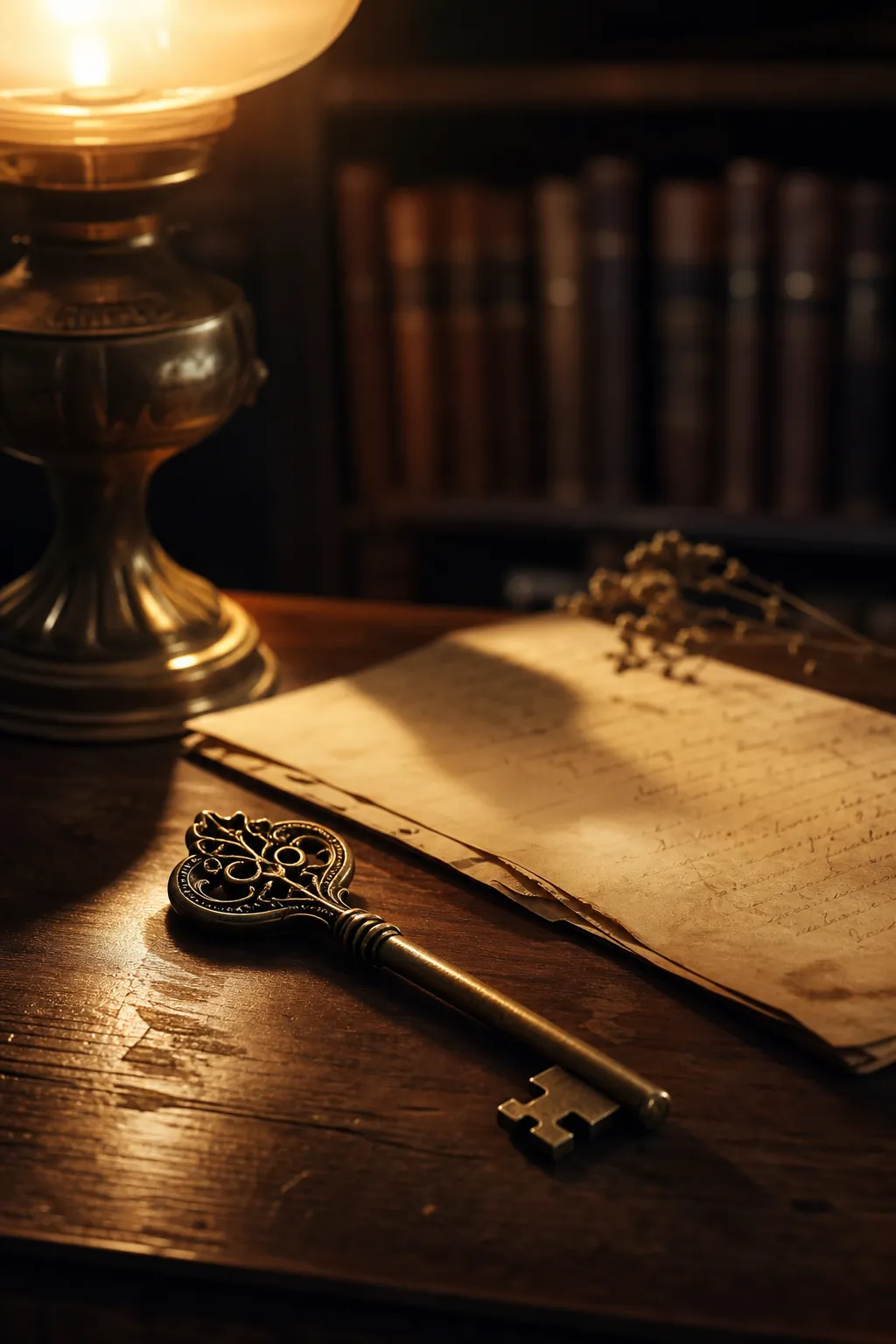
The letter arrived on a Tuesday.
Marcus hadn't spoken to his father in fifteen years — not since the argument that sent him packing at nineteen, not since the silence that followed, not since the slow realization that some wounds don't heal; they just scab over and wait.
He found the envelope wedged between a grocery store flyer and a credit card offer, the kind of mail he usually threw away without reading. But his father's handwriting — sharp, angular, unmistakable — stopped him at the kitchen sink.
Marcus set down his coffee. His hands trembled slightly, a remnant of the anxiety that had plagued him since childhood, the constant hum of not-enough that his father had both caused and mocked.
He didn't open it immediately. He stared at it for ten minutes, the coffee growing cold, the morning light shifting across the linoleum. Then he slit the envelope with a butter knife, careful, surgical, as if the paper might bite.
The letter was short. His father had never been one for words.
"Marcus,"
"I'm dying. Cancer. Six months, maybe less. The house is yours. The money too — what's left of it. But there's something else. Come home. There's something you need to see."
"— Dad"
Marcus read it three times. He looked out the window at the Seattle skyline, gray and familiar, and thought about the farmhouse in Eastern Washington where he had grown up, the wheat fields stretching to the horizon, the silence that had always felt like judgment.
He didn't want to go. Every instinct screamed against it — the same instincts that had kept him away for fifteen years, that had built a life deliberately distant from everything his father represented.
But he went.
The drive took four hours. Marcus listened to podcasts he didn't hear, music he didn't feel. The landscape flattened as he crossed the mountains, the trees thinning, the sky opening up into something vast and indifferent.
His father was thinner than he remembered, but the eyes were the same — sharp, assessing, always looking for weakness. They sat in the living room, surrounded by the furniture of Marcus's childhood, the same cracked leather sofa, the same dusty bookshelves, the same painting of Jesus knocking at the door that his mother had hung before she died.
"You're late," his father said.
"Traffic."
"Always an excuse."
Marcus felt the old tightening in his chest, the familiar constriction. "You asked me to come. I'm here."
His father studied him for a long moment. "You've gotten old."
"I'm thirty-four."
"Thirty-four and still running from your own shadow."
Marcus stood up. "If this is why you called me —"
"Sit down."
The command was automatic, Pavlovian. Marcus sat.
"I'm not going to apologize," his father said. "I did what I thought was right. I pushed you because the world will push harder. I was hard on you because life is hard, and I wanted you ready."
"You were cruel because you enjoyed it."
His father's jaw tightened. For a moment, Marcus saw something flicker — not remorse, exactly, but something adjacent to it. "Maybe. Maybe I was. But that's not why you're here."
He stood, slowly, painfully, and led Marcus to the basement door.
"There's something down there. Has been for thirty years. Your mother knew. She made me promise to show you when the time was right."
"The time was right fifteen years ago."
"The time is right now."
The basement smelled of mildew and old paper. Marcus followed his father down the creaking stairs, the single bulb casting shadows that danced like memories.
In the corner, covered by a tarp, was a wooden trunk. Not just any trunk — his grandmother's trunk, the one she had brought from Mississippi in 1962, the one Marcus had been forbidden to touch as a child.
His father pulled off the tarp. The trunk was locked, but the key hung on a string around his father's neck. He unlocked it and stepped back.
"It's yours now. Everything in it."
Marcus knelt. His knees cracked. He lifted the lid.
Inside were papers. Dozens of them. Letters, typed on old manual typewriters, some on legal paper, some on notebook pages. And beneath them, photographs — black and white, creased with age, showing people he didn't recognize.
"What is this?"
"Your inheritance," his father said. "The one that matters."
Marcus picked up the first letter. The handwriting was his mother's — he knew it instantly, the careful loops, the way she dotted her i's with small circles.
"Dearest Marcus,"
"If you're reading this, I'm gone. And if your father has kept his promise, he's finally shown you what I've been hiding all these years. I'm sorry for the secrecy. But your father and I agreed — some truths are too heavy for childhood, and we wanted you to find them when you were strong enough to carry them."
"Marcus, your grandmother didn't just move from Mississippi. She fled. She was twenty-two, unmarried, and pregnant with your father. The father was a white man. In 1962 Mississippi, that was a death sentence — or worse. She escaped in the middle of the night, took a bus to Washington, changed her name, built a new life."
"She never told your father who his real father was. She thought she was protecting him. But protection became secrecy, and secrecy became shame, and shame became the cruelty you know too well. Your father's hardness isn't strength, Marcus. It's fear. Fear that if he's not perfect, if he's not in control, someone will see what he's hiding: that he doesn't know who he is."
Marcus looked up at his father. The old man was sitting on the bottom step, his head bowed, his hands shaking.
"Keep reading," his father said, his voice barely audible.
Marcus read.
His grandmother's story unfolded across the letters — the fear, the running, the constant looking over her shoulder. The love she had for the son she raised alone. The pride she felt when he graduated high school, the first in their family. The way she died without ever telling him the truth, leaving the burden to Marcus's mother.
And then, the photographs.
A young woman, beautiful, her face a mixture of defiance and terror. A baby in her arms. And then — Marcus's breath caught — a man. White. Young. Standing beside a car, his arm around her waist, both of them smiling at the camera as if the world weren't about to destroy them.
On the back of the photograph, in his grandmother's handwriting: "James and Delilah, 1961. Before everything fell apart."
Marcus looked at his father. "You knew?"
His father shook his head. "I found out six months ago. After the diagnosis. Your mother left these letters with a lawyer, instructions to deliver them to me if she died before she could tell me herself. She died twenty years ago, Marcus. The lawyer forgot. A new associate found the file, called me out of the blue."
He laughed, a dry, cracked sound. "I spent fifty years being angry at a woman who thought she was protecting me. Fifty years of hardness because I didn't know where I came from. And now I know, and it's too late to do anything about it."
Marcus set down the letters. He sat beside his father on the step, close enough to feel the heat of his body, the fragility of his bones.
"It's not too late," Marcus said.
"I'm dying."
"You're still breathing."
His father looked at him, really looked at him, for the first time in fifteen years. Marcus saw the fear in his eyes, the same fear his mother had described, the fear that had driven every cruel word, every harsh discipline, every wall built to keep the world out.
"I don't know how to be anything else," his father whispered. "I've been this man for so long. I don't know how to be soft."
"Then don't be soft," Marcus said. "Just be honest. For once. Tell me what you actually feel, instead of what you think you should feel."
His father was quiet for a long time. The bulb flickered. Somewhere above them, the wind pushed against the old farmhouse, testing its seams.
"I feel like I wasted it," his father finally said. "All of it. The years with your mother. The years with you. I was so afraid of being weak that I became cruel. And cruelty is just weakness wearing a mask."
Marcus felt tears prick his eyes. He hadn't cried in front of his father since he was twelve. "Why didn't you ever tell me?"
"Tell you what? That I was scared? That I didn't know what I was doing? That every time I looked at you, I saw myself — uncertain, desperate, reaching for something solid?"
"Yes. That's exactly what you should have told me."
His father laughed, wet and broken. "I didn't know how. My mother didn't teach me. She taught me survival. She didn't teach me how to live."
Marcus reached out and took his father's hand. It was smaller than he remembered, the skin papery, the veins blue and prominent. But it was warm. It was alive.
"Then let me teach you," Marcus said. "We've got six months. Maybe less. Let's find out what living looks like."
They didn't become best friends. The damage was too deep, the patterns too entrenched. But they became something else — honest.
Marcus stayed in Eastern Washington. He found a job at a community college, teaching writing to students who reminded him of himself — angry, uncertain, desperate for someone to see them. On weekends, he drove to the farmhouse and sat with his father, and they talked.
They talked about Marcus's mother, about her laughter, her stubbornness, her faith that had never wavered even when the church disappointed her. They talked about the grandmother Marcus had never known, the woman who had crossed a country to save her son. They talked about the white man in the photograph, James, whose family had probably never known about the child he had abandoned.
"Do you want to find him?" Marcus asked one afternoon, watching his father nap in the recliner.
His father opened one eye. "James? He's probably dead. Or ninety."
"But do you want to know?"
His father was quiet. "I spent fifty years not knowing. Now I know I don't know, and somehow that's worse. But also better. Does that make sense?"
"It makes sense."
"Then yes. I want to know. But not because I want a father. I want..." He searched for words. "I want the story to have an ending. Even if the ending is just knowing there isn't one."
They never found James. They found his family — children who didn't know about their half-brother, grandchildren who were confused by the stranger asking questions. But they found something else: the church where Delilah had worshipped before she ran, the minister who had helped her escape, the community of Black families in Washington who had taken her in, no questions asked.
Marcus wrote it all down. The letters, the photographs, the stories. He wrote about his grandmother's courage, his mother's compassion, his father's fear. He wrote about the inheritance that mattered — not the house, not the money, but the truth, finally spoken, finally heard.
His father died on a Tuesday, four months after the letter arrived. Marcus was holding his hand. The last thing his father said was, "I'm sorry. For all of it."
"I know," Marcus said. "I forgive you."
Whether his father heard him, he never knew. But he said it anyway. Because forgiveness, he had learned, wasn't about the other person hearing it. It was about the person saying it finally meaning it.
At the funeral, forty people came — neighbors, his father's old coworkers, the families from the church he had stopped attending decades ago. Marcus stood at the graveside and read from his mother's letters, the words she had written for a moment just like this.
"My husband was a frightened man who dressed his fear in anger. But he was also brave in ways he never understood. He stayed. He provided. He loved imperfectly, but he loved. And love, imperfect as it is, is still love."
Afterward, Daniel — his father's hospice nurse, who had become a friend — pulled Marcus aside.
"He talked about you," Daniel said. "In his last weeks. He said you were the only good thing he ever made."
Marcus felt the tears come, finally, the ones he had held back for fifteen years. "He made me scared," Marcus said. "He made me angry. He made me run. But he also made me want to be different. To be better. Is that what he meant?"
Daniel smiled. "I think it's exactly what he meant."
Marcus stood at the farmhouse window that evening, watching the wheat fields sway in the wind, golden and endless. He thought about inheritance — the houses and money that didn't matter, and the stories that did. He thought about his grandmother, running through the dark, carrying everything she had. He thought about his mother, hiding letters to protect a son she loved. He thought about his father, dying with a truth he had only just learned.
And he thought about himself — thirty-four, uncertain, finally understanding that the cruelty he had fled was born from the same fear that still lived in him, the fear of not being enough, not knowing enough, not having enough.
He picked up his pen. He opened his notebook. And he began to write.
"The letter arrived on a Tuesday."
"But the inheritance — the real one — had been waiting all along."