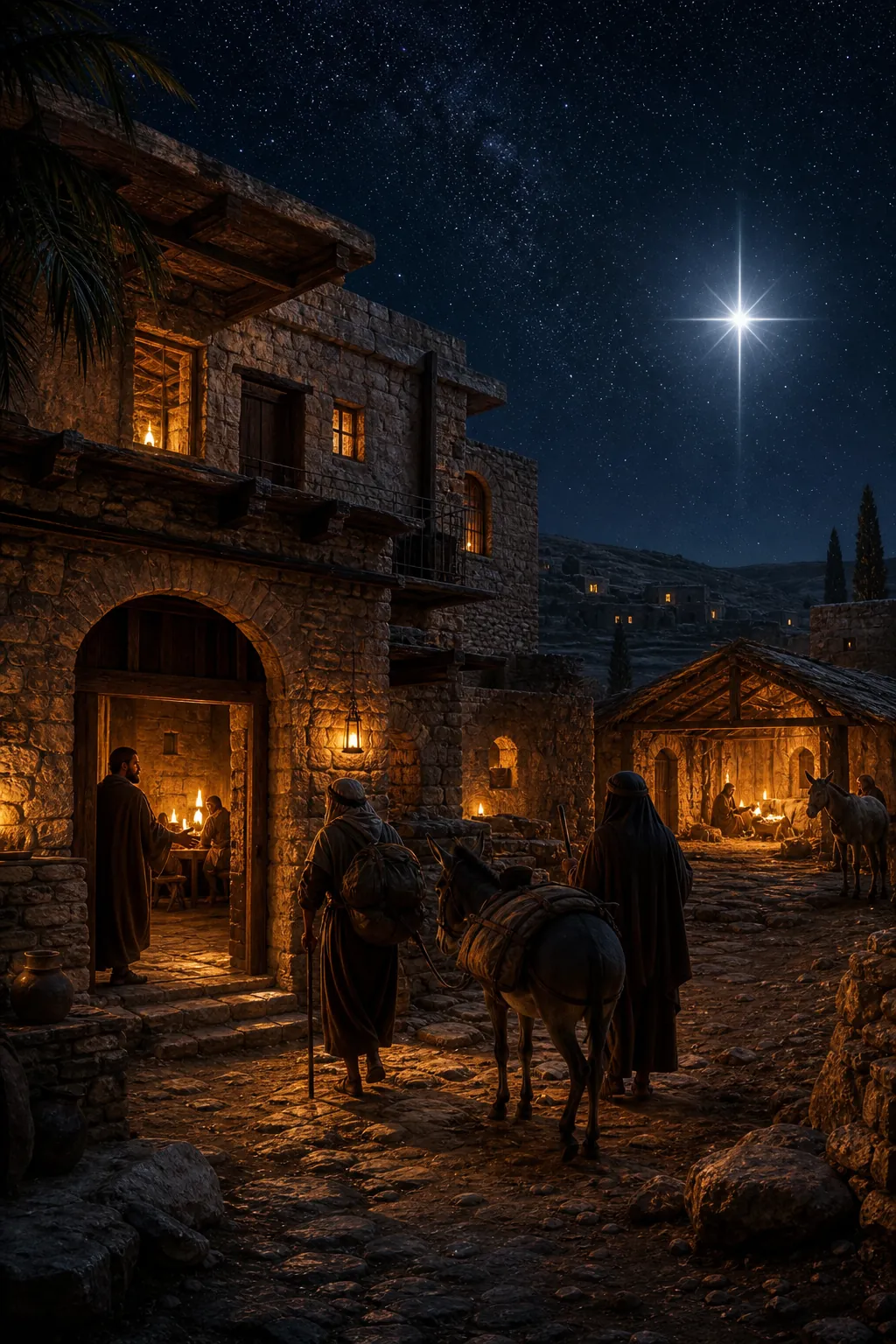
Eliab had never forgotten the night. Thirty-three years, and still he woke sometimes in the dark hours before dawn, hearing the donkey's bray, seeing the young woman's face — exhausted, patient, expectant in a way that made his own exhaustion feel small.
He had told them there was no room. It was true. The census had filled every corner of Bethlehem, bodies packed into every spare chamber, courtyards crowded with cooking fires and complaining travelers. He had been overwhelmed, irritable, running on hours of sleep snatched between the arrivals of yet more families with yet more names to register.
But the truth was, he had not tried very hard.
The stable was already occupied by his cousin's animals, true. But his own chamber, where he and his wife slept, had a corner where a mat could have been laid. The roof where his sons sometimes slept was cold but dry. He had looked at the couple — poor, Galilean, the woman obviously far along in pregnancy — and he had seen inconvenience. He had seen one more demand on a night when he had nothing left to give.
"No room," he had said. "Try the stable."
He had not watched them walk away. He had turned back to his ledger, to his calculations, to the small empire of beds and oil lamps he managed. He had told himself it was not his problem. He had told himself he was not responsible for every desperate traveler in Judea.
The stories started the next morning. Shepherds in the hills, wild-eyed, speaking of angels and a child in a manger. Eliab had gone to the stable at dawn and found them gone, the straw disturbed, a few woolen cloths left behind. He had held one to his face and smelled it — milk, dust, something else he could not name, something that made his chest ache with a longing he did not understand.
Years passed. Eliab's wife died. His sons grew and married and moved to Sepphoris. The inn grew shabby, then closed, then became a storage house for grain. Eliab grew old in a room above what had once been his thriving business, alone with his ledger books and his memories.
He heard the rumors about the Galilean teacher. He heard that the man had been born in Bethlehem, that shepherds had found him in a stable, that his first bed had been a feeding trough. Eliab felt the connection like a thread pulled tight across his chest. He did not go to hear him preach. He did not want to know.
But the teacher came to him anyway.
It was Passover season. Eliab had traveled to Jerusalem to sell some property, a final transaction before his money ran out and his life with it. He was sitting in the courtyard of the temple, watching the crowds surge toward the sacrifices, when he saw the commotion. A teacher, surrounded by followers and enemies both, moving through the colonnade with the ease of a man who belonged nowhere and everywhere.
Eliab would have stayed seated. He was too old, too tired, too full of his own failures to push through a crowd. But the teacher stopped. He looked across the courtyard, past the Pharisees and the Sadducees and the temple guards, and his eyes found Eliab as if he had been looking for him all along.
Then he walked over and sat on the bench beside him.
Eliab's hands shook. He was seventy years old and suddenly felt seventeen, the age he had been when he first took over the inn from his father, full of pride and ambition and the belief that enough hard work would make him worthy.
"I remember you," the teacher said quietly.
Eliab could not speak.
"You gave my parents the only shelter you had."
"I gave them the stable," Eliab whispered. "The place for animals. It was not enough. It was not even close to enough."
The teacher was silent for a long moment. Around them, the crowd pressed and pulled, but in the space where the two men sat, something held still.
"Do you know what I have learned?" the teacher said at last. "That the places we think are too small, too dirty, too inadequate — those are the places where heaven comes. The stable was not a rejection. It was an invitation."
Eliab looked at him, this man with his carpenter's hands and his endless eyes, and for the first time in thirty-three years, the ache in his chest loosened.
"I had no room," Eliab said. "That is the truth. I had no room in my heart for one more need, one more burden. I was full of myself."
"And now?"
Eliab felt the tears running down his weathered face, not from sorrow but from something older and deeper, the release of a held breath too long denied. "Now I am empty," he said. "I have been empty for years."
The teacher smiled, and in that smile Eliab saw the child he had turned away, the infant wrapped in shepherd's cloth, the boy who had grown into a man who carried the weight of the world without complaint.
"Then there is room," the teacher said. "That is the whole of it. I do not come to the full. I come to the empty. I do not ask for palaces. I ask for stables. The only room I need is the room you did not know you had."
He stood then, and Eliab watched him walk back into the crowd, a ordinary-looking man in ordinary robes, indistinguishable from the pilgrims unless you had seen what Eliab had seen — the light that did not come from torches or the sun but from somewhere inside him, gentle and unrelenting, the light that finds you in the dark places you have tried to forget.
Eliab sat on the bench until the shadows lengthened and the temple emptied. He did not sell his property that day. He never did. He returned to Bethlehem and lived three more years, enough time to tell the story to his grandchildren, enough time to understand that grace does not wait for us to make room. Grace makes the room for us, in the places we thought were too broken, too small, too late.
Discussion Questions
1. Why did Eliab turn Mary and Joseph away? What was really going on in his heart?
2. What does the teacher mean when he says "the stable was not a rejection, it was an invitation"? How does that change how we think about our own inadequacies?
3. What does it mean that Christ comes to the empty, not the full? Is there an empty place in your life where He might be waiting to make room?