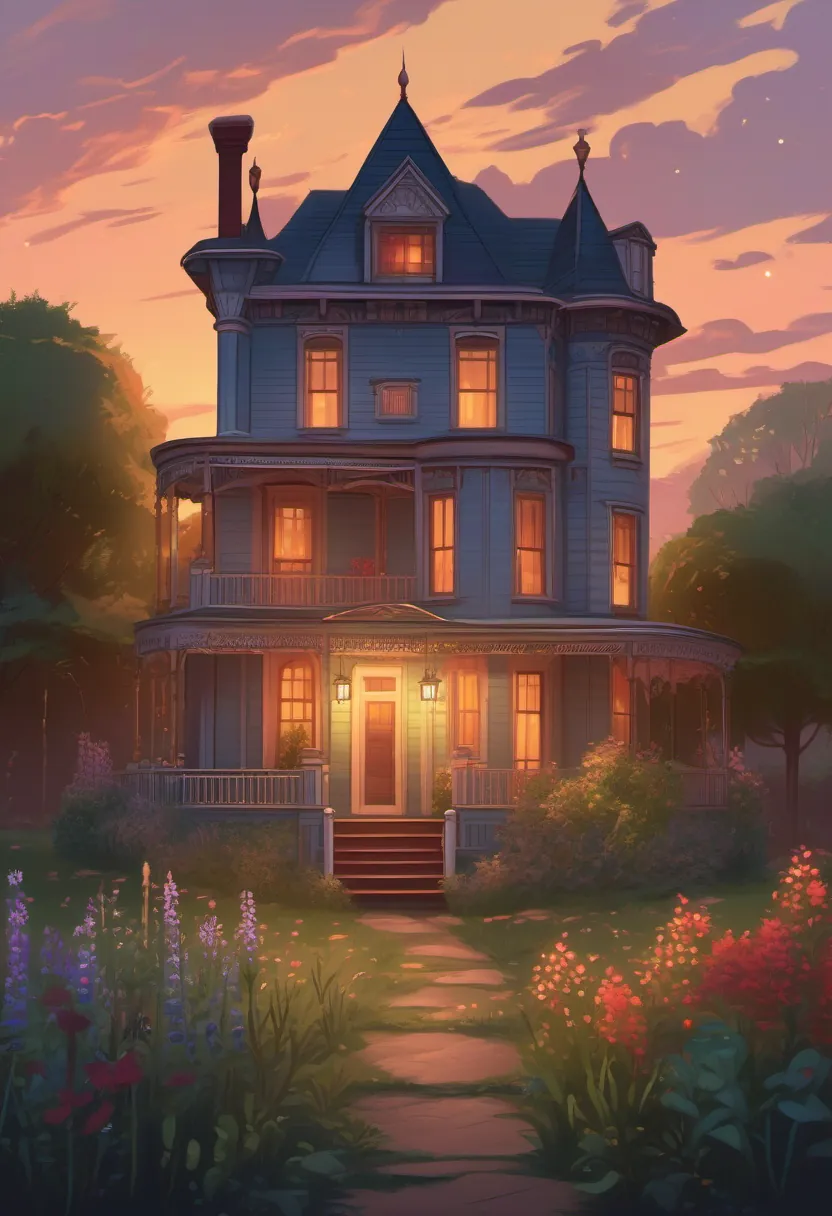
Daniel Crane had not planned to return to Everwood. He had not planned to return anywhere, really. For fifteen years he had built a careful life in Portland: a small apartment, a smaller circle of friends, and a job managing inventory for a medical supply company that required no creativity and asked no personal questions. It was not a good life, but it was his. Then the attorney's letter arrived.
His grandmother, Eleanor Vance, had died at ninety-three in the house where Daniel had spent his childhood summers. The estate was modest: the house, a few acres of overgrown land, and a checking account the funeral would probably empty. Daniel was the last living relative. He was expected to come back, sign papers, and sell the place to someone who would knock it down for the view.
He drove south through Oregon in a rented sedan, listening to podcasts he did not absorb. The highway climbed through forests that smelled of pine and rain. By the time he reached the turnoff, the sun had dropped behind the coastal range and the sky was the color of wet slate.
Everwood sat on a low hill above a creek that had once powered a mill. The house was larger than he remembered and more tired. White paint peeled in long strips. A chestnut tree Daniel's grandfather had planted now leaned against the roof like an old man needing support. The porch swing hung broken from one chain.
Daniel stood in the gravel drive and felt the past press against him like a hand on his chest. He had been happy here once. He had also been cruel here, and wounded, and silent in ways that still shamed him.
The attorney had left the key under a ceramic frog near the back door. Daniel let himself in. The air smelled of lavender and old wood. His grandmother had kept everything: the upright piano in the parlor, the pie-safe in the kitchen, the hooked rugs his mother had made before she left. Dust lay over it all like a soft gray blessing.
He slept in his grandfather's study because the bedroom upstairs felt too raw. In the morning he made coffee with a percolator he found in a cabinet and sat on the porch steps with a clipboard, listing what needed to be done before the house could be shown. Roof. Furnace. Wiring. Septic. The list grew long and expensive.
On the third day, while sorting through boxes in the attic, Daniel found a locked tin box under a stack of quilting magazines. He jimmied the latch with a screwdriver and lifted out a bundle of letters tied with faded ribbon. The top letter was addressed to him in his grandmother's looping hand.
'Dear Daniel,' it began, 'if you are reading this, I am gone and you have come back. I was not sure you would.'
He read it on the attic floor, breathing dust and lavender. Eleanor wrote that she had known, years ago, about the argument that had driven Daniel away. She had known about the lie he told. She had known about the money he took from his father's wallet and the way he had blamed his cousin. She had known, and she had never confronted him, because she had been waiting for him to tell her himself.
'I am not writing to shame you,' she continued. 'I am writing because a house cannot be sold with its rooms still full of shadows. I loved you before you did those things, while you did them, and after. That is what love does. It does not wait for a person to become worthy. If it did, none of us would ever be loved.'
Daniel sat with the letter for a long time. Outside, a crow called from the chestnut tree. The house creaked in the wind. He thought of all the years he had kept Everwood at a distance, not because of geography but because of guilt. He had turned a twelve-hundred-mile gap into a wall.
The other letters were older. They were from his great-grandfather to his great-grandmother during the war, full of fear and longing and faith. They mentioned a chest in the cellar that held something meant for the family. Daniel carried a flashlight down the basement stairs and found the chest behind a rack of mason jars. Inside was a leather journal, a pocket watch, and a deed to two acres of forest his great-grandfather had set aside 'for prayer and peace, so that the generations may remember they are not alone.'
That night Daniel sat in the parlor with the journal. His great-grandfather had not been a perfect man. He had struggled with drink, with temper, with doubt. But each entry ended the same way: with a verse copied out, a prayer scrawled in shaky letters, and a resolution to try again. The faith in the journal was not triumphant. It was weathered. It was believable.
Daniel thought of his own failures: the marriage that had ended because he could not say he was sorry, the friendship he had abandoned, the years of pretending he needed no one. He had carried his guilt like a badge, as if punishing himself made the wrong things smaller. His grandmother's letter suggested another way.
He called his ex-wife the next morning. He did not ask for anything back. He simply apologized, without excuses, for the years of coldness and cowardice. She was quiet for a long time. Then she said, 'Thank you. I have waited a long time to hear that.' They did not reconcile. Some wounds do not close neatly. But the call opened a door that had been bolted from the inside.
Daniel decided not to sell Everwood. Not yet. He hired a local contractor to stabilize the roof. He planted a garden where his grandmother's lilacs had once grown. He began attending the small Presbyterian church in town, not because he had become a saint, but because he had run out of reasons to stay away. On Sunday mornings he sat in a pew near the back and listened to hymns his grandmother had hummed while making pie.
One afternoon in October, a young woman from the church stopped by with a casserole and an offer to help catalog the books in the study. Her name was Ruth, and she was a nurse with a practical manner and a sharp sense of humor. Daniel told her about the letters and the chest and the two acres his great-grandfather had set aside.
'Sounds like your family believed in second chances,' she said.
'Sounds like they needed them,' Daniel replied.
He stayed at Everwood through the winter. In spring he began hosting a small Bible study in the parlor for people who, like him, were not sure they belonged in a church. They were awkward and honest and sometimes wrong. Daniel found himself caring about them. He found himself praying out loud, haltingly, for the first time in decades.
Years later, when people asked Daniel why he had kept the old house, he would say, 'Because it had something to tell me, and I had to come back to hear it.' He never claimed that Everwood had fixed him. Grace had not made his past disappear. But it had made the future possible. The house that had once been a place of escape became a place of welcome. And Daniel Crane, who had spent half his life running, learned at last how to stand still and be found.