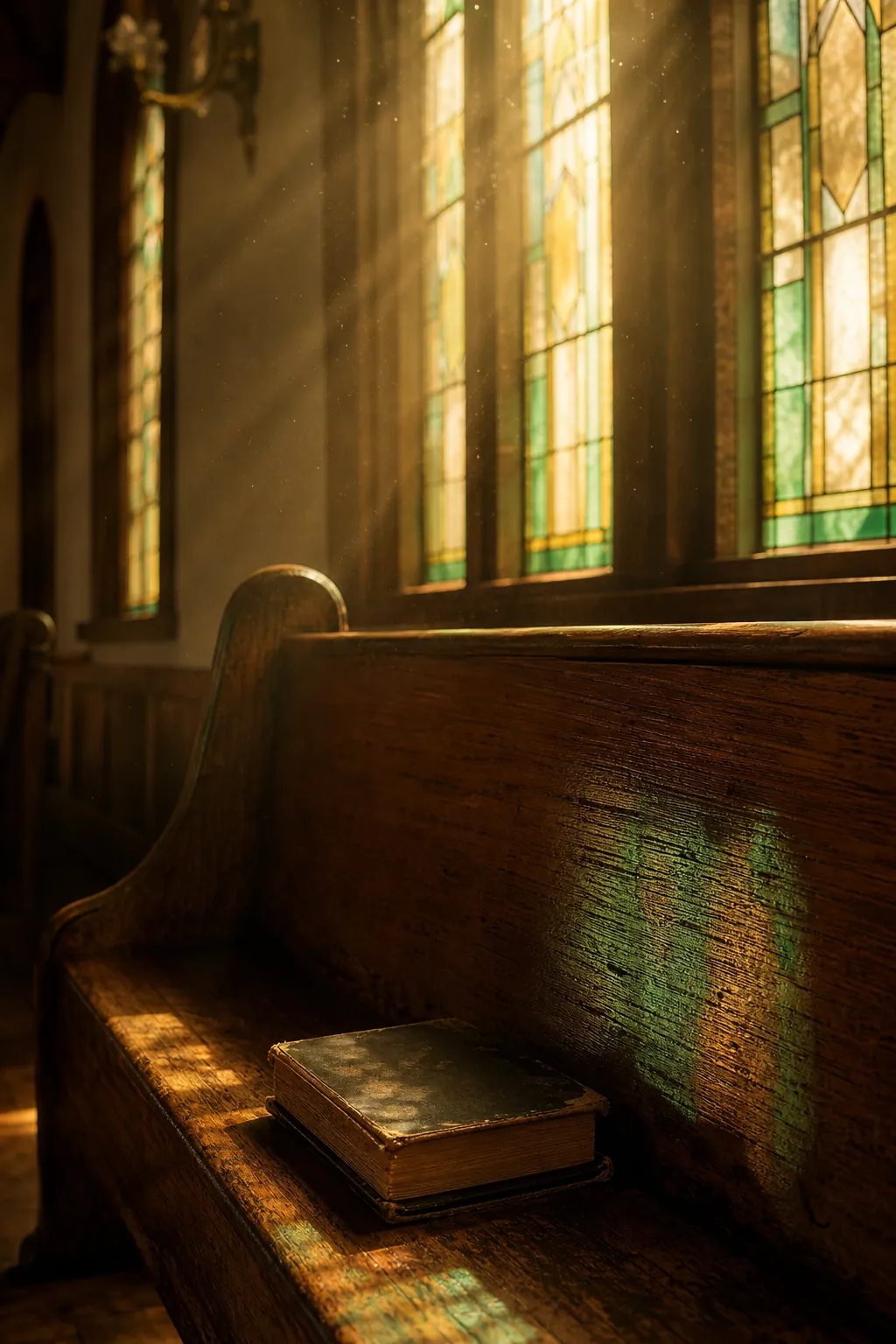
The floorboards of St. Jude's didn't just creak; they groaned with the weight of a century. They were seasoned by decades of heavy boots, kneeling knees, and the soft-soled shoes of women who came to light candles for sons who never came home from wars that history had already forgotten.
Reverend Thomas Hale pressed his palm against the oak pew in front of him, feeling the familiar grooves where countless hands had rested. At seventy-three, he had served this congregation for forty-one years. He had baptized their children, married their couples, buried their dead. And now, on this rain-soaked Tuesday evening, he sat alone in a sanctuary that could hold two hundred but held only him.
The last parishioner had stopped coming three months ago.
Mrs. Eleanor Vance, eighty-nine, who had attended every Sunday since 1952, had finally moved to live with her daughter in Spokane. Thomas had performed her husband's funeral in 2019, her sister's in 2021, her brother's in 2022. He had watched her sit in the same pew — third from the front, left side — as the people she loved were carried out one by one. Now she too was gone, and the church felt like an empty ribcage.
Thomas opened his leather-bound journal, the one he had kept since seminary. The pages were filled with sermon notes, prayer requests, wedding details, funeral preparations. The last entry was from six weeks ago, when he had preached to an audience of exactly four: himself, the organist who played out of loyalty, and two homeless men seeking shelter from the rain.
He wrote:
"Lord, I do not understand what you are doing. I have preached your word faithfully for four decades. I have visited the sick at 3 AM. I have sat with grieving families until the sun came up. I have believed, even when believing felt like holding water in my hands. And now this church — your church — sits empty. Is this failure, or is this something else?"
Thomas closed the journal and stood. His knees protested, as they always did. He walked to the altar, his footsteps echoing in the hollow space. The stained glass windows — depicting the resurrection, the feeding of the five thousand, the prodigal son — cast colored shadows across the empty pews. He had always loved this light. It made the sanctuary feel holy, even on days when holiness seemed distant.
The church's decline hadn't been sudden. It had been a slow leak, a faucet dripping for twenty years. Young families moved to the suburbs and found churches with rock bands and coffee bars. The elderly died. The middle-aged grew tired of traditions they no longer understood. Thomas had tried everything — contemporary services, youth groups, community dinners, social media. Nothing stuck. The world had moved on, and St. Jude's had stayed still, like a tree that refused to bend in the wind.
But Thomas had not given up. Not yet.
Every Sunday, he prepared a sermon. He chose hymns, practiced them on the old organ, set out communion elements for a congregation that never came. Every Wednesday, he kept office hours, sitting in his study with the door open, just in case. Every day, he prayed the Daily Office, read Scripture, waited.
He had read about other pastors who had faced similar declines. Some had closed their churches and taken jobs as chaplains or counselors. Some had become bitter, blaming culture, blaming millennials, blaming God. Thomas didn't want to be either of those men. But he didn't know what he was supposed to be instead.
The rain intensified, drumming against the stained glass. Thomas looked up at the window depicting the resurrection — Christ emerging from the tomb, angels bowing, soldiers falling back in fear. He had preached on that image a hundred times. But tonight, he saw something different. He saw the empty tomb. He saw the absence. He saw that the resurrection was, in part, a story about what was no longer there.
"Maybe," he whispered, "that's the point."
The door creaked.
Thomas turned, startled. A young man stood in the narthex, dripping wet, his hoodie soaked through. He was maybe twenty-five, with a scruffy beard and tired eyes that suggested he hadn't slept well in weeks.
"Sorry," the man said, his voice rough. "I just needed... I don't know. A place to sit."
"You're welcome here," Thomas said, his voice steady despite his surprise. "Come in. Sit anywhere."
The man hesitated, then walked down the center aisle. He didn't go to a pew. He sat on the steps leading to the altar, his back against the communion rail, looking up at the stained glass.
"I used to come here," the man said. "When I was a kid. My grandmother brought me."
Thomas studied him. "What's your name, son?"
"Daniel. Daniel Vance."
Thomas's breath caught. "Eleanor Vance's grandson?"
Daniel looked up, surprise in his eyes. "You knew her?"
"I baptized you," Thomas said softly. "You were six weeks old. Your grandmother was so proud. She held you up afterward and said, 'This boy is going to do great things for the Lord.'"
Daniel laughed, but it was hollow. "Yeah. Well. I didn't do great things. I did a lot of stupid things."
He pulled a flask from his pocket, looked at it, then put it away. "I'm thirty days sober. Again. I've been here before. It never sticks."
Thomas lowered himself onto the step beside Daniel, his joints creaking. "Thirty days is thirty days. That's not nothing."
"It's nothing when you've been trying for three years."
They sat in silence for a while, listening to the rain. Thomas felt something shift in his chest — not hope, exactly, but the possibility of hope.
"Your grandmother wrote me every week from Spokane," Thomas said. "She asked about you. She said you had stopped calling."
Daniel's jaw tightened. "I couldn't. Every time I talked to her, I lied. I told her I was fine. I told her I had a job, an apartment, a life. And I had none of those things."
"So you stopped calling to protect her from your lies?"
"I stopped calling because I was ashamed."
Thomas nodded slowly. "Shame is a powerful thing. It builds walls higher than any brick. But here's what I've learned in seventy-three years: the walls we build to keep people out also keep us in. And eventually, we suffocate in the spaces we made for ourselves."
Daniel looked at him. "How do you tear them down?"
"One brick at a time. And you don't do it alone."
They talked for two hours. Daniel told Thomas about his addiction, his failed relationships, his years wandering from city to city, job to job, always running from something he couldn't name. Thomas told Daniel about the empty church, his fears, his doubts, the prayers that seemed to rise no higher than the ceiling.
"I thought God had left this place," Thomas admitted. "I thought I had failed."
Daniel was quiet for a moment. Then he said, "I'm here. Maybe that's not failure. Maybe that's just... waiting for the right person."
Thomas smiled, the first genuine smile he had felt in months. "Your grandmother would be proud. Not of your perfection — she never expected that. But of your showing up. That's the hardest part."
Daniel came back the next night. And the next. By the end of the week, he was helping Thomas sweep the sanctuary, polish the pews, prepare the communion elements. They talked about Scripture, about recovery, about what it meant to believe in a God who seemed silent.
Word spread slowly. Daniel told a friend. The friend told another. A woman from the neighborhood shelter asked if she could bring coffee on Sunday mornings. An elderly man who had stopped coming years ago saw the lights on and wandered in. A college student, writing a paper on dying churches, stayed for the service and kept coming back.
By autumn, St. Jude's had twenty people on a Sunday morning. Not two hundred. Not the glory days of Thomas's youth. But twenty people who wanted to be there. Twenty people who had found something they needed — not a performance, not a production, but a place to sit in the dark and know they weren't alone.
Thomas preached his final sermon on the first Sunday of Advent. He didn't know it would be his final sermon, of course. He woke up that morning with chest pain, ignored it, and preached on waiting — on Advent as a season of active, hopeful patience. Afterward, Daniel found him slumped in the sacristy, still breathing but pale.
The ambulance came. The doctors said it was a mild heart attack, manageable, but Thomas was seventy-three and tired. His daughter insisted he retire. The bishop agreed.
On his last Sunday, the church was full — not with the old families who had left years ago, but with the new ones who had found St. Jude's in its emptiness. Daniel sat in the front pew, third from the left, the same spot Eleanor Vance had occupied for sixty years. He was six months sober. He was studying to be a deacon.
Thomas looked out at the congregation — the homeless men, the college students, the recovering addicts, the lonely widows, the seekers who didn't know what they were seeking. He thought about all the empty years, the empty pews, the prayers that seemed unanswered.
And he understood, finally, what God had been doing.
The church hadn't failed. It had been hollowing out, like a tomb, to make room for resurrection. The emptiness wasn't absence. It was preparation.
"This is my last Sunday with you," Thomas said, his voice stronger than he felt. "And I want you to know something. For forty-one years, I thought success meant full pews and growing budgets. I thought it meant keeping the doors open by any means necessary. But I was wrong. Success is this. It's a handful of broken people who found each other in an empty room and decided to stay. It's Daniel, six months sober, sitting where his grandmother sat. It's the homeless man who came in for shelter and found family. It's you — all of you — who didn't come because the church was impressive, but because you needed a place to groan with the weight of your century, and be heard."
He paused, looking at the stained glass, the resurrection window, the empty tomb.
"I thought I was the last parishioner. But I wasn't. I was just the first of the new ones. And now it's your turn. Keep the light on. Keep the door open. And when the church feels empty again — and it will — remember: emptiness is not failure. It's a tomb, waiting for resurrection."
Daniel stood at the door as Thomas left for the last time. The rain had stopped. The sun was setting, casting long shadows across the worn floorboards.
"Thank you," Daniel said.
Thomas clasped his hand. "Thank your grandmother. She never stopped praying."
He walked down the steps, slower now, leaning on his daughter's arm. Behind him, St. Jude's stood quiet and solid, its windows glowing with the light of twenty people who had nowhere else to be.
The floorboards groaned. The candles flickered. And somewhere, in the silence between heartbeats, God was still working.