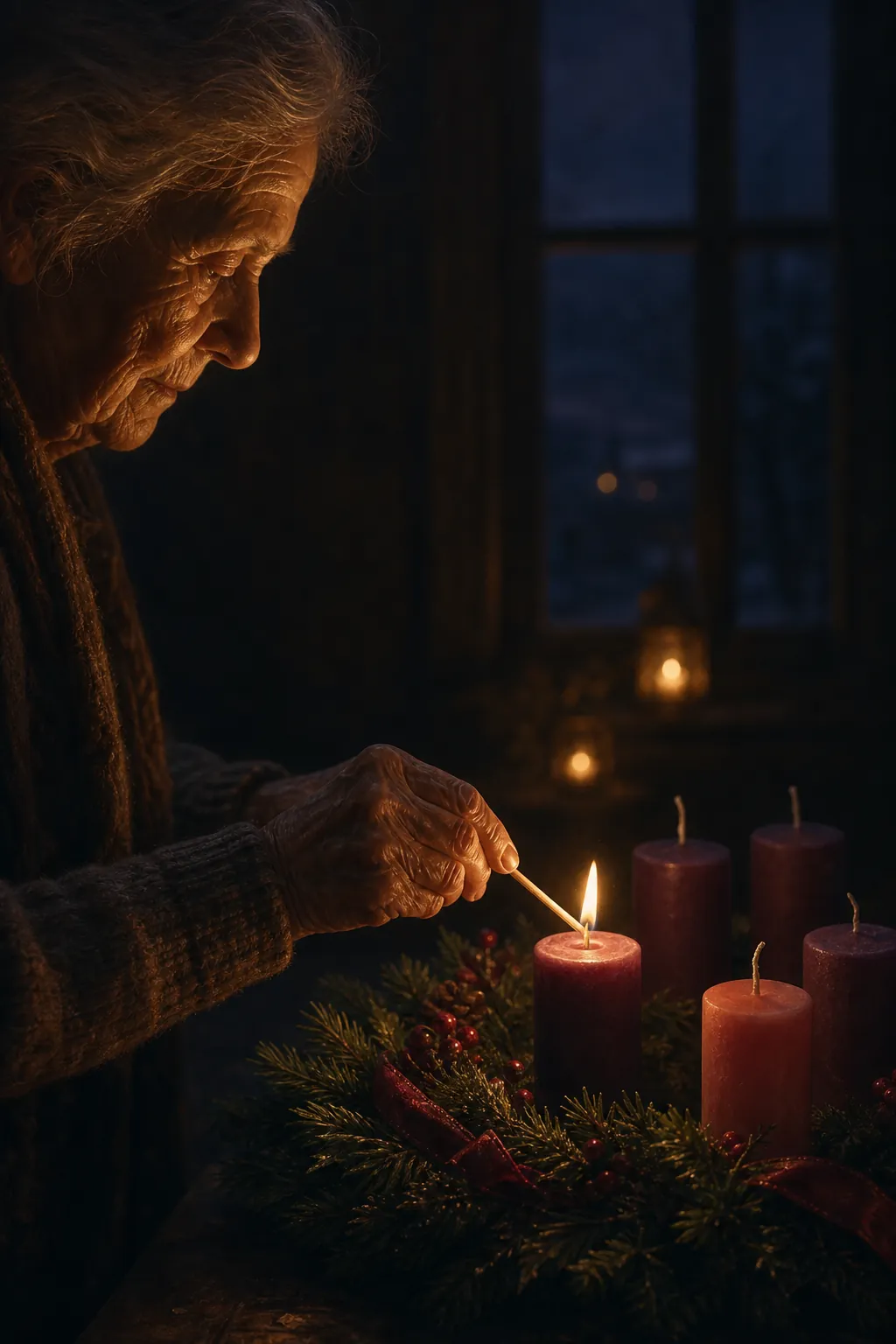
The match struck on the third try, and Ruth held the flame to the pink candle with hands that remembered when they had been steady. Advent wreath, third Sunday, the candle of joy. Or was it peace? She could never keep them straight anymore. The blue ones and the purple ones and the one pink one, all meaning something she had once known by heart.
She set the match down on the ceramic dish and stepped back, breathing in the scent of beeswax and the memory of decades of Decembers. The apartment was small, a single room with a kitchenette and a bed that folded into the wall, but she had placed the wreath on the windowsill where the late afternoon light fell weak and golden through glass that had not been cleaned in months.
Three candles. One for hope, one for peace, one for — yes, joy. The fourth would come next week, and then Christmas Eve, when she would light the white candle in the center, the Christ candle. If she lived that long.
She was eighty-six. The doctor had been kind but clear at her last appointment. Heart not strong. Lungs not clear. Time, the great enemy, had finally caught up with her, and there was no use pretending otherwise.
But the wreath had not let her pretend, not for forty years. Not since the winter of 1968.
She had been thirty-two then, and the world was ending.
That was how it felt, anyway. David had been dead six months, killed in a factory accident that should not have happened, leaving her with three children under ten and a mortgage she could not pay and a God she could not speak to. She had stopped going to church in October, stopped answering the phone, stopped getting out of bed some days.
December came gray and cold. The neighbors brought casseroles. The pastor came once and stood in her kitchen and told her grief was a season, that spring would come, that God was near to the brokenhearted. She had nodded and waited for him to leave.
She had thrown the Advent wreath in the trash on December 15th.
It was a small thing, a craft-project circle of pine branches and four candles she had made with the children years before. But she could not look at it. Hope felt like a lie. Peace felt like mockery. The whole season of waiting-for-light seemed like a cruel joke when the light had gone out of her life forever.
That night, Christmas Eve Eve, she had sat in the dark living room with the curtains drawn, the children asleep upstairs, the house silent except for the furnace clicking on and off. She had not bothered with decorations. She had not bought presents. She had told the children Santa was not coming this year, and they had cried, and she had felt nothing, which was worse than feeling pain.
Then someone knocked at the door.
She had not answered. She was not answering doors anymore.
The knocking persisted. Soft, patient, like a heartbeat.
Finally she had opened it, and there stood old Mrs. Patterson from two houses down, eighty years old herself, carrying something in her weathered hands.
"I made you a wreath," Mrs. Patterson had said. "I know you threw yours away."
Ruth had stared at her. "Why?"
"Because you need it more than you know."
Mrs. Patterson had stepped inside without being invited, had placed the wreath on the coffee table where the old one had sat, had lit all four candles with matches from her own pocket.
"You think Advent is for people who are happy," Mrs. Patterson had said. "It is not. It is for people in the dark. That is the whole point. The light comes because the dark is here."
Ruth had sat on the couch and wept. Not politely, not the way women were supposed to cry. She had sobbed until her ribs ached, until Mrs. Patterson sat beside her and held her hand with fingers gnarled by arthritis and a lifetime of kneading bread and tending gardens.
"I do not believe He is coming," Ruth had whispered.
"That does not matter," Mrs. Patterson had said. "He is coming anyway. That is what the candles mean. Not your faith. His promise."
They had sat in the candlelight until the flames burned low, two women in a dark house, waiting.
Ruth had gone back to church the next morning. She had cried through the Christmas service, held her children too tightly, eaten too much food at the church potluck. The grief did not lift all at once. It took years, decades, a whole lifetime of learning that joy and sorrow could sit beside each other without one canceling the other out.
But the wreath had stayed. Through remarriage and widowhood again. Through children growing and grandchildren arriving and great-grandchildren she only saw on video calls now. Through the move to this small apartment, the slow narrowing of her world, the doctor's gentle prognosis.
Now she stood at the windowsill, three candles burning, and she thought of Mrs. Patterson long dead, of David long dead, of herself not long for this world.
"Are You there?" she asked the silence. It was not really a question anymore. She had asked it enough times to know the answer, even when she could not feel it.
The light from the three candles flickered on the glass. In their glow she could see her own reflection — old, lined, fragile, but still here. Still watching. Still waiting.
That was the thing about hope. It was not a feeling. It was a posture. A choice to keep lighting candles even when the darkness felt deeper than the light. A trust that the promise outlasted the doubt, that the coming was more certain than the waiting.
She reached out and touched the pink candle, not caring if she burned her finger, feeling the warmth against her cold skin.
"Come," she whispered. "Come, Lord Jesus."
The words were old, older than her, older than Mrs. Patterson, older than the prophets who first spoke them into a world that had not yet seen what it was waiting for. They were the words of every heart that had ever sat in darkness and refused to believe that darkness was the last word.
The sun set fully. The candles burned on. Ruth sat in her chair and watched them, an old woman with an old promise, waiting for the light she had been waiting for all her life.
Discussion Questions
1. Why did Ruth throw away her Advent wreath? Have you ever felt like hope was a lie?
2. Mrs. Patterson says Advent is for people in the dark, not people who are happy. What does that change about how you think about the Christmas season?
3. Ruth says hope is a posture, not a feeling. What does that mean? How do you keep waiting when you cannot feel the light?